Can You Make Money Off of YouTube Shorts? How Pay Works in 2026
Yes, Shorts pay, but the ad pool pays very little per view and the rules tighten on February 1, 2027. Here is how Shorts revenue works, what it really pays, and the income paths that pay more.
On this page
Yes. You can make money off of YouTube Shorts through the YouTube Partner Program, which pays you 45% of your share of Shorts Feed ad revenue once your channel has 1,000 subscribers and 10 million qualified Shorts views in 90 days. Brand deals, affiliate links, products and fan funding usually earn far more per view.
The catch is scale. In AIR Media-Tech's September 2026 analysis of 274 channels, Shorts made up less than 2% of total revenue for most channels while bringing in 1% to 35% of their views. And from February 1, 2027, a channel will need 10 million qualified Shorts views in the last 90 days just to earn Shorts ad revenue in a given month. Plan for Shorts as distribution first and a paycheck second.
How do YouTube Shorts make money?
Shorts income comes in two kinds: money YouTube controls and money you control.
Paid by YouTube (requires YPP):
- Shorts Feed ad revenue: ads that run between Shorts fund a monthly Creator Pool, and you keep 45% of your allocation.
- YouTube Premium revenue: when Premium members watch your Shorts, you receive 45% of the Premium revenue YouTube distributes for them (55% for long-form videos).
- Fan funding and YouTube Shopping: available from the lower 500-subscriber tier, before ad revenue.
Controlled by you (no threshold):
- Brand deals: a company pays you to feature its product in a Short.
- Affiliate links: you earn a commission when viewers buy something you recommend.
- Your own products or services: templates, courses, coaching, freelance work, a local business.
- Long-form conversion: Shorts send viewers to longer videos, which earn a much higher RPM.
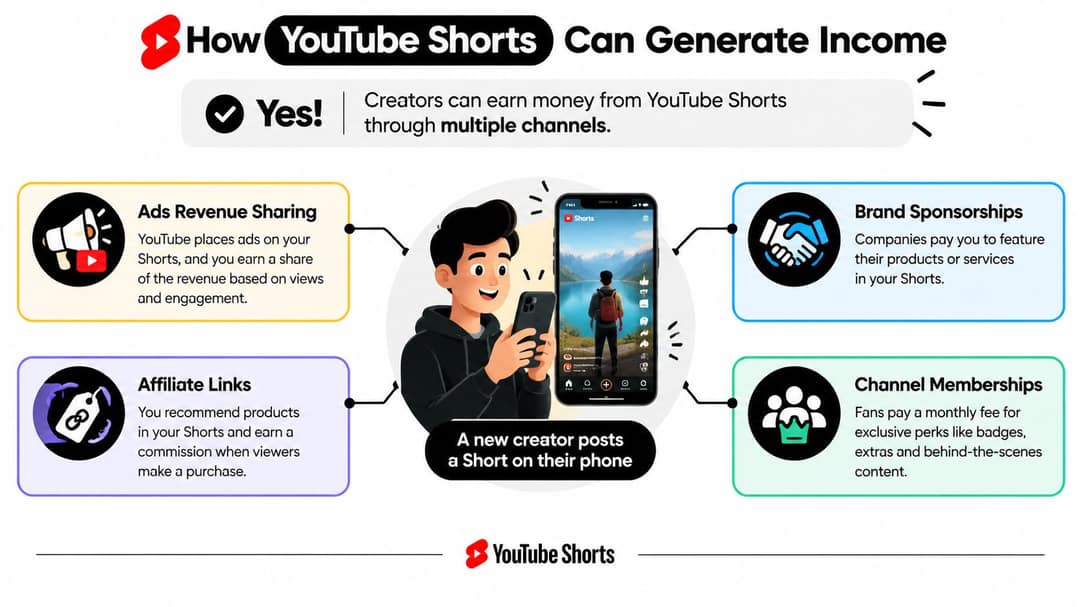
YouTube's own numbers show how the pieces fit. In March 2024, one year after Shorts revenue sharing launched, YouTube said more than 25% of channels in the Partner Program were earning through it, and more than 80% of creators who joined through the Shorts thresholds were also earning from other YPP features such as long-form ads, fan funding or Premium. Shorts get you in the door; the rest pays the bills.
Prompt to try
Create a 40-second vertical YouTube Short with original AI voice-over and no licensed music, explaining why a kitchen knife dulls faster on glass cutting boards. Open with the hook "Your cutting board is ruining your knives", show close-up kitchen b-roll, and end by pointing viewers to a longer video on knife care.
How Shorts ad revenue sharing works
Shorts ad revenue sharing started on February 1, 2023. There is no per-video CPM. Instead, YouTube pools the money and splits it, as described in YouTube's Shorts monetization policies:
- Ads shown between Shorts in the Shorts Feed generate revenue each month, country by country.
- For Shorts that use music, part of that revenue covers music licensing. What remains forms the Creator Pool.
- The pool is allocated to monetizing creators by their share of engaged Shorts views in each country.
- You keep 45% of your allocation, whether or not your Shorts used music.
Music shrinks the pool, not your cut. For a Short with one track, half of its revenue goes to the Creator Pool; with two tracks, one third does. In practice, original audio or voice-over keeps more money in the pool your views draw from.
The view count on your Short is not the number you are paid on. Since August 24, 2026, YouTube counts a view the moment a video starts to play, on Shorts, long-form and live. YPP earnings still use engaged views, so your payout tracks a smaller number than the public counter.
How much do YouTube Shorts pay per 1,000 views?
YouTube publishes no standard RPM (it defines RPM as your earnings per 1,000 views after its revenue share). The best recent benchmark is AIR Media-Tech's 2026 Shorts RPM study, based on partner channel data:
| Audience country | Shorts RPM per 1,000 views (AIR Media-Tech, 2026) |
|---|---|
| United States | $0.328 |
| United Kingdom | $0.166 |
| Canada | $0.165 |
The same study found Shorts RPM was 3% to 14% of long-form RPM in almost every niche, so most channels need 11,000 to 34,000 Shorts views to earn what 1,000 long-form views generate. More figures are collected on our YouTube Shorts statistics page.
That sounds like a contradiction with Alphabet's claim, made in October 2025, that in the US Shorts now earn more revenue per watch hour than traditional in-stream viewing. It is not one. A Short is watched for seconds, so per hour of viewing it monetizes well, but per view it pays a fraction of a long video. For another walkthrough of the program and how creators read their numbers, see vidIQ's YouTube Shorts monetization guide.
A simple decision rule: if ad revenue is your only plan, you need huge, sustained volume in high-RPM countries. If you have something to sell or a long-form library, Shorts become cheap, fast distribution for it.
How to get monetized on YouTube Shorts
YPP has two tiers. Only the higher one pays ad revenue.
| Requirement | Expanded YPP (lower tier) | Full YPP (ad revenue) |
|---|---|---|
| Subscribers | 500 | 1,000 |
| Shorts route | 3 million qualified Shorts views in the last 90 days | 10 million qualified Shorts views in the last 90 days |
| Long-form route | 3,000 qualified watch hours in the last 12 months | 4,000 qualified public watch hours in the last 12 months |
| Uploads | 3 public uploads in the last 90 days | Covered by YouTube's activity rules |
| What you can earn | Fan funding (such as channel memberships), Creator Partnerships, YouTube Shopping | Shorts Feed ad revenue, Premium revenue, plus the lower-tier features |
Two details trip up Shorts-first channels. Watch hours from Shorts in the Shorts Feed do not count toward the 4,000-hour threshold, so a Shorts channel has to qualify through views. And Image Posts in the Shorts Feed do not count as qualified Shorts views.
Beyond the numbers, joining also requires living in an eligible country, no active Community Guidelines strikes, 2-Step Verification, advanced features access and a linked AdSense for YouTube account; review typically takes about a month. The full list is in YouTube's YPP eligibility overview, and Neal Schaffer's summary of Shorts monetization thresholds lays out the tiers side by side.
Before you apply, audit your channel:
- Remove or replace Shorts built on clips, music or footage you do not own.
- Check for Shorts over one minute with Content ID claims (more on that below).
- Set up 2-Step Verification and AdSense for YouTube so approval is not delayed.
- Apply from the monetization section of YouTube Studio once you meet a threshold.
What changes for Shorts monetization on February 1, 2027
YouTube announced in August 2026 a set of changes that take effect on February 1, 2027. Details are in YouTube's notice of Partner Program changes.
| Rule | Until January 31, 2027 | From February 1, 2027 |
|---|---|---|
| New applicants, Shorts route | 1,000 subscribers + 10 million qualified Shorts views in 90 days | 1,000 subscribers + 20 million qualified Shorts views in 90 days |
| New applicants, long-form route | 1,000 subscribers + 4,000 watch hours in 12 months | 1,000 subscribers + 8,000 qualified watch hours in 365 days |
| Earning Shorts ad and Premium revenue in a month | Any monetizing YPP channel | Only with 10 million qualified Shorts views in the last 90 days |
| Targeted Shorts ads | Creator Pool only | Ads targeted to 5 or fewer channels pay those creators 45% of net ad revenue, on top of the pool |
| Staying active | Monetization may be turned off after 6 months with no uploads or posts | 1,000 watch hours in 365 days, or 1 million qualified Shorts views in 90 days, or 2 long-form videos or 5 Shorts every 90 days |
Channels already in YPP are not affected by the new entry thresholds, and channels below the 10 million Shorts views mark stay in YPP and keep their long-form earnings. The 500-subscriber tier does not change.
What stops a Short from earning
Meeting the thresholds is not enough if the content breaks a monetization rule. Check these before you scale a format:
- Content ID claims on longer Shorts: any Short longer than one minute with an active Content ID claim of any type is blocked globally and cannot be monetized.
- Music length: most Shorts Audio Library songs can be used for up to 90 seconds in a 3-minute Short; some are limited to 60 or 30 seconds.
- Reused content: reading out text you did not write (website copy, news feeds) or relying on mostly non-verbal reactions is not monetizable, and the policy applies to the whole channel.
- Inauthentic content: since July 15, 2025, YouTube calls its repetitive or mass-produced content rule "inauthentic content". Template-looking AI videos without original insight fall here.
- AI clip compilations and personas: stitched unrelated AI clips meant to shock, realistic fakes of events, and AI personas posing as experts on health, legal, financial or political topics cannot monetize.
AI itself is allowed. YouTube permits AI and automated tools when the final video shows your creative vision and gives educational or entertainment value, which is why faceless YouTube channel ideas that make money still work when each video carries a real angle. Realistic AI content must be disclosed with the "AI use" setting in YouTube Studio, and disclosure alone does not limit reach or earnings. Rules for each policy are on YouTube's channel monetization policies page.
How to make money on YouTube Shorts beyond the ad pool
These paths give you more control, and most have no view threshold. For a longer list of options, see ways to earn on YouTube without AdSense.
| Income path | Needs YPP? | Works best for | What to set up first |
|---|---|---|---|
| Brand deals | No | Focused niches with clear buying interests | A media kit and a short list of fitting brands |
| Affiliate links | No (YouTube Shopping needs the 500-subscriber tier) | Product demos, comparisons, tool tips | Tracked links you can explain honestly |
| Digital products | No | Audiences asking the same question repeatedly | One narrow offer: a template, checklist or mini-course |
| Services | No | Coaches, freelancers, local businesses | A clear offer and a way to book or inquire |
| Long-form videos | Helps with ads | Viewers who want depth | A longer video for each Short series |
| Fan funding | Yes, 500-subscriber tier | Loyal, returning viewers | Memberships perks you can deliver every month |
Brand deals
Sponsors pay for a specific audience, not raw views. Pitch with who watches, what they want, and why the product fits naturally into your format. A media kit for creators should list your niche, audience, sample Shorts, placements and contact details. Agree on deliverables, usage rights, approval steps, deadlines and payment terms in writing; this guide to pricing and contracts for YouTube sponsorships helps you structure the negotiation.
Affiliate links, products and services
Affiliate income fits Shorts that show a solution working: a kitchen tool, a software workflow, a gym accessory. Disclose every commercial relationship, track clicks and conversions, and judge a Short by sales, not views. When the same questions keep appearing in your comments, that is the brief for a digital product or a service offer.
Long-form videos
Long-form pays many times more per view, and Shorts feed it subscribers. Alphabet said in April 2023 that channels posting Shorts weekly saw the majority of their new subscribers come from Shorts. AIR Media-Tech's study of 18,000 channels found the best results when Shorts made up 25% to 40% of total uploads. If you also post on TikTok, how TikTok monetization works is a different system with its own thresholds.
For a feed of takes from people building creator businesses on X, Xholic keeps a collection of creator economy tweets.
Common Shorts monetization myths
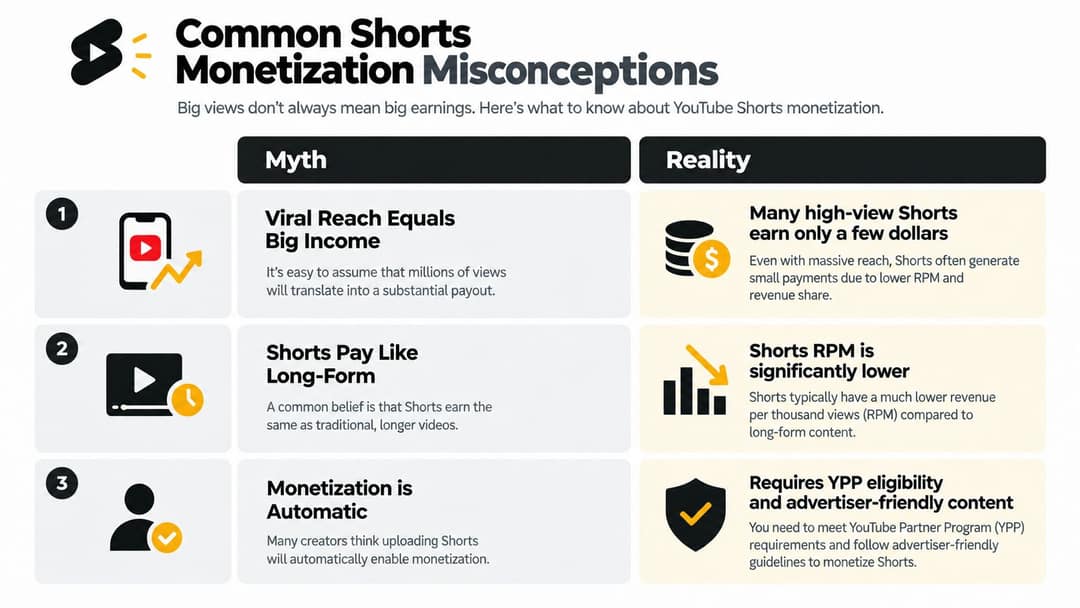
- "A viral Short means a big payout." The pool pays per engaged view at a low rate. A viral Short is worth most when it brings subscribers, clicks or customers.
- "Shorts pay like long-form." Per view they pay a small fraction, per AIR Media-Tech's 3% to 14% finding.
- "Monetization is automatic." You must apply, be approved, follow monetization policies and, from 2027, keep 10 million qualified Shorts views in 90 days to earn Shorts ad revenue each month.
- "Any RPM screenshot applies to me." RPM varies by country, niche and music use. Plan around your own analytics after approval.
Prompt for a series
Make episode 1 of a Short series called "Budget Gym Fixes": a 30-second vertical video showing how a $10 resistance band replaces three gym machines. Open on the result in the first second, use energetic voice-over with bold synced captions, and end with "Link to the band in the pinned comment."
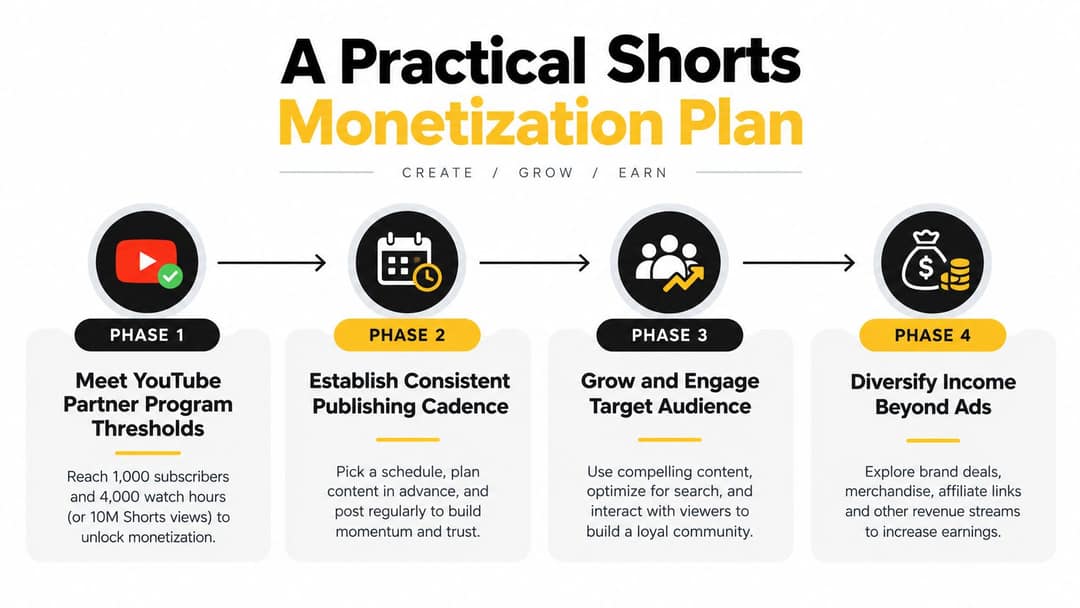
A practical Shorts monetization plan
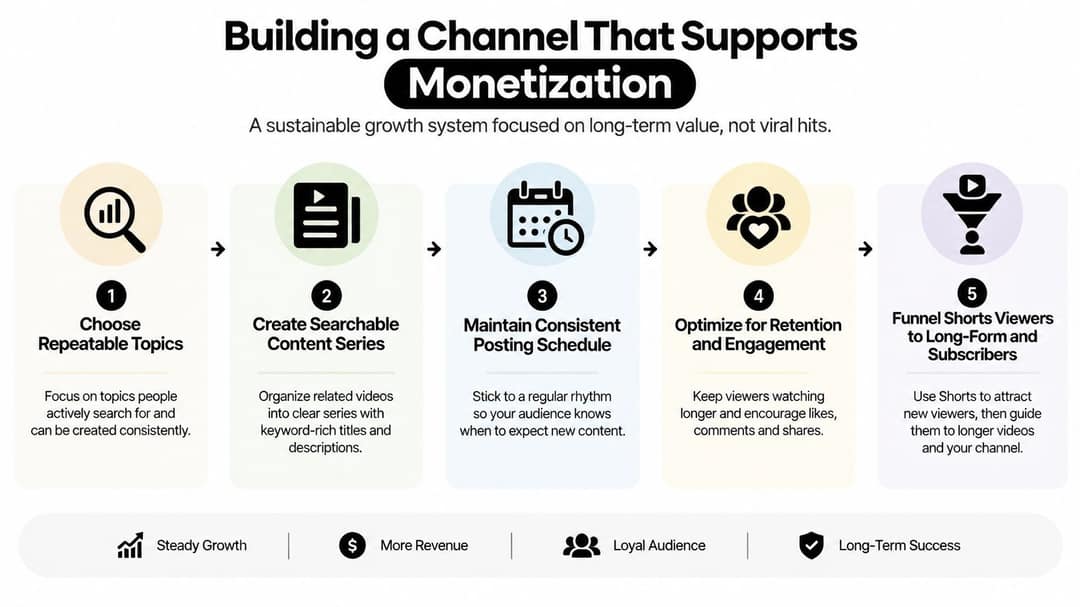
- Pick a repeatable niche. Choose a topic with many related questions and a natural offer behind it: a product, a service, or a long-form library.
- Build series, not one-offs. Group Shorts into recurring formats with the same opening style and visual identity. YouTube began rolling out Shorts series in September 2026, which lets you organize Shorts into seasons and episodes.
- Hook in the first seconds and caption everything. Open on the result, the mistake or the question. Burned-in captions from a video caption generator keep the Short clear with the sound off.
- Give every Short a next step. A pinned comment, a related long-form video, an affiliate link or a booking page. The next step should continue the viewer's question, not interrupt it.
- Qualify for YPP, then diversify. Apply as soon as you meet a threshold, and add brand deals, products or fan funding as your audience asks for them.
- Measure money, not views. Track subscriber conversion, link clicks, leads, sales and each income source's share of revenue every month.
Making Shorts faster with Revid
If your bottleneck is producing enough Shorts to test a niche, Revid's AI YouTube Shorts generator turns an idea, a script or a link into a vertical Short with visuals, AI voice-over and synced captions, then publishes or schedules it to YouTube. The free YouTube Shorts script generator drafts hooks and scripts, and the YouTube clip maker cuts your long videos into vertical clips, which also feeds the long-form funnel above. Before committing to a series, you can search Revid's library of about 2.77 million real short-form videos with their engagement data to see which formats already get watched in your niche. Add your own angle or expertise to every video, since YouTube does not monetize mass-produced, template-looking AI content. Sign-up is free and new accounts get free credits to try video creation, no credit card needed. Regular creation then uses a paid plan's monthly credits, from $39/month (see Revid pricing).
FAQ
How many views do you need to make money on YouTube Shorts?
For ad revenue, you need 1,000 subscribers and 10 million qualified Shorts views in 90 days (or 4,000 long-form watch hours instead). From February 1, 2027, new applicants need 20 million, and every partner needs 10 million qualified Shorts views in the last 90 days to earn Shorts ad revenue that month. Brand deals and affiliate income have no view minimum.
How much does YouTube pay for 1 million Shorts views?
There is no fixed amount: it depends on the monthly pool, where your viewers are and whether you used music. AIR Media-Tech's 2026 data put US Shorts RPM at $0.328 per 1,000 views and UK and Canada RPM at about half that, a small sum next to the same views on long-form.
Do Shorts views count toward the 4,000 watch hours?
No. Watch hours from Shorts in the Shorts Feed do not count toward the 4,000-hour YPP threshold. Shorts-first channels qualify through the 10 million qualified Shorts views route instead.
Can you monetize AI-generated or faceless Shorts?
Yes, if each video shows your creative input and gives real educational or entertainment value. YouTube blocks mass-produced template AI content, incoherent AI clip compilations and AI personas giving health, legal, financial or political advice.
Is the YouTube Shorts Fund still running?
No. The $100 million Shorts Fund paid creators over 2021 and 2022; Shorts ad revenue sharing through YPP has been the program since February 1, 2023.
Can you make money on Shorts before joining YPP?
Yes. Brand deals, affiliate links, your own products and services need no YouTube approval. At 500 subscribers with 3 million qualified Shorts views in 90 days, the lower YPP tier adds fan funding and YouTube Shopping.