How to Create a Link to a Video File: 5 Free Ways + Fixes
Upload a video to Google Drive, Dropbox, OneDrive, iCloud or YouTube, switch sharing to anyone with the link, and copy the URL. Here are the steps for each method, fixes for links that won't open, and how URL to video makers do the reverse.
On this page
To create a link to a video file, upload it to a cloud service such as Google Drive, Dropbox, OneDrive or iCloud, change sharing to "Anyone with the link," and copy the URL. For a link that plays instantly in any browser and can be embedded on a website, upload the video to YouTube as Unlisted instead.
The step most people skip is the second one. Cloud drives keep new files private, so the person you send the link to lands on a "request access" page instead of your video. Below are the exact steps for each service, a quick way to choose between them, and fixes for links that won't play. If you came for the opposite task (turning an article or web page URL into a video), that part is near the end.
How do I create a link to a video file?
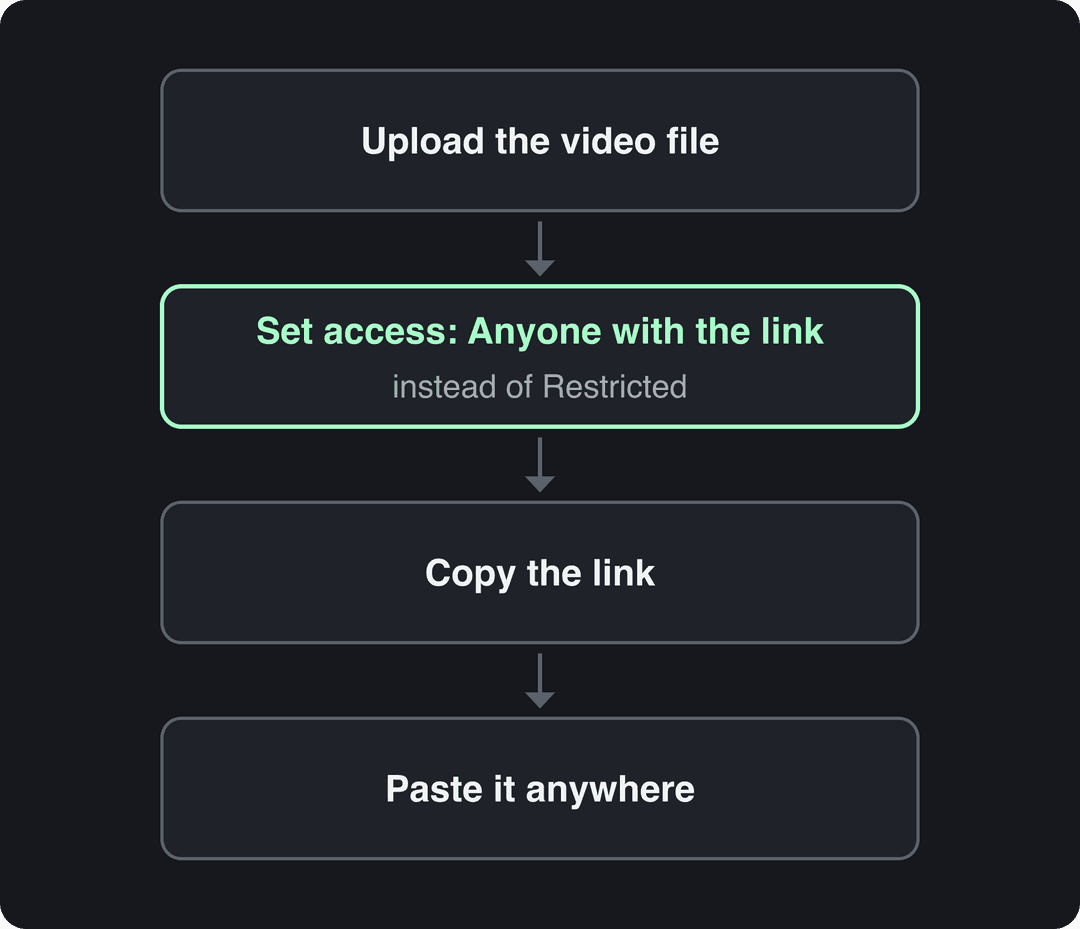
A link is only an address that points to a copy of your file on a server. A video sitting on your laptop or phone has no URL until it is online, so every way to turn a video into a link follows the same four steps:
- Upload the video file to a cloud drive or a video host.
- Set access to "Anyone with the link" (or Unlisted on YouTube).
- Copy the link the service gives you.
- Paste it wherever you need it: an email, a chat, a document, a bio or a website.
How to create a link for a video with Google Drive
Google Drive is the default choice if you already have a Google account, and recipients don't need one to watch.
- Go to drive.google.com, click New, then File upload, and pick your video.
- Wait for the upload to finish, then right-click the file and choose Share.
- Under General access, change Restricted to Anyone with the link, with the role set to Viewer.
- Click Copy link, then Done.
In the Drive app on a phone, tap the three-dot menu next to the file, open its sharing settings and make the same change. Drive needs a little time to process a new video before it can preview it, so a link sent seconds after upload may show "still processing" at first.
If you attach a big video in Gmail, Gmail turns attachments over its size limit into a Drive link automatically. Check that link's access setting too.
How to make a video link with Dropbox
- Upload the video to Dropbox (drag it into a folder on dropbox.com or use the app).
- Hover over the file and click Share.
- Make sure the link setting lets anyone with the link view the file.
- Click Copy link.
Dropbox links open a preview page where the viewer can play or download the video. Paid plans add options such as passwords and expiry dates on links.
How to create a shareable link for a video with OneDrive
- Upload the video to OneDrive.
- Select the file and click Share.
- Open the link settings and choose Anyone (anyone with the link can view).
- Click Copy link.
Work or school OneDrive accounts are often set by an administrator to allow links only for people inside the organization. If "Anyone" is greyed out, use a personal account or ask your IT team.
How to get a link for a video on iPhone with iCloud
For a video in the Photos app, select it, tap the Share button and choose Copy iCloud Link. Anyone who opens it can view and download the video in a browser.
For a video saved in iCloud Drive (the Files app on iPhone, Finder on a Mac), use the Share option on the file, choose to share it as a link, set access so anyone with the link can open it, then copy the link.
How to turn a video into a link that plays anywhere: YouTube Unlisted
Cloud drive links open a file preview. A YouTube link opens a real video player that streams well on slow connections, plays on any device and can be embedded on a web page. Unlisted means the video doesn't appear in search or on your channel, but anyone with the link can watch it.
- Open YouTube Studio and click Create, then Upload videos.
- Select your file and fill in the title and details.
- On the Visibility step, choose Unlisted.
- Copy the video link shown on the upload screen and click Save.
Two limits to know. By default, YouTube uploads are capped at 15 minutes; verify your account to upload longer videos, up to 256 GB or 12 hours, whichever is less. And a vertical or square video up to 3 minutes long is classified as a Short, which still gets a normal shareable link.
Use Private instead of Unlisted only when you want to name the people allowed to watch: Private videos can't be opened by anyone else, even with the link.
Which method should you use?
| Method | Best for | Viewer needs an account | What the link opens |
|---|---|---|---|
| Google Drive | Sending a file to a client or teammate | No (with "Anyone with the link") | Preview player plus download |
| Dropbox | Files you also want people to download | No | Preview page plus download |
| OneDrive | Microsoft 365 users | No (personal accounts) | Preview player plus download |
| iCloud | Videos shot on iPhone | No | Browser page with download |
| YouTube Unlisted | Links that play smoothly anywhere, website embeds | No | Full streaming video player |
A simple rule: if the recipient needs the original file (an editor, a client approving a cut), use a cloud drive. If people only need to watch, especially on phones or on a web page, use YouTube Unlisted.
How to get a link for a video you already posted
If the video is already on a social platform, you don't need to upload it again:
- TikTok: tap the Share arrow on the video, then Copy link.
- Instagram: tap the paper plane icon (or the three-dot menu) on the Reel or post, then Copy link.
- YouTube: tap Share under the video, then Copy link.
Why your video link isn't working
- The viewer sees "request access" or a sign-in page. The file is still private. Change access to "Anyone with the link" and send the same link again; the URL doesn't change.
- The preview says the video is still processing. Large files take time to process after upload. Wait, then refresh, or send the link with a note that it can be downloaded.
- The video won't play in the preview. Unusual formats and codecs often can't be previewed in a browser. Convert the file to MP4, the most widely supported video format. Converters are a large software category of their own, as the video converter market report from Cognitive Market Research shows, and most free editors can export MP4.
- The link worked yesterday and is now broken. Deleting the file, moving it to trash or removing it from a shared folder breaks the link. Keep the original where it is until people are done watching.
The reverse: URL to video makers
Many people searching "url to video" or "link to video" want the opposite of everything above: paste the URL of a blog post, article or product page and get a finished video back. Two kinds of tools do this, and picking the wrong kind is the usual mistake. This section covers the choice and the short version of the steps; our guide on converting a link into a video for social media has the full walkthrough.
AI generator or screen recorder?
An AI URL to video generator reads the page and makes a new video about it: script, visuals, voice-over and captions. A screen recorder films the page itself while you scroll and talk. If you want a video that explains what the page says, use a generator. If you need to show the page (a website tour, a dashboard, a checkout flow), record your screen.
| Tool | Type | What you get from a URL | Best for |
|---|---|---|---|
| Revid | AI generator | A short video with a script, scenes, AI voice-over, captions and music, ready to publish | TikToks, Reels and Shorts from articles, blog posts and product pages |
| Pictory | AI generator | A video assembled from the text with licensed stock footage | Repurposing blog posts and scripts at volume |
| Synthesia | AI avatar platform | The page text becomes a script read by an avatar presenter in a slide-based editor, in 140+ languages | Corporate training and internal videos |
| Veed | Browser editor | Screen recording plus manual editing and auto-subtitles | Editing recordings and footage by hand |
| Loom, ScreenPal, Clipchamp, Snagit | Screen recorders | A recording of you scrolling through the page, with optional webcam | Tutorials and walkthroughs of a website or web app |
For side-by-side details, see Revid vs Pictory, Revid vs Synthesia and Revid vs Veed. If you are after UGC-style clips featuring AI influencers rather than a narrated summary, Sprello's launch announcement describes that separate approach.
How to make a video from a URL with Revid
Revid's article to video tool turns a blog post, news article or any text page into a narrated short video. YouTube, TikTok, X and Reddit links work as sources too.
- Paste the link into the generation box.
- Revid reads the page, uses its headings and structure, and writes a script broken into scenes around the most important points.
- Review the draft: visuals for each scene (stock footage, AI images or AI video), an AI voice-over in your choice of 70+ languages, synced captions and background music.
- Edit in the timeline: swap in your own media, change the voice or music, and adjust the text and timing of each scene.
- Export in 720p, 1080p or 4K, or publish and schedule it directly to TikTok, Instagram and YouTube.
For a product page, the product video generator reads the page, keeps its real photos and writes the script for you. Sign-up is free with credits to try it; regular creation uses a paid plan, from $39/month on the Revid pricing page.
When you refine the draft, check pacing first: shorten scenes that carry one quick statement and give more time to scenes that introduce a complex idea. Then read the script out loud and rewrite any line that doesn't sound like your brand. Replacing generic stock clips with your own product shots does more for trust than any other edit.
Which links make the best videos?
Articles with a clear structure convert best: listicles, how-to guides and data-heavy posts. Their headings, steps and statistics map almost directly onto video scenes.
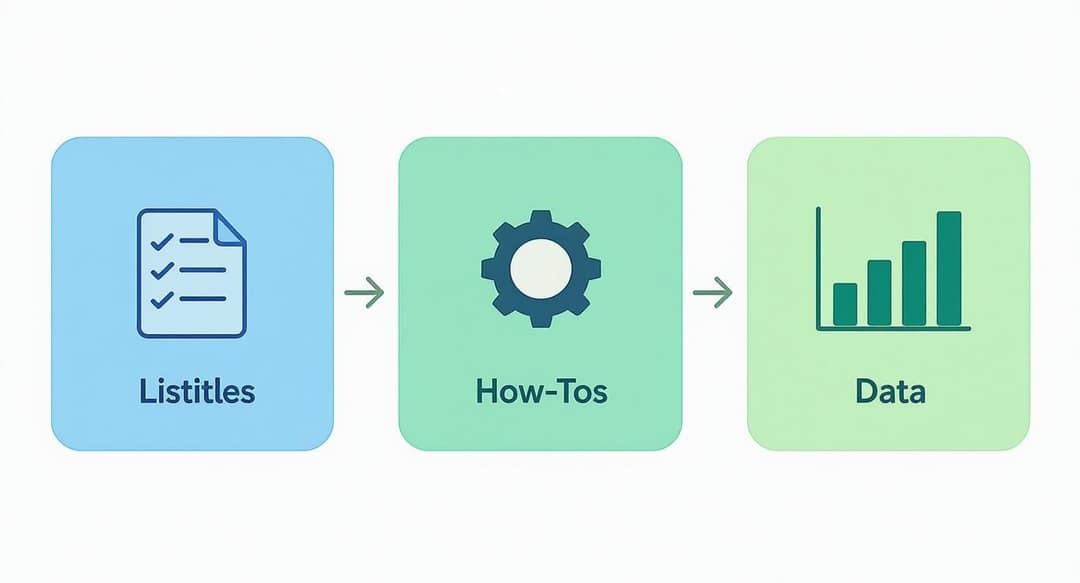
Before you paste a URL, scan the page for three things:
- Strong headings. H2s and H3s often become the title cards of your scenes.
- Short sentences. Punchy lines read better as on-screen captions.
- Numbers and key takeaways. Statistics and quotes make good visual callouts.
If you can get the gist of an article from its headings and bold text alone, it will convert well. A post titled "5 Ways to Improve Your SEO" already splits into an intro, five scenes and an outro. The same storyboard logic applies to explainer videos for complex tech products, where clarity of structure decides whether the video lands.
Prompt to try
Make a 30-second vertical video titled "5 Ways to Improve Your SEO". Open with the hook "Most sites lose traffic for one simple reason.", then give one quick scene per tip with big bold captions and a clean motion graphics style. End with "Full guide linked in bio."
Size it and share it for each platform
One link can produce several videos. A common split is a fast 30-second cut with big, bold captions for TikTok and Reels, and a more detailed one-minute or two-minute version for LinkedIn or YouTube.
Export each in the shape its platform expects. TikTok recommends 9:16 at 1080x1920, and Instagram Reels accept aspect ratios from 1.91:1 to 9:16. A square video that looks fine in a feed gets letterboxed in a vertical player, so resize the video rather than reposting one file everywhere. On length: Reels can run up to 20 minutes, but Reels longer than 3 minutes aren't recommended to non-followers, and YouTube treats vertical videos up to 3 minutes as Shorts.
To send viewers back to the article, use a cover frame with a few bold words that state the payoff, open the post copy with the most surprising point (not a summary), and say exactly where to go next, such as "Full guide linked in bio."
Viewers are asking for this format: 84% of consumers in Wyzowl's 2026 survey said they want to see more videos from brands, and 85% said a video had convinced them to buy a product or service. For older benchmarks, WordStream keeps a 2017 roundup of video marketing statistics. To judge results, start with how each platform counts a view; Cometly's explainer on what video views measure is a useful primer.
FAQ
Can I create a link for a video without uploading it?
No. A link has to point to a copy of the file on a server, so the video must be uploaded somewhere first, whether that's a cloud drive, YouTube or a social platform.
Do people need an account to open my video link?
Not if you set access to "Anyone with the link" (Google Drive, Dropbox, OneDrive, iCloud) or Unlisted (YouTube). If viewers are asked to sign in, the file is still restricted.
How do I make a video link on my phone?
Upload the video in the Google Drive, Dropbox, OneDrive or YouTube app, change sharing to anyone with the link, and copy it. On iPhone, the fastest route is Photos, then Share, then Copy iCloud Link.
Is there a free URL to video converter?
You can try one for free: Revid gives new accounts free credits to turn a link into a video, with no credit card needed to sign up. Many screen recorders also have free plans with limits on length or features, which work if you only need to record the page itself.
Can I turn any link into a video with Revid?
You can try any link, but articles, blog posts and news stories with clear headings give the best results. Pages with little text, or text locked behind a login, give the AI less to work with.