15 Faceless YouTube Channel Ideas That Make Money (2026)
Fifteen faceless YouTube channel ideas that can earn, with Revid's data on faceless video performance, the real monetization thresholds and the originality rules that decide whether a faceless channel gets paid.

On this page
The best faceless YouTube channel ideas are formats where the content carries the video without a host: animated explainers, software tutorials, finance explainers, hands-only cooking or tech reviews, gaming guides, ambient sound and POV vlogs. Pick one you can make every week with your own script, because YouTube does not pay for mass-produced or reused content.
The niche is rarely what keeps a faceless channel from getting paid. Originality is. Since July 15, 2025, YouTube's "inauthentic content" policy has blocked monetization for repetitive, mass-produced videos. Its reused content policy also covers channels that only read out text someone else wrote, such as news feeds or website posts. Each idea below comes with the version that earns and the version that gets rejected.
What counts as a faceless YouTube channel?
A faceless YouTube channel is one where the creator never appears on camera. Narration, animation, screen recordings, stock or AI visuals, gameplay or hands-only footage carry the video. Every idea below also works as a no-face or anonymous YouTube channel idea if you want to keep your name private too. For how these channels are set up and run, see our complete faceless YouTube channel guide.
15 faceless YouTube channel ideas at a glance
| # | Idea | How it's made | Main income | Effort to start |
|---|---|---|---|---|
| 1 | Animated explainers (history, science) | Script, voice-over, 2D or 3D animation | Long-form ads, sponsors | High |
| 2 | Software and automation tutorials | Screen recording plus voice-over | Affiliate links, software sponsors | Low |
| 3 | Personal finance and business explainers | Voice-over, charts, stock or AI visuals | Ads, affiliate links | Medium |
| 4 | Tech reviews, hands only | Tabletop footage, close-ups | Affiliate links, sponsors | Medium |
| 5 | Book summaries and lessons | Voice-over, text and illustrations | Affiliate links, ads | Low |
| 6 | Gaming guides and lore | Your own gameplay plus commentary | Ads, memberships, sponsors | Low |
| 7 | Relaxation, sleep and ambient sound | Long scenes with original or licensed audio | Long-form ads | Low |
| 8 | Lo-fi and music visualizers | Looping visuals over music you own | Ads, music releases | Medium |
| 9 | True crime and mystery stories | Narration, maps, documents | Ads, memberships | High |
| 10 | Motivation and self-improvement | Voice-over, b-roll, text | Digital products, ads | Low |
| 11 | Cooking, hands only | Overhead phone or camera | Ads, affiliate kitchen tools | Medium |
| 12 | Gardening, DIY and crafts | Hands-only process, before and after | Affiliate tools, digital plans | Medium |
| 13 | Animal and pet channels | Your pet on camera, voice-over or captions | Ads, pet-brand sponsors | Low |
| 14 | Faceless POV vlogs | Chest-height or hand-held POV footage | Ads, sponsors | Low |
| 15 | Niche news and trend explainers | Voice-over, screenshots, motion graphics | Ads, sponsors | Medium |
Each idea splits into many sub-niches. A history channel can cover only naval battles, and a tutorial channel only Google Sheets, which is how one short list turns into a hundred channel concepts. For a longer brainstorm, Flarecut's list of faceless channel ideas is a useful second source.
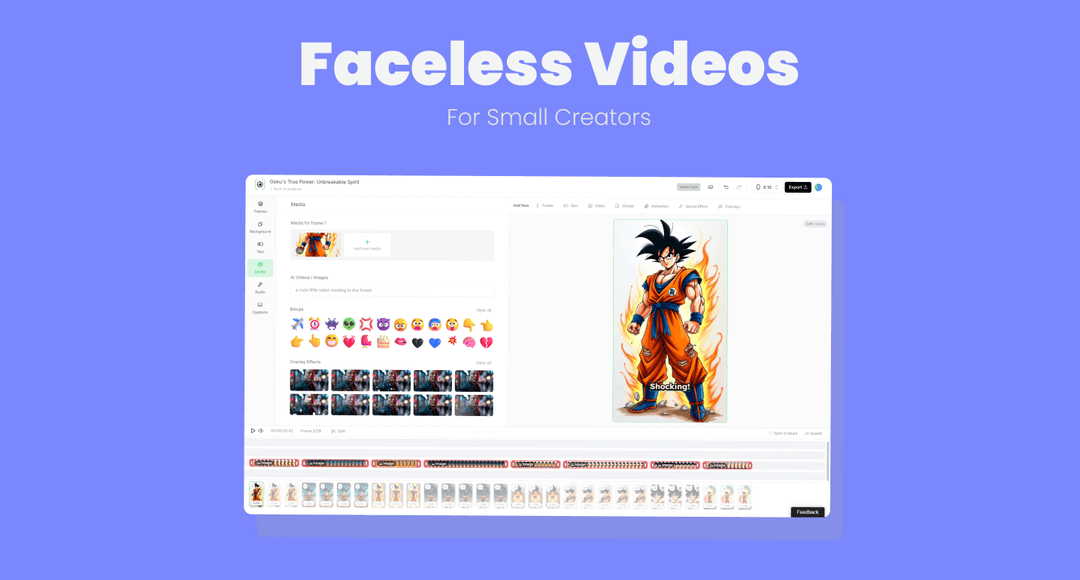
Input
Why can you pull a seatbelt slowly, but it locks during a sudden stop? Show the retractor mechanism and the consequence in a fast stylized 3D explainer.
Output
The 15 ideas, and what makes each one earn
1. Animated explainers: history, science, how things work
Maps, diagrams and 3D models replace the host. The Armchair Historian, Animagraffs and Kurzgesagt built large audiences this way. A free 3D tool like Blender covers the heavy modeling work, and simpler 2D explainers can come from an AI educational video maker. These videos stay relevant for years, so old uploads keep earning. The cost is research time: one wrong fact fills your comments.
2. Software and automation tutorials
Screen recording plus a clear voice-over is the cheapest faceless format there is. Viewers search for exact problems ("automate invoices in Google Sheets", "Notion habit tracker"), so a title that names the problem gets found. Income comes from affiliate links to the software and from sponsorships by tools in your niche.
Prompt to try
Make a 60-second faceless finance explainer titled "Why your savings lose value every year." Open with the hook "Leaving money in a regular savings account can quietly cost you." Explain inflation with simple charts and calm stock visuals, end with three practical options to consider, and use a clear, steady narrator voice.
3. Personal finance and business explainers
Budgeting, investing basics, side businesses and company breakdowns attract viewers who spend money, which is what advertisers and affiliate programs pay for. Use charts, cite your sources on screen and add your own analysis. Skip one shortcut: YouTube will not monetize channels that present an AI-generated persona as a human expert giving financial advice.
4. Tech reviews, hands only
Film the product on a desk from above or at a low angle, with close-ups of ports, screens and buttons. Your hands and voice are enough. Affiliate links in the description are the main income, with sponsorships once brands notice you. Say on screen every time a video is sponsored.
5. Book summaries and lessons
Summarize a book in your own words, then add what you would apply and where you disagree. That opinion is what makes the video yours: reading long passages aloud is a copyright problem and counts as reused content. Affiliate links to the book pay on every sale.
6. Gaming guides, lore and commentary
Record your own gameplay and talk over it: walkthroughs, build guides, lore explainers, rankings. Covering one game series builds a loyal audience faster than covering everything. Avoid compilations of other streamers' clips, which attract Content ID claims and fall under reused content.
7. Relaxation, sleep and ambient sound
Rain on a window, a cafe ambience, a fireplace for studying. Viewers leave these playing for hours, so watch time is high. The trap is uploading the same loop under a new title. Give each video its own scene, and use audio you recorded or licensed.
8. Lo-fi and music visualizer channels
Lofi Girl is the best-known example: one recognizable scene and music that never stops. You need the rights to every track, so make the music yourself or license it. An AI music visualizer can turn tracks you own into looping visuals.
9. True crime and mystery storytelling
Narration over maps, documents, timelines and photos of places. The format rewards tight scripts and pacing more than budget. Keep descriptions of violence non-graphic, since graphic detail can limit which ads run on a video.
Prompt to try
Create a 45-second faceless self-improvement video about the two-minute rule for building habits. Hook: "The easiest way to start a habit is to make it too small to skip." Show one concrete example, like reading one page a night, with warm b-roll and bold captions, and end with a single action the viewer can try tonight.
10. Motivation and self-improvement
A motivational faceless YouTube channel is one of the most common ideas, and one of the most crowded. In Revid's TikTok data (more below), inspirational videos had the lowest median of any mood at 45K views, with 11.3% passing 1 million. Generic quote-over-sunset videos blur together, and compilations of famous speeches are reused content. Win with specifics: one habit, one study or one story per video, in a script you wrote.
11. Cooking, hands only
An overhead phone or camera above the counter is all you need. People search for recipes constantly, and the format fits both long tutorials and Shorts. Kitchen tools and ingredients make natural affiliate links, and a recipe ebook is an easy first digital product.
12. Gardening, DIY and crafts
Hands-only process videos with a clear before and after. Searches follow the seasons (planting guides in spring, decor projects in autumn), so publish ahead of the demand. Tool affiliate links and downloadable plans or patterns are the usual income.
13. Animal and pet channels
Your pet is the star, not you. Animal videos were among the strongest performers in Revid's TikTok data (see the next section). A voice-over or captions that give the animal a personality turn cute clips into a series, and pet brands become natural sponsors.
14. Faceless POV vlogs
A faceless vlog channel shows life from your point of view: walks through a city filmed at chest height, a day in your workshop, a morning routine filmed over your hands. On TikTok, POV videos had a 107K median and 19% passed 1 million views in Revid's data, well ahead of selfie-style video. City walks, travel and slow-living vlogs also work at long length on YouTube.
15. Niche news and trend explainers
Pick a narrow beat (AI tools, one game's updates, a league's transfers) and explain what changed and why it matters. Write the analysis yourself: a channel that only reads out news feeds counts as reused content and is not allowed to monetize.
Which faceless ideas are easiest to start?
With no budget and no editing experience, start with ideas you can film on a phone or record on a computer:
- Software tutorials (idea 2): a screen recorder and a microphone.
- Cooking or crafts (ideas 11 and 12): a phone mounted above the table.
- POV vlogs (idea 14): a phone held at chest height.
- Gaming guides (idea 6): your own gameplay capture.
Animated explainers and true crime are the hardest to start because every video needs heavy research and custom visuals. Choose them if you write well and can accept publishing less often.
Do faceless videos get fewer views? Revid's data says no
In Revid's analysis of 176,367 TikToks with 1,000+ likes posted between October 2025 and October 2026, faceless videos had a median of 114K views and 17.4% passed 1 million. Videos with one person on camera had 67K and 12.7%. Animal videos did even better, at 147K and 24.1%. The method and every chart are in our study of what makes a TikTok go viral.
Faceless videos earned a median of 114K views, against 67K for videos with one person on camera, and passed 1M views 38% more often.
Source: Revid analysis of 176,367 TikToks with 1,000+ likes posted between Oct 1, 2025 and Oct 16, 2026 (61,203 creators)
Show the data
| Median views | Share that passed 1M views | |
|---|---|---|
| Animals | 147.4K | 24.1% |
| Faceless | 113.9K | 17.4% |
| Groups of people | 96.1K | 16% |
| Objects or products | 70.8K | 13.2% |
| One person on camera | 67.4K | 12.7% |
The gap is widest in the formats faceless channels rely on. Faceless tutorials had a 156K median with 22.1% past 1 million, versus 52K and 10% for tutorials with a person on camera. Faceless comedy reached 327K against 136K.
Faceless tutorials earned about 3x the median views of on-camera tutorials (156K vs 52K).
Source: Revid analysis of 176,367 TikToks with 1,000+ likes posted between Oct 1, 2025 and Oct 16, 2026 (61,203 creators)
Show the data
| Median views | Share that passed 1M views | |
|---|---|---|
| Faceless tutorials | 155.6K | 22.1% |
| Product or object tutorials | 80.7K | 14.9% |
| On-camera tutorials | 52.5K | 10% |
| Faceless storytelling | 72.7K | 13.3% |
| On-camera storytelling | 64.4K | 11.7% |
| Faceless comedy | 326.7K | 26.4% |
| On-camera comedy | 135.5K | 20.7% |
Two limits matter. This is TikTok data, not YouTube data, so read it as evidence for faceless Shorts more than for long documentaries. The index also holds only videos that already passed 1,000 likes, so it shows what successful videos have in common, not what causes success, and the perspective of each video comes from Revid's AI analysis. Revid's separate faceless vs on-camera study of 2.4 million TikToks across all posting dates points the same way: faceless videos averaged 2.2M views against 1.6M for person-focused ones.
Which faceless niches make the most money?
YouTube publishes no standard RPM (its term for what a creator earns per 1,000 views after YouTube's share), so any per-niche figure you see online is an estimate. Three things move earnings reliably:
- Who advertises to your viewers. Niches where viewers are about to spend money (software, finance, tech, home improvement) attract more advertisers and better affiliate offers than pure entertainment.
- Long-form versus Shorts. AIR Media-Tech's September 2026 analysis of 274 channels found Shorts RPM was 3% to 14% of long-form RPM in almost every niche, so most channels need 11,000 to 34,000 Shorts views to earn what 1,000 long-form views pay. More figures are on our YouTube Shorts statistics page.
- Income outside ads. In a small but focused niche, affiliate links and digital products often earn more than ads.
As for the highest-earning faceless YouTube channels: YouTube does not publish channel earnings, so every ranking relies on third-party estimates, and subscriber counts alone say little. vidIQ's stats page for a news and politics channel named FACELESS showed 138,000 subscribers and over 30 million views when this article was first written, yet estimated monthly earnings of only $1.97 to $5.91 because uploads had become irregular. Current views pay; old subscriber counts do not.
How do faceless YouTube channels make money?
Ad revenue through the YouTube Partner Program
Today, ad revenue sharing needs 1,000 subscribers plus either 4,000 qualified public watch hours in the last 12 months or 10 million qualified Shorts views in the last 90 days. Watch hours from the Shorts feed do not count toward the 4,000.
The bar rises on February 1, 2027. New applicants will need 8,000 qualified watch hours in the last 365 days or 20 million qualified Shorts views in the last 90 days; channels already in the program are not affected. From the same date, earning Shorts ad revenue in a given month requires 10 million qualified Shorts views in the last 90 days, which is one more reason to build long-form videos into a faceless channel.
Affiliate links
Put tracked links to products you actually use in the description and pin them in a comment. Affiliate income does not depend on Partner Program status, and it suits tutorials, tech, cooking, books and DIY.
Sponsorships
Brands care about views per video and audience fit, not your face. Use a business email, keep a one-page media kit with your recent views and audience countries, and disclose every sponsored segment. A representative can take calls if you want to stay anonymous.
Digital products and memberships
Templates, guides, presets, courses or a paid community tied to your niche: planning worksheets for a productivity channel, cutting lists for a woodworking channel. You own the product, so it earns regardless of ad rates.
How do I build a successful faceless video channel?
- Pick an idea where you add something. Your research, your gameplay, your hands or your opinion. This is what keeps the channel monetizable.
- Check demand before you film. Type your topic into YouTube search and note the autocomplete suggestions, then check volumes in Google Keyword Planner or Ahrefs. Study the top channels in the niche: which titles get views and what viewers ask for in the comments.
- Build a repeatable production system. One script template, one voice, one visual style, and batched work: a block of time to research, one to write, one to record and edit.
- Mix long-form and Shorts. Vertical videos up to 3 minutes count as Shorts and bring new viewers, while long-form earns more per view. AIR Media-Tech's study of 18,000 English-language channels found the best results when Shorts made up 25% to 40% of a channel's uploads.
- Review your analytics every month. Keep the topics and title styles that pull above your average, and drop the rest.
For the setup itself (channel name, branding, first upload), follow our step-by-step guide to creating a faceless YouTube channel.
Tools for making faceless videos
| Job | Free options | Paid or more advanced |
|---|---|---|
| Video editing | DaVinci Resolve (free version), iMovie on Apple devices | Adobe Premiere Pro, or Filmora for a simpler interface |
| Animation and motion graphics | Blender for 3D | Adobe After Effects, or Animaker and Vyond for quick 2D |
| Voice recording and cleanup | Audacity for editing and noise removal | The Blue Yeti USB microphone and Adobe Audition |
Without a face on screen, your voice carries the trust, so audio deserves more care than visuals. Record in a small room with soft furnishings, keep the same distance from the microphone every take, and cut breaths and long pauses in editing. The video below covers a breathing technique for reading long sentences cleanly.
Start with free tools and upgrade once the channel earns. Mastering one editor beats switching between four.
How to make faceless videos with Revid
If writing, voicing and editing every video is the bottleneck, Revid handles the assembly:
- Open the faceless video generator and paste a script, a prompt or a link to an article.
- Choose one of 1,000+ AI voices in 70+ languages, and a visual style per scene: stock footage, AI images, or AI video from Seedance 2.5, MiniMax Hailuo H3, Wan 3.0 or Google Veo 3.
- Adjust scenes, captions and music in the timeline editor, then export in 1080p or 4K.
- Publish or schedule to YouTube, TikTok and Instagram from one publishing queue.
For vertical videos, the AI YouTube Shorts generator turns text into Shorts. To find what to make, search Revid's library of about 2.77 million short-form videos by topic and engagement, open one that performs in your niche, and use "Make it about your topic" to turn its structure into an original video. Keep your own insight in every script: YouTube pays for AI-assisted videos that show creative vision, not for template output.
What gets faceless channels demonetized
These are the YouTube monetization rules faceless channels break most often:
- Template or mass-produced AI videos without your own insight (the "inauthentic content" policy, renamed from "repetitious content" on July 15, 2025).
- Reading out material you did not write, such as website text or news feeds, or relying on mostly non-verbal reactions. This is reused content, and it is judged across the whole channel.
- Stitching unrelated AI clips together to shock viewers, or using realistic AI visuals to fake events.
- AI personas presented as human experts on health, legal, financial or political topics.
Realistic AI content (a real person appearing to say something they did not, a realistic scene that never happened) must be disclosed with the "AI use" setting in YouTube Studio. The label alone does not limit reach or earnings, and since May 2026 YouTube labels undisclosed photorealistic AI automatically.
FAQ
Can you monetize an AI faceless channel on YouTube?
Yes, if the final videos show your creative vision and give real educational or entertainment value. YouTube allows AI for scripts, voices and visuals, but it does not monetize mass-produced template content or incoherent AI clip compilations.
Do I have to disclose an AI voice-over on YouTube?
Usually not. YouTube does not require disclosure for AI-written scripts, captions or cloning your own voice for voice-overs; it requires it only for realistic content, such as making a real person appear to say something they did not.
Do Shorts views count toward YouTube monetization?
Yes, through the Shorts path: 1,000 subscribers plus 10 million qualified Shorts views in the last 90 days. Watch hours from the Shorts feed do not count toward the 4,000 watch-hour path.
Can you start a faceless YouTube channel with no money?
Yes. DaVinci Resolve's free version, Audacity and Blender cover editing, audio and animation, and tutorials, hands-only cooking and POV vlogs need nothing beyond a phone or computer you already own.
What are the most popular faceless YouTube channels?
Well-known examples include Kurzgesagt and The Armchair Historian (animated explainers), Animagraffs (3D explainers) and Lofi Girl (music). YouTube does not publish channel earnings, so treat any ranking of the most profitable faceless channels as an estimate.