Good Hooks for Reels: 8 Hook Types With Examples and Data
Eight Reel hook formulas with example lines you can adapt, the visual hooks that stop the scroll, and a hook structure for business Reels, backed by Revid's data on 176,367 viral TikToks.
On this page
Good hooks for Reels deliver the payoff in the first second or two. That can be a pointed question, a claim that flips a common belief, a numbered promise, a named problem, a before-and-after, a behind-the-scenes secret or a trend tie-in. Keep the spoken line short, repeat it as on-screen text, and start the shot mid-action.
The most common mistake is talking before anything happens. Revid analyzed 176,367 TikToks with 1,000+ likes posted between October 2025 and October 2026. Videos with under 40 characters of speech had a median of 123K views, and 20.2% passed 1 million views. Videos that talked throughout (300+ characters) had 68K and 11.9%. This is TikTok data, and it shows what successful videos have in common rather than proving a cause. The direction still holds for Reels: a hook is one sharp line, not an intro. The full method is in Revid's study of what makes a TikTok go viral.
Videos with just a few spoken words (a line or two) beat both silent videos and videos that talk the whole way through, which were the most common and the weakest.
Source: Revid analysis of 176,367 TikToks analyzed by AI, with 1,000+ likes posted between Oct 1, 2025 and Oct 16, 2026 (61,203 creators)
Show the data
| Median views | Share that passed 1M views | |
|---|---|---|
| No speech | 73.3K | 14.3% |
| Under 40 | 122.7K | 20.2% |
| 40 to 120 | 97.2K | 17.6% |
| 120 to 300 | 91.6K | 16.8% |
| 300+ | 67.7K | 11.9% |
The 8 Reel hook types at a glance
Pick the hook from what the video actually delivers. A tutorial earns a question or problem hook, a makeover earns a before-and-after, and a hot take earns a surprise hook. The table gives a fill-in formula for each.
| Hook type | Formula | Example opening line | Best for |
|---|---|---|---|
| Question | Why does [common thing] keep [bad result]? | "Why do your houseplants die by the window?" | Tips, explainers |
| Surprise | [Common belief] is wrong. Here's why. | "You've been loading your dishwasher wrong." | Myths, hot takes |
| Story | [Low point]. Then [turning point]. | "My launch made zero sales. Then I changed one thing." | Founders, personal brands |
| List | [Number] [things] that [result] | "Three edits that make cheap Reels look expensive" | Education, tips |
| Problem/solution | [Problem]? Do this instead. | "Reels stuck at a few hundred views? Fix your first frame." | Services, products |
| Before and after | [Before] to [after] in [time] | "Same room, one weekend, no contractor" | Makeovers, fitness, design |
| Behind the scenes | What [insiders] do that you never see | "What a florist does with roses that don't sell" | Small businesses, crafts |
| Trend | [Trend], but for [your niche] | "That trending audio, explained by an accountant" | Reach to new viewers |
If you need more lines to adapt, Revid keeps a library of copy-and-paste hooks. It was written for TikTok, and the lines work just as well for Reels.
1. Question hook
A question hook opens a gap the viewer wants closed. It works when the answer is useful and not obvious. It fails when the viewer can answer it in their head ("Do you want more followers?").
Formulas that work:
- "Why does [common thing] keep [bad result]?"
- "What's the one [thing] to stop doing before [goal]?"
- "Would you [do surprising thing] for [result]?"
- "Which of these [items] is actually [quality]?" (show the options on screen)
Do not default to questions. Among TikToks with over 100 million views, Revid's 100M Club analysis found that 51% of the videos with a transcript open with a statement and 16% with a question. A direct claim is often the stronger opener. Use a question when the uncertainty itself is the draw.
Rule: answer the question before the end, ideally in the first half. A question you never answer trains people to skip you.
2. Surprise or shock hook
The surprise hook contradicts something the viewer believes, and that breaks the scroll pattern. "Everything you've been told about stretching before a run is backwards" works because the viewer has been told something and wants to know if it was wrong.
Emotion explains a lot of its pull. In Revid's TikTok study, videos whose dominant mood was outrage had a median of 156K views (23.7% passed 1 million). Humor had 121K (19.3%) and sadness 104K, while inspirational videos had only 45K (11.3%). The mood labels come from Revid's AI analysis of each video, and the sample only includes TikToks that already reached 1,000+ likes.
High-arousal emotions (outrage, humor, sadness) earned the most views. Calm, inspirational videos earned the least, even though they collect the most likes per view.
Source: Revid analysis of 176,367 TikToks with 1,000+ likes posted between Oct 1, 2025 and Oct 16, 2026 (61,203 creators)
Show the data
| Median views | Share that passed 1M views | |
|---|---|---|
| Outrage | 156K | 23.7% |
| Humor | 121K | 19.3% |
| Sadness | 104.4K | 16.5% |
| Excitement | 92.5K | 15.9% |
| Joy | 89.9K | 18% |
| Informative | 64.1K | 11.2% |
| Neutral | 61.2K | 11.5% |
| Inspirational | 44.6K | 11.3% |
Formulas:
- "Stop [common habit]. Here's what it actually does."
- "Nobody in [industry] will tell you this, so I will."
- "[Popular thing] is overrated, and here's the proof."
This hook has two limits:
- Every claim must be true and checkable. A debunked hook damages trust faster than a boring one.
- The surprise has to lead into the content. If the body doesn't explain the claim, viewers feel baited and say so in the comments.
3. Story hook
A story hook starts at the turning point, not at the beginning. "A while ago I was struggling..." is slower than "I lost my biggest client on a Tuesday. Here's what I did on Wednesday."
Storytelling alone is not the edge. In Revid's TikTok study, storytelling videos had a median of 66K views (12.2% past 1 million), about the same as the 64.4K median for the whole sample. So the topic of the story doesn't set it apart. The opening line does: the stories that break out tend to open on the conflict.
Formulas:
- "[Bad thing happened]. This is what I did next."
- "The [email / review / customer] that made us rebuild [product]."
- "I almost [quit / closed / gave up]. One conversation stopped me."
Three rules for the opening:
- Use one concrete detail in the first line (a day, an amount, a place) instead of an adjective.
- Cut every sentence that comes before the conflict.
- Tie the ending to the point of the Reel. Without that link, the story is entertainment with no takeaway.
Prompt to try
Create a 30-second vertical Instagram Reel titled "3 mistakes that make your houseplants die." Open with the hook line "Three habits are killing your plants, and the last one surprises everyone" shown as large on-screen text. Count each item on screen (1/3, 2/3, 3/3) with close-up stock footage of plants, a friendly voiceover and bold captions.
4. List or number hook
A number tells the viewer how long they are committing to and what they'll get. "Three edits that make cheap Reels look expensive" sets a clear contract.
Formulas:
- "[Number] [mistakes / tools / rules] for [goal]"
- "[Number] things I'd do differently if I started [X] today"
- "Ranking [number] [items] from worst to best"
How to make it work:
- Show the number on screen and count each item as it appears ("1/3"). Viewers stay to finish the set.
- Tease your strongest item early ("the last one is the one nobody does").
- Keep the list short. If it runs long, split it into a series.
- Make every item usable. One filler item undoes the promise.
5. Problem/solution hook
This hook names the problem in the viewer's own words and promises a fix. It is the most direct hook for businesses because it filters the audience: anyone who stops has the problem you solve.
Examples:
- "Can't get clients from Instagram? Your bio is the problem, not your posts."
- "Frizz back by lunch? Try this before you blow-dry."
- "Burned rice again? It's the water, not the pot."
- "Spending Sunday night on invoices? Here's a template that does it for you."
Take the wording from your comments, reviews and DMs. The phrase customers use ("my Reels flop") beats the phrase marketers use ("low engagement"). Then give a fix that works without buying anything. The product can come after the value.
Prompt to try
Make a 20-second faceless before-and-after Reel of a cluttered home office turned into a clean, cozy workspace in one weekend. Open on the finished room with the text "Same room, one weekend, under $200," then cut back to the messy before and show the steps in fast close-ups of hands at work. Upbeat music, short captions, warm natural lighting.
6. Before-and-after hook
The transformation hook shows the result first so the viewer stays for the process. It suits makeovers, cleaning, interior design, fitness, renovations, editing and any service with a visible result. It also works faceless: hands, a room or a screen are enough.
How to make it work:
- Open on the after, or on a split screen, then cut back to the before. Saving the reveal for the end only works if the before is striking on its own.
- Put the specifics in the text overlay: the time it took, the cost, the tool.
- Show the work in between. The process is the value, the result is the hook.
- Keep it honest. Lighting tricks and fake timelines get called out, and health or fitness claims draw extra scrutiny.
7. Behind-the-scenes or secret hook
Behind-the-scenes hooks promise access: how something is made, priced, packed or decided. They suit small businesses because everyday work is new to the viewer, whether that is packing orders, prepping a menu or fixing a client's file.
Formulas:
- "What happens to [product] after you order it"
- "What a [job] does that customers never see"
- "How I price a [service], line by line"
Use "secret" only for something real. "The algorithm secret Instagram doesn't want you to know" is a cliché that sets up a letdown. "Why I stopped using hashtags on half my Reels" is concrete, and you can deliver on it.
8. Trend hook
A trend hook ties your topic to something people are already watching: a sound, a format, an event or a meme. The upside is reach to non-followers. The downside is a short shelf life.
How to make it work:
- Move early. Check what's rising on Revid's feed of viral Instagram Reels and post while the format is still growing.
- Add your angle. "This trend, but for [your niche]" beats a straight copy.
- Keep hashtags tight. Instagram allows up to 5 hashtags per post, and a caption with more won't post.
- Skip trends tied to tragedies or divisive news unless that is your field.
What are the best visual hooks for Instagram Reels?
A visual hook works even for viewers who scroll with the sound off. The best Reels pair a spoken line with one of these in the first frame:
- Text on the first frame. Put the hook line in large text inside the safe area, away from the caption and buttons. Check placement with the Instagram Reels safe zone template.
- Motion from frame one. Start mid-action (pouring, cutting, walking into frame), never on a still intro or a logo.
- The result first. Open on the finished dish, room or design.
- POV framing. In Revid's TikTok study, POV videos had a median of 107K views (19% past 1 million), against 48K (9.2%) for selfie-style shots.
- Faceless close-ups. Faceless TikToks in the same study had a median of 114K views (17.4% past 1 million), versus 67K (12.7%) for one person on camera. You don't need your face in the first frame to hook someone.
- Something out of place. An odd object, a contrast in scale, a setting that doesn't fit the topic.
The POV and faceless figures are TikTok data based on AI-labeled shooting styles. They describe patterns among videos that were already popular, so test them on your own Reels before you change your whole style.
What hook structure works best for business Reels?
The structure that turns a hook into business results has four beats. The first line names the problem and the outcome, proof follows right away, then the payoff, then one ask.
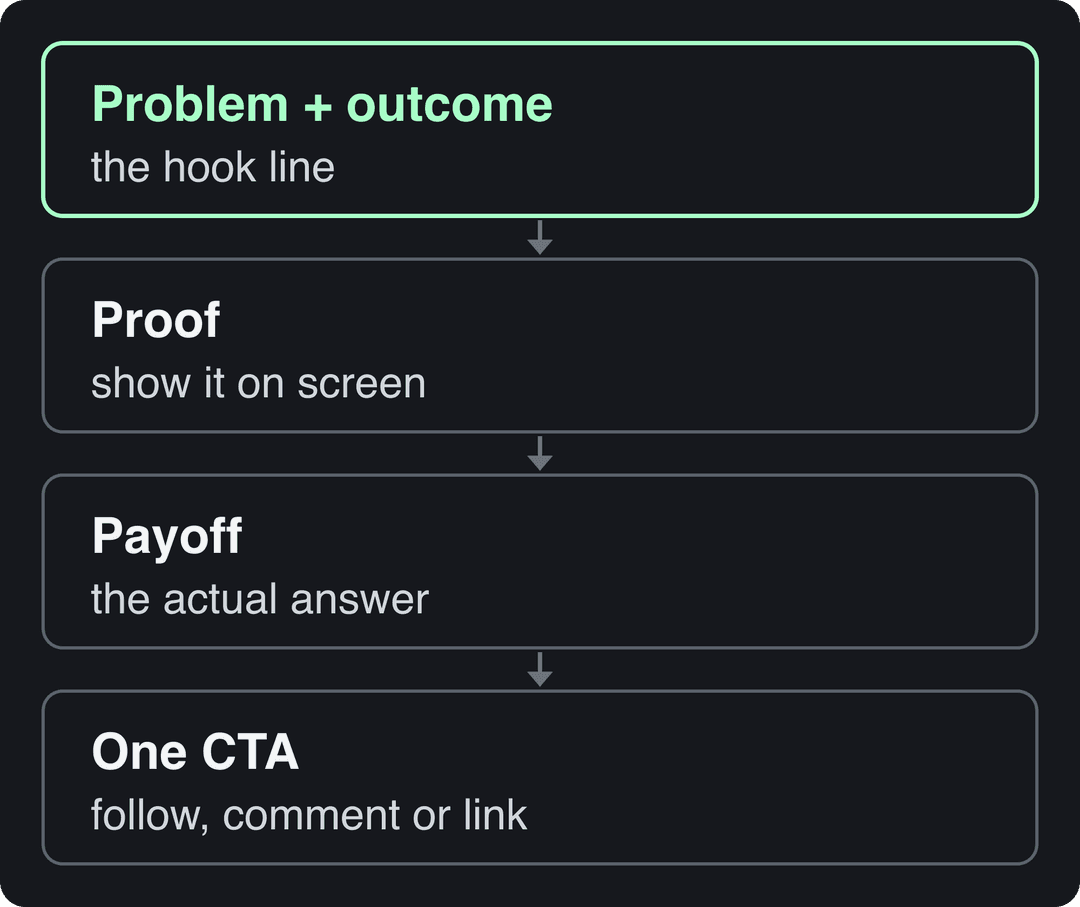
- Problem and outcome (the hook): "Your product photos look fine but don't sell? Here's the one shot that does."
- Proof: a result, a screen recording, a customer clip or a before-and-after. Show it, don't describe it.
- Payoff: the actual tip, demo or answer. This is what earns saves and shares.
- One call to action: follow for part two, comment a keyword, or tap the link in bio. Pick one, not three.
| Business | Hook line | Proof to show |
|---|---|---|
| SaaS or app | "Still copying data between tabs? This does it in one click." | Screen recording of the feature |
| Local service | "Why your AC smells musty, and the quick fix" | Close-up of the dirty filter |
| E-commerce | "This sells out every restock. Here's why." | Customer clips, packed orders |
| Coach or consultant | "The pricing mistake that keeps freelancers broke" | Old rate sheet next to the new one |
Screen recordings deserve a test for software. In Revid's TikTok study they had a median of 91K views, ahead of handheld and tripod footage.
Two business mistakes kill a Reel in the first second. The first is opening on your logo or brand name: nobody stops scrolling for a logo. The second is opening with "Hi, I'm [name] from [company]." Introduce yourself after the hook, or in the caption.
How do you test which Reel hook works?
Film the body once and record three different first lines. That way the hook is the only variable.
Instagram's trial reels are built for this:
- Trial reels are shown first to non-followers, and insights arrive within 24 hours.
- A trial that performs well can be shared to everyone, manually or automatically.
- Trials don't affect how your standard reels rank.
- You need a public account with at least 200 followers (professional account) or 1,000 followers (personal account).
Compare Views across the versions (Instagram insights now lead with Views, counted separately from unique Viewers), then saves and shares. Keep the winning formula and rewrite it for your next topic.
Watch the length too. Reels can run up to 20 minutes, but Reels longer than 3 minutes are not recommended to non-followers. For the rest of the checklist, see these Instagram Reels best practices.
How to make Reels with proven hooks in Revid
Revid starts from short-form videos that already performed, so your hook doesn't have to be a guess.
- Search Revid's library of about 2.77 million short-form videos and posts by topic, platform and engagement tier, and pick one that fits your niche.
- Run Deep analysis on it (free, up to 60 a day). It explains the hook (spoken or visual, its formula and its strength), the timed structure and the scroll-stopping moment.
- Choose "Make it about your topic" to apply that hook style and pacing to your niche. You can also add a Reel as a reference in Revid's Instagram Reels repurposing tool. Either way, Revid writes a new script and new visuals rather than copying the original.
- Starting from an idea instead? The AI Reel generator writes the script and builds the visuals, voice-over and captions.
- Rewrite the first line in the timeline editor if needed, then publish or schedule straight to Instagram.
FAQ
What is a hook in an Instagram Reel?
A hook is the opening line, image or movement in the first second or two of a Reel that gives viewers a reason to keep watching. The strongest hooks combine a short spoken line, matching on-screen text and motion in the first frame.
Can AI tools find viral hooks in a long YouTube video and pick where a clip should start?
Partly. Clipping tools such as OpusClip and Klap score moments in long videos for virality, and Revid's YouTube clip maker turns a long video into vertical clips. Check that each clip's first sentence makes sense on its own, and trim any lead-in before the strongest line.
Should a Reel hook be spoken or written on screen?
Use both. Say the line out loud for viewers with sound on, and show it as large text for viewers scrolling muted, keeping the two nearly identical so neither feels like a different message.
Do the same hooks work on TikTok and Instagram Reels?
Mostly yes, because both are full-screen vertical feeds where viewers decide in the opening moments. The differences are in reach and audience, covered in Instagram Reels vs TikTok, so test hooks on each platform rather than assuming one winner carries over.
How many hooks should I write for one Reel?
Write at least three opening lines for every Reel and pick the clearest, or test them as trial reels. Most weak Reels come from settling for the first hook that came to mind.