How to Increase Engagement: What Works in 2026 (With Data)
A practical guide to increasing engagement on social media, with customers and with employees: hooks, formats, platform benchmarks and what Revid's data on 176,367 TikToks says gets people to react.

On this page
To increase engagement, give people one clear reason to respond and make responding easy: hook them in the first seconds, ask one specific question, reply to comments quickly, and post in the format each platform favors. Then track shares, saves and comments instead of follower counts, and make more of whatever earns them.
Most people grade themselves on the wrong action. In Revid's analysis of 176,367 TikToks with 1,000+ likes posted between October 2025 and October 2026, viewers left 7.1 likes per 100 views but only 0.88 shares and 0.08 comments per 100 views. Comments are the rarest signal there is, so a post with a handful of real replies may be doing better than it looks, and a lazy "comment below" will not change that math.
This guide covers the three kinds of engagement people usually mean: social media and content (where you have the most levers), customers, and employees.
What counts as engagement?
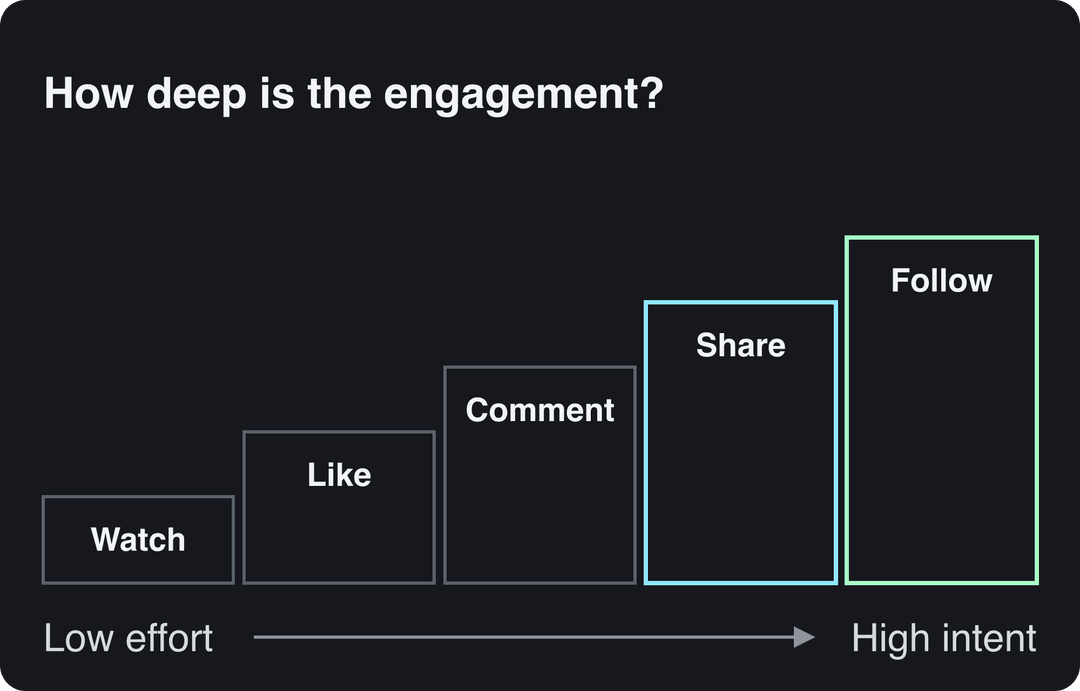
Engagement is any action that shows attention beyond a passive glance. The actions are not equal: a like costs a tap, a comment costs a thought, and a share puts the viewer's own reputation behind your post. The deeper the action, the more it tells you.
| Audience | Weak signals | Strong signals |
|---|---|---|
| Social media | Views, likes | Comments with substance, shares, saves, follows |
| Customers | Email opens, site visits | Repeat purchases, replies, reviews, referrals |
| Employees | Attendance, survey completion | Extra effort, retention, referrals of friends, candid feedback |
Decision rule: before you post or launch anything, pick the strong signal that matches your goal, and judge every tactic below against it.
How to increase engagement on social media
1. Win the first seconds
Attention is decided almost immediately. In Clutch's October 2025 survey of US consumers, 88% said a video needs to grab their attention in 30 seconds or less, and only 9% said they give short-form videos their full attention. Open with the payoff, a bold claim or a visual surprise, never with a logo, an intro or "hey guys".
Hook templates you can adapt:
- "Most people get [topic] wrong. Here's the fix."
- "Stop doing [common habit] if you want [result]."
- "POV: you just found out [surprising fact about your niche]."
For more, browse these copy-and-paste TikTok hooks.
Prompt to try
Make a 30-second vertical video for small business owners that opens with the hook "Most people get posting times wrong. Here's the fix." Give three quick, practical tips with bold on-screen captions, an energetic voiceover and fast cuts, and end by asking viewers which tip they will try first.
2. Post the native format for each platform
The same idea needs a different shape on each network. LinkedIn rewards in-depth posts and professional insight, while Instagram and TikTok are built around short vertical video. Cross-posting the identical file with the identical caption everywhere is the most common reason a post works on one platform and dies on the others.
3. Choose formats people react to
Some formats invite a response by design. In Revid's study of 176,367 TikToks, challenges had the highest median views (182K), followed by comedy (155K) and reactions (105K), while tutorials sat at 62K. Faceless videos reached a 114K median versus 67K for one person on camera. These are TikToks that already passed 1,000 likes, so the figures show what top performers have in common, not guaranteed causes. The full method is in what makes a TikTok go viral.
Challenges and comedy passed 1M views about twice as often as tutorials and storytelling, which are the most common formats.
Source: Revid analysis of 176,367 TikToks with 1,000+ likes posted between Oct 1, 2025 and Oct 16, 2026 (61,203 creators)
Show the data
| Median views | Share that passed 1M views | |
|---|---|---|
| Challenge | 182.3K | 25.6% |
| Comedy | 154.8K | 22.1% |
| Reaction | 104.8K | 16% |
| Dance | 83.8K | 15.5% |
| Storytelling | 66.1K | 12.2% |
| Lip Sync | 61.7K | 12.3% |
| Tutorial | 61.9K | 12.1% |
If your niche is educational, you do not have to abandon tutorials: add a challenge ("try this before you scroll"), a reaction angle, or a hot take viewers can agree or argue with.
4. Ask one specific question
"Thoughts?" gets silence. A question with an easy, opinionated answer gets replies:
- "Which would you pick, A or B?"
- "What's the one tool you'd never give up for [task]?"
- "Rate this setup from 1 to 10."
Polls, quizzes and question stickers in Stories lower the effort even further, which is the whole point.
Prompt to try
Create a 25-second vertical video that answers a viewer comment asking "What is the one tool you would never give up for editing videos?" Start by showing the question on screen, give a confident answer with two reasons, use a casual conversational voice with clear captions, and close by asking viewers to share their own pick.
5. Reply fast and turn comments into content
Reply to every comment while the post is fresh, pin the best one, and answer good questions with a new video: TikTok and Instagram both let you reply to a comment with a video. Each reply restarts the conversation and gives you your next post idea for free.
6. Write short captions and use a few relevant hashtags
On TikTok, Revid's data favors short captions: 41 to 80 characters had the best median (67K views), and posts with no caption had 36K. Hashtags followed the same pattern: 4 hashtags had the best median (77K) and 3 had 75K, against 51K with none and only 16K with 9 or more. On Instagram the question is settled for you, since the platform allows up to 5 hashtags per post.
7. Feature your audience
Showing real customers and followers invites more of them to join in. Reposting user videos, stitching or dueting replies, and running "show us your setup" prompts all work. Authenticity matters here: 44% of US consumers in Clutch's survey said they prefer casual, authentic videos from independent creators over polished brand spots. See more data in our UGC statistics.
8. Repeat what already works
Open your analytics weekly. In TikTok Studio, the Viewers tab shows when your viewers were most active over the last 7 days; Instagram shows follower activity once you have at least 100 followers. Tag each post by hook and format, then make more of the top performers. For a platform-by-platform version of these tactics, read our social media engagement playbook.
What is a good engagement rate on each platform?
Compare yourself with your own platform's norms, never across platforms. Socialinsider's 2026 study of 69 million short-form videos, summarized in our YouTube Shorts statistics, found very different baselines:
| Platform | Avg engagement rate by followers | Avg comments per video | Avg views per video (accounts under 5,000 followers) |
|---|---|---|---|
| TikTok | 2.60% | 50 | 350 |
| Instagram Reels | 0.45% | 20 | 625 |
| YouTube Shorts | 0.30% | 10 | 15,160 |
The pattern is useful: TikTok audiences interact more, while Shorts give small accounts far more reach. If you want comments, lean on TikTok; if you want to be discovered with a small following, do not skip Shorts. For benchmarks on other post types, ClearVoice keeps a roundup of social media statistics.
How to make engaging short videos with Revid
The hardest part of engagement is knowing which format your audience already responds to. Revid starts from that evidence instead of a blank prompt:
- Search Revid's library of about 2.77 million real short-form videos by topic, platform and engagement tier to see what already works in your niche, then remix a viral video into your own.
- Run a free deep analysis (up to 60 a day) to see why a video worked: the hook, the timed structure and three ways to adapt it.
- Choose "Same energy, new script" or "Make it about your topic" to get an original video with the same hook style and pacing, or start from an idea with the short video maker.
- Adjust scenes, voice and captions in the timeline editor, then publish directly to TikTok, Instagram and YouTube. Each published post reports its views, likes and comments, and any post that did well can be remixed in one click.
How to increase customer engagement
Customers engage when talking to you is easy and worth their time. Five moves cover most of it:
- Answer where they ask. Customers raise questions and complaints on social platforms and expect a quick reply. Maven Agency's 2023 social media trends roundup covers social customer service and listening.
- Personalize on behavior, not demographics: recommend products from browsing and purchase history, and send follow-ups tied to what someone actually bought.
- Show real customers. Bazaarvoice's 2024 Shopper Experience Index found 65% of global shoppers rely on UGC such as ratings, reviews, photos and videos when buying, and in its 2025 report 43% said they trust creators who share both the pros and cons of a product.
- Give customers a place to talk to each other: a community group, a forum or a recurring live Q&A.
- Remove friction at every touchpoint: a shorter checkout, a personal follow-up email, proactive help before a problem becomes a ticket.
For a full plan, see how to increase customer engagement.
How to increase employee engagement
Workplace engagement is low almost everywhere. Gallup's 2023 State of the Global Workplace report put the share of engaged employees worldwide at 23%, and Gallup's report on US employee engagement hitting an 11-year low put US engagement at 31%.
The levers are mostly in managers' hands:
- Talk often, both ways. Hold regular one-on-ones, share the reasons behind decisions, and ask for input you actually act on.
- Show a path forward: mentorship, cross-training, and funded courses or certifications tied to a next role.
- Recognize specific work soon after it happens. A precise public thank-you ("your fix cut our support queue") beats a generic "great job" at the quarterly meeting.
- Measure and follow up: short pulse surveys, retention by team, and a visible response to what people said last time. Surveys without follow-up teach people to stop answering.
How to measure engagement (and act on it)
Measure the signal that matches your goal, not the one that is easiest to see.
| Goal | Track | Ignore as a success measure |
|---|---|---|
| Reach new people | Shares, views from non-followers, follows per post | Total follower count |
| Build a community | Comments with substance, replies between members, repeat commenters | Likes alone |
| Drive sales | Clicks, saves, replies asking about price, repeat purchases | Impressions |
| Retain employees | Pulse survey trends, retention, internal referrals | Survey response rate alone |
The common social formula is engagement rate = (likes + comments + shares + saves) divided by views (or by followers) x 100. Tools differ on the denominator, so always compare like with like. Our guide to video engagement metrics explains each metric.
Run the loop every week: tag posts by hook and format, sort by your strong signal, make two more of the top performer, and drop the bottom format.
FAQ
How do I get more comments on my posts?
Ask one question with an easy, opinionated answer (A or B, a rating, a favorite) and reply to the first comments quickly. Replying to good comments with a video gives people a reason to come back and comment again.
Does posting more often increase engagement?
Only if quality holds. Posting regularly helps you learn faster which hooks and formats work, but a weaker post published just to hit a schedule teaches your audience to scroll past you.
Does AI-generated content get less engagement?
It depends on the platform. In Revid's study of AI videos vs real footage, AI-generated TikToks averaged twice the views of real footage, while on X, Instagram and Threads AI visuals clustered in the lowest engagement tier. TikTok and YouTube both say that an AI label alone does not reduce a video's distribution.
Why is my engagement dropping?
Usually because your format has gone stale or your hooks got slower. Compare your last ten posts with your best ten: if the openings, formats or topics changed, go back to what worked and test one change at a time.
Should I buy likes or followers?
No. Bought engagement corrupts the data you need to improve, and platforms discount it; TikTok's Creator Rewards Program, for example, excludes artificial views from the views it pays on.