On this page
To make a viral TikTok, start from a format audiences already reward (challenges, comedy, reactions), hook viewers in the first 3 seconds, and deliver the payoff fast. Then post with a short caption and 3 to 4 hashtags, reply to early comments, and turn whatever works into a series.
Format matters far more than most creators think. In Revid's analysis of 176,367 TikToks with 1,000+ likes posted between October 2025 and October 2026, challenge videos had a median of 182K views and tutorials 62K, while every video length from under 15 seconds to 10 minutes landed between 58K and 76K. If you spend your energy on length and none on format, you are tuning the wrong dial.
What makes a TikTok video go viral?
A TikTok goes viral when strangers on the For You feed keep watching and then do something: rewatch, share, comment or follow. How the first viewers react decides how far the video travels, which is why the TikTok algorithm explained always comes back to attention and action.
Action is rarer than you think. Across the same 176,367 TikToks, likes ran at 7.1% of views, shares at 0.88% and comments at 0.08%. A video that gives people a concrete reason to reply or send it to a friend stands out even among popular posts.
Here is what the top-performing videos in Revid's sample had in common, and what to do with it:
| Element | What Revid's TikTok data shows | What to do |
|---|---|---|
| Format | Challenges 182K median views, comedy 155K, tutorials 62K | Start from a format with proven demand |
| Hook and speech | Under 40 characters of speech: 123K median; talking throughout: 68K | Make the opening visual and say less |
| Perspective | Faceless videos 114K vs 67K for one person on camera | Test POV, hands-only or screen-recorded shots |
| Emotion | Outrage 156K, humor 121K, inspirational 45K | Lead with a reaction, not a lecture |
| Caption | 41 to 80 characters: 67K; no caption: 36K | Write one line that adds context |
| Hashtags | 4 hashtags: 77K; 9 or more: 16K | Use 3 to 4 specific tags |
These figures come from videos that already cleared 1,000 likes, so they show what strong performers share, not what causes a video to take off. Format, perspective and mood come from Revid's AI analysis of each video. The full method and every chart are in our study on what makes a TikTok go viral. For platform-wide numbers beyond this sample, Thunderbit keeps a third-party roundup of TikTok statistics.
Pick a format that already wins
Challenges led the sample with a 182K median and 25.6% of videos past 1 million views. Comedy followed at 155K (22% past 1M), then reactions at 105K (16%) and dance at 84K. Storytelling (66K) and tutorials (62K) sat near the overall median of 64.4K, so they can still work, but they start with less wind behind them.
Challenges and comedy passed 1M views about twice as often as tutorials and storytelling, which are the most common formats.
Source: Revid analysis of 176,367 TikToks with 1,000+ likes posted between Oct 1, 2025 and Oct 16, 2026 (61,203 creators)
Show the data
| Median views | Share that passed 1M views | |
|---|---|---|
| Challenge | 182.3K | 25.6% |
| Comedy | 154.8K | 22.1% |
| Reaction | 104.8K | 16% |
| Dance | 83.8K | 15.5% |
| Storytelling | 66.1K | 12.2% |
| Lip Sync | 61.7K | 12.3% |
| Tutorial | 61.9K | 12.1% |
Use these decision rules:
- If you have a skill, turn it into a challenge viewers can try or attempt it under a constraint.
- If you teach, wrap the lesson in a reaction or a mistake ("I tried the viral method so you don't have to") instead of a straight explainer.
- If you sell a product, show it in a comedy or reaction setup before you show features.
The format has to fit the people you want to reach. If you haven't pinned that down yet, Baslon Digital's guide on how to determine who your online audience is walks through it.
Prompt to try
Make a 30-second vertical TikTok about Sunday meal prep. Open in the first frame with the hook "Stop doing this when you meal prep" over a close-up of soggy containers, then show three quick fixes with fast cuts and bold on-screen captions. Keep the voiceover short, use an upbeat track, and end by asking viewers which fix they will try.
Write a hook for the first 3 seconds
The first 3 seconds decide whether anyone sees the rest. In Revid's analysis of the 1,588 TikToks with over 100 million views, 51% of the videos with a transcript open with a statement and 16% with a question. Statements win because they promise something immediately; a question asks the viewer to do work first.
Say less, show more. In the 12-month sample, videos with under 40 characters of speech had a 123K median and 20.2% passed 1 million views, while videos with talking throughout had 68K. Silent videos landed at 73K. A visual hook (something happening on screen in the first frame) beats a spoken preamble.
Emotion sets the ceiling. Videos with outrage as the dominant mood had a 156K median, humor 121K and sadness 104K, while inspirational videos had 45K. Provoke a reaction first and teach second.
Hook templates you can adapt:
- "Stop doing this when you [common task]."
- "Nobody tells you this about [topic]."
- "This is the worst [product] I've ever bought."
- "I tried [viral method] so you don't have to."
- "POV: you just found out [surprising fact]."
For more, Revid keeps a list of copy-and-paste TikTok hooks sorted by type.
Spot trends before they peak
Jumping on a trend once it's everywhere puts you at the back of the line. The goal is to catch a sound or format while it's still rising, then adapt it to your niche.
Scroll your For You page with intent. The clearest early signal is the same sound used by creators in unrelated niches: a fitness creator uses it for a workout tip, then a finance creator uses it to explain a stock concept. Cross-niche use means the sound travels on its own. Tap the sound and check how many videos use it; one with a few thousand videos leaves more room than one with millions.
Look beyond your own feed:
- TikTok Creative Center: TikTok's own Creative Center trending music page shows rising songs, hashtags and creators, filterable by region.
- Revid's TikTok Video Finder: the free TikTok Video Finder searches viral TikToks by topic without a login, so you can see what already works in your niche.
- Daily trend tracking: Revid's page of TikTok trends today lists rising hashtags, sounds and videos.
- Collections: save promising sounds and videos to a Collection in TikTok so your idea file is ready when you plan.
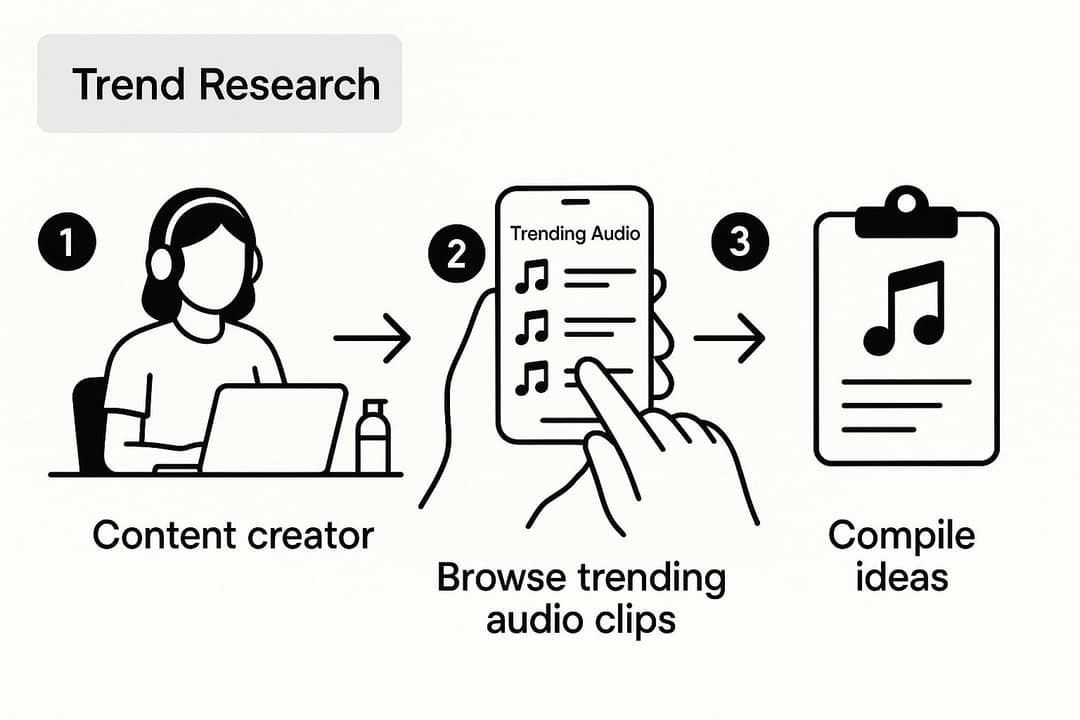
Copying a trend shot for shot gets lost in the noise. Ask one question before you film: what does this format look like when it's about my topic? The answer is your video.
Film and edit to hold attention
You don't need a studio, but you do need light and clear audio. Face a window or use a ring light, and record close to your mic or in a quiet room; muffled sound loses viewers faster than average visuals. Shoot vertical: TikTok recommends 9:16 at 1080x1920 pixels.
Structure every video in four beats: a hook, a short setup, the payoff you promised, and an ending that invites a replay or a reply.
Cut long static shots. A cooking video becomes a close-up of the knife, a quick shot of the prepped bowls, then a cut back to your reaction. Each cut resets attention.
You may not need to show your face at all. Faceless videos had a 114K median and 17.4% passed 1 million views, against 67K and 12.7% for one person on camera. The gap was widest in tutorials: faceless tutorials had a 156K median versus 52K on camera. By shooting style, POV videos led at 107K and screen recordings reached 91K, while selfie-style videos had 48K.
Add on-screen text. Many people watch with the sound off, so text overlays carry your key line, the punchline or the question you want answered. An AI caption generator adds synced captions in 100+ languages if you don't want to type them by hand.
Don't obsess over length. In the 12-month sample every length bucket had a median between 58K and 76K views, with 61 to 90 seconds slightly ahead at 70K. Videos under 15 seconds had the lowest median (58K) but the most shares: 1.41 per 100 views. Make it as long as the payoff needs.
Duets and Stitches put your video next to one people are already watching, which is a fast way into an existing conversation: Stitch a bad brand ad and explain what went wrong, for example. Treat them as reach tools, not your whole channel.
Write the caption and choose hashtags
A caption is context, not a summary. Captions of 41 to 80 characters had the best median (67K, 12.5% past 1M), while videos with no caption had 36K and 7.5%. One sentence that adds a twist or asks something specific is enough:
- Flat: "My new morning routine."
- Better: "The one morning habit I'd keep if I had to drop the rest"
- Better: "Which of these would you actually stick to?"
For hashtags, 4 tags had the best median at 77K views (13.4% past 1M), and 3 tags were close at 75K. Videos with no hashtags had 51K, and 9 or more hashtags dropped to 16K.
Posts with 3 or 4 hashtags earned the most views. Captions stuffed with 9 or more hashtags did worst of all, with median views cut by about 80%.
Source: Revid analysis of 176,367 TikToks with 1,000+ likes posted between Oct 1, 2025 and Oct 16, 2026 (61,203 creators)
Show the data
| Median views | Share that passed 1M views | |
|---|---|---|
| None | 51.1K | 9.8% |
| 1 | 64K | 11.8% |
| 2 | 71.3K | 12.7% |
| 3 | 75.4K | 13.1% |
| 4 | 77.2K | 13.4% |
| 5 | 67.3K | 12.1% |
| 6 to 8 | 71.8K | 12.7% |
| 9+ | 15.6K | 7.8% |
A simple mix: one broad tag for your topic (#healthyrecipes, #booktok) and two or three specific ones your community actually follows (#veganmealprep, #woodworkingtips). Generic tags like #fyp say nothing about who the video is for, so they are the first to cut.
When should you post on TikTok?
In Revid's data on English-language TikToks, posts at 4 a.m. US Eastern had the highest median (120K views) and the best window was 3 to 6 a.m., while 5 to 9 p.m. was the weakest and 7 p.m. had the lowest median at 50K. Saturday had the best median of the week (70K) and Sunday the highest share past 1 million (13.6%); weekdays were all within a few percent of each other.
Those early US hours are daytime in the UK, Europe, India and Asia, and creators in the sample post from everywhere, so treat this as a sign that crowded evening slots are hard, not as a universal clock. Your own audience matters more. In TikTok Studio, open Analytics: the Viewers tab shows when your viewers were most active over the last 7 days, and the Followers tab breaks follower activity down by hours and days. Post shortly before those peaks and keep the schedule consistent.
What to do in the first hours after posting
Early reactions from real viewers decide whether a video keeps getting shown, so don't post and walk away.
- Reply to comments fast. Answer every early comment, and turn the best question into a video reply; it creates your next post and pulls viewers back to the first one.
- Send warm viewers. Share the TikTok to your Instagram Stories with a short prompt, not a screenshot. People who already follow you elsewhere tend to watch longer. If you're weighing how much effort each app deserves, SQ Magazine compares the two in its TikTok vs Instagram statistics.
- Post where your community talks. A relevant Discord server, Facebook group or subreddit works if its rules allow self-promotion.
- Ask a few friends. Send the link to people who will actually watch and leave a real comment.
Prompt for a Part 2
Make a 45-second faceless POV TikTok called "Part 2: the budgeting mistakes nobody told me about" that picks up where a viral first video left off. Start with the line "You asked what happened next, so here it is", show three mistakes with quick cuts and on-screen text, and close with a question that invites viewers to request Part 3.
Turn one viral video into a series
One hit doesn't build an account. When a video takes off, open its analytics before you do anything else; TikTok's own guide to TikTok analytics explains each metric. Ignore the view count and look at the retention curve: where did people drop off, and where did they rewatch?
Then run a simple loop:
- Name what worked. The format, the hook type, the editing pace, the topic angle.
- Write a hypothesis. "The faceless POV and the outrage hook held attention better than my usual talking-head setup."
- Repeat it on purpose. Build those elements into your next three videos and compare their retention with the hit.
Treat the hit as a pilot episode. Post a Part 2 that answers what the first video left open, reply to the most common comment with a new video, and stay on the topic while the new audience is paying attention.
How to make a viral TikTok with Revid
Revid starts from videos that already performed instead of a blank prompt. To make a TikTok with the AI TikTok video generator:
- Search Revid's library of about 2.77 million short-form videos with engagement data by topic, platform, engagement tier and length, then open one that fits your niche (see how repurposing viral videos works).
- Run Deep analysis (free, up to 60 a day): an AI model breaks down the hook, the timed structure, the scroll-stopping moment and three ways to adapt it.
- Choose "Make it about your topic" or "Same energy, new script". Revid writes a new script and generates the visuals, a voice-over in 70+ languages, synced captions and music.
- Fix any scene in the timeline editor, then publish directly to TikTok or schedule it. Each published post reports its views, likes and comments back in Revid.
If a video contains realistic AI-generated images, audio or video, turn on TikTok's AI-generated content label; TikTok says the label alone does not affect distribution when the video follows its Community Guidelines.
FAQ
What is the best tool for creating viral TikTok videos quickly?
It depends on what you start with. CapCut is the fastest way to edit footage you filmed and has a generous free tier; OpusClip cuts long recordings into clips; Revid generates a finished TikTok from an idea or a proven viral format, with script, visuals, voice, captions and direct publishing (see Revid vs CapCut).
How many views count as viral on TikTok?
There is no official number. In Revid's sample of 176,367 TikToks with 1,000+ likes, the median was 64.4K views and only 11.9% passed 1 million, so a video that passes a million or several times your usual views is viral by any practical measure.
How long should a viral TikTok be?
As long as the payoff needs: in the 12-month sample every length from under 15 seconds to 10 minutes had a median between 58K and 76K views. Revid's full index (all posting dates) favored 16 to 30 seconds at about 141K, an edge that has faded for recent posts; keep in mind only videos of at least one minute earn Creator Rewards.
Can AI-generated TikToks go viral?
Yes. Revid's study of AI videos vs real footage found AI-generated TikToks averaged twice the views of real footage, though AI visuals clustered in the lowest engagement tier on X, Instagram and Threads. Label realistic AI content on TikTok as required.
Is Revid's TikTok Video Finder free?
Yes. The TikTok Video Finder is a free search of viral TikToks by topic and works without a login.