
What Is Considered Going Viral in 2026 Explained Simply
Learn what is considered going viral in 2026, from view thresholds and engagement rates across TikTok, YouTube, and Instagram to the signals that prove real
On this page
Going viral means reaching far beyond your usual audience quickly and earning engagement that substantially outperforms your normal results, not hitting one universal view count. On TikTok, roughly 1 in 120 tracked videos reached 1 million views, a reminder that even on a discovery-focused platform, that milestone is exceptional rather than routine.
The more useful question isn't whether a post crossed a magic number. It's whether your video spread faster, reached more new people, and prompted more sharing and interaction than comparable posts on your account. That relative view helps a small creator judge a breakout fairly, without treating a large publisher's ordinary performance as the standard.
A Working Definition of Going Viral
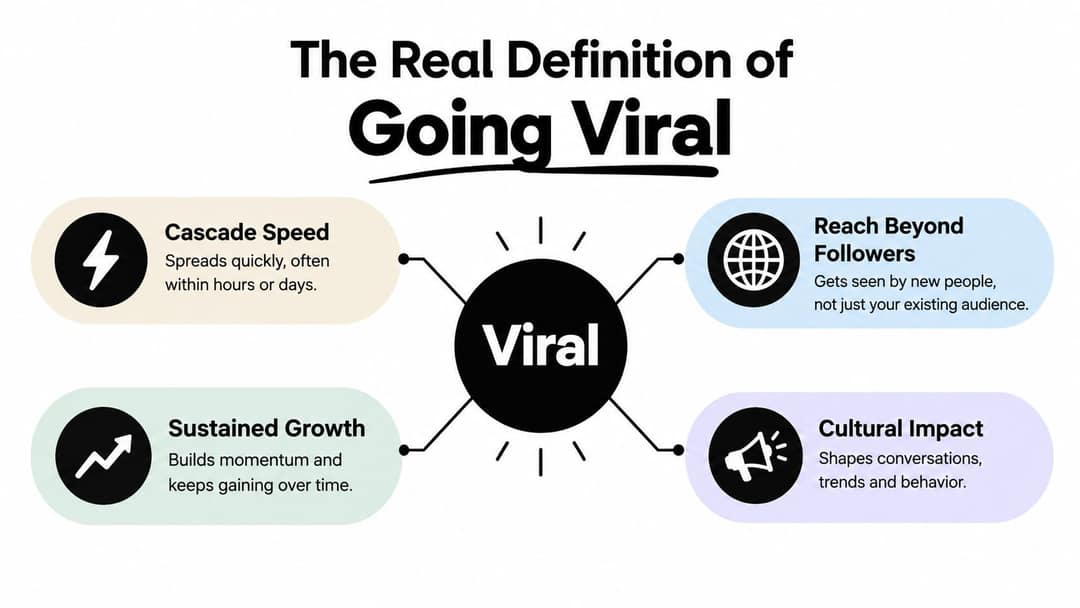
A creator's usual performance works like a measuring stick. A post reaching unfamiliar viewers, attracting unusually strong sharing, and gathering attention faster than comparable posts shows a meaningful change against that measure. The practical definition combines reach beyond your usual audience, rapid growth, and engagement above your normal baseline.
Consider two creators posting similar videos. The smaller account's video reaches people who don't follow it, and viewers share it much more often than usual. The larger account earns more total views, with sharing and engagement close to its typical results. The smaller creator has stronger evidence of a viral event. The larger creator has a successful post whose performance remains familiar.
Views are one signal among several; shares, engagement rate, and audience source help explain the scale and character of the breakout.
Judge the post against its own baseline
There's no official, platform-wide definition of “viral.” Resources such as TikTok view benchmarks offer context for raw view totals. Your account's history provides the comparison that makes those totals useful: how unusual was this result for you?
Start with comparable posts on the same platform. Compare a TikTok video with your typical TikTok videos, a YouTube upload with similar uploads, and an Instagram Reel with your usual Reels. Use similar time windows so an older post's accumulated views don't distort the comparison.
Then review views or reach, shares, comments, engagement rate, growth speed, and audience source together. Engagement rate helps you judge how actively viewers responded as reach expanded. Audience source helps establish whether attention extended beyond existing followers.
A small or mid-tier creator can recognize a meaningful breakout before reaching a widely recognized milestone. The strongest judgment comes from several signals rising together against a relevant baseline.
How Viral Content Actually Spreads
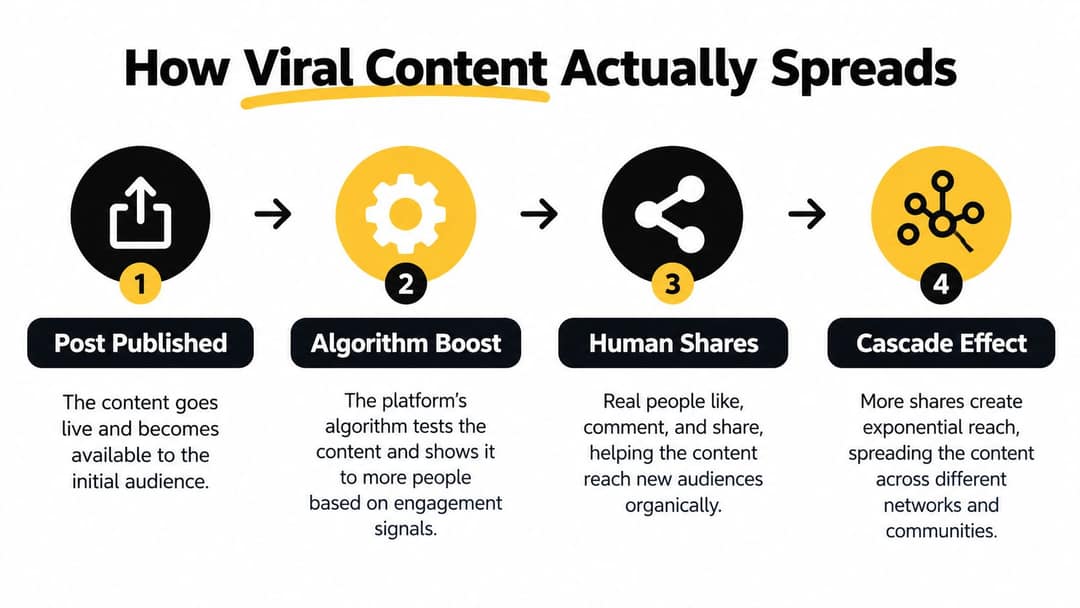
A viral post often begins with a seed audience: the people who see it early through a creator's account, a recommendation surface, or a share. If viewers respond by watching, interacting, or sharing, the platform may show it to additional people. Those viewers can then share it onward, widening the audience.
But spread doesn't usually mean an endless chain of person-to-person reshares. Research analyzing 940,290 retweets found that 83.2% were directly retweeted from seed users. The average sharing cascade had a depth of 1.23, and 79.0% of cascades reached no more than two levels (research on diffusion cascades). In plain language, many people share or encounter the original post directly, while comparatively few posts travel through long chains of repeated reshares.
Why early momentum matters
That pattern makes the first stretch after publication useful to watch. A post that quickly attracts shares and reaches viewers beyond its existing audience has evidence of distribution beyond the original seed group. A post that gathers views slowly over time may still be valuable, but it's a different pattern from a rapid viral burst.
Research on social-media diffusion identifies early signals such as reshare velocity, initial audience influence, and time to peak, alongside cascade depth, as more informative than any single view count (communication research on diffusion). These signals don't guarantee that a video will keep spreading. They help creators recognize whether its growth is accelerating while the post is still new.
The platform's recommendation system and viewers' choices both matter. Creators can't control exactly who sees a post next, but they can make the opening clear, give viewers a reason to stay, and make the idea easy to pass along. For a broader look at how distribution choices fit into a publishing plan, see SubmitMySaas channel strategies.
View Benchmarks That Matter
View counts work like distance markers: they show how far a post has travelled, but the starting point matters. TikTok, Instagram Reels, YouTube Shorts, and YouTube on-demand videos have different formats and distribution patterns. A creator's niche, audience size, geography, and paid promotion also affect what a total means.
Use these tiers as rough landmarks:
| View signal | What it can suggest |
|---|---|
| Around 100,000 views | A strong breakout for a creator whose comparable posts usually reach a much smaller audience. |
| Around 1 million views | A commonly used short-form viral milestone, rather than an official definition. |
| Multi-million views | Exceptional reach, with stronger evidence of virality when growth is fast and viewers share the post. |
The scale needs context. In the TikTok benchmark context, roughly 1 in 120 tracked videos reached a million views, and the top 0.1% began at around 8.4 million views. Those findings describe the tracked sample, not the odds for every creator.
How a post reaches its total matters too. Paid promotion and gradual accumulation can produce large counts without the rapid, audience-driven spread associated with a viral breakout.
Compare formats with care
Dash Social's cross-platform social benchmarks reported an overall average of 95,100 views per post across measured accounts, with YouTube on-demand videos averaging about 95,000 views and Shorts about 45,000 views. These sample averages help set context; they are neither viral thresholds nor promises of individual performance.
Compare like with like.
For a small or mid-tier creator, start with the usual reach of similar posts on the same account and platform. Compare a Reel with other Reels, or a YouTube on-demand upload with similar uploads. Then assess how far the new post exceeded that baseline, whether it reached non-followers, and whether growth came quickly. Shares and engagement rate help interpret that reach. Together, these signals make a breakout easier to judge than a single platform-wide target.
Engagement Rate and Early Velocity Signals
A view count tells you how many times a video was watched or counted as a view under the platform's rules. It doesn't show whether viewers cared enough to share it, comment, or keep sending it to other people. Rate-based metrics can reveal that difference, especially while a post is still gaining momentum.
Start with engagement rate:
Engagement rate = interactions ÷ views × 100
For example, if a video receives 50 interactions from 1,000 views, the calculation is 50 ÷ 1,000 × 100, or a 5% engagement rate. That arithmetic example is only a way to use the formula, not a benchmark for what counts as good. Compare the result with similar posts on the same account and platform.
Use a quick analytics check
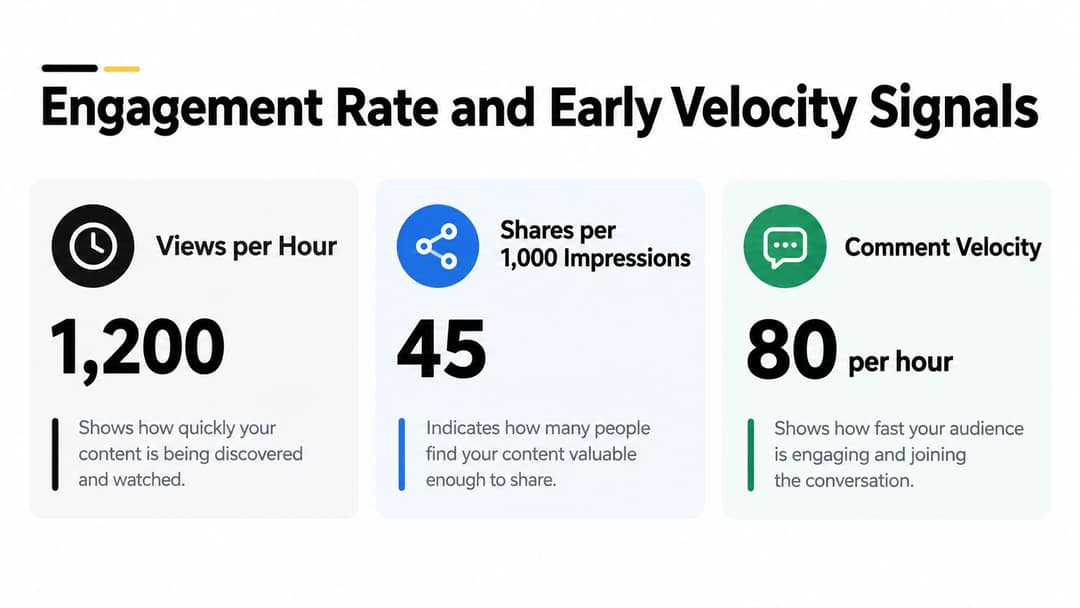
Look at how quickly views, shares, and comments are arriving rather than checking only the total. These comparisons make early performance easier to interpret:
- Views per hour: Compare the current pace with the post's earlier pace and with comparable uploads. Accelerating views can signal expanding distribution.
- Shares per thousand impressions: Divide shares by impressions, then multiply by 1,000. This helps compare sharing when posts have different exposure.
- Comment velocity: Check whether comments are continuing to arrive, not just whether a total has accumulated.
- Non-follower reach: Look at the proportion of views or reach from people who don't follow the account. It's a useful sign that the post has moved beyond its existing audience.
No one figure proves that a post is viral. A strong completion rate or a large number of likes may be encouraging, but a combination of rapid growth, sharing, and new-audience reach gives a more informative read. A creator can also compare each video's first-hour and first-day results with the account's rolling median to identify unusual acceleration.
For a deeper guide to measuring responses to video content, use this overview of video engagement metrics. The key habit is to compare like with like: the same account, similar formats, and comparable points in a post's lifetime.
What Makes Content Worth Sharing
People share videos when passing them along feels worthwhile. That value can come from emotion, recognition, novelty, timing, or a clear idea they want someone else to see. A creator can't force a viewer to share, but can shape the video so its point is easy to grasp and its payoff feels relevant.

Give viewers a reason to pass it on
Emotion can make a moment memorable. Research examining viral posts across TikTok, Instagram, and YouTube associated high-arousal emotions, including awe and anger, with stronger engagement, while nostalgia encouraged more enduring interaction and repetition (research on emotion and viral posts). That doesn't mean a creator should manufacture outrage. It means that a video with a clear emotional response may be easier for viewers to remember and discuss.
Relatability gives viewers a reason to tag someone or send a clip privately. A familiar situation, workplace frustration, or small social awkwardness can make someone think, “That's exactly what my friend does.” Specific details often make the moment feel more recognizable than a broad, generic claim.
Novelty offers a fresh way to look at something people already know. A familiar subject can become shareable when the framing is unexpected, useful, or funny. The opening should make the premise clear without explaining away the payoff.
Timeliness can connect a post to a conversation people are already having. A trend or current topic may give viewers an immediate reason to pay attention, but the video still needs a distinct point. Copying a format without adding a recognizable perspective can make the post feel interchangeable.
Clarity helps viewers understand what they're watching and why it matters. A focused hook, tight editing, and a satisfying ending make the core idea easier to follow. When a viewer can describe the video in simple terms, they can also pass that idea on more easily.
Prompt to try
Create a 30-second vertical video about the three things every coworker does in a Monday morning meeting. Open with the hook "Tag the person who always does number two." Use relatable office b-roll, a dry, funny voiceover and bold captions, and end on a quick punchline viewers want to send to a friend.
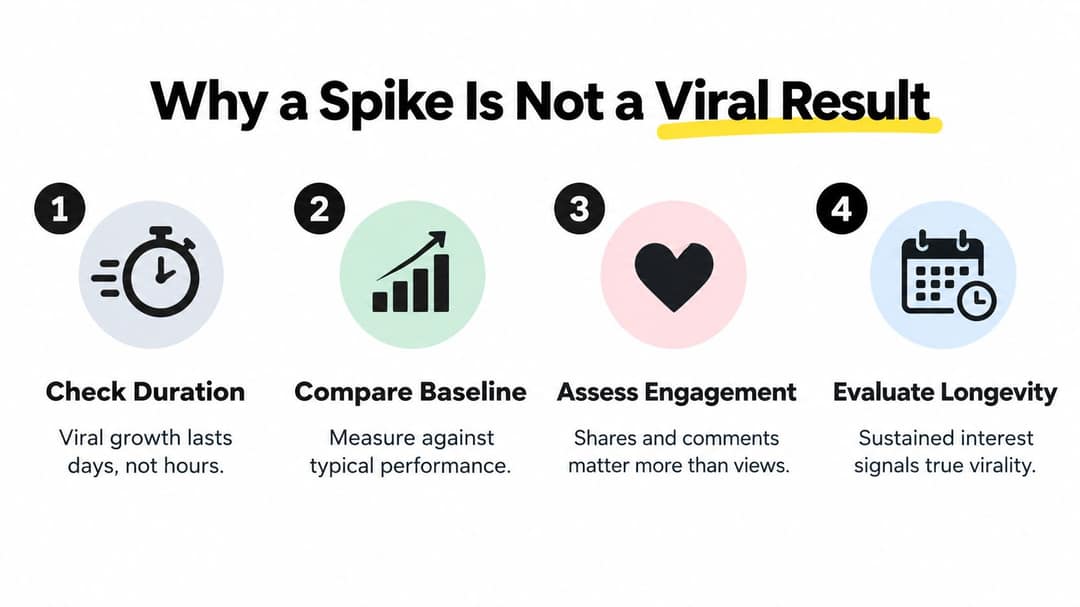
Why a Spike Is Not the Same as a Viral Result
A sudden jump in views can be exciting, but a spike alone doesn't tell you whether the video helped build an audience. Research analyzing Facebook and YouTube content from more than 1,000 European news outlets between 2018 and 2023 found that most viral events didn't significantly increase sustained engagement. Faster spikes tended to fade sooner, while slower diffusion processes were associated with more persistent growth (analysis of viral events and sustained engagement).
For creators, the lesson is to look beyond the post's peak. Did viewers visit the profile, follow the account, return to watch more, or respond to the next video? Those outcomes help distinguish a temporary recommendation burst from attention that carries forward.
Run a post-breakout review
After a standout post, compare what happened around its peak with the account's performance in the following week. The point isn't to expect a fixed outcome, but to see whether the post's reach translated into a meaningful next step.
- Check profile activity: Did more viewers visit the account after seeing the video?
- Review follower changes: Did the post bring in new followers, or did the audience count remain largely unchanged?
- Watch the next upload: Did the following video reach or engage more people than comparable posts?
- Look for returning viewers: Did people who discovered the breakout come back for other content?
A spike with no movement in later viewing or audience participation may have been a one-off distribution event. Continued sharing, return visits, and interest in later posts suggest that the content connected with more than a passing recommendation. For businesses, that distinction also matters when designing ways for satisfied customers to share their experience; this guide to turn customers into marketers offers one perspective on encouraging advocacy beyond a single moment of attention.
Common Myths and a Practical Viral Checklist
Several common shortcuts make it harder to judge a post accurately. There isn't one universal view threshold: the same total can mean a major breakout for one account and a routine result for another. Paid reach isn't the same as organic sharing: paid distribution can generate views, but it doesn't by itself show that viewers chose to spread the video. And a slow build to a high lifetime total differs from a fast viral moment, because the speed and source of growth matter.
Short-form video also doesn't go viral automatically. TikTok, Reels, and Shorts can introduce content to new audiences, but creators still need a video that holds attention and gives people a reason to engage or share. Compare posts within the same account and format before drawing conclusions from platform-wide numbers.
Use this checklist when a post starts outperforming expectations:
- Baseline-relative reach: Did it clearly exceed similar posts on your account?
- Early velocity: Did views, shares, or comments accelerate soon after publication?
- Audience expansion: Did a substantial share of the reach come from non-followers?
- Active engagement: Did viewers share, comment, or otherwise participate, not just watch?
- Downstream interest: Did the post lead to profile activity, new followers, returning viewers, or stronger interest in later content?
If the answer is yes across several signals, you have a stronger case for calling the post viral than a raw view total can provide. Keep the result in context, record what worked, and use it to guide the next video rather than treating one spike as a repeatable formula.
Revid.ai helps creators turn ideas and existing content into videos for TikTok, Instagram, and YouTube, with tools for finding trends, generating scripts, and editing clips. If you're testing concepts designed to earn attention and shares, visit revid.ai to explore the platform.