What Is Engagement Rate? Formulas, Benchmarks and Good vs Bad
Engagement rate is engagements divided by reach, views or followers, times 100. Here are the formulas, worked examples, 2026 benchmarks and how to tell a good rate from a bad one.

On this page
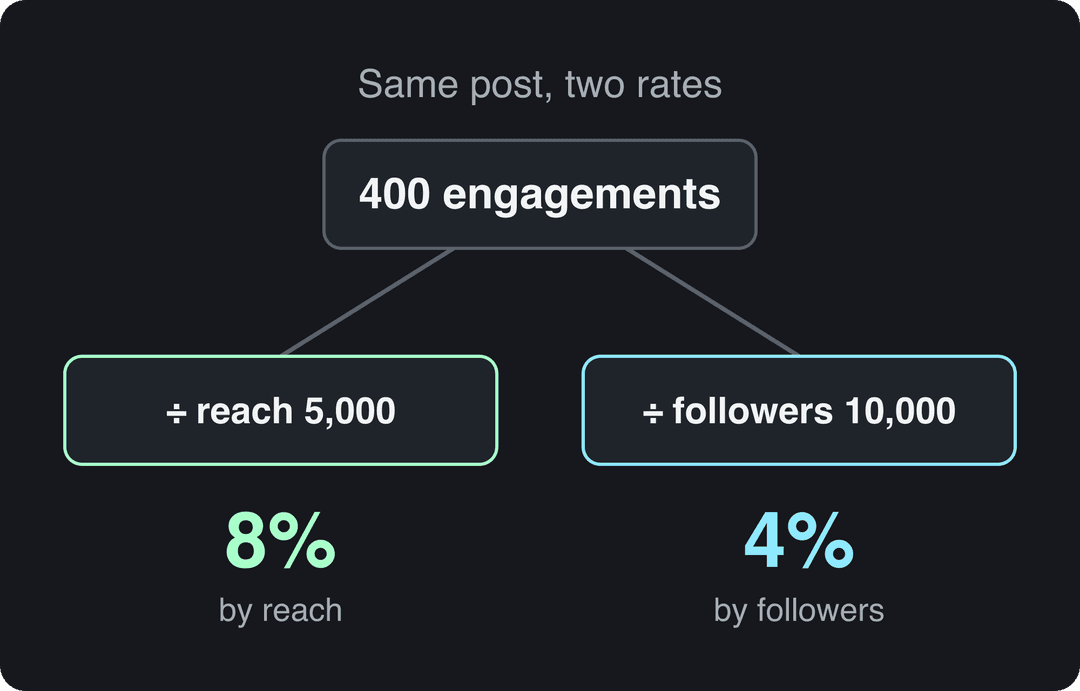
Engagement rate is the percentage of people who interact with your content: total engagements (likes, comments, shares and saves) divided by reach, impressions, views or followers, multiplied by 100. A post with 400 engagements seen by 5,000 people has an 8% engagement rate by reach.
The catch is the denominator. On an account with 10,000 followers, that same post has a 4% engagement rate by followers. Most "is my engagement rate bad?" worry comes from comparing a rate calculated one way with a benchmark calculated another way, so pick one formula first and stick to it.
What does engagement rate mean?
Engagement rate measures how strongly an audience responds, not how big it is. Engagement is the raw count (400 likes, comments and shares). Engagement rate divides that count by how many people could have reacted, which lets you compare a small post with a big one, or your account with a competitor's.
It sits next to reach metrics, not in place of them. Followers, impressions and views tell you how many people a post got in front of; engagement rate tells you what share of them cared enough to tap, type or send it on. For the full family of metrics, see our guide to content performance metrics, and for an overview of engagement across every network, read what social media engagement is.
What does engagement rate mean on Instagram?
On Instagram, engagement rate usually means interactions on a post or reel (likes, comments, shares and saves) divided by either your followers or the accounts that saw it. Instagram's insights now lead with Views (the times content was played or displayed) and show Viewers (unique accounts) separately; Viewers is the closest figure to reach. This Instagram engagement rate guide from Reach Influencers walks through Instagram-specific examples.
What counts as total engagements?
Total engagements is the sum of every interaction you choose to count on a post. Decide once, write it down and keep it constant: adding saves one month and dropping them the next makes your trend line meaningless.
| Interaction | Count it? | Why |
|---|---|---|
| Likes and reactions | Yes | The lightest signal, but available everywhere |
| Comments | Yes | Takes effort and shows the post started a conversation |
| Shares and sends | Yes | The strongest signal: viewers pass it to people they know |
| Saves and favorites | Yes, where shown | Means "I'll come back to this" |
| Link clicks, profile visits | Optional | Useful for business goals, but private, so you can't compare competitors |
| Views and impressions | No | These are the denominator, not engagement |
How is engagement rate calculated?
Every version of the engagement rate formula has the same shape:
Engagement rate = (total engagements ÷ denominator) × 100
What changes is the denominator, and each one answers a different question.
| Formula | Calculation | Use it when |
|---|---|---|
| By reach (ERR) | Engagements ÷ reach × 100 | You want the fairest read on post quality, using unique people who saw it |
| By impressions | Engagements ÷ impressions × 100 | You run ads or posts people see more than once |
| By views | Engagements ÷ views × 100 | Short-form video (TikTok, Reels, Shorts), where views are the public number |
| By followers (ER per post) | Engagements ÷ followers × 100 | You only have public data, for example when comparing creators or competitors |
| Daily | Engagements in a day ÷ followers × 100 | You track account-wide activity rather than single posts |
Engagement rate by reach
This is the most honest measure of a single post, because not every follower sees every post. Example: a video reaches 5,000 unique people and gets 400 engagements. (400 ÷ 5,000) × 100 = 8%. The limit is that reach is private, so you can only calculate it for your own accounts.
Engagement rate by followers
Same 400 engagements, on an account with 10,000 followers: (400 ÷ 10,000) × 100 = 4%. It's the only formula you can run on someone else's account with public numbers, which is why brands use it to vet creators. Its weakness: it ignores non-followers, so a post that spreads widely looks inflated and a post the platform barely showed looks weak.
Engagement rate by impressions or views
Impressions count every display, including repeats by the same person, so engagement rate by impressions is never higher than engagement rate by reach. On short-form video, views play the same role.
One 2026 change matters here. Since August 24, 2026, YouTube counts a view the moment a video starts to play across Shorts, long-form and live (Shorts already worked this way from March 31, 2025). More views in the denominator means a YouTube engagement rate by views can look lower than older benchmarks calculated on the previous count. YouTube still uses engaged views and engaged watch hours for Partner Program earnings.
Like rate, comment rate and interaction rate
Breaking engagement into single actions tells you more than the combined number:
- Like rate = likes ÷ views × 100. The quickest read on whether people enjoyed it.
- Comment rate = comments ÷ views × 100. Shows whether the post gave people something to say.
- Share rate = shares ÷ views × 100. The best predictor of a post traveling beyond your audience.
- Interaction rate is a name some analytics tools use for engagement rate, usually interactions ÷ followers or ÷ impressions. Check your tool's definition before comparing.
In Revid's analysis of 176,367 TikToks with 1,000+ likes posted between October 2025 and October 2026, viewers liked 7.1% of views, shared 0.88% and commented on 0.08%. The sample only includes videos that already cleared 1,000 likes, so treat these as the rates of videos that did reasonably well, not a platform average. The gap is the useful part: comments are roughly a hundred times rarer than likes, so a post whose comment rate clearly beats 0.08% started a real conversation. The full method is in our study of what makes a TikTok go viral, and more sourced numbers are on our short-form video statistics page.
What is a good engagement rate?
A good engagement rate is one above the average for the same platform, the same formula and accounts of similar size, and above your own recent median. There is no universal number, because platforms differ by an order of magnitude.
Socialinsider's 2026 study of 69 million short-form videos gives a clean comparison, since it uses one formula (engagement rate by followers) across platforms:
| Platform | Average engagement rate by followers | Average comments per video |
|---|---|---|
| TikTok | 2.60% | 50 |
| Instagram Reels | 0.45% | 20 |
| YouTube Shorts | 0.30% | 10 |
The same study found that for accounts under 5,000 followers, YouTube Shorts averaged 15,160 views per video against 625 on Reels and 350 on TikTok. So Shorts can bring the most views and the lowest engagement rate at once: another reason to read rate and reach together. More sourced Shorts figures are on our YouTube Shorts statistics page.
Averages also drift down as feeds get more crowded. One edition of the Rival IQ social media industry benchmark report, covering over 4 million posts, found year-over-year engagement drops of 36% on Facebook, 16% on Instagram, 34% on TikTok and 48% on X. If your rate held steady through a year like that, you gained ground.
Use these rules to judge a number:
- Above the platform average for your formula: the post works. Make more in the same format.
- Below average by followers but steady by reach: the content is fine and fewer people saw it. Work on hooks and posting consistency, not on the topic.
- Falling by both followers and reach: the content stopped landing. Test a new format or angle.
- Rising rate on falling views: your core fans love it, but it isn't reaching new people. Aim for more shareable posts.
Why does engagement rate fall as you gain followers?
Engagement rate by followers tends to shrink as an account grows, even when total likes rise. Each post is shown to a smaller share of a large following, and a big audience includes more people who followed once and drifted. Compare yourself with accounts in your own size band, not with a niche account a tenth of your size.
What is a bad engagement rate?
A bad engagement rate is one that sits clearly below your own median for several posts in a row, or below the platform average for the formula you use. One weak post is noise; a run of them is a signal.
| Symptom | Likely cause | What to do |
|---|---|---|
| Low rate across several posts | Hook or topic no longer lands | Rework the first seconds; test a format that did well before |
| Likes fine, comments near zero | Nothing to respond to | End with a specific question or a choice |
| Rate high, reach tiny | Only loyal fans see it | Make posts people want to send to a friend |
| Sudden spike from unknown accounts | Bought or bot engagement | Ignore it in your averages; it distorts every benchmark |
Why is engagement rate important?
Engagement rate matters for three practical reasons. Recommendation systems on Instagram, TikTok and Facebook use interactions among their signals, so posts people engage with tend to get shown to more people. Brands and agencies check engagement rate by followers before they pay a creator, because follower counts alone can be inflated. And it is the fastest feedback you get on what to make next: the posts with the highest rates are the formats to repeat.
User engagement rate and customer engagement rate
Outside social media, "engagement rate" means something else. In Google Analytics 4, engagement rate is the share of website or app sessions that count as engaged sessions; check Google's Analytics Help for the current definition of an engaged session. This user engagement rate measures whether visitors stick around on your site, and it can't be compared with a social engagement rate.
Customer engagement rate is a business metric with no fixed formula: usually the share of your customers who interacted with your brand (opened an email, replied, posted, bought again) in a given period. Define it for your own business and keep the definition stable.
Related metrics: audience growth rate and engagement velocity
| Metric | Formula | What it tells you |
|---|---|---|
| Audience growth rate | New followers in a period ÷ followers at the start × 100 | Whether your reach is compounding |
| Engagement velocity | Engagements in the first hours after posting | How fast a post takes off, an early read on whether it will spread |
| Total engagements | Likes + comments + shares + saves | Raw volume, useful for comparing your own posts of similar reach |
How to measure engagement rate on TikTok, Instagram and YouTube
You don't need a paid tool to start; each platform shows the numbers you need.
- TikTok: open your profile, then the menu, then TikTok Studio, Analytics and View all (also on Studio Web). Pick a 7, 28, 60 or 365-day range or a custom one, then note views, likes, comments, shares and favorites per post.
- Instagram: open insights on a post or reel and note Views, Viewers and interactions. Follower insights need at least 100 followers and cover up to the past 90 days.
- YouTube: in YouTube Studio, open a video's analytics and note views, likes, comments and shares.
- Put the numbers into one formula, in a spreadsheet or an engagement rate calculator.
- Track the median of your last posts, not single outliers, and compare each new post with it.
Prompt to try
Make a 20-second vertical video for home cooks titled 'Which one are you: A or B?' Open with the hook 'Most people pick the wrong one,' compare two ways to cook pasta with quick close-up visuals and bold captions, and end by asking viewers to comment A or B.
How to raise your engagement rate
Posting more often won't fix a low rate; giving people a reason to react will.
- Win the first seconds. Viewers who scroll past can't engage. Borrow structures from these TikTok hooks.
- Ask a question people can answer in a word. "Which design do you prefer, A or B?" or "Tell us your best road trip memory" beats "comment below".
- Make it worth sending. Shares are the signal that carries a post beyond your followers.
- Reply to early comments. Replies add to the comment count and give the next viewer a thread to join.
Shorter isn't always better for views, but it does help sharing. In Revid's 12-month TikTok study, every length bucket from under 15 seconds to 10 minutes landed between 58K and 76K median views, yet videos under 15 seconds drew the most shares per view (1.41 per 100).
Length alone barely moves views: every bucket lands between 58K and 76K median views (the 790 videos over 10 minutes are a small, unusual group). Clips under 15 seconds get shared the most per view.
Source: Revid analysis of 176,367 TikToks with 1,000+ likes posted between Oct 1, 2025 and Oct 16, 2026 (61,203 creators)
Show the data
| Median views | Share that passed 1M views | Shares per 100 views | |
|---|---|---|---|
| Under 15 s | 57.6K | 11.6% | 1 |
| 16 to 30 s | 64.9K | 12.3% | 1 |
| 31 to 60 s | 61.8K | 11.8% | 1 |
| 61 to 90 s | 70.5K | 12.2% | 1 |
| 91 s to 3 min | 63.4K | 11.1% | 1 |
| 3 to 10 min | 76.4K | 12.4% | 1 |
| 10 min+ | 129.6K | 13.8% | 0 |
For broader tactics (formats, posting rhythm, community posts), these social media marketing strategies for businesses from Rebus Advertising are a useful companion.
Track and repeat what works with Revid
Every post you publish to TikTok, Instagram or YouTube through Revid's publishing and scheduling reports its views, likes and comments in one place, so you can work out like rate and comment rate per video without exporting anything. When a post beats your median, you can remix it in one click into a new video with the same hook and pacing. To see which of your existing TikToks over-perform before you start, run a free TikTok account audit.
FAQ
What is the difference between engagement and engagement rate?
Engagement is the raw number of interactions on a post. Engagement rate divides that number by reach, views or followers and turns it into a percentage, so posts and accounts of different sizes can be compared.
Can engagement rate be higher than 100%?
Yes, when you calculate it by followers. If a post spreads to many non-followers, its engagements can exceed your follower count; by reach or views it almost never happens.
Do views count as engagement?
No. Views, impressions and reach are the denominator of the formula; engagements are the actions people take after seeing the post, such as likes, comments, shares and saves.
How often should you check your engagement rate?
Check each post a few days after publishing, once most of its views are in, and review a monthly average. A 28-day range in TikTok Studio works well for the monthly view.
Is a high engagement rate with low views a good sign?
It means the content works for the people who see it, but distribution is the bottleneck. Focus on stronger hooks and more shareable posts so the platform shows it to more people.