On this page
To turn text into a YouTube video with AI, paste a script, article or link into a text-to-video tool. It splits the text into scenes, generates visuals and an AI voiceover, adds captions and music, and exports the video. Vertical or square videos up to 3 minutes count as YouTube Shorts.
Most text-to-video output is faceless by default, and that is not a handicap. In Revid's analysis of 176,367 TikToks with 1,000+ likes posted between October 2025 and October 2026, faceless videos had a median of 114K views against 67K for one person on camera. That is TikTok data, and only for videos that had already cleared 1,000 likes. The real risk on YouTube is different: a video that only reads out text you did not write counts as reused content and cannot be monetized.
How do you turn text into a YouTube video with AI?
- Start from text you own. Use your blog post, newsletter, product page or a script you wrote. If you start from someone else's article, use it as research and write your own take.
- Rewrite it for the ear. Cut the intro, the headings and anything that only works on a page. Open with the result or the surprise, then keep one idea per sentence.
- Pick the format before you generate. Choose a vertical Short for one tip or one story, or a 16:9 video for a full tutorial (details in the table below).
- Generate scenes, voice and captions. Choose a voice that fits your niche and a visual style (stock footage, AI images or AI video).
- Fix the weak scenes. Replace generic shots that do not match the line, correct mispronounced names, and trim pauses.
- Upload with search in mind. Write a specific title, a real description and a thumbnail, as covered in the last section.
Should your text become a Short or a long-form video?
Decide by how many ideas the text holds. If your article makes one point, make a Short. If it teaches a process step by step, make a long-form video and cut a few Shorts from its strongest moments.
| YouTube Short | Long-form video | |
|---|---|---|
| Shape | Vertical or square | 16:9 landscape |
| Length | Up to 3 minutes | Up to 15 minutes by default, longer once your account is verified |
| Best source text | One tip, one fact, one story | A full guide, tutorial or explainer |
| Custom thumbnail | Verified accounts, YouTube Studio on a computer, 2160x3840 recommended | Verified accounts, 3840x2160 recommended, at least 640 px wide |
| Music | Most Shorts Audio Library songs usable for up to 90 seconds | Your own licensed or royalty-free tracks |
Shorts now carry much of YouTube's viewing. Tubular Labs data published in January 2026 found that 77% of global YouTube views in 2025 came from videos under a minute long, and YouTube said in August 2026 that it sees over 200 billion daily Shorts views (both listed in our YouTube Shorts statistics). For most text you already have, that makes the Short the first format to try.
One rule to remember: a Short longer than one minute with an active Content ID claim is blocked globally and cannot be monetized. Only use music you have the rights to.
The best text to YouTube video AI tools in 2026
These five tools all turn text into video, but they produce very different results. The list is grouped by use case, not ranked. Prices are entry list prices checked in August and September 2026, so confirm them on each site before you buy.
| Tool | Best for | Visuals | From | Free option |
|---|---|---|---|---|
| Revid | Shorts from a script, article or link, published to YouTube | Stock, AI images, AI video (Seedance 2.5, MiniMax Hailuo H3, Wan 3.0, Google Veo 3) | $39/month | Free sign-up with free credits to try it; regular creation uses paid-plan credits |
| InVideo | Editing by typing commands to a chat agent | 16M+ stock library plus third-party models | $20/month per seat | Free plan with watermark |
| Pictory | Turning blog posts and webinars into videos at volume | 12M+ licensed stock (Getty Images, Storyblocks) | $29/month | Free trial |
| Fliki | Voice-led videos | Stock-based scenes, 2,000+ voices in 80+ languages | $28/month | Free plan: watermark, 720p, 1-minute max |
| Synthesia | Presenter-led explainers and training | AI avatars, 140+ languages | $29/month | Up to 10 minutes a month, 9 stock avatars |
Revid: best for Shorts you publish straight to YouTube
Revid is an AI video platform that turns an idea, a link or a proven viral format into finished short-form videos and publishes them to TikTok, Instagram and YouTube. From your text it writes the script and builds scene-by-scene visuals: stock footage, AI images or AI video, with the model chosen per scene. It then adds a voiceover (1,000+ AI voices in 70+ languages), synced captions in 30 styles and music, and gives you a timeline editor to fix any scene.
The difference is where a video can start. Instead of a blank prompt, you can pick a short-form video that already performed from Revid's library of about 2.77 million videos with engagement data, and Revid writes an original version on your topic with the same hook style and pacing. Output is vertical-first, so Revid fits Shorts best. For a long-form channel edited shot by shot, a classic editor fits better.
To turn text into a YouTube Short with Revid:
- Open Revid's text to video AI and paste your script, or paste a blog URL into the article to video converter.
- Choose the voice, the caption style and the visual style for your scenes.
- Review the generated script and scenes, then swap any shot in the timeline editor.
- Export in 720p, 1080p or 4K at 30 or 60 fps, or publish and schedule it to YouTube from the same queue.
As a guide, a 30-second video with Pro AI visuals and a voiceover costs about 40 to 80 credits, and the Growth plan includes 2,000 credits a month. To keep a channel posting without a daily session, the AI YouTube Shorts generator pairs with Auto-Mode workers that create a fresh video every day from a prompt or a content source.
InVideo: best if you prefer typing edits to using a timeline
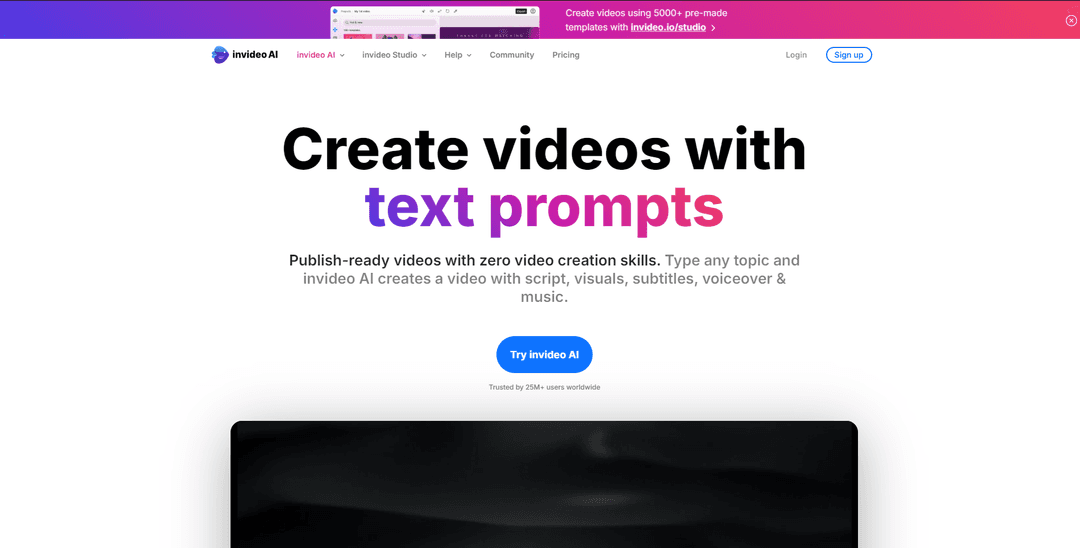
InVideo centers on a chat-style AI agent. You describe the video, then change it by typing commands instead of dragging clips on a timeline. It draws on a 16M+ stock library (with metered iStock assets on paid plans) and a menu of third-party models such as Veo 3.1, and it bundles AI avatars and voice clones from the entry tier. Pick it if you want to direct by conversation. Pick Revid if you want a real timeline editor and direct publishing (Revid vs InVideo).
Pictory: best for repurposing blog posts and webinars
Pictory turns blog posts, scripts and URLs into videos at volume and auto-clips highlights from Zoom, Teams and webinar recordings. Its scenes come from a licensed stock library from Getty Images and Storyblocks, with ElevenLabs voices on premium plans and a gentle scene-based editor. The result has a stock-footage look. If you want AI-generated scenes and vertical output tuned for Shorts, compare the two in Revid vs Pictory.
Fliki: best when the voice matters most
Fliki has the largest voice library in this group (2,000+ voices in 80+ languages), with emotional delivery such as laughing or deadpan. It suits narration-heavy formats like explainers, quotes and listicles, where the voice carries the video. Its visuals are stock-based scenes, so pick it for voice, not for generated footage (Revid vs Fliki).
Synthesia: best for a presenter on screen
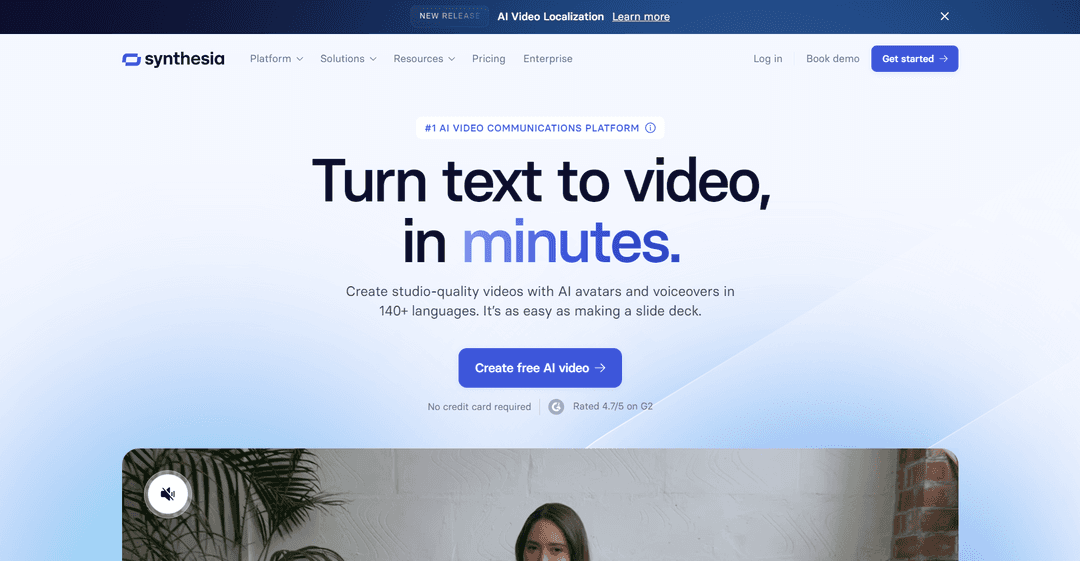
Synthesia turns a script into a video read by an AI avatar presenter, in 140+ languages, with a slide-based workflow. It is built for corporate training and internal communications, which also makes it a fit for structured tutorials. For entertainment-style Shorts with generated scenes, it is the wrong tool (Revid vs Synthesia).
How should you write a script for an AI YouTube video?
Write less than you think. In Revid's TikTok study, videos with under 40 characters of speech had a median of 123K views, and 20.2% passed 1 million. Videos that talked throughout (300+ characters of speech) had a 68K median, with 11.9% past 1 million, and silent videos sat at 73K and 14.3%. The data covers TikToks with 1,000+ likes and shows what top videos have in common, not causes. Still, it points one way: a pasted blog post read word for word is the opposite of what performs (full study).
Videos with just a few spoken words (a line or two) beat both silent videos and videos that talk the whole way through, which were the most common and the weakest.
Source: Revid analysis of 176,367 TikToks analyzed by AI, with 1,000+ likes posted between Oct 1, 2025 and Oct 16, 2026 (61,203 creators)
Show the data
| Median views | Share that passed 1M views | |
|---|---|---|
| No speech | 73.3K | 14.3% |
| Under 40 | 122.7K | 20.2% |
| 40 to 120 | 97.2K | 17.6% |
| 120 to 300 | 91.6K | 16.8% |
| 300+ | 67.7K | 11.9% |
Use this structure for a Short built from an article:
- Line 1 (hook): the result, the surprise or the mistake. "Your café throws away food every night. Here is the cheapest fix."
- Middle lines: one step or one fact per scene, each short enough to read as a caption.
- Last line: one next step, such as following for part two or trying the method.
Compare that with a typical blog opening: "In this post, we will look at several ways small cafés can reduce food waste." It takes several seconds to say nothing. Cut it, and let the visuals show what the words used to describe.
Prompt to try
Make a 30-second vertical YouTube Short for small café owners. Open with the hook "Your café throws away food every night. Here is the cheapest fix." Then give three short scenes with one tip each, shown in warm stock footage with bold captions. End with "Follow for part two."
Can you monetize AI text-to-video content on YouTube?
Yes, if the final video shows your creative vision and gives viewers educational or entertainment value. YouTube explicitly allows AI for tasks like editing scripts or creating background visuals. On July 15, 2025, it renamed its "repetitious content" policy to "inauthentic content" to make clear that it covers repetitive or mass-produced videos.
These are not allowed to monetize:
- AI videos made from generic templates that look mass-produced, without your own insight.
- Videos that stitch together unrelated AI clips to shock, or use realistic visuals to fake events.
- AI personas presented as human experts giving health, legal, financial or political advice.
- Videos that only read out material you did not write, such as website text or news feeds.
To earn ad revenue at all, you need to be in the YouTube Partner Program. Today that takes 1,000 subscribers plus either 4,000 qualified public watch hours in the last 12 months or 10 million qualified Shorts views in the last 90 days. From February 1, 2027, new applicants will need 8,000 qualified watch hours in 365 days or 20 million qualified Shorts views in 90 days. From the same date, earning Shorts revenue in a given month will require 10 million qualified Shorts views in the last 90 days.
Do you have to label AI-generated videos on YouTube?
Only when the content is realistic. Use the "AI use" setting in YouTube Studio if your video makes a real person appear to say or do something, or shows a realistic scene that did not happen. You do not need to disclose AI-written scripts, titles, thumbnails, captions or a clone of your own voice used for voiceovers.
Disclosure does not by itself limit a video's audience or its eligibility to earn. Since May 2026, YouTube automatically labels undisclosed videos with significant photorealistic AI, and labels are permanent for content made with Veo or carrying fully generative C2PA metadata. Disclosing it yourself is the safer habit.
How do you get an AI-made video found on YouTube?
The tool makes the video; the upload decides whether anyone finds it.
- Title: up to 100 characters. Put the phrase people search first, then the promise. The free YouTube title generator gives you variants to choose from.
- Description: up to 5,000 characters. Your source article is a head start: summarize it in the first two lines and link back to it.
- Tags: 500 characters in total, not per tag. Add misspellings and close variants, not your whole keyword list.
- Captions: burned-in captions help silent viewers; uploading a caption file also gives YouTube a transcript to read.
- Thumbnail: for long-form, 3840x2160 is recommended (files up to 50 MB on desktop, 2 MB on mobile). For vertical videos, YouTube replaces a 16:9 thumbnail with an auto-generated 4:5 one on the home, explore and subscription pages.
- Testing: YouTube Studio on desktop can A/B test up to 3 titles and thumbnails on long-form videos. Shorts are not eligible.
FAQ
Is there a free AI that turns text into a YouTube video?
Partly. Fliki and InVideo have free plans with a watermark, and Synthesia's free plan covers up to 10 minutes of video a month with 9 stock avatars. Revid sign-up is free with no credit card, and new accounts get free credits to try video creation. Regular creation then uses the credits of a paid plan from $39/month.
Can I turn someone else's article into a YouTube video?
Not if you want to earn from it. YouTube counts videos that only read out material you did not write as reused content, so use the article as research and write your own script.
How long can an AI-made YouTube Short be?
Up to 3 minutes, as long as the video is vertical or square. Anything longer, or in landscape, is published as a regular YouTube video.
Will YouTube flag my video for using an AI voice?
Not on its own. An AI voiceover only needs disclosure if it makes a real person appear to say something; cloning your own voice is exempt, and disclosure alone does not reduce reach or earnings.
Do I need a verified YouTube account?
You need one for custom thumbnails (including Shorts thumbnails) and for uploads longer than 15 minutes. Standard uploads up to 15 minutes do not require it.