How to Make Funny Videos: 7 Steps, Script Template and Data
A practical guide to making funny videos: how to find ideas, write a joke for a short video, film on a phone and edit for timing, with Revid data on which comedy formats get the most views.

On this page
To make a funny video, pick one relatable situation, write it as a setup with a twist, open on the funniest visual, film it on your phone with clean audio, and cut every pause that isn't part of the joke. Keep one joke per video, add captions, and post where that style of humor already performs.
Comedy is worth learning because it pays off in views. In Revid's analysis of 176,367 TikToks with 1,000+ likes posted between October 2025 and October 2026, comedy videos had a 155K median and 22% passed 1 million views, more than double the 62K median of tutorials. The most common mistake is assuming you have to perform: faceless comedy did even better, at a 327K median against 136K for comedy with a person on camera.
- Median views of comedy TikToks, vs 62K for tutorials
- 155K
- Revid analysis of 176,367 TikToks
- Share of comedy TikToks that passed 1 million views
- 22%
- Revid analysis of 176,367 TikToks
- Median views of faceless comedy, vs 136K for on-camera comedy
- 327K
- Revid analysis of 176,367 TikToks
- Marketers who say funny content yields the highest ROI in short-form video
- 48%
- HubSpot, September 2026
How to make a funny video in 7 steps
- Pick one situation your audience lives through. A boss who replies "quick question" at 6 p.m., a cat that ignores a new toy, a recipe that looks nothing like the photo. Specific beats general every time.
- Choose a format. POV skit, reaction, sketch, text-on-screen joke, animated or faceless story. The format decides whether you need to be on camera.
- Write the joke as setup, escalation, punchline and button. One premise, two or three escalations, one twist, one small extra laugh at the end.
- Open on the strongest visual or line. The first frame has to make someone stop scrolling, so cut the greeting and the context.
- Film simply. A phone on a tripod, light from a window, a clip-on mic. Shoot several takes of the punchline.
- Edit for timing. Cut breaths and dead air, keep the one pause before the punchline, add captions and at most one or two sound effects.
- Post, then read the numbers. Shares and the retention graph tell you which jokes landed. Make more of those.
The sections below cover each step in detail.
Prompt to try
A 30-second funny nature-documentary short about a golden retriever who refuses to walk past the vet's office. Open on the dog planted on the sidewalk with the hook "Here we observe the rarest behavior in the wild." Use a calm, over-serious documentary narrator, slow zooms on the dog's face and end on the dog sprinting happily the opposite way.
How do you come up with funny content ideas?
Funny ideas come from friction: the gap between what people expect and what happens. Keep a running note on your phone and add anything that made you laugh, annoyed you, or made you say "why is it always like this."
Templates that reliably produce ideas:
- "[Role] when [situation]": "Teachers when the projector works on the first try."
- Expectation vs reality: the product photo vs what arrived, the plan for Saturday vs Saturday.
- "Things nobody says about [X]": the unspoken rules of your job, hobby or city.
- Explaining something simple to the wrong audience: "Me explaining Wi-Fi to my grandmother."
- The over-serious treatment: a nature-documentary voiceover for your dog, a courtroom drama about who ate the last slice.
- Your niche's inside jokes: what only nurses, developers or real estate agents find funny is exactly what they share with each other.
To see what already works, browse viral funny TikToks in your niche and note the premise, the first frame and where the twist lands. You are studying structure, not copying jokes.
Before filming, say the idea out loud to one person. If you have to explain why it's funny, rewrite it or drop it. If they add their own version ("oh, and when they..."), you have a series.
Which kinds of funny videos get the most views?
In Revid's study of what makes a TikTok go viral, comedy was one of the strongest formats measured: a 155K median and 22% past 1 million views. Only challenges did better (182K median, 25.6% past 1M). Reactions reached 105K, dance 84K, storytelling 66K and tutorials 62K.
Challenges and comedy passed 1M views about twice as often as tutorials and storytelling, which are the most common formats.
Source: Revid analysis of 176,367 TikToks with 1,000+ likes posted between Oct 1, 2025 and Oct 16, 2026 (61,203 creators)
Show the data
| Median views | Share that passed 1M views | |
|---|---|---|
| Challenge | 182.3K | 25.6% |
| Comedy | 154.8K | 22.1% |
| Reaction | 104.8K | 16% |
| Dance | 83.8K | 15.5% |
| Storytelling | 66.1K | 12.2% |
| Lip Sync | 61.7K | 12.3% |
| Tutorial | 61.9K | 12.1% |
The same pattern shows up by mood. Videos whose dominant emotion was humor had a 121K median and 19.3% passed 1 million views, behind only outrage (156K) and well ahead of inspirational content (45K). By shooting style, POV videos led with a 107K median, which is good news for the classic "POV: you're the friend who..." skit, while selfie-style videos had the lowest median at 48K.
Keep the limits in mind. The index only contains TikToks that already reached 1,000+ likes, so these numbers compare videos that did reasonably well, and they show what successful videos have in common rather than proving cause. Format, mood and shooting style come from Revid's AI analysis of each video.
Brands see the same appeal: among short-form content types, funny content yields the highest ROI according to 48% of marketers in HubSpot's 2026 research, collected on our short-form video statistics page. Vidico also keeps a broader roundup of short-form video statistics. Comedy is a large commercial category beyond social video too, as Dataintelo's market report on the global comedy film market shows.
Pick a humor style that fits you
Your humor style should match what you can deliver consistently, not what's trending this week. Use this table to pick one or two and stick with them long enough for viewers to know what to expect.
| Style | What it is | Works best for | Watch out for |
|---|---|---|---|
| Observational | Pointing out the absurd in everyday life | Any niche, any account size | Being too general ("Mondays, am I right") |
| POV skit | The viewer is placed inside a scene | Relatable work, school and family moments | Unclear setup in the first line |
| Physical / slapstick | Falls, exaggerated reactions, props | Visual, wordless comedy that travels across languages | Safety; fake it with editing |
| Deadpan | Absurd content delivered completely straight | Creators who aren't natural performers | Pacing that's too slow |
| Self-deprecating | Making fun of yourself | Building trust and likability | Tipping into sad instead of funny |
| Parody / satire | Imitating a format or a type of person | Commentary on your industry | Needing context the viewer lacks |
| Dark humor | Jokes about taboo subjects | Narrow audiences who opt in | Platform guidelines and backlash |
Humor also works inside educational content. If you teach, sell or explain something, Comedy Bus Tours has a short explainer on how humor improves learning retention, and a joke every few lines keeps a tutorial watchable.
Prompt to try
A 25-second vertical POV comedy skit: "POV: your boss says 'quick question' at 6 p.m." Show a tired office worker at a desk as one notification turns into a long message, then a call request, then a meeting invite, each sound louder than the last. Punchline: they silently close the laptop and lie on the floor; button: the laptop opens by itself with the text "One more thing." Use bold on-screen captions and quick cuts.
How to write a joke for a short video
A funny short follows a simple shape: a hook that sets the premise, a setup that makes it believable, escalation that raises the stakes, a punchline that breaks the pattern, and a button (a small extra laugh) that often loops back to the start.
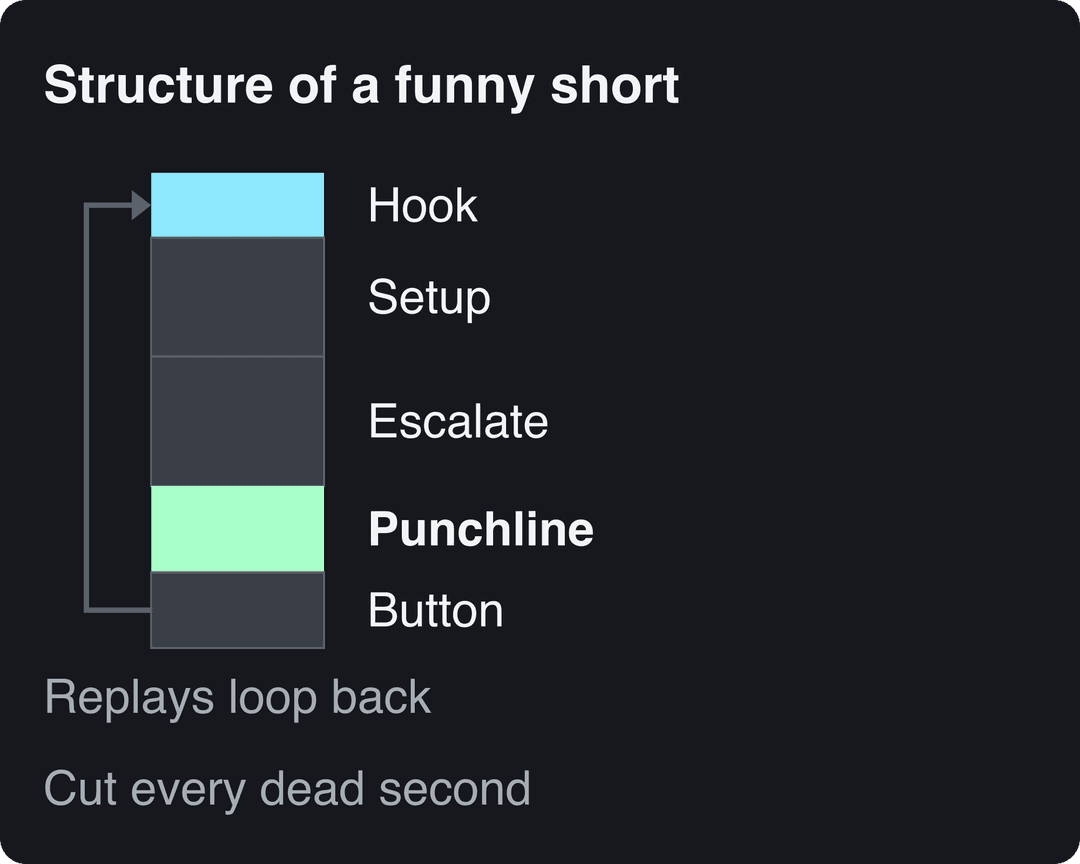
Rules that keep the structure tight:
- One joke per video. If you have three ideas, you have three videos.
- Escalate in steps. Each beat should be slightly more absurd than the last, so the punchline feels earned.
- Never explain the punchline. End within a beat of the laugh.
- Use the button to drive replays. A final reaction, a callback or a line that matches the opening makes people watch again.
Here is a template with a sample you can adapt:
| Beat | On screen | Audio or text |
|---|---|---|
| Hook | You at a desk, laptop open | Text: "POV: your boss says 'quick question'" |
| Setup | Notification pops up | Text: "Quick question" |
| Escalation | Reply turns into a long message, then a call request, then a meeting invite | Each new notification sound gets louder |
| Punchline | You quietly close the laptop and lie on the floor | Silence |
| Button | Laptop opens on its own | Text: "One more thing" |
The video below walks through the same idea from a writer's angle: why some things are funny and others fall flat.
If your opening line is weak, borrow a proven structure from a list of TikTok hooks that stop the scroll and rewrite it for your joke.
Input
A strawberry discovers her fiance banana is secretly in love with the new mango. Episode 1 of a fruit drama series.
Output
Can you make funny videos without showing your face?
Yes, and the data suggests you may not want to. In Revid's TikTok study, faceless comedy had a 327K median and 26.4% of those videos passed 1 million views, against a 136K median for comedy with one person on camera. Across all formats, faceless videos had a 114K median versus 67K for one person on camera.
Faceless tutorials earned about 3x the median views of on-camera tutorials (156K vs 52K).
Source: Revid analysis of 176,367 TikToks with 1,000+ likes posted between Oct 1, 2025 and Oct 16, 2026 (61,203 creators)
Show the data
| Median views | Share that passed 1M views | |
|---|---|---|
| Faceless tutorials | 155.6K | 22.1% |
| Product or object tutorials | 80.7K | 14.9% |
| On-camera tutorials | 52.5K | 10% |
| Faceless storytelling | 72.7K | 13.3% |
| On-camera storytelling | 64.4K | 11.7% |
| Faceless comedy | 326.7K | 26.4% |
| On-camera comedy | 135.5K | 20.7% |
Comedy that leans on visuals rather than talking also stood out. Videos with under 40 characters of speech had a 123K median and 20.2% passed 1 million views, while videos talking throughout had 68K. If your joke can work with a caption and a reaction instead of a monologue, try that version first.
Faceless comedy formats that work:
- Text-on-screen POV over a simple clip of your hands, your desk or your pet.
- Animal comedy with a voiceover or captions giving the animal a personality.
- Animated or AI characters acting out a sketch, such as the AI fruit drama generator format, where 3D fruits act out betrayals and love triangles.
- Narrated stories over gameplay or stock footage, with the humor in the script.
How to film funny videos on your phone
You don't need a camera. A recent phone shoots more than enough quality for TikTok, Reels and Shorts, so spend on stability and sound first.
| Item | Why it matters for comedy | Budget option | Upgrade |
|---|---|---|---|
| Camera | Shoots the scene | Your phone | Mirrorless camera |
| Tripod | Steady framing for solo skits and repeat takes | Phone tripod with a remote | Tripod with a fluid head |
| Microphone | Muffled audio kills a punchline faster than a soft image | Clip-on lavalier | Shotgun mic |
| Light | Faces need to read clearly for reactions | Face a window | LED panel or softbox |
| Background | A busy room competes with the joke | Plain wall or tidy shelf | A set that is part of the joke |
Framing choices that make jokes land:
- Wide shot for physical comedy, so the whole fall or reaction is visible.
- Close-up for reactions. A cut from a wide shot to a tight face is a punchline on its own.
- POV or handheld for skits where the viewer plays a character. Hold the phone at eye level and talk to the lens.
- Low angle to exaggerate a fall or make a character look absurdly important.
If you film alone, mark your position on the floor with tape, set the framing before you start, and record each line three or four times. Playing two characters? Shoot all of character A's lines first, then change shirts and shoot character B, then cut them together.
How to edit funny videos for timing
Editing is where most of the comedy happens, because timing is the joke. Start with these passes:
- Cut the dead air. Remove breaths, "um" and the half-second before each line. Fast pacing makes the one deliberate pause stand out.
- Keep one pause before the punchline. A beat of silence or a held stare signals that something is coming.
- Cut to the reaction. The laugh often comes from the face after the line, not the line itself.
- Use sound sparingly. One well-timed sound effect or record scratch beats ten. Drop music under dialogue so words stay clear.
- Add captions and text. Burned-in captions make the joke work with the sound off; an AI caption generator handles this in 100+ languages. Use a text overlay for the premise or for a deadpan label on the punchline.
- Plant running gags. If a series has a recurring line or prop, bring it back in the button so regular viewers get an extra laugh.
For software, DaVinci Resolve is free on desktop and handles cuts, sound and color well beyond what short comedy needs. Adobe Premiere Pro is the paid standard if you already work in Adobe apps. On a phone, CapCut's free tier includes 1080p export and auto-captions.
If you would rather hand off editing, check typical freelance video editing rates before budgeting, and send the editor a clear brief: where the punchline is and where the pause goes.
Where to post funny videos
Short comedy fits every vertical feed, but the rules differ. On TikTok, quick POV skits and trend-based jokes dominate; on YouTube, Shorts handle single jokes while long-form videos suit sketches and recurring characters; Instagram Reels (see Instagram's original announcement of Reels) reward relatable, shareable jokes people send to friends.
| Platform | Length limit | What to know for comedy |
|---|---|---|
| TikTok | Uploads up to 60 minutes (10 minutes when recorded in the app) | Creator Rewards only pays on original videos of 1 minute or more |
| YouTube Shorts | Up to 3 minutes, square or vertical | A Short over 1 minute with a Content ID claim is blocked globally |
| YouTube long-form | 15 minutes by default, longer for verified accounts | Best for sketches, series and compilations |
| Instagram Reels | Up to 20 minutes | Reels over 3 minutes are not recommended to non-followers |
How long should the video be? As long as the joke needs. In Revid's 12-month TikTok study, every length bucket from under 15 seconds to 10 minutes had a median between 58K and 76K views, so length matters far less than pacing. Very short videos (under 15 seconds) did get the most shares per view: 1.41 per 100.
A few more posting rules:
- Hashtags: on TikTok, videos with 4 hashtags had the best median in Revid's study (77K), while 9 or more did worst (16K). Instagram allows up to 5 per post.
- Timing: check when your audience is online. TikTok Studio's Viewers tab shows when viewers were most active over the last 7 days; Instagram shows follower activity once you have 100 followers.
- Repurposing: cut a long YouTube sketch into vertical clips with a YouTube clip maker, and lead each clip with its own punchline.
For TikTok-specific tactics, see our guide to making funny TikTok videos.
How to make funny videos with Revid
If you want comedy without filming, Revid starts from videos that already made people laugh and turns their structure into an original video.
- Search Revid's viral video library (about 2.77 million real short-form videos with engagement data) for a comedy topic, and filter by platform and engagement tier.
- Run the free deep analysis (up to 60 a day) on a clip to see its hook, timed structure and scroll-stopping moment.
- Choose "Make it about your topic" or "Same energy, new script": Revid writes new words and visuals in the same rhythm, rather than copying the original.
- Pick a voice and one of 30 caption styles, adjust scenes in the timeline editor, then publish or schedule to TikTok, Instagram and YouTube.
Sign-up is free and new accounts get free credits to try video creation, no credit card needed; regular creation then uses credits from a paid plan, starting at $39/month.
How to tell if your funny videos are working
Views tell you a video was shown. These tell you the joke landed:
- Shares per view. Comedy spreads by people sending it to friends. The TikToks in Revid's index averaged 0.88 shares per 100 views; compare each video against your own average, not someone else's.
- Retention graph. A drop before the punchline means the setup is too long. A bump at the end means people rewatched for the button.
- Comments. Tagging a friend or quoting the line back is the strongest signal. Explaining the joke to each other means it was unclear.
Log every post in a simple spreadsheet: premise, format, length, shares per 100 views and where viewers dropped off. After a dozen videos, the pattern is usually obvious: one format or one character outperforms the rest. Make that a series.
FAQ
How long should a funny video be?
As short as the joke allows. In Revid's 12-month TikTok study, median views were similar from under 15 seconds to 10 minutes (58K to 76K), so cut for pacing, not to hit a number. If you want TikTok Creator Rewards, the video must be at least 1 minute long.
Can I make funny videos with AI?
Yes. AI characters, voices and scripts are allowed, but TikTok requires a label on realistic AI-generated content, and that label does not affect distribution if the video follows the Community Guidelines. YouTube allows AI-assisted videos to monetize when they show your creative vision, but not mass-produced template content.
Can you make money from funny videos?
Yes, once you meet each platform's thresholds. TikTok's Creator Rewards Program requires being 18 or older, 10,000 followers and 100,000 views in the last 30 days, and pays on original videos of at least 1 minute. YouTube ad revenue currently needs 1,000 subscribers plus 4,000 watch hours in 12 months or 10 million Shorts views in 90 days, with higher thresholds for new applicants from February 1, 2027.
What is the best app to make funny videos?
It depends on how you make them. To edit footage you filmed, CapCut on mobile or DaVinci Resolve on desktop are strong free options. To generate faceless comedy from a script or a proven viral format, use an AI video tool such as Revid.
How do I get funnier on camera?
Post more, shorter videos and study the retention graph of each one. Record several takes of every punchline, slow down before the twist, and lean on reactions instead of explanations; many creators find deadpan delivery easier than performing big energy.
Sources
- Revid analysis of 176,367 TikToks with 1,000+ likes posted between Oct 1, 2025 and Oct 16, 2026 (61,203 creators)
- HubSpot, The Future of Social Media [Research]: What Marketers Need to Know in 2026 (September 2026)
Charts and figures checked on November 6, 2026.