
How to Create Viral Content: A Science-Backed Guide With Data
Viral content follows a pattern: a proven format, a fast hook, high-arousal emotion paired with real value, and constant measurement of shares. Here are 7 steps, with Revid data from 176,367 TikToks.
On this page
To create viral content, start from a format audiences already share, hook people in the first seconds, and pair a high-arousal emotion (humor, surprise, outrage, awe) with something genuinely useful or interesting. Then post consistently, track share rate and remake your winners: virality comes from many tested attempts, not one perfect post.
The most repeated advice, keep it positive and inspiring, gets video almost backwards. In Revid's analysis of 176,367 TikToks with 1,000+ likes posted between October 2025 and October 2026, inspirational videos had a median of 45K views, while outrage reached 156K and humor 121K. Feel-good content is fine. Flat feel-good content is what gets scrolled past.
What makes content go viral?
People share content that makes them feel something strong and makes them look good for passing it on. Wharton researchers Jonah Berger and Katherine Milkman studied which New York Times articles made the most-emailed list and found that positive content was shared more than negative content overall, but that arousal mattered most: high-arousal emotions such as awe, anger and anxiety drove sharing, while low-arousal sadness did not.
Berger later organized the drivers of sharing into a framework in his book Contagious. Use it as a checklist before you publish:
| Why people share | What it means | How to apply it |
|---|---|---|
| Emotion | High-arousal feelings push people to act | Aim for laughter, surprise, awe or justified anger, not mild interest |
| Social currency | Sharing makes the sharer look smart, funny or in the know | Lead with insider facts, little-known tricks, first looks |
| Practical value | It helps someone the sharer knows | Make it specific enough that the viewer thinks of one person to send it to |
| Stories | Ideas travel inside narratives | Wrap the tip in a before-and-after or a mistake-and-fix arc |
| Triggers | Everyday cues bring the content back to mind | Tie it to routines: Monday mornings, grocery runs, payday |
| Public | Visible behavior gets copied | Create formats others can join: challenges, duets, templates |
Revid's own data points the same way for short video. In our full TikTok virality study, videos whose dominant mood was outrage had a 156K median and 23.7% passed 1 million views; humor had 121K (19.3%), sadness 104K and inspirational 45K (11.3%). Two limits matter: the sample only includes TikToks that already reached 1,000+ likes, and the mood of each video comes from Revid's AI analysis, so the figures show what successful videos have in common, not what causes success.
High-arousal emotions (outrage, humor, sadness) earned the most views. Calm, inspirational videos earned the least, even though they collect the most likes per view.
Source: Revid analysis of 176,367 TikToks with 1,000+ likes posted between Oct 1, 2025 and Oct 16, 2026 (61,203 creators)
Show the data
| Median views | Share that passed 1M views | |
|---|---|---|
| Outrage | 156K | 23.7% |
| Humor | 121K | 19.3% |
| Sadness | 104.4K | 16.5% |
| Excitement | 92.5K | 15.9% |
| Joy | 89.9K | 18% |
| Informative | 64.1K | 11.2% |
| Neutral | 61.2K | 11.5% |
| Inspirational | 44.6K | 11.3% |
If your topic is calm by nature (finance, software, cooking), get the arousal from surprise or a strong opinion rather than forced drama. "The phone setting quietly draining your battery" will travel further than "Tips to save battery".
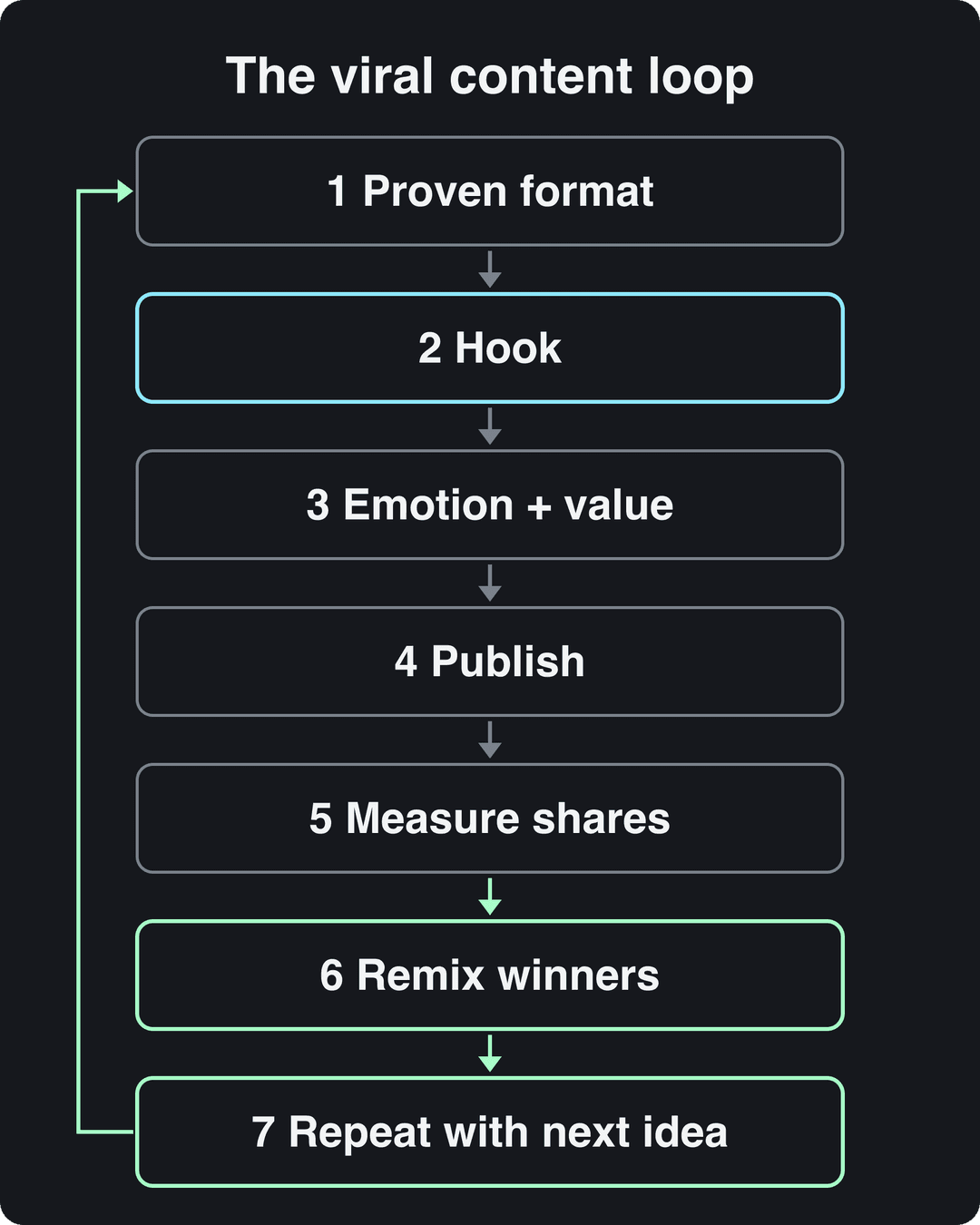
How to create viral content in 7 steps
- Start from a format that already spreads in your niche.
- Write a hook that works in the first seconds.
- Pair a high-arousal emotion with real value.
- Package it for how people actually consume it.
- Catch trends while they are still rising.
- Post when your audience is active.
- Measure share rate, then remake the winners.
1. Start from a format that already spreads
A blank-page idea is a guess; a format with a track record is evidence. In Revid's TikTok study, format moved the numbers far more than length did: challenges had a 182K median (25.6% past 1 million views), comedy 155K, reactions 105K, storytelling 66K and tutorials 62K, while every length bucket from under 15 seconds to 10 minutes sat between 58K and 76K.
Format choice matters inside a niche too. Faceless tutorials (screen recordings, hands-only shots, B-roll with a voice-over) had a 156K median versus 52K for on-camera tutorials. If you teach, test a faceless version before deciding your face is the hook.
Before you script anything, collect a handful of recent hits in your niche and write down four things for each: the first line, the emotion, the payoff and the length. Revid's viral video library lets you search about 2.77 million real short-form videos and posts by topic, platform and engagement tier, and its free deep analysis (up to 60 a day) explains the hook, the timed structure and the scroll-stopping moment of any video.
Prompt to try
Make a 30-second vertical TikTok about the phone setting that quietly drains your battery. Open on a battery percentage dropping fast with the on-screen text "This setting is killing your battery", no greeting. Use quick B-roll cuts with a calm, confident voice-over, then show the fix in three short steps.
2. Write a hook that works in the first seconds
Attention is decided fast. In Clutch's October 2025 survey, 88% of US consumers said a video needs to grab their attention in 30 seconds or less, and only 9% said they give short-form videos their full attention. In practice, the opening frame and first line carry the whole post.
Talking less at the start helps. In Revid's TikTok data, videos with under 40 characters of speech had a 123K median and 20.2% passed 1 million views, versus 68K and 11.9% for videos that talk throughout. Lead with the visual (the result, the mess, the reveal) and explain afterwards.
Three rules for any hook:
- Show the payoff or the problem in the first frame, not a logo or a greeting.
- Put the hook on screen as text so it works with the sound off.
- Cut every word before the first interesting one ("Hey guys, so today..." goes).
For ready-made openers, browse these copy-and-paste TikTok hooks.
3. Pair a high-arousal emotion with real value
Emotion gets the share; value keeps the sharer from looking foolish for sending it. Use these decision rules:
- If it's useful but dull, lead with the counterintuitive part.
- If it's funny but empty, add one takeaway the viewer can repeat to a friend.
- If it's opinionated, back it with a specific example or number.
- If it's angry, aim the anger at a situation (hidden fees, bad design), never at a group of people.
Honesty is part of the value. In Bazaarvoice's Shopper Preference Report 2025, 43% of shoppers said they trust creators who share both the pros and cons of a product, and at least 44% said they lose trust when creators refuse to mention flaws.
Interactive formats add a reason to respond. A quiz or a "guess the answer" video invites people to post their result and send it to someone to compare; Revid's video quiz maker turns a list of questions into a short video that challenges viewers to answer.
4. Package it for how people actually consume it
For articles and posts, write short paragraphs, descriptive headings and one idea per paragraph, and add an image or video only where it explains something. For short-form video, these choices matter most:
| Element | Do this | Why |
|---|---|---|
| Frame | Vertical 9:16 at 1080x1920 | TikTok's recommended spec; Reels and Shorts are vertical too |
| On-screen text | Put the hook in burned-in text | The hook still works with the sound off |
| Post caption | 41 to 80 characters | Best median in Revid's TikTok data (67K) versus 36K with no caption |
| Hashtags | 3 to 4 relevant tags | 4 tags had a 77K median and 3 tags 75K; 9 or more only 16K. Instagram caps posts at 5 |
| Face or faceless | Test both | Faceless TikToks had a 114K median versus 67K for one person on camera |
| Length | Whatever the idea needs | Every length bucket landed between 58K and 76K median views |
For filming and editing details, see our guide to making viral videos.
5. Catch trends while they are still rising
A trend helps only before it saturates. Join too late and your post reads as a copy. These tools show what is rising:
- Google Trends: search interest over time. Look for a curve that is climbing, not one that has peaked.
- Brand24 and Sprout Social: social listening for mentions and hashtags, useful before posting (what people discuss) and after (how they talk about your post).
- Apple News and Feedly: follow the publications in your niche so stories reach you early.
- Revid's TikTok trends page: rising hashtags, sounds and videos, updated daily.
Connect the trend to what you already know instead of forcing it. A cooking account that spots rising interest in an ingredient should post a recipe that uses it well, not a generic reaction. For predictable events such as the Super Bowl, prepare the content before the day so you publish while attention peaks. If large accounts have already parodied a trend, skip it or add a twist only you can add.
6. Post when your audience is active
Timing will not save a weak post, but it decides who sees a strong one first. One labeled data point for TikTok: in Revid's study, English-language posts at 3 to 6 a.m. US Eastern outperformed the evening, with 4 a.m. posts reaching a 120K median versus 50K at 7 p.m. Because English TikToks come from creators worldwide, that window also covers daytime in the UK, Europe, India and Asia. Saturday had the best median (70K), and weekdays sat within a few percent of each other.
Your own audience beats any average. TikTok Studio's Viewers tab shows when your viewers were most active over the last 7 days, and Instagram's follower insights show most-active times once you have 100 followers. Post when your people are awake, then keep publishing: each post is another test.
7. Measure share rate, then remake the winners
Views tell you a post was shown; shares tell you it spread. Track these:
| Metric | How to calculate it | What it tells you |
|---|---|---|
| Share rate | Shares divided by views | Whether people pass it on: the closest signal to virality |
| Reach | Unique accounts that saw it | How far it traveled beyond your followers |
| Views or impressions | Total plays or displays | How often it was watched, including repeats |
| Amplification rate | Reposts and reshares per post | Whether sharing chains keep going |
| Conversion rate | Actions divided by visitors | Whether attention became followers, sign-ups or sales |
For a benchmark, the TikToks in Revid's study averaged 7.1 likes, 0.88 shares and 0.08 comments per 100 views. Videos under 15 seconds had the most shares per view (1.41 per 100). These are videos that already cleared 1,000 likes, so treat 0.88% as the bar for a strong post, not an average one.
To find your numbers, use the native dashboards: Meta's business tools for Facebook, Instagram for Business resources alongside in-app insights, X analytics for posts on X, and Google Analytics for the traffic your content sends to your site. Revid's free TikTok account audit shows which of your own videos and patterns perform.
When a post beats your usual share rate, remake it three ways: a part 2 that answers the question it left open, the same format on a new topic, and the same topic with a new hook.
Prompt to try
Create a 40-second vertical video titled "You're stretching wrong (here's the fix)". Show the common mistake in the first frame with the title as on-screen text, explain in one line why it fails, then demonstrate the correct stretch in two steps. Faceless B-roll, energetic voice-over, bold captions.
Headline and hook formulas you can copy
The same formulas work for article headlines, video titles and spoken hooks. Swap in your niche:
| Formula | Example | Why it works |
|---|---|---|
| Numbered list | "5 mistakes that make your bread dense" | Promises a scannable, finite payoff |
| How-to | "How to fix a squeaky door without tools" | Names the problem and the outcome |
| Curiosity gap | "Nobody tells you this about renting your first apartment" | Opens a question only the post answers |
| Contrarian | "You're stretching wrong (here's the fix)" | Challenges a belief, which triggers arousal |
| Justified outrage | "This airline fee should be illegal" | Gives viewers something to agree with loudly |
| Question | "Is your content actually shareable? Check these signs" | Invites the viewer to test themselves |
| POV | "POV: your first day as a barista goes wrong" | Drops the viewer into a story |
Publishers like BuzzFeed built their reach on lists, quizzes and relentless headline testing. Copy the discipline, not the clickbait: the headline has to be true to the content, or the share never happens.
Test instead of guessing. YouTube Studio on desktop can A/B test up to 3 titles and thumbnails and shows the variant with the most watch time to everyone (Shorts are not eligible). Instagram's trial reels are shown first to non-followers, with insights within 24 hours; they need a public account with at least 200 followers for professional accounts or 1,000 for personal ones. On any platform, posting two versions of the same idea with different hooks is the cheapest test you can run.
How to make viral content with Revid
Revid starts from videos that audiences have already proven they watch, then turns their structure into an original video:
- Search Revid's viral library for your topic and filter by platform, engagement tier and length.
- Run a deep analysis on the strongest match to see its hook, timed structure and three ways to adapt it to your niche.
- Choose "Make it about your topic" or "Same energy, new script": Revid writes a new script and generates the visuals, a voice-over in 70+ languages, captions and music.
- Adjust any scene in the timeline editor, then publish or schedule to TikTok, Instagram and YouTube. Each post reports its views, likes and comments, and any winner can be remixed in one click.
If you prefer to start from a prompt or script, use the AI video generator. Sign-up is free and new accounts get free credits to try video creation, no credit card needed; regular creation then uses the monthly credits of a paid plan, from $39/month.
Mistakes that keep content from spreading
- Positivity without punch. Inspirational TikToks had the lowest median of the moods above. Add surprise, humor or a stake.
- Hashtag stuffing. Posts with 9 or more hashtags had a 16K median in Revid's TikTok data, against 77K for 4.
- Arriving late to trends. By the time a trend is everywhere, your version competes with thousands of copies.
- Generic AI content. Sprout Social research from March 2026 found that 50% of Gen Z have blocked, muted or unfollowed a brand or creator because their content felt like "AI slop". If you use AI, bring the idea and the point of view, and label realistic AI content where platforms require it (TikTok does, and says the label does not affect distribution for content that follows its guidelines).
- Judging by likes. A post with many likes and few shares entertained people without spreading.
- Begging for shares. "Share this" rarely works; content worth forwarding to a specific person does.
FAQ
How many views does it take to be viral?
There is no official threshold, but Revid's library classifies 1 million+ views as viral and 100,000+ as high engagement. For context, the median TikTok in Revid's study of videos with 1,000+ likes had 64.4K views, and 11.9% passed 1 million.
Can you make content go viral on purpose?
No one can guarantee it, but you can raise the odds a lot. Start from proven formats, hook in the first seconds, trigger a high-arousal emotion, publish often and remake whatever earns the most shares per view.
Do you need to show your face to go viral?
No. In Revid's TikTok study, faceless videos had a 114K median and 17.4% passed 1 million views, versus 67K and 12.7% for one person on camera; animal videos reached 147K.
Does AI-generated content go viral?
It can, depending on the platform. Revid's AI videos vs real footage study found AI-generated TikToks averaged twice the views of real footage, while on X, Instagram and Threads AI visuals clustered in the lowest engagement tier.