
How to Make a Video Go Viral: Steps Backed by Real TikTok Data
How to make a video go viral, step by step: the formats, hooks, emotions, lengths and hashtags that top-performing short videos share, based on Revid's analysis of 176,367 TikToks.

On this page
To make a video go viral, hook viewers in the first seconds, pick a format people already share (comedy, challenges, reactions), aim for a strong emotion such as humor or outrage, keep it tight, and post natively on each platform. Then reply to comments quickly and post a follow-up while it spreads.
Most advice tells you to be inspiring. The data disagrees. In Revid's analysis of 176,367 TikToks with 1,000+ likes posted between October 2025 and October 2026, inspirational videos had a median of 45K views, against 156K for outrage and 121K for humor. Below are the steps, with the numbers behind each one.
What makes a video go viral?
A video goes viral when people share it and the platform's recommendation feed keeps showing it to people who don't follow you. On TikTok, Reels and Shorts, that push depends on what the first viewers do: keep watching, rewatch, share, comment or follow. Your follower count matters less than their reaction.
Viral reach is rare even among good videos. In Revid's study of what makes a TikTok go viral, the median video had 64.4K views and only 11.9% passed 1 million, and that sample only includes posts that already cleared 1,000 likes. The findings below show what top-performing videos have in common, not guaranteed causes. Used together, they shift the odds.
How to create viral videos, step by step
- Pick a format audiences already share.
- Write a hook that works in the first 3 seconds.
- Aim for a strong emotion, not a polite one.
- Structure the video: hook, setup, payoff, loop.
- Decide whether to show your face and how to shoot.
- Cut it to the length the content needs.
- Write the caption, hashtags and title.
- Publish natively on each platform, at the right time, and seed it in communities.
- Work the first 48 hours, then turn viewers into followers.
Which video formats go viral most often?
Start with the format, then find the idea. Some formats are built to be passed around: a challenge invites people to try it, a joke gets sent to a friend, a reaction gives viewers someone to agree or argue with.
Revid's TikTok data shows it clearly. Challenges had the highest median (182K views, with 25.6% passing 1 million), followed by comedy (155K, 22%) and reactions (105K, 16%). Dance reached 84K, storytelling 66K and tutorials 62K, close to the overall median.
Challenges and comedy passed 1M views about twice as often as tutorials and storytelling, which are the most common formats.
Source: Revid analysis of 176,367 TikToks with 1,000+ likes posted between Oct 1, 2025 and Oct 16, 2026 (61,203 creators)
Show the data
| Median views | Share that passed 1M views | |
|---|---|---|
| Challenge | 182.3K | 25.6% |
| Comedy | 154.8K | 22.1% |
| Reaction | 104.8K | 16% |
| Dance | 83.8K | 15.5% |
| Storytelling | 66.1K | 12.2% |
| Lip Sync | 61.7K | 12.3% |
| Tutorial | 61.9K | 12.1% |
Decision rule: if your niche is educational, keep teaching, but package the lesson in a higher-share format. Turn a tip into a challenge (can you spot the mistake?), a reaction to a common myth, or a comedy skit showing the wrong way first.
Prompt to try
Make a 20-second vertical TikTok that opens on the result: a cluttered desk transformed into a clean workspace in one frame, with the on-screen text "You've been organizing your desk wrong your whole life." Keep the voiceover to one short sentence, let bold captions and fast visual cuts carry the three fixes, and end on a frame that loops back to the start.
How do you hook viewers in the first 3 seconds?
The opening decides whether someone keeps watching or swipes. Three rules cover most cases:
- Open on the most interesting moment. Show the result, the reveal or the conflict first, then explain how you got there.
- Put text on screen in the first frame. Many people watch with the sound off, and a line of text tells them why to stay.
- Cut every greeting, logo and intro. Nobody shares the part where you say hi.
Hook lines you can adapt:
- You've been doing [common task] wrong your whole life.
- Nobody talks about this part of [topic].
- Watch what happens when [unexpected action].
- This is why your [thing] keeps [failing].
- POV: [relatable situation your audience lives every week].
- I tried [popular advice] so you don't have to.
For more templates, browse these copy-and-paste TikTok hooks.
Say less than you think. Videos with under 40 characters of speech (one short sentence or none) had a 123K median and 20.2% passed 1 million, compared with 68K and 11.9% for videos that talk from start to finish. Silent videos sat at 73K. If you talk on camera, cut every line that doesn't move the story forward and let visuals and on-screen text carry the rest.
Prompt to try
Create a 25-second comedy TikTok about the shared frustration of hidden fees when booking a cheap flight: the price climbs with every click until it doubles. Open with the absurd final total on screen, exaggerate each fee with a punchy caption, and end with one quick tip to avoid them. Fast cuts, playful tone.
Which emotions make people share a video?
People share what makes them feel something strongly enough to want a reaction from someone else. In Revid's data, outrage had the highest median (156K views, 23.7% past 1 million), then humor (121K, 19.3%) and sadness (104K). Inspirational videos came last at 45K (11.3%), probably because motivational clips compete with countless near-identical posts.
How to use this:
- Humor is the safest bet for most brands and creators. Exaggerate a situation your audience knows too well.
- Outrage works when it targets a shared frustration (hidden fees, a broken process, bad advice everyone repeats), not a person.
- Surprise into delight is a strong combination: open with something unexpected, end with a laugh or a satisfying payoff.
- Inspiration needs a twist. A specific story with a real number or a real failure beats a generic quote over stock footage.
The emotion has to be real. Viewers spot forced reactions quickly, and a genuine moment filmed on a phone often outperforms a polished one that feels staged.
How should a viral video be structured?
Even a 20-second video needs a beginning, middle and end. Use four beats:
- Hook (0 to 3 s): the scroll-stopper.
- Setup: the minimum context needed, with a visual change every few seconds to keep attention.
- Payoff: the reveal, punchline or result. This is the moment people send to a friend.
- Loop or next step: end on a frame that flows back into the start so viewers rewatch, ask a question that invites comments, or tease a Part 2.
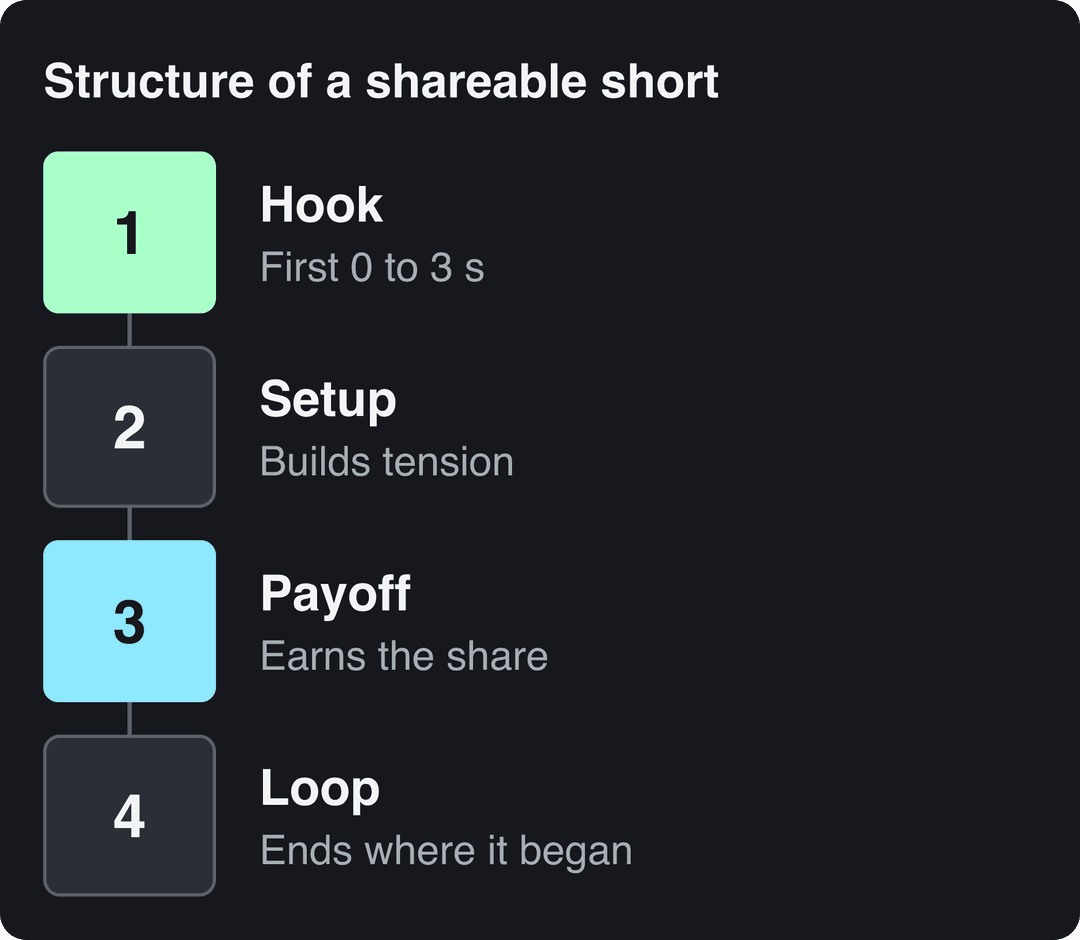
If the payoff is weak, no hook will save the video. Write the payoff first, then work backward to the fastest route there.
Should you show your face to go viral?
You don't have to. Faceless TikToks had a 114K median and 17.4% passed 1 million, against 67K and 12.7% for one person on camera. Animal videos did even better at 147K. The gap was widest for tutorials: faceless tutorials reached a 156K median versus 52K for on-camera ones. (Perspective and style labels come from Revid's AI analysis of each video.)
Shooting style matters too. POV videos had a 107K median (19% past 1 million), screen recordings 91K, handheld 80K, tripod 77K and selfie-style talking heads only 48K.
Decision rule: if your strength is personality, stay on camera but avoid the static selfie shot: move, use POV framing, cut to B-roll. If not, show hands, screens, products or scenes with a voice-over or text. A faceless video generator can produce this kind of video from a script.
How long should a viral video be?
Length matters less than most guides claim. In the 12-month study, every length bucket from under 15 seconds to 10 minutes had a median between 58K and 76K views. Videos of 61 to 90 seconds reached 70K. Clips under 15 seconds had the lowest median (58K) but the most shares per view: 1.41 per 100 views.
Revid's larger index of about 2.39 million TikToks across all posting dates tells a slightly different story: 16 to 30 second videos had the highest median, about 141K. Recent posts show that the edge of very short videos has faded.
Decision rule: make the video as short as the payoff allows. Jokes, loops and visual reveals belong under 30 seconds. Stories and tutorials can run 60 to 90 seconds if every beat earns its place.
Platform limits in October 2026:
| Platform | Maximum length | Reach rule to know |
|---|---|---|
| TikTok | Uploads up to 60 minutes (10 minutes when recorded in the app) | 9:16 at 1080x1920 is recommended |
| Instagram Reels | Up to 20 minutes | Reels longer than 3 minutes are not recommended to non-followers |
| YouTube Shorts | Up to 3 minutes (square or vertical) | A Short over 1 minute with a Content ID claim is blocked globally |
| Every video is a reel, no length limit | Reaction-only, clip-stitching and lightly edited reposts are deprioritized since March 2026 |
How many hashtags and what caption should a viral video have?
On TikTok, 3 to 4 hashtags did best: posts with 4 had a 77K median (13.4% past 1 million) and posts with 3 had 75K. Posts with no hashtags had 51K, and posts with 9 or more fell to 16K. Mix one broad tag with two or three tags specific to your niche.
Captions follow the same logic. Captions of 41 to 80 characters had the best median (67K), while posts with no caption had 36K. One line that adds context or a question beats both an empty caption and a paragraph.
On Instagram, you can't overdo it anyway: posts are limited to 5 hashtags, and a caption or comment with more won't post.
Titles and thumbnails for YouTube
YouTube is partly a search engine, so titles matter more there. Put the phrase people actually search near the start (titles can be up to 100 characters), and check demand with Google Keyword Planner. Keep the title accurate: a misleading title gets clicks and then early exits.
For long-form videos, YouTube recommends 3840x2160 custom thumbnails, and verified accounts can test up to 3 titles and thumbnails with Test and Compare in YouTube Studio on desktop (Shorts are not eligible). Verified accounts can also upload custom Shorts thumbnails from YouTube Studio on a computer. On the home page, vertical videos get an auto-generated 4:5 thumbnail, so make your first frames readable.
How do you post the same video on TikTok, Instagram and YouTube?
Adapt it instead of reposting the same file. TikTok rewards fast, trend-aware pacing, Instagram leans toward polished visuals and its own audio, and YouTube rewards searchable titles and videos that keep people on the platform.
- Export a clean file without another app's watermark for each platform.
- Keep text and faces out of the edges where each app places its buttons and captions.
- Add native touches in each app: its trending sounds, text styles and cover.
- Test on Instagram with trial reels, which are shown first to non-followers and don't affect your regular reels. They need a public account with at least 200 followers (professional) or 1,000 (personal).
- Cut long videos into clips for short-form feeds. A long video to short video converter finds the strongest moments and reframes them vertically.
For tactics specific to one app, see how to make your TikTok go viral.
Where should you share a video to help it spread?
The feed is not the only starting point. Niche communities can give a video its first wave of engaged viewers:
- Subreddits and Facebook Groups. Find the subreddits and Facebook Groups where your topic is discussed, read their rules, and take part before you post. Share the video with context (why it matters to that group), not a bare link.
- Micro-influencers. Smaller creators in your niche often have engaged audiences. Offer a collaboration, a Duet or Stitch on TikTok, or a co-created video instead of a cold request to share.
- Your own channels. Send it to your email list, post it in your community and pin it on your profile.
When is the best time to post a video?
On TikTok, Revid's data found that English-language posts at 3 to 6 a.m. US Eastern had the highest median views and 5 to 9 p.m. the lowest. Those creators post from around the world, so the early US hours also cover daytime in Europe and Asia.
Your own audience is a better guide than any general rule. In TikTok Studio, the Viewers tab shows when your viewers were most active over the last 7 days. Instagram shows follower activity times once you have at least 100 followers. Freshness also counts: Meta said same-day posts made up more than 30% of recommended Reels on Instagram and Facebook in Q1 2026.
Trends move fast, so if you react to one, publish within days. Balance trend videos with evergreen ones that can be found for months.
What should you do in the first 48 hours after posting?
The first two days are when a video either keeps spreading or stalls. Use them:
- Reply to early comments, and answer the best questions with video replies, which count as new posts.
- Pin a comment that adds context or asks a question.
- Post the follow-up if viewers ask for more: a Part 2, the behind-the-scenes, or the answer to the most common comment.
- Publish adapted versions on your other platforms.
- Check the numbers below before deciding what to make next.
| Metric | What it tells you | Benchmark |
|---|---|---|
| Watch time and retention | Whether people stay past the hook and reach the payoff | Find where the retention curve drops and fix that moment |
| Share rate | Whether people pass it on, the engine of viral reach | Across Revid's 176,367-video sample: 0.88 shares per 100 views. Even TikToks with 100M+ views have a median share rate of 0.15% |
| Likes and comments | Whether viewers care enough to react | Sample average: 7.1 likes and 0.08 comments per 100 views |
| Reach and non-follower views | Whether the feed is pushing it beyond your followers | Compare with your recent posts |
| Follows from the video | Whether views turn into an audience | Compare with your recent posts |
TikTok, Instagram and YouTube all show these in their built-in analytics. For videos hosted on Vimeo, its analytics cover watch time and retention. To see patterns across your whole account, run a free TikTok account audit.
How do you turn a viral video into followers or customers?
Views fade within days; followers and customers stay. Plan the next step before you post:
- One clear call to action. Follow for Part 2, comment a keyword for the link, or visit the profile. Pick one.
- A landing page that matches the video. If the video is about one product or tip, send people to that page, not your homepage.
- A reason to leave an email. A checklist, template or early access works better than a newsletter pitch.
- Tracking. Add tracking parameters to your profile link and measure the traffic in Google Analytics.
For businesses, short video is worth the effort. In Wyzowl's 2026 survey, 63% of consumers said a short video was how they would most like to learn about a product or service. Competition is heavy too: 91% of businesses in the same survey use video as a marketing tool. For more context, see Yaguara's short-form video statistics roundup and Vidico's video marketing statistics.
Consistency matters more than any single video. Each post is another try at the format, hook and emotion that works for your audience, and a viral hit usually comes from a creator who was already posting regularly.
How to make a viral video with Revid
Revid starts from videos audiences have already proven they watch, instead of a blank prompt. To find viral videos and remix them:
- Search Revid's library of about 2.77 million real short-form videos by topic, platform, engagement tier and length.
- Open a video and run Deep analysis (free, up to 60 a day) to see its hook, timed structure, scroll-stopping moment and three ways to adapt it to your niche.
- Choose Make it about your topic or Same energy, new script. Revid writes a new script and new visuals that keep the original's structure, pacing and hook style.
- Adjust it in the timeline editor, with AI voices in 70+ languages, synced captions and export up to 4K.
- Publish or schedule it to TikTok, Instagram and YouTube, then check each post's results and remix the winners.
Sign-up is free and new accounts get free credits to try video creation, no credit card needed; regular creation then uses the monthly credits of a paid plan, from $39/month.
FAQ
How many views count as viral?
There is no official threshold. Revid classifies cross-platform posts with 1 million+ views as viral and 100,000+ as high engagement. In Revid's TikTok study, 11.9% of videos that had already reached 1,000 likes passed 1 million views.
Can AI-generated videos go viral?
Yes, on TikTok in particular: in Revid's AI vs real footage study, AI-generated TikToks averaged twice the views of real footage, while on X, Instagram and Threads AI visuals clustered in the lowest engagement tier. Label realistic AI content; TikTok says its AI label does not affect distribution when a video follows its Community Guidelines.
Is going viral just luck?
Partly, since no one controls who sees a video first. But format, hook, emotion and length clearly shift the odds: challenges and comedy had about three times the median views of inspirational videos in Revid's data.
Can I repost a viral TikTok on Reels and Shorts?
Yes, if it is your own video and you export a clean version without the TikTok watermark. Adapt the caption, hashtags (5 at most on Instagram) and cover, and avoid lightly edited reposts of other people's content, which Facebook has deprioritized since March 2026.