On this page
To edit a TikTok video, tap the plus button, record or upload your clips, then tap Edit to open the timeline. Trim and split clips, adjust speed, add a sound and balance its volume, add text and effects, then choose a cover, write a caption and post or save a draft.
The edit does more work than the talking. In Revid's analysis of 176,367 TikToks with 1,000+ likes posted between October 2025 and October 2026, videos with under 40 characters of speech had a median of 123K views, while videos that talked throughout (300+ characters of speech) had 68K. The sample only holds videos that already did well, so this is a pattern, not a cause, but it points one way: cuts, on-screen text and sound carry the story. The full study of what makes a TikTok go viral has the method.
Videos with just a few spoken words (a line or two) beat both silent videos and videos that talk the whole way through, which were the most common and the weakest.
Source: Revid analysis of 176,367 TikToks analyzed by AI, with 1,000+ likes posted between Oct 1, 2025 and Oct 16, 2026 (61,203 creators)
Show the data
| Median views | Share that passed 1M views | |
|---|---|---|
| No speech | 73.3K | 14.3% |
| Under 40 | 122.7K | 20.2% |
| 40 to 120 | 97.2K | 17.6% |
| 120 to 300 | 91.6K | 16.8% |
| 300+ | 67.7K | 11.9% |
How to edit a TikTok video step by step
- Open TikTok, tap the plus button at the bottom of the screen, then record with the camera or tap Upload to pick clips from your camera roll. In-app recordings can run up to 10 minutes; uploaded videos up to 60 minutes.
- Tap Edit to open the full timeline editor (on some versions you tap Next first).
- Trim the start and end of each clip and split clips where you want a cut.
- Change speed on clips that drag (2x) or deserve emphasis (0.5x).
- Add a sound, then set the volume of your original audio and the added sound.
- Add text, captions and stickers, and set when each one appears.
- Add effects and transitions, sparingly.
- Tap Next, choose a cover, write the caption and hashtags, then Post or save to Drafts.
Button names shift slightly between app versions. If a label doesn't match, look for the same icon in the right-hand toolbar or along the bottom of the editor.
Which TikTok video editing tools you'll use most
| Tool | What it does | Use it for |
|---|---|---|
| Adjust clips | Trim, split, reorder and change speed | Cutting dead air and setting the order |
| Sound | Add music, original audio or a voiceover; set volume | Mood, trends and narration |
| Text | Text overlays, captions and text-to-speech | Hooks, context, subtitles, calls to action |
| Effects | Filters, Green Screen, AR and AI effects | Visual changes and trend formats |
| Transitions | Animations between clips | Smoothing or punching up a cut |
| Stickers | Polls, Q&A, GIFs and emojis | Getting taps and comments |
Most of your time goes into the first three. Effects, transitions and stickers are seasoning.
How to edit clips on TikTok: trim, split and reorder
Tap Adjust clips, or tap a clip directly in the timeline. Drag the handles at the start or end of a clip to cut dead air. To split, move the playhead to the cut point and tap Split. To reorder, press and hold a clip, then drag it to a new position.
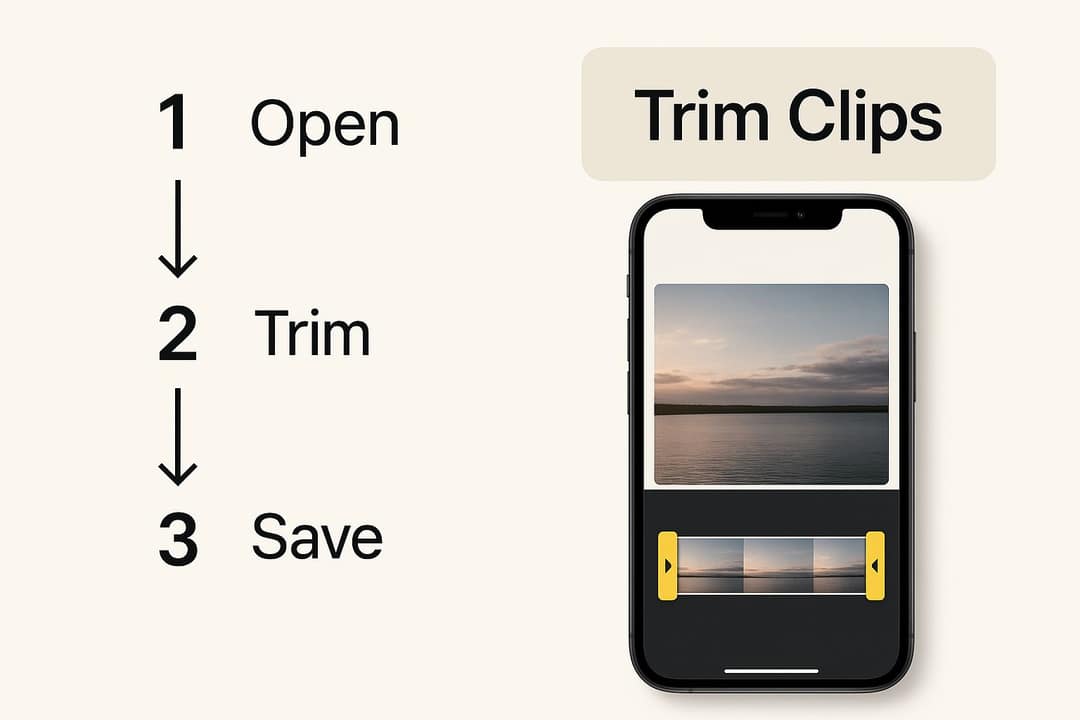
Use three rules when trimming:
- If nothing happens in the first second, cut it. The video should start mid-action.
- Cut every pause longer than a breath in talking clips.
- If a shot adds no new information or reaction, delete it, however nice it looks.
Don't trim to hit a magic length. In the same Revid study, every length bucket from under 15 seconds to 10 minutes had a median between 58K and 76K views. Videos under 15 seconds got the most shares per view (1.41 per 100), so very short works well for shareable jokes and reveals. One exception: if you're in the Creator Rewards Program, only videos of at least one minute can earn, so tighten the pacing inside the minute rather than cutting below it.
How to change the speed of a clip
Select a clip in the timeline and tap Speed. Two settings cover most needs:
- 0.5x (slow motion): the reveal, the pour, the before-and-after moment you want viewers to look at.
- 2x (speed-up): anything slow and repetitive, such as chopping, cleaning, setup or makeup application.
In a cooking video, that means 2x through the prep and 0.5x on the final plating. Mixing sharp trims with speed changes keeps the rhythm moving without adding more footage.
How to add sound to a TikTok video and sync it
On TikTok, tap Add sound at the top of the editor to search the library or browse what's trending. Revid tracks viral TikTok songs right now if you want to see which sounds are rising before you pick one. Business accounts are limited to the Commercial Music Library, so check that a trending track is available to you before building an edit around it.
To sync visuals to the audio:
- Play the sound a few times and note the beat drops, key lyrics and melody changes.
- Trim each clip so the visual change lands on one of those moments.
- Play the whole video back and nudge any cut that feels early or late.
A get-ready-with-me video is the classic example: foundation on one beat, eyeshadow on the next, outfit reveal on the drop.
How to balance a voiceover with music
Record your voiceover first with the Voiceover option (the microphone icon), then add music and open Volume.
| Video type | Original sound | Added sound |
|---|---|---|
| Voiceover or talking video | 100% | 5 to 15% |
| Music-driven edit | Muted or very low | 100% |
Original audio and voiceovers aren't second best to trending sounds. For tutorials and opinions, your voice is the content, and the music only fills the silence.
How to add text, captions and stickers
Tap Text (the Aa icon), type your line, and pick a font and color. A bold font with an outline or background box stays readable over almost any footage. Tap the text and choose Set duration to drag its start and end on a mini timeline, so each line appears exactly when it's needed:
- Tutorials: show each instruction the moment you start that step.
- Voiceovers and punchlines: show the key words as they're spoken.
Tap a text box and choose Text-to-speech to have TikTok read it aloud, which is handy for faceless videos. Use the Captions tool to generate subtitles from your audio, then correct any wrong words, since many people scroll with the sound off.
Placement matters as much as wording. TikTok's buttons, caption and username cover the right side and bottom of the screen, so keep text in the center of the frame. Check a layout with the free TikTok safe zone checker.
Your opening text overlay is usually the hook. If you need a starting line, borrow one from these TikTok hooks that stop the scroll and adapt it. Then add a sticker where it earns a tap: a Poll for an either-or question, a Q&A when you want topics for the next video.
TikTok effects and transitions: use fewer than you think
Tap Effects to find filters, Green Screen backgrounds, AR effects and AI effects. The Trending tab shows which effects are being used right now, which is the fastest way to join a format while it's still rising.
Two rules on AI. TikTok may automatically label a video "AI-generated" if you use its AI effects or upload a file carrying C2PA Content Credentials, and that auto label can't be removed. If your video contains realistic AI images, audio or video, you're required to label it yourself. TikTok says turning on the AI-generated label does not affect distribution as long as the video follows the Community Guidelines.
For transitions, tap the small icon between two clips on the timeline and pick one. Match it to the video's energy: a glitch or whip pan for chaotic, fast clips, a fade or dissolve for travel and cinematic footage. A hard cut on the beat beats a flashy transition in most edits.
In-app editors keep adding AI-assisted features, part of a wider shift you can see in these video editing statistics from Triple A Review. Before adding any effect, ask whether it helps the joke, the reveal or the explanation. If it doesn't, leave it out.
Finishing touches: cover, caption and hashtags
After tapping Next, choose your cover. Scrub to a sharp, well-lit frame that shows what the video is about, and add a short text title if your profile grid uses them. A blurry mid-motion frame is the most common cover mistake.
Write a caption that adds something: a question, a strong claim or the keyword the video is about. In Revid's study, captions of 41 to 80 characters had the best median (67K views), while posts with no caption had 36K. Two examples in that range:
- "The one edit that saved this recipe video. Can you spot it?"
- "Stop using transitions like this. Do this instead."
For hashtags, a few relevant tags beat a pile. TikToks with 4 hashtags had the best median (77K views, 13.4% past 1M views) and 3 hashtags were close behind at 75K. No hashtags had 51K (9.8%), and 9 or more only 16K (7.8%). A good mix is one broad tag (#homecooking) plus two or three specific ones (#easypastarecipe).
Posts with 3 or 4 hashtags earned the most views. Captions stuffed with 9 or more hashtags did worst of all, with median views cut by about 80%.
Source: Revid analysis of 176,367 TikToks with 1,000+ likes posted between Oct 1, 2025 and Oct 16, 2026 (61,203 creators)
Show the data
| Median views | Share that passed 1M views | |
|---|---|---|
| None | 51.1K | 9.8% |
| 1 | 64K | 11.8% |
| 2 | 71.3K | 12.7% |
| 3 | 75.4K | 13.1% |
| 4 | 77.2K | 13.4% |
| 5 | 67.3K | 12.1% |
| 6 to 8 | 71.8K | 12.7% |
| 9+ | 15.6K | 7.8% |
Know who you're editing for. TikTok demographics from Exploding Topics show users aged 18 to 34 lead the audience, and in the U.S., 63% of adults under 30 use TikTok, compared with 12% of adults 65 and older, according to Pew Research Center data from March 2026. Fast cuts and readable text suit that audience. If you run a local business, such as a salon, these social media tips for hair salons cover how to turn TikTok views into bookings.
Can you edit a TikTok video after posting?
No, not the video itself. Once a TikTok is live, you can't change its clips, sound, text overlays or effects. Depending on your app version, the post's menu may let you edit the caption or cover; if it doesn't, those are locked too.
To fix a real mistake, save the posted video to your phone (or reopen the project from Drafts if you kept a copy), make the change, upload it again and delete the old post. You lose the original's views and comments, so only do this for errors that matter.
Prompt to try
Make a 30-second vertical TikTok on the one editing mistake that kills a cooking video. Open with the on-screen hook "Your recipe video loses people in second one", keep narration to a few short lines, and lean on fast cuts, bold centered text and a beat-synced trending-style track.
How to edit viral TikTok videos: what to prioritize
The best way to edit TikTok videos is to fix the few things that decide whether people keep watching:
- Hook in the first 3 seconds. Start on the most interesting frame and put the promise on screen as text.
- Show, don't narrate. If a line can be shown as an action or text, cut the spoken version. The speech data above favors videos that lean on visuals.
- Cut on the beat. Sync cuts to the sound so the rhythm pulls viewers through.
- Shoot for the edit. In Revid's study, POV-style videos had a 107K median versus 48K for selfie-style footage, so capture the action from the viewer's point of view and you'll have stronger clips to cut.
- Polish last. Effects, transitions and stickers come after pacing is right, never before.
How to edit TikTok videos with Revid
If you're editing a talking video, Revid's auto edit video tool does the first pass: upload the clip or paste a link, and it comes back edited, with your key lines turned into motion graphics. Add AI captions in 100+ languages, then adjust anything by hand in the timeline editor. If you have no footage, the AI TikTok video generator builds a vertical voiceover video from a script or a link. Export in 1080p or 4K at 30 or 60 fps, and publish or schedule straight to TikTok from the same queue. Sign-up is free and new accounts get free credits to try video creation, no credit card needed; regular creation then uses the monthly credits of a paid plan, from $39/month.
FAQ
Can you recover a deleted TikTok draft?
No. TikTok has no trash folder for drafts, and drafts are stored on your device, so deleting one (or uninstalling the app) removes it. Saving a copy to your camera roll before you delete or post is the only backup.
How can I record clean voiceovers on my phone and keep the audio in sync when an AI tool chops the video into TikTok clips?
Record in a small room with soft furnishings, hold the phone close to your mouth, and record the voice as part of the same video file rather than as a separate track. Clipping tools cut picture and sound from the same file, so sync holds; drift starts when a separate audio track is laid over after the cuts. If the recording is noisy, clean it with an audio enhancer before clipping.
Should I edit a video for TikTok in the app or in another editor?
Edit in TikTok when you want trending sounds, effects and quick cuts; use a dedicated editor such as CapCut or a desktop program for multi-track work, color and precise audio. TikTok Studio Web accepts uploads up to 60 minutes in 1080p, 2K or 4K. Our guide to editing TikTok videos in the app and CapCut covers the CapCut side.
What resolution and aspect ratio should a TikTok video be?
Export vertical 9:16 at 1080x1920 pixels, which is what TikTok's Creator Academy recommends. Footage in other ratios gets letterboxed or cropped, so frame your shots vertically from the start.