On this page
To edit TikTok videos, tap +, record or upload your clips, then open the editing timeline to trim, split and reorder them. Back on the preview screen, add a sound and sync your cuts to the beat, place text with set durations, use effects sparingly, pick a cover and post in 9:16 at 1080x1920.
Most TikToks don't need more effects. They need fewer words. In Revid's analysis of 176,367 TikToks with 1,000+ likes posted between October 2025 and October 2026, videos with under 40 characters of speech had a median of 123K views, and 20.2% passed 1 million. Videos that talked throughout (300+ characters of speech) reached 68K and 11.9%. The sample only holds videos that already reached 1,000 likes, so this shows what top videos share, not a cause. The editing lesson still holds: cut the talk and let visuals, text and sound carry the story.
Videos with just a few spoken words (a line or two) beat both silent videos and videos that talk the whole way through, which were the most common and the weakest.
Source: Revid analysis of 176,367 TikToks analyzed by AI, with 1,000+ likes posted between Oct 1, 2025 and Oct 16, 2026 (61,203 creators)
Show the data
| Median views | Share that passed 1M views | |
|---|---|---|
| No speech | 73.3K | 14.3% |
| Under 40 | 122.7K | 20.2% |
| 40 to 120 | 97.2K | 17.6% |
| 120 to 300 | 91.6K | 16.8% |
| 300+ | 67.7K | 11.9% |
Where is the video editor on TikTok?
The editor isn't a separate button on the home screen. It opens once you start a post:
- Tap + at the bottom of the screen.
- Record with the TikTok camera (up to 10 minutes) or tap Upload to pick clips from your camera roll. Uploaded videos can run up to 60 minutes.
- Tap Next to reach the preview screen.
- Open the timeline editor from the toolbar on the right. Depending on your app version, it is labeled Edit or Adjust clips.
- Trim, split and reorder clips there, then tap Save to return to the preview screen, where you add sounds, text, stickers, effects and filters.
- Tap Next to open the post screen with caption, hashtags, cover and privacy settings. Tap Drafts instead of Post if you want to finish later.
TikTok renames buttons between updates. If a label differs on your phone, look for the scissors or timeline icon.
These are the tools you will use on almost every video:
| Tool | What it does | Use it for |
|---|---|---|
| Trim | Shortens a clip from either end | Starting on the action, ending before a shot drags |
| Split | Cuts one clip in two at the playhead | Removing a fumble mid-take without re-recording |
| Text | Adds on-screen text with a set start and end | Hooks, context, captions, punchlines |
| Sounds | Adds music or audio from TikTok's library | Trends, mood, beat-synced edits |
| Effects and filters | Visual styles, AR effects, green screen | Trends, mood, explaining with visuals |
| Transitions | An animated move between two clips | Reveals and scene changes, used sparingly |
The editing order that saves time
Edit in the same order every time. Cut first, because everything after it depends on clip timing: if you trim a clip after placing text or syncing to a beat, your overlays drift and your cuts land off the beat. Effects go last, and only where they add something.
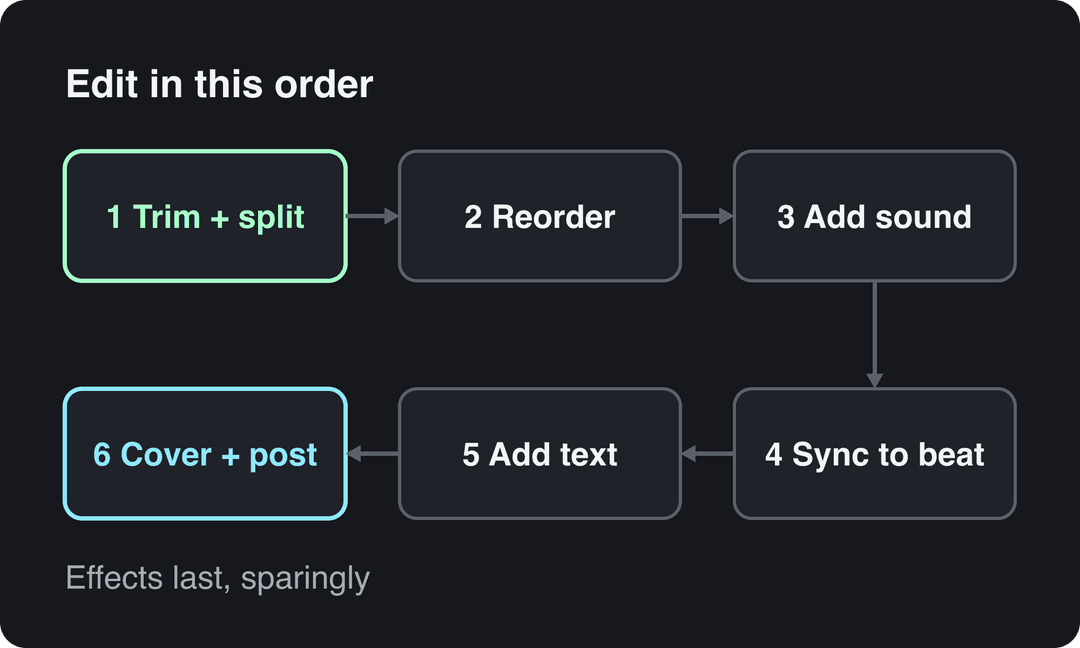
How to trim, split and reorder clips
Trim
In the timeline, drag the handles at either end of a clip. Start on movement or the first spoken word, never on you reaching to start the recording. End the moment the point is made.
Split
Move the playhead to the exact frame where a mistake starts, tap Split, then do the same where it ends and delete the middle piece. This saves a good take that has one stumble in it.
Reorder to build the story
Press and hold a clip, then drag it to its new position. Reordering is how you put the payoff first. For a DIY project, open on the finished result, then show the before and the steps. Viewers stay to see how you got there.
Jump cuts for talking videos
The jump cut is the default style for tutorials, storytimes and talking heads. Film in one long take, then split out every pause, breath and "um" so each sentence starts the moment the last one ends. Keep the camera in the same position so the cuts look intentional. A simple decision rule: if a sentence adds neither information nor a laugh, cut it.
How long should a TikTok video be?
Length matters less than people think. In Revid's 12-month analysis, every length bucket from under 15 seconds to 10 minutes had a median between 58K and 76K views. Videos under 15 seconds had the lowest median (58K) but the most shares per view, 1.41 per 100 views, while 61 to 90 seconds reached 70K.
Length alone barely moves views: every bucket lands between 58K and 76K median views (the 790 videos over 10 minutes are a small, unusual group). Clips under 15 seconds get shared the most per view.
Source: Revid analysis of 176,367 TikToks with 1,000+ likes posted between Oct 1, 2025 and Oct 16, 2026 (61,203 creators)
Show the data
| Median views | Share that passed 1M views | Shares per 100 views | |
|---|---|---|---|
| Under 15 s | 57.6K | 11.6% | 1 |
| 16 to 30 s | 64.9K | 12.3% | 1 |
| 31 to 60 s | 61.8K | 11.8% | 1 |
| 61 to 90 s | 70.5K | 12.2% | 1 |
| 91 s to 3 min | 63.4K | 11.1% | 1 |
| 3 to 10 min | 76.4K | 12.4% | 1 |
| 10 min+ | 129.6K | 13.8% | 0 |
Cut to the length the idea needs, not to a target:
- If the video is one joke, one reveal or one tip, keep it under 15 seconds. Short videos get shared the most.
- If it teaches or tells a story, take the time it needs, and cut every second that doesn't move it forward.
- If you are in TikTok's Creator Rewards Program, only videos at least one minute long earn. Edit those to just past a minute with real content rather than padding.
Prompt to try
Make a 15-second vertical TikTok on one quick kitchen tip: how to peel garlic in 10 seconds by shaking cloves in a jar. Open with the on-screen hook "Stop peeling garlic by hand", keep the voiceover to one or two short lines, and use fast cuts with bold captions.
How to add sound and sync your cuts to the beat
Tap Add sound at the top of the preview screen to browse the library on TikTok, or start from a sound you saved. Trending audio puts your video in front of people already watching that sound, so check the viral TikTok songs right now before you pick.
To sync cuts to the beat:
- Play the sound a few times and note where the beats and drops fall.
- Trim each clip so the cut lands exactly on a beat, and put your biggest moment (the reveal, the outfit change, the punchline) on the drop.
- If your app version offers an automatic sync to the beat, use it as a first pass, then adjust the clips by hand.
- Open Volume to balance the music against your original audio or a voiceover recorded with the Voiceover tool.
How to add text overlays people can actually read
Tap Text, type your line, then pick the font, color and background. A background box behind the text keeps it readable on busy footage. Then tap the text, choose Set duration and drag the start and end so each line appears exactly when it is relevant, such as an ingredient name popping up as it hits the bowl.
Three rules for text that works:
- Put a hook on screen in the first second. Templates: "Stop doing X if you want Y", "The cheapest fix for X", "POV: you finally figured out X", "Nobody tells you this about X".
- Keep text out of the bottom and right edges, where the caption, username and buttons sit. Check your layout with the free TikTok safe zone checker.
- Caption your speech. TikTok's built-in captions turn your speech into subtitles; proofread names and numbers before posting. For styled, animated captions, use a TikTok subtitle generator.
Effects, green screen and transitions
Tap Effects to open the library, sorted into tabs such as Trending, New and Green Screen. The Trending tab is where to start: an effect that is spreading right now gives viewers something familiar. You can also see what is rising on TikTok trends today.
Green screen
Green screen puts any photo or video from your camera roll behind you, which makes it ideal for reactions, commentary and explaining something with a visual. In Revid's short-form video statistics, green-screen memes had a median of about 204,000 views among 21,037 TikToks classified by format, about 2.2x the 91,000 of talking-head videos.
Filter trends come and go fast. Niche ones like the color analysis filter trend on TikTok show that a filter can be the whole premise of a video when it gives viewers a result they want to see. Use an effect when it is the point of the video or makes it clearer, not as decoration.
Transitions
After two clips are next to each other on the timeline, tap the small icon between them to choose a transition. Pick one or two styles for the whole video and use plain cuts everywhere else: a flashy transition between every clip looks amateur. Match the transition to its job:
- Spin: an outfit change or before-and-after reveal.
- Glitch: impact on a punchline or a chaotic moment.
- Slide, Zoom and Fade: clean scene changes that don't call attention to themselves.
Match cuts and speed ramps
A match cut links two different scenes through a shared shape, color or motion: a ball thrown into the air cuts to the sun in the same spot of the frame. Plan it while filming by framing both shots the same way, then cut on the matching frame. Viewers rewatch to see how it was done.
Speed changes set the mood. Use Speed to slow a clip down for a reveal or to speed up a long process (a recipe, a painting, a room makeover) into a few seconds. A speed ramp, slowing down or speeding up within one clip, works best right before and after the key moment.
https://www.youtube.com/embed/i1a0yOcyYkI
Editing technique only takes a video so far. For the strategy side, this breakdown of how Stanley cups became a TikTok sensation shows how a format, a product and a trend combined.
Cover, caption, hashtags and export settings
Cover. On the post screen, tap the cover and pick a sharp frame that shows what the video is about, then add short text if the frame alone is unclear. TikTok's default frame is often a blurry transition.
Caption. Short captions with a point do best. In Revid's TikTok analysis, captions of 41 to 80 characters had the best median (67K views), while videos with no caption had 36K. Write one line that adds context or asks a question, or draft options with the free TikTok caption generator.
Hashtags. In the same data, posts with 4 hashtags had the best median (77K views) and 3 hashtags 75K. No hashtags reached 51K and 9 or more only 16K. Use 3 or 4: one broad tag for the topic (#DIY) and two or three specific ones (#ikeahack).
AI label. If your video contains realistic AI-generated images, audio or video, TikTok requires you to turn on the AI-generated content label. TikTok states that the label does not affect distribution for videos that follow its Community Guidelines.
| Setting | What to use |
|---|---|
| Aspect ratio | 9:16 vertical |
| Resolution | 1080x1920, as TikTok's Creator Academy recommends |
| Maximum length | 60 minutes uploaded, 10 minutes recorded in the app |
| Upload from a computer | TikTok Studio Web takes 1080p, 2K or 4K, files up to 30 GB |
| Frame rate | Keep your source frame rate; TikTok's posting API accepts 23 to 60 FPS |
When to edit outside the TikTok app
TikTok's editor handles single videos well. Move to another editor when you need multiple tracks, keyframes or precise color work, or when you post the same video to Reels and Shorts. CapCut is the usual next step for editing footage you filmed: its free tier includes 1080p export and auto-captions, and its trend templates plug your clips into popular formats. See how it compares in Revid vs CapCut, or browse the best video editors for TikTok.
Editing outside the app also gives you a clean master file. Export it once, then upload the same file to every platform.
How to edit a TikTok with Revid
If you film talking videos and want the first cut done for you, Revid's auto edit video tool handles it:
- Upload your talking video or paste a link.
- Revid returns an edited version with your key lines turned into motion graphics.
- Open it in the timeline editor to adjust any scene, change the music or pick one of 30 caption styles.
- Export in 720p, 1080p or 4K at 30 or 60 fps, or publish and schedule it straight to TikTok.
If you have no footage, Revid can also generate the whole video from a script or a link, with voice-over and synced captions.
FAQ
Can I edit a TikTok after I post it?
No, the video itself (clips, sound, text and effects) is locked once it is live. Open the post's menu to see which settings your app version lets you change, such as privacy. To fix the video, delete it and repost a corrected version from your draft or original file.
How do I save a TikTok without the watermark?
Edit the video in a separate editor such as CapCut or Revid and keep that exported file: it never had a watermark, so you can upload it straight to Reels or Shorts. Screen recording works in a pinch, but it lowers quality and captures the app interface.
What is the best app to edit TikTok videos?
TikTok's built-in editor is enough for trims, sound, text and effects on single videos. CapCut is a better fit for precise edits of your own footage. Revid is the better fit when you want a video auto-edited or generated, then published for you.
Can I edit a TikTok draft?
Yes. Open your profile, tap Drafts and select the video to reopen it, then change its edits, caption or cover before posting.