On this page
Virality grows when viewers find a video relevant, keep watching, and feel it delivered on its promise. Emotionally distinctive ideas can stand out, but a thumbnail alone cannot create that audience fit.
A strong title and thumbnail may win a click; the video still has to satisfy the people it attracts. And a spike in Shorts views does not necessarily mean viewers will return for another upload. A viral Short and a channel that keeps its audience are different outcomes. The useful question is whether each choice, from the first glance to the final moment, matches what viewers came to see.
How a YouTube Video Actually Goes Viral
A YouTube video spreads through repeated audience tests, not one lucky break. The platform offers the video to viewers it thinks may be interested, reads how they respond, then adjusts who sees it next. A weak result can slow distribution at any point in that loop.
Imagine a creator uploads a practical video about repairing a loose chair leg. The system first needs to find people who might care. What happens next is a sequence of viewer choices, not a guaranteed march toward a viral view count.
- Impression: The video appears on a viewer's Home page, in suggested videos, or somewhere else YouTube recommends content. That appearance is an opportunity, not a view.
- Click: The viewer decides whether the title and thumbnail make the video relevant enough to open. If the package attracts the wrong people, a click may not turn into a meaningful watch.
- Watch: The creator has to deliver on the premise. YouTube considers both average view duration and average percentage viewed, which show how long people watched in minutes and what share of the video they watched.
- Satisfaction: Viewers' choices, likes, dislikes, and other feedback help indicate whether the video met their expectations. Strong responses can support another, broader test.
Here's that process at a glance.
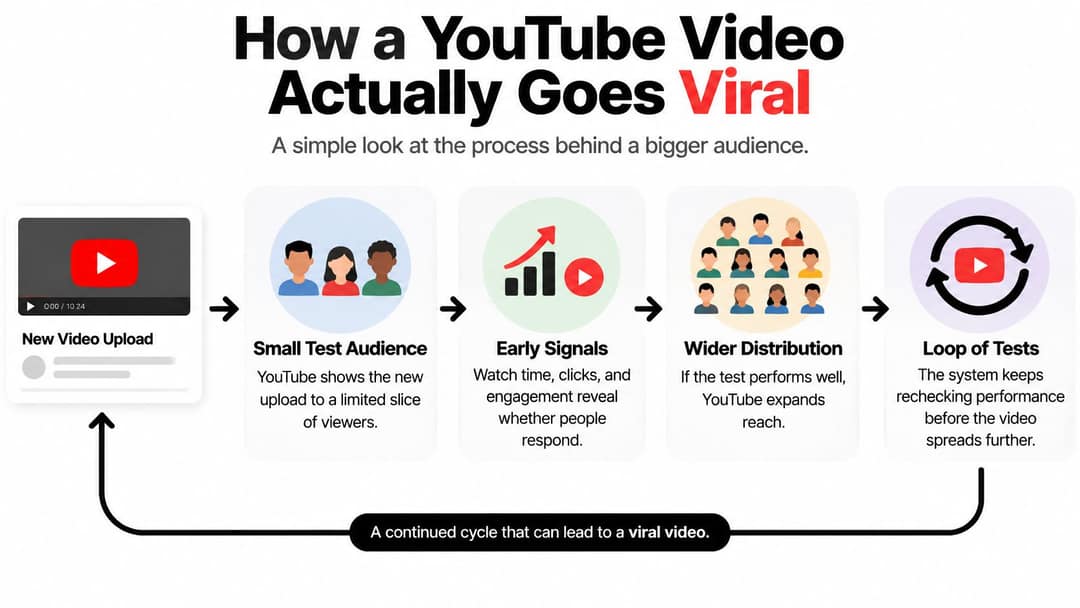
A failure at any point can limit the next round. A confusing thumbnail can lose the click; a slow opening can lose the viewer; a payoff that doesn't match the promise can leave viewers dissatisfied. Views alone don't reveal which part broke.
The audience changes the test
There isn't one fixed audience that every video has to win over. YouTube personalizes recommendations using signals such as a viewer's watch and search history, device, time of day, and prior habits. The chair repair video might interest people who watch home-improvement tutorials, but not viewers looking for fast comedy on a phone.
Google's YouTube recommendation guidance describes signals that include what viewers watch, ignore, search for, like, dislike, or mark “Not interested,” alongside how much they watch and whether they seem satisfied. It also distinguishes between video lengths: relative watch time generally matters more for short videos, while absolute watch time matters more for longer videos.
That length distinction isn't a target to game. A short video has little time to earn attention, so losing a large share of viewers early is a warning. A longer video can earn substantial viewing time even if each person watches a smaller share of the total runtime. In either case, the useful question is whether the intended viewers got what they came for.
The next decision is not “How do I get more clicks?” It's “Which viewer signals show that this video deserves a wider audience?”
The Signals That Decide If Distribution Widens
Virality is an audience-fit and satisfaction problem, not a click-through-rate contest. A high click-through rate can mean the package attracted interest, but it doesn't establish that the people who clicked wanted the video they received. YouTube describes a broader set of recommendation signals, including whether people choose or ignore a video, how much they watch, their likes and dislikes, and post-watch satisfaction surveys, as explained in its guidance on recommendations.
Use the signals as a diagnostic rather than treating any one of them as a universal algorithm hack.
| Signal | What a healthy result looks like | What stops the next round |
|---|---|---|
| Choose, ignore, or Not interested | Viewers in the test pick the video instead of skipping it | Many mark “Not interested” or scroll past |
| Impression click-through rate | The title and thumbnail win clicks from the intended audience | Clicks come from people who don't want the topic |
| Average view duration | Longer videos earn substantial absolute minutes | People leave before the payoff |
| Average percentage viewed | Shorter videos hold a high share of their length | Viewers abandon the video in the opening |
| Likes and dislikes | Positive votes line up with people who watched through | Dislikes or little positive response follow a clickbait opening |
| Post-watch satisfaction | Viewers feel the video delivered what it promised | Surveys and behavior suggest the promise was missed |
Read the combination, not one number
A thumbnail with an outrageous claim might lift clicks, but if the video opens with unrelated setup, the people it attracted may leave. In that case, more clicks haven't solved distribution. They've sent the system a weak match between promise and experience.
The reverse can happen too. A video may satisfy a small group of viewers who would have watched it anyway, while its packaging fails to persuade new people to try it. That's not proof the video is bad. It suggests the intended audience may not recognize the value from the impression they see.
Click-through rate also needs context. A package can perform differently with loyal viewers than with people seeing the channel for the first time. It can shift by traffic source, device, timing, and the audience YouTube is currently testing. So don't compare every upload against one magic percentage or assume a change means the creative suddenly improved or declined.
Practical rule: If clicks are high but the audience doesn't stay or respond well, check audience fit and the video promise before making the thumbnail louder. If the right viewers never click, the package may be failing to explain why the video is for them.
A precise promise aimed at a specific viewer can look less sensational at first and still earn a better test. The goal isn't to attract everyone regardless of intent. It's to help the right people recognize the video and then give them a reason to feel that choice was worthwhile.
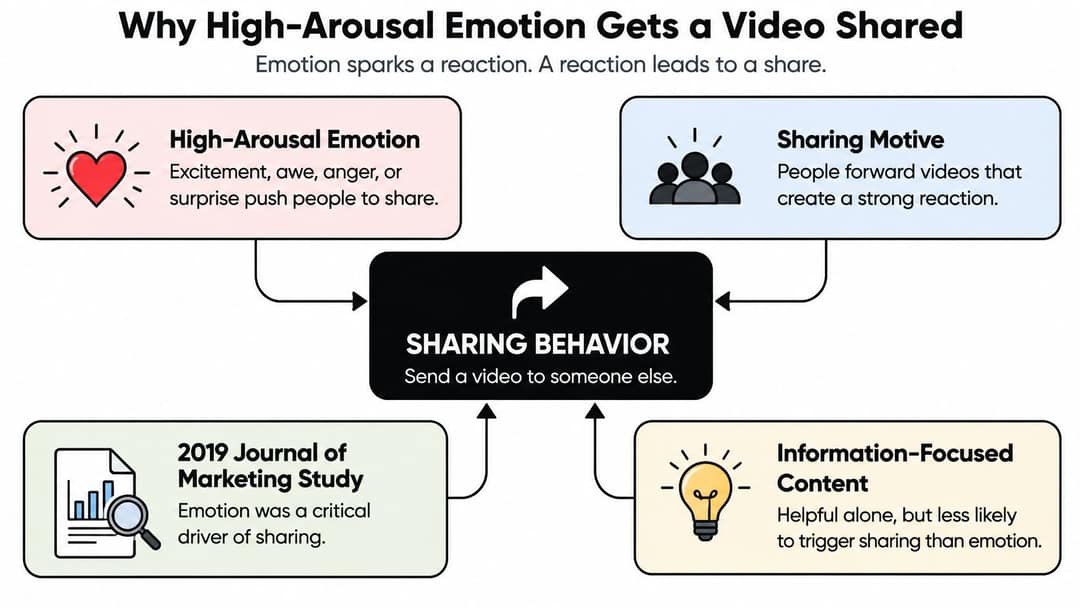
Why High-Arousal Emotion Gets a Video Shared
A viewer may remember a useful fact, but a strong reaction gives them a reason to pass the video along. Delight, suspense, surprise, inspiration, outrage, and awe can all create that impulse. The reaction need not be positive. It needs to give the viewer something they want another person to experience.
A 2019 Journal of Marketing study found that emotion played a key role in sharing, while information-focused content generally reduced sharing unless the product was new or expensive. The American Marketing Association's summary of the findings highlights excitement, inspiration, amusement, and warmth, along with dramatic plots, surprising developments, and appealing characters such as celebrities, babies, and animals.
Information can be a note someone saves for later. A high-arousal moment is more like a story they hand to a friend. A clear tutorial can be useful without prompting a share; a surprising repair, joyful reveal, or funny failure can teach something while also giving viewers a reaction to pass on.
Input
Why can you pull a seatbelt slowly, but it locks during a sudden stop? Show the retractor mechanism and the consequence in a fast stylized 3D explainer.
Output
Intensity can matter more than whether the feeling is positive
Research on video sharing suggests that strong emotional intensity can drive sharing more than whether the feeling is positive or negative. That helps explain why suspense, humor, awe, outrage, and meaningful human stories may travel, while a video that only lists facts may not create the same urge to share.
The emotion still has to fit what the video delivers. A small-business owner explaining a hard-won lesson might build warmth or inspiration through a personal story. A science creator might create awe by showing a result before explaining the method. The emotional entry point should suit the subject, not overwhelm it.
The American Marketing Association's research summary reports that only 7% of YouTube video advertisements evoke strong positive emotions. That figure is about video ads, not every video on YouTube. It suggests that emotionally distinctive ideas may stand out when ads rarely take that approach.
A viral share is one kind of audience response, not proof that a channel will keep viewers. The idea still needs to fit the audience and offer a satisfying experience beyond its emotional hook. Before scripting the details, ask whether a stranger could feel something from the premise alone. If not, the idea may be informative, but it may not yet give viewers a reason to pass it along.
How the Click and the Opening Stay Honest
A thumbnail can earn a click, but only the video can confirm the promise. The title, thumbnail, and opening work as one package: the package attracts a viewer, and the first moments show whether the video delivers what that viewer expected. A mismatch can bring in clicks from people who leave quickly, while a clear, honest promise helps the right audience recognize the video is for them.
An academic analysis found that higher click-through rate was significantly associated with more YouTube views, while higher retention percentages and average watch time per view had a more limited relationship with views in that dataset. The estimated marginal effect for higher click-through, scaled by subscribers, was 71 to 318 times larger than the marginal effect for increased watch time per view, according to the analysis of YouTube views and engagement. This is a finding about that study's analysis, not a reason to chase clicks at the expense of the video. Distribution depends on both the decision to click and the experience that follows.
Prompt to try
Make a 35-second vertical YouTube Short showing how to fix a wobbly chair leg in under five minutes. Open on the finished, rock-solid chair with the line "This chair wobbled for two years, here's the 5-minute fix," then show each step with close-up footage. Clean, practical style with bold captions and a calm, confident voice.
Make the promise specific, then prove it
A title that promises “the fastest fix” may attract attention. If the opening then wanders through general background instead of showing the fix, viewers may decide the video is not what they expected. The reverse can happen too: a useful video with an unclear title and thumbnail may struggle to attract viewers, leaving its content with fewer chances to meet the right audience.
Research has associated emotionally clear thumbnails with higher view counts, and found a relationship between title punctuation and clicks. These are associations, not a recipe to add dramatic expressions or punctuation to every package. Choose a visual cue that makes the idea easier to understand, and use punctuation only when it fits the title's tone. The thumbnail is a signpost, not a substitute for the video.
Build the package and opening together:
- Write one sentence that states the payoff. If the video shows how to repair a chair leg, say what repair viewers will learn. A vague promise of a “mysterious secret” gives them less reason to trust the click.
- Give the thumbnail one clear feeling or idea. A single visual clue is easier to read than a collage of unrelated expressions, arrows, and claims. For practical guidance on making the artwork legible in its intended format, see this YouTube thumbnail size guide.
- Validate the promise at the start. Show the problem, result, or first meaningful step before logos or background details delay the premise.
Then compare click-through by traffic source and audience familiarity. A regular viewer and someone encountering your channel for the first time may read the same package differently. If a video is promoting a product, marketing teams may also need to understand what happens after someone sees an ad without clicking. This guide explains how view-through attribution works, a separate measurement question from whether YouTube viewers choose to click and stay.
A strong package can help a video reach an audience, but it cannot make every viewer a lasting channel viewer. The goal is to earn the click with an accurate promise and make the opening prove it.
How to Read the Retention Curve
A retention curve is a diagnostic, not a trophy. It shows where viewers leave, which moments hold attention, and whether people watch through. YouTube says creators can use retention curves to see early exits, drops at specific points, and completions, then adjust a video's length for its audience and content type in its audience retention guidance.
Don't look only at the final average. Two audiences can produce a similar average while behaving very differently: returning viewers may stay through the full explanation, while people arriving from a broad recommendation leave early. When possible, compare retention by device, geography, traffic source, and new versus returning viewers.
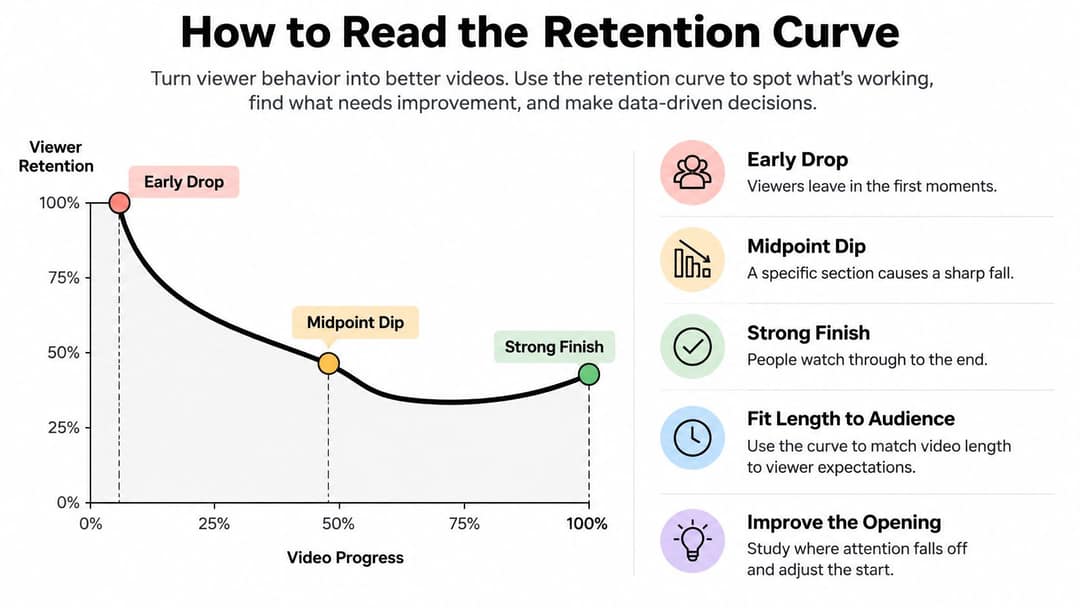
Read the shape, then change the part it identifies
Use the curve to locate a visible behavior and connect it to a likely editing cause.
- Check the opening. A sharp early drop can mean the premise takes too long to appear. State the payoff quickly and remove branding or setup that delays it.
- Find the first substantial dip. If viewers leave during an explanation, look for a confusing sentence, a missing visual, or a stretch of dead air. If the drop follows a sudden change in topic, the transition may have lost them.
- Look for a spike. A spike can indicate that viewers replayed a moment or found it especially shareable. Ask what made that moment clear, surprising, useful, or visually satisfying, then consider whether that structure belongs in a later video.
- Check for a strong finish. If viewers stay to the end, identify what the final stretch delivers. A clear result or payoff can make the preceding explanation feel worthwhile.
- Compare audience segments. A healthy overall line can hide a cold-traffic collapse. If new viewers leave early while returning viewers stay, don't assume the video works equally well for both groups.
- Change the section the curve indicts. Shorten, clarify, or restructure that part, then compare the next upload's early hold and relevant audience segments rather than judging by total views alone.
The point isn't to cut every pause or speed up every sentence. Some viewers need enough explanation to understand the method, and some subjects require a slower demonstration. The curve helps you see whether a segment is doing useful work for the intended audience.
For a practical test, create more than one opening for the same core idea. Keep the body and promise consistent while changing the opening's route into the subject, then compare how new viewers respond. Reuse the structure that holds attention; don't copy the topic of a trend without understanding what made its audience stay.
When a Viral Short Fails to Build the Channel
A Short can attract a burst of views and still send almost nobody to the channel's next video. That isn't necessarily a failed Short. It may have succeeded at reach while doing little to build an audience for anything beyond that one moment.
There's another reason to be careful with completion figures. Reporting on Shorts benchmarks notes that feed loop-back behavior can distort retention, so a viewer seeing the opening again isn't automatically proof that they were satisfied. The Shorts benchmarks discussion also frames sustainable growth as a question of whether Shorts attract viewers who return for long-form videos, products, or business content, rather than just people who watch once.
Choose the job before you write the hook
A reach Short aims to stop a viewer in a fast-scrolling feed. A trailer Short aims to attract someone who's likely to watch a related long video. A business Short may have a different goal again: connecting a specific viewer problem to a useful next step.
| Job of the Short | Hook | Call to action | Metric that matters |
|---|---|---|---|
| Reach | Pattern interrupt in the first second | None, or a light follow | Views and replays, while remembering loops can inflate retention |
| Trailer for a long video | The same promise as the long video | End screen or pinned long video | Returning viewers and subscribers who watch the long video |
| Business or product | A viewer's problem, not a generic trend | One next step tied to that topic | Qualified actions, not completion rate alone |
| Mismatched trend | A broad trend the channel doesn't own | Subscribe | High views with almost no later watches |
Say a faceless channel about personal finance follows a broad comedy trend because it's getting attention. The Short picks up views, but the next practical finance upload attracts little interest. That's a sign the trend may have reached people who enjoyed the format without wanting the channel's deeper subject. A small business can face the same problem if its most-viewed Short entertains a broad audience but attracts few potential customers.
The job sets the metric. A reach Short can be useful even if it doesn't send viewers into a series. A trailer has to connect its hook and next step to the long video it's meant to support.
For Shorts that are meant to build a channel, watch for return behavior and topic continuity. Are viewers who subscribed after the Short watching later long-form uploads? Do they click through to a related video or take a relevant business action? Views and completion alone can't answer those questions. Design the Short for its intended outcome, then judge it by whether it creates the next viewer behavior you need.
Ride a Trend Without Losing the Audience
A trend can bring new viewers to your channel, but the format's audience may not care about your subject. The useful test is whether those viewers have a reason to watch again.
Check three things before building a video around a trend:
- Overlap: Compare the trend's likely viewers with the people who watch your longer videos. Little overlap can mean a view spike without later interest.
- Payoff: Make sure your video delivers the hook, whether it's surprise, humor, or awe. If viewers leave once they understand the premise, the trend may be a poor fit.
- Ownership: Give the format something only your niche can contribute. A specific explanation, perspective, or demonstration makes the trend feel like it belongs on your channel, rather than like a copy anyone could make.
Then judge the result by audience fit and satisfaction. High click-through from new viewers alongside weak watch behavior suggests the trend or its presentation drew the wrong people. A smaller group that watches and responds well may be more valuable than a larger audience that leaves after the clip.
“Gangnam Style” shows how far a trend video can travel: it reached an enormous audience. That kind of reach is a possible outcome, not a repeatable formula. Use trends to test a format or timing, then ask whether the viewers they attract have a reason to stay with your channel. A viral Short and a channel that keeps viewers are different outcomes.
Prompt to try
Create a 30-second vertical Short for a personal finance channel using the "things I stopped buying" trend, but with a twist only this niche can add: show the real yearly cost of each item. Hook: "I stopped buying these 5 things and saved $3,100 this year." Fast cuts, on-screen numbers, energetic voiceover, and end by pointing to a full budgeting video.
Match the Next Video to the Audience That Stayed
For your next upload, choose one clear outcome: earn a wider test from viewers who already respond to your topic, or make a Short that brings the right viewers into a specific long video. Trying to do both with one vague promise makes it harder to understand what worked.
Build the next video from evidence you can act on:
- Name the viewer and the feeling. Write one sentence that identifies who the video is for and what reaction or result it should deliver. “First-time gardeners who want to feel confident pruning” is more useful than “everyone who likes plants.”
- Study videos that already hold that viewer. Note the hook, pace, and payoff. Look for a structure you can learn from, not a topic or surface trend to copy.
- Run the trend check. Confirm that a trend's audience overlaps with the viewers you want and that the video can deliver its promise without forcing the format.
- Draft a few openings for different intents. One might lead with the problem; another might show the result first. Keep the version your footage pays off.
- Publish and read the right signals. Check click-through from relevant traffic sources, early retention among new viewers, and signs of satisfaction or return behavior. A view count by itself won't tell you whether the next upload reached the people you want.
- Change the right part when the result is weak. If the right viewers click but leave, revise the audience promise or opening before making another thumbnail. If they don't click, make the package clearer for that audience.
For creators researching a niche before writing, Revid's Viral Search finds top-performing videos in a niche and shows why they land. Its script writer studies a viral video's hook, structure, and pacing before drafting a new script. To start, a user can type an idea, paste a link such as a website, product page, YouTube video, article, or song, or pick a proven video from the library.
A repeatable production process can make those comparisons easier to run; this guide to save hours on content production offers ideas for organizing the work. Keep the editorial decision in your hands: choose one audience, make one honest variation, and learn from the response before chasing a broader trend.
Revid helps creators research viral formats, turn ideas or links into scripts and videos, and prepare content for social channels. Use it to develop a few audience-specific openings for your next upload, then visit revid.ai to explore the workflow.