
On this page
To go viral on YouTube, a video has to win the click and then keep people watching. That means a title and thumbnail that make one clear promise, a hook in the first seconds that delivers it, and pacing that holds viewers. Strong click-through and watch time then push the video to Home, Suggested and the Shorts feed.
Shorts are where a small channel has the best odds. Socialinsider's 2026 study of 69 million short-form videos found that accounts with under 5,000 followers averaged 15,160 views per YouTube Short, against 625 per Instagram Reel and 350 per TikTok. The common mistake is doing things in the opposite order: polishing long videos for months before testing a single idea as a Short.
This guide is about YouTube specifically. For advice that applies to any platform, see our guide on how to make videos go viral.
What makes a YouTube video go viral?
A video goes viral on YouTube when viewer behavior tells the recommendation system to keep showing it. YouTube shows a new upload to some viewers, measures whether they click and how long they stay, and widens the audience when the answers are good. Each round of viewers who click and keep watching earns the video a bigger round.
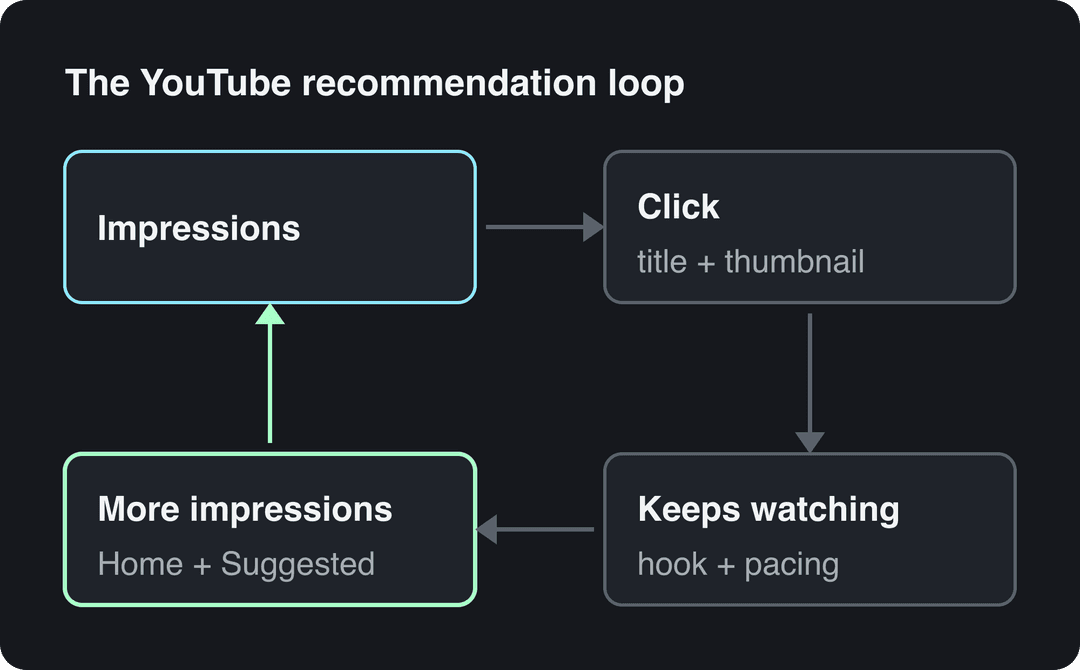
So going viral is not one lucky break. It is a loop that keeps turning because every step works. These traits make each step easier:
| Trait | What it looks like on YouTube |
|---|---|
| Strong emotion | Laughter, awe, outrage or a moving moment viewers want to pass on |
| Relatability | A situation viewers recognize from their own life or work |
| Novelty | A new angle, an odd experiment or a result nobody expected |
| Timeliness | A fresh take on a trend, release or event while people are searching for it |
| Clarity | Clean audio, readable text and a premise you can explain in one sentence |
| Tight length | Every second earns the next one; nothing worth skipping |
None of these replace the loop. A hilarious video with a vague title never gets the click, and a perfect thumbnail on a slow video gets the click and then loses the viewer.
How to make your YouTube video go viral, step by step
Start from a format that already works
The fastest way to find a winning idea is to look for outliers: videos that got many times their channel's usual views. On any channel page, open Videos or Shorts and sort by Popular. When one video beats the rest of the channel by a wide margin, the topic or format did the work, not the subscriber count.
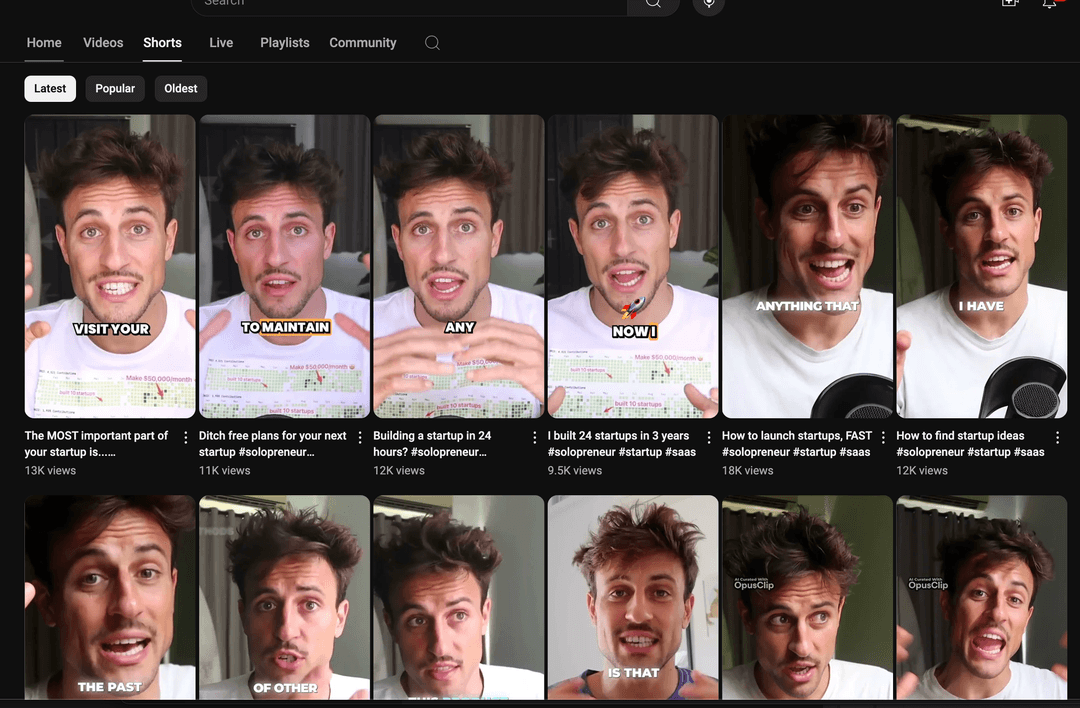
Then add your own angle: a different audience, a stronger result, a faster version or a contrarian take. To see which formats break out at the very top, browse the most viewed YouTube Shorts.
Write the title and thumbnail before you film
If you cannot write a title someone would click, the video is not ready to make.
- One specific promise. "Why your sourdough comes out flat (and the fix)" beats "Sourdough tips".
- Key words first. Titles can be up to 100 characters, but phones cut them off long before that, so the first words carry the click.
- Numbers or a question often make the promise concrete.
- One subject on the thumbnail, with a visible emotion or result and a few words of text that add to the title instead of repeating it. Check that it still reads at phone size.
- Specs. Custom thumbnails need a verified account. YouTube recommends 3840x2160 (minimum width 640 px), with files up to 50 MB on desktop or 2 MB on mobile.
- Test. Test & Compare in YouTube Studio on desktop tries up to 3 titles and thumbnails and keeps the one with the highest watch time. Shorts are not eligible.
A YouTube title generator gives you a batch of options to test against your own.
Hook viewers in the first seconds
Open on the payoff, the problem or the most surprising frame, never on a greeting. Hook templates that work across niches:
- "Most people do [X] wrong. Here's the version that works."
- "I tried [unusual thing] so you don't have to."
- "This [item] is cheap. This one is expensive. Here's the difference."
- "If you [specific situation], watch this before you [action]."
The hook must match the title and thumbnail. Viewers who clicked for a promise leave the moment the opening drifts away from it.
Prompt to try
Make a 30-second vertical YouTube Short that opens with the hook "Most people store coffee beans wrong. Here's the version that keeps them fresh." Show the common mistake, then three quick fixes with a text line on screen every few seconds. Use a fast, friendly voiceover, close-up kitchen shots and bold captions, and end on the payoff shot of a fresh brew that loops back to the opening.
Pace the video for retention
- Cut pauses, false starts and setup that never pays off.
- In Shorts, change something on screen every few seconds: the angle, a text line or a cutaway.
- Open a loop early (tease the best moment) and pay it off late.
- End on the payoff, not a long goodbye. In Shorts, an ending that flows back into the opening invites a rewatch.
- Add captions for viewers who watch with the sound off.
Fill in the description, tags, cards and end screens
Descriptions can run to 5,000 characters, but the first lines matter most: put the main search phrase and the promise there. Tags are capped at 500 characters in total and play a small role, so do not spend long on them. A YouTube description generator drafts the structure quickly. Then add cards and an end screen that send viewers to your next most relevant video, so one viral hit lifts the rest of the channel.
Promote it where your audience already gathers
- Post a teaser or clip on TikTok, Instagram and X, cut for each platform rather than cross-posted unchanged.
- Share in subreddits and forums only where the video answers a question people are asking, and read each community's rules first.
- Collaborate with creators in neighboring niches: a joint video exposes each channel to an audience that already trusts the other.
Reply to comments and post between uploads
Reply to comments in the first hours, when the video is being tested on new viewers. Pin a comment that asks a question people want to answer. Use the Posts tab for polls and teasers, and turn the best questions in your comments into your next videos.
Read your analytics and change one thing at a time
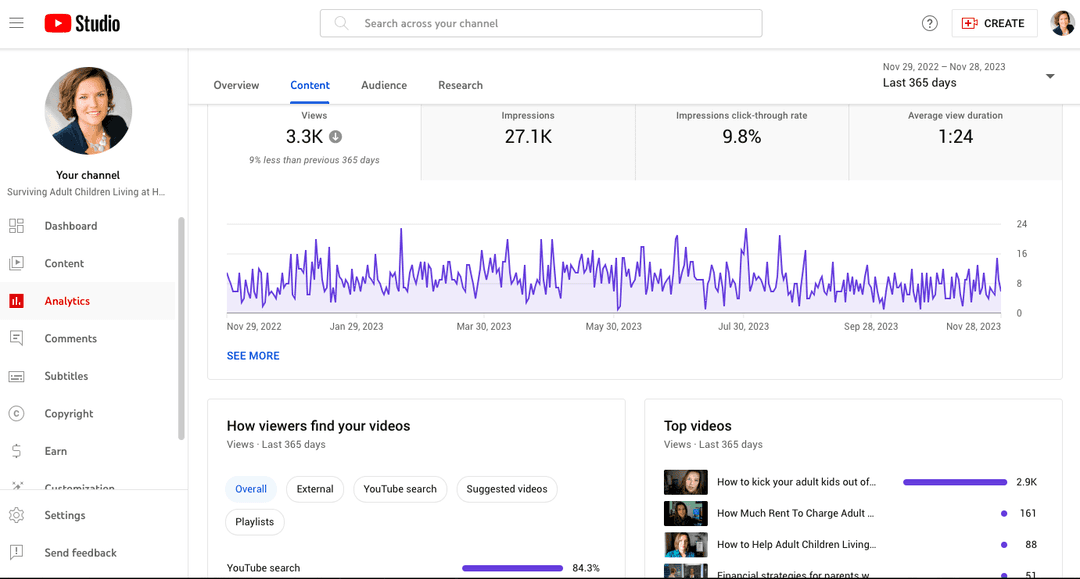
| What you see in YouTube Studio | Likely problem | What to change |
|---|---|---|
| Plenty of impressions, low click-through rate | Packaging | New title or thumbnail; test variants with Test & Compare |
| Good click-through rate, viewers leave early | The hook does not match the promise | Open on the payoff in your next video |
| Good clicks and retention, few impressions | Topic too narrow | Try a broader angle or a Short version |
| Most views from YouTube search | You answered a real search | Make follow-ups on related questions |
Which formats and emotions spread fastest
In Revid's analysis of 176,367 TikToks with 1,000+ likes posted between October 2025 and October 2026, challenges had the highest median views (182K, with 25.6% passing 1 million), followed by comedy (155K) and reactions (105K). Storytelling (66K) and tutorials (62K) sat close to the overall median of 64.4K. This is TikTok data, not YouTube, but Shorts compete for the same swipe, so it is a useful signal for which formats to test first.
Challenges and comedy passed 1M views about twice as often as tutorials and storytelling, which are the most common formats.
Source: Revid analysis of 176,367 TikToks with 1,000+ likes posted between Oct 1, 2025 and Oct 16, 2026 (61,203 creators)
Show the data
| Median views | Share that passed 1M views | |
|---|---|---|
| Challenge | 182.3K | 25.6% |
| Comedy | 154.8K | 22.1% |
| Reaction | 104.8K | 16% |
| Dance | 83.8K | 15.5% |
| Storytelling | 66.1K | 12.2% |
| Lip Sync | 61.7K | 12.3% |
| Tutorial | 61.9K | 12.1% |
Emotion showed a similar pattern. Videos whose dominant mood was outrage had a 156K median (23.7% passed 1 million) and humor videos had 121K, while inspirational videos had 45K. On YouTube, use outrage as a strong reaction to a real problem, not as rage bait that breaks your title's promise.
High-arousal emotions (outrage, humor, sadness) earned the most views. Calm, inspirational videos earned the least, even though they collect the most likes per view.
Source: Revid analysis of 176,367 TikToks with 1,000+ likes posted between Oct 1, 2025 and Oct 16, 2026 (61,203 creators)
Show the data
| Median views | Share that passed 1M views | |
|---|---|---|
| Outrage | 156K | 23.7% |
| Humor | 121K | 19.3% |
| Sadness | 104.4K | 16.5% |
| Excitement | 92.5K | 15.9% |
| Joy | 89.9K | 18% |
| Informative | 64.1K | 11.2% |
| Neutral | 61.2K | 11.5% |
| Inspirational | 44.6K | 11.3% |
Keep the limits in mind: the sample only includes TikToks that already reached 1,000+ likes, the figures show what high performers have in common rather than what causes success, and format and mood labels come from Revid's AI analysis of each video. The method and every chart are in the full study, what makes a TikTok video go viral.
How to go viral on YouTube Shorts
Shorts are the biggest reach engine on the platform: YouTube said in August 2026 that Shorts get over 200 billion daily views, and Tubular Labs found that 77% of global YouTube views in 2025 came from videos under a minute long. More figures are in our YouTube Shorts statistics. The competition is real too: more than 10 million channels were publishing Shorts each day as of March 2026.
- Length. Square or vertical videos up to 3 minutes, uploaded on or after October 15, 2024, count as Shorts. Use the length the idea needs; most viral Shorts state their premise immediately.
- Music. Most Shorts Audio Library songs can be used for up to 90 seconds, and some tracks are limited to 60 or 30 seconds. Any Short longer than one minute with an active Content ID claim is blocked globally, so keep claimed music on Shorts under a minute.
- Thumbnails. Verified accounts can upload a custom Shorts thumbnail in YouTube Studio on a computer (9:16, 2160x3840 recommended). On the home, explore and subscription pages, vertical videos get an auto-generated 4:5 thumbnail instead of a 16:9 one.
- Volume and mix. AIR Media-Tech's study of 18,000 channels found the best results when Shorts made up 25% to 40% of a channel's uploads.
- Clips from long videos. Your best long-form moments are ready-made Shorts. Revid's YouTube clip maker turns a long YouTube video into vertical clips from its link.
How to make your music video go viral on YouTube
Cut the song's strongest section (the chorus or the most quotable line) into Shorts, with that moment in the first seconds. YouTube said that in January 2023, artists active on Shorts saw more than 50% of their new channel subscribers come from their Shorts, on average, and fan-created Shorts increased the average artist's audience of unique viewers by more than 80%.
So make the song easy to reuse. When fans remix a music video into a Short, they can sample up to 90 seconds of its audio (some videos are limited to 30 seconds). Put the artist and song name in the title of the full video so searches find it. If you have the track but no footage, Revid's AI music video generator turns an MP3, WAV or Suno link into a beat-synced music video.
Can you go viral on YouTube overnight?
Sometimes, and mostly with Shorts, where a video that holds its first viewers can be pushed to a large audience within days. Long-form videos more often build over weeks through search and Suggested, and an older video can take off months later when its topic gets popular. Since August 24, 2026, YouTube counts a view the moment a video starts to play, so view counts on a breakout video climb fast (monetization still uses engaged views).
What you control overnight is the setup: a tested title and thumbnail, a hook in the first seconds, a Short version and replies to early comments. Never buy views or use view bots: YouTube treats them as fake engagement.
How do you boost views on a video that stalled?
- Check impressions and click-through rate first. If people see it but do not click, change the title or thumbnail.
- Cut the best moment into a Short and link the full video from it.
- Add the video to a playlist and point end screens and cards from your popular videos to it.
- Pin a comment with a question to increase engagement, and reply to every early comment.
- Share it where it answers a live question: a subreddit thread, a forum or a newsletter.
If nothing moves after these changes, the topic is the problem. Note what you learned and make the next video on a sharper angle.
Can you make a video trend on YouTube?
Not in the old sense. YouTube's Help Center no longer describes a general Trending tab; it describes Trending Charts for select categories (Movie Trailers, Music Videos, Gaming), updated roughly every 30 minutes. Aim for the places where views actually come from: Home, Suggested, Search and the Shorts feed.
What makes channels go viral quickly: three examples
MrBeast: a premise that fits in a title
Jimmy Donaldson (MrBeast) built his channel on premises you can explain in one line: extreme challenges and big giveaways. The stakes are visible in the thumbnail, the edits move fast, and many videos end on an emotional payoff. Takeaway: if the premise fits in a title, half the packaging work is done.
Hydraulic Press Channel: one format, endless variations
The channel crushes everyday objects with an industrial press. Every video asks the same built-in question (what happens to this one?) and pays it off with satisfying visuals and sound. Takeaway: a simple, repeatable format beats a string of one-off ideas.
"Charlie Bit My Finger": the unplanned moment
A short home video of a baby biting his brother's finger became one of YouTube's best-known viral clips: genuine, relatable, easy to share and built around a quotable line. Takeaway: you cannot plan accidents, but you can keep filming and post real moments while they are fresh.
Mistakes that keep videos from spreading
- Clickbait that disappoints. A title the video does not deliver gets the click and loses the viewer, which tells YouTube to stop showing it.
- Copying a trend without an angle. The hundredth identical version gets the leftovers.
- Reused content. Reading out text you did not write or reposting others' clips with light edits counts as reused content and cannot be monetized.
- Changing format every video. Viewers who loved one video need a reason to expect the next.
- Giving up after a few uploads. Each video is a test; the data from it is how the next one improves.
Make a viral-ready Short with Revid
Revid starts from videos that already performed instead of a blank prompt. Its library holds about 2.77 million short-form videos and posts with public engagement data, including 73,227 from YouTube.
- Search the library by topic, platform and engagement tier, and open a Short that clearly beat its channel's usual numbers.
- Run the free deep analysis (up to 60 a day). It breaks down the hook, the timed structure and the scroll-stopping moment, with ways to adapt it to your niche.
- Choose "Make it about your topic": Revid keeps the hook style and pacing, writes a new script, and generates the visuals, voice-over, captions and music.
- Fix any scene in the timeline editor, then publish or schedule the Short straight to YouTube.
To remix a Short you found, start with the Repurpose YouTube Shorts tool. To start from an idea or a script, use the AI YouTube Shorts generator. Sign-up is free and new accounts get free credits to try it, no credit card needed; regular creation then uses the monthly credits of a paid plan.
FAQ
How many views do you need to go viral on YouTube?
There is no official number. For a small channel, 10,000 to 100,000 views can count as viral, and many people reserve the word for 1 million+ views. A more useful test is relative: a video with 10x your usual views that keeps reaching people outside your subscribers has gone viral for you.
Do YouTube Shorts or long videos go viral more easily?
Shorts reach new viewers faster, especially on small channels, because the Shorts feed shows videos to people who have never heard of you. Long-form videos spread more slowly through search and Suggested but build watch time and subscribers who stay, so the strongest channels use both.
Does posting time matter for going viral on YouTube?
Less than the video itself. Post when your audience is active (YouTube Studio's audience analytics shows when your viewers are on YouTube), then judge the video on its click-through rate and retention, not its first hour.
Can a new channel with no subscribers go viral on YouTube?
Yes. Recommendations are based on how viewers react to each video, not on subscriber count, so a new channel's Short can reach a large audience if its first viewers keep watching. Start with Shorts built on a format that already works, then point viewers to your longer videos.