
On this page
The usual fix for a quiet TikTok is to post more, pile on hashtags, or move the upload to a "better" hour. That advice treats every flat post as the same problem, and it sends you to the wrong edit.
Why are my TikTok views so low is usually one of three failures: a weak first test, a bad audience match, or a crowded topic. A narrower search gap can be worth more than copying a broad trend that already has a crowd of near-identical clips.
A posting window can put the video in front of people who are awake. It cannot make those people stay. If the first viewers leave, the next round of distribution does not open, no matter which afternoon you chose.
Read the last three posts as separate tests. Mark the failure you have, then change one thing. A new account, a heavier schedule, and a trending sound are the wrong moves until that mark is clear.
Name the Low View Problem First
Low views are usually a failed test of this video, not proof the account is shadowbanned. The popular next step, post again tomorrow at a different hour, skips the only question that changes the edit: what did the first viewers do?
Use the table as the diagnosis. Pick one row that matches the pattern on your last three posts, and ignore the other rows until that one is understood.
| What you see | What it means | First check |
|---|---|---|
| Early swipes in the first seconds | Weak watch behavior stops a wider round | Completion and average watch time versus similar-length posts |
| High completion but very few views | A small test stayed, but the topic or packaging did not earn expansion | For You views versus search views, and whether the wording matches a real query |
| Last video did well and this one did not | Each upload is tested on its own viewer response | This video's retention, not the account's best previous post |
| Trending sound or many hashtags, still flat | Classification is lighter than watch behavior | Whether the premise is clear before the sound or hashtag pays off |
| Followers did not see it | Follower count is not a direct recommendation factor | Whether the first non-followers stayed, skipped, or shared |
| Strangers rarely like it | Unfamiliar accounts need clearer relevance to convert a recommendation | Shares and comments, not likes from existing followers |
How to Read the Matching Row
Early swipes mean the first people left before the premise landed. Compare completion and average watch time with other videos of a similar length. If this clip loses them faster, the opening is the problem, not the account.
High completion with very few views means a small audience finished it and distribution never widened. Check For You views against search views, and check whether the caption matches a phrase someone would type.
A hit followed by a flop means this upload is judged on its own response. Do not average it with last week's winner. Retention on this file is the evidence.
A trending sound or a heavy hashtag stack with flat views means the label did not hold attention. If the premise is still unclear when the sound pays off, classification never gets a chance to matter.
Followers missing the post is expected. A following is not a guaranteed delivery list. The useful check is whether the first non-followers stayed, skipped, or shared.
Fewer likes from strangers fits a feed where familiar accounts convert more easily. An unfamiliar creator has to be more obvious. Read shares and comments before you read likes from people who already follow you.
Practical rule: Mark the one row that fits the last three posts, and leave posting-time changes alone until that row is understood.
If the video is meant to send someone to a page, build that page only after the test is clear. Landra's landing page builder is useful once you know the clip holds the right people, because a quiet post does not need a new URL. It needs a diagnosis you can act on.
Which Analytics Numbers to Compare First
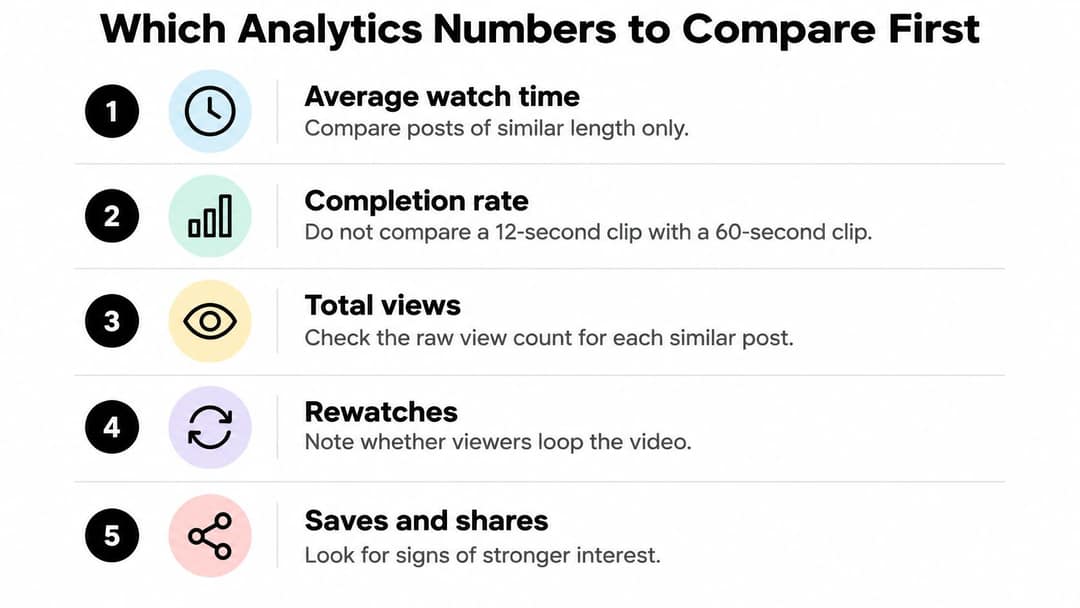
Open TikTok Analytics and compare only posts of a similar length. A 12-second clip and a 60-second clip do not share a fair completion bar. A short clip can look "finished" while a longer one looks weak for the same viewer behavior.
Work these five checks in order. Each one points to a single decision.
- Average watch time. Express it as a share of that video's length, so you can see how far the typical viewer gets. If people stop in the first few seconds, the next edit is the opening, not a new caption.
- Completion rate across the last five posts of similar length. A clear gap means the whole video is losing people, even if the start looks fine. Rebuild the middle before you touch the posting schedule.
- Early retention and rewatches. Leaving during the setup is a different problem from staying for a second pass. A rewatch says the clip had a reason to loop. An early exit says the setup delayed the point.
- Shares and comments. Treat these as stronger interest than likes alone. A like can be a habit. A share means someone wanted another person to see it.
- Traffic source. Separate For You from search so a small For You test is not mistaken for a search miss. If almost all views are search and For You stayed tiny, the next edit is the query match, not a louder hook for a broad audience.
TikTok's guide to how recommendations work says the system looks at whether people watch, skip, or finish, alongside sounds, hashtags, language, location, and device type, and that interaction signals, including time spent watching, are generally weighted more heavily. If the first viewers leave quickly or barely engage, the system has less evidence the video is relevant, and it is less likely to widen distribution.
What You Change After the Numbers
Only after those watch metrics are read should you test a posting time, a caption, or a hashtag set. Those inputs help classify a video. They do not offset weak watch behavior.
Name the weakest metric on the flat posts. "The account feels stuck" is not a metric. "Completion is half of our other 20-second clips" is. For a fuller map of what each number is measuring, use this breakdown of video engagement metrics beside the TikTok screen, not instead of it.
The same split helps on other apps. Teams that understand Instagram audience metrics already separate raw reach from the actions that show real interest. On TikTok, that split is the whole diagnosis.
How TikTok Tests Each New Upload
Think of a new upload like a club with a bouncer at the door. A small group gets in first. Their behavior is the evidence. A bigger group is invited only when that evidence is strong. A weak room does not get a second room because you posted yesterday's hit, or because you used a popular sound.
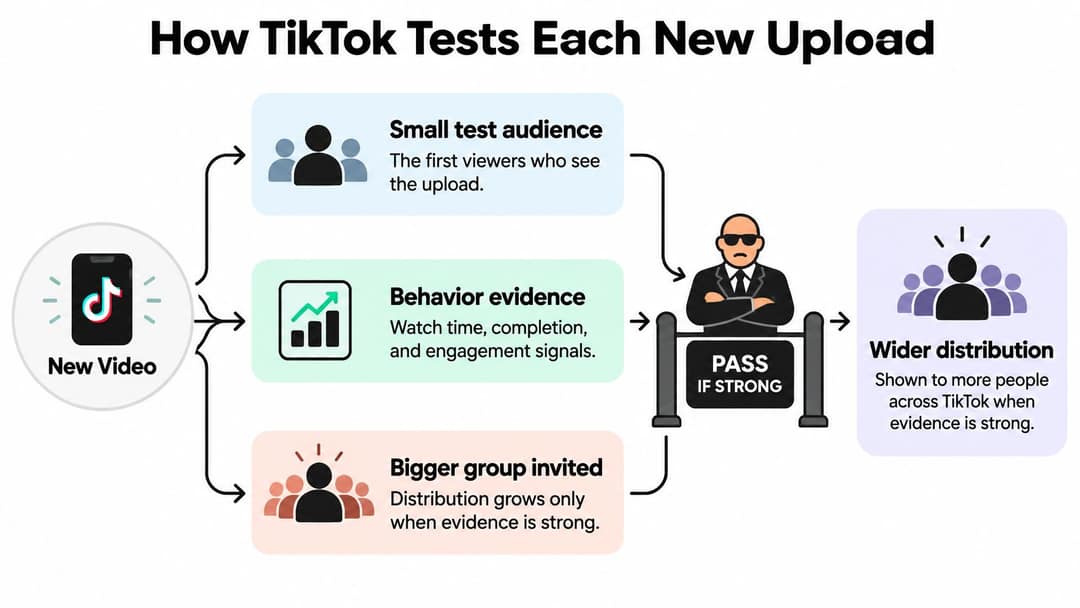
Say you post a 25-second demo of a phone stand. TikTok does not hand it to your whole following. It shows it to a small set of people whose recent behavior looks adjacent to the topic. Some watch it through. Some skip in the first second. A few share it. That bundle is the test. If skips dominate and almost nobody finishes, the bouncer does not open the next door.
The Three Inputs the System Actually Reads
TikTok's newsroom account of recommendations says recommendations are based mainly on user interactions, video information, and device or account settings. Interactions include watching a video in full, skipping it, liking, sharing, commenting, and following, and time spent watching is generally weighted more heavily than other signals. Video information, including captions, sounds, hashtags, view counts, and publication country, helps classify the clip. Language, location, and device or account settings help find plausible viewers. Follower count and an account's history of high-performing videos are not direct recommendation factors, although a larger account may still pick up views because it has more followers.
That is why a new upload can underperform right after a viral post. This file has to earn fresh signals from the people who see it first. Weak early retention, rapid swipes, limited completion, or few shares make a wider round less likely. Low views are often a mismatch between the topic, the opening seconds, the packaging, and the interests inferred from viewer behavior, not an account penalty.
| Input group | Examples | How heavily it counts |
|---|---|---|
| User interactions | Watching through, skipping, liking, sharing, commenting, following | Heaviest, especially time spent watching |
| Video information | Captions, sounds, hashtags, view counts, publication country | Lighter signals used to classify the video |
| Device and account settings | Language, location, device or account settings | Used to find plausible viewers, not to replace watch behavior |
| Follower count and past hits | Not direct recommendation factors | A large following may add views, but it does not guarantee the next test expands |
Why a Decent Start Can Still Stall
The feed is crowded, and attention is selective. An academic study of TikTok recommendations recruited 347 TikTok users and collected 9.2 million video recommendations, finding that average daily usage time rose while attention stayed at about 45%, measured as whether recommended videos were watched to the end, and that users liked more videos from people they followed than from accounts they did not follow.
Videos are ranked by the predicted chance a specific person will find them interesting. Finishing a longer video counts more than a weaker contextual signal such as creator and viewer country matching. An unfamiliar creator needs sharper relevance to turn a recommendation into a like, a share, or a follow.
A post can receive an initial batch and then stop when its retention compares poorly with rival videos shown to the same people. The metrics from your analytics screen are that comparison. Average watch time, completion, rewatches, shares, and the split between For You and search are the evidence the bouncer reads. Optimize for sustained viewing and a meaningful action, not for posting frequency or follower growth by themselves.
When Low Views Are a Search Problem
Low views is not one condition. A small For You test, a search-shaped post, and a crowded trend can all look like "the account is dead" if you only stare at the view counter.
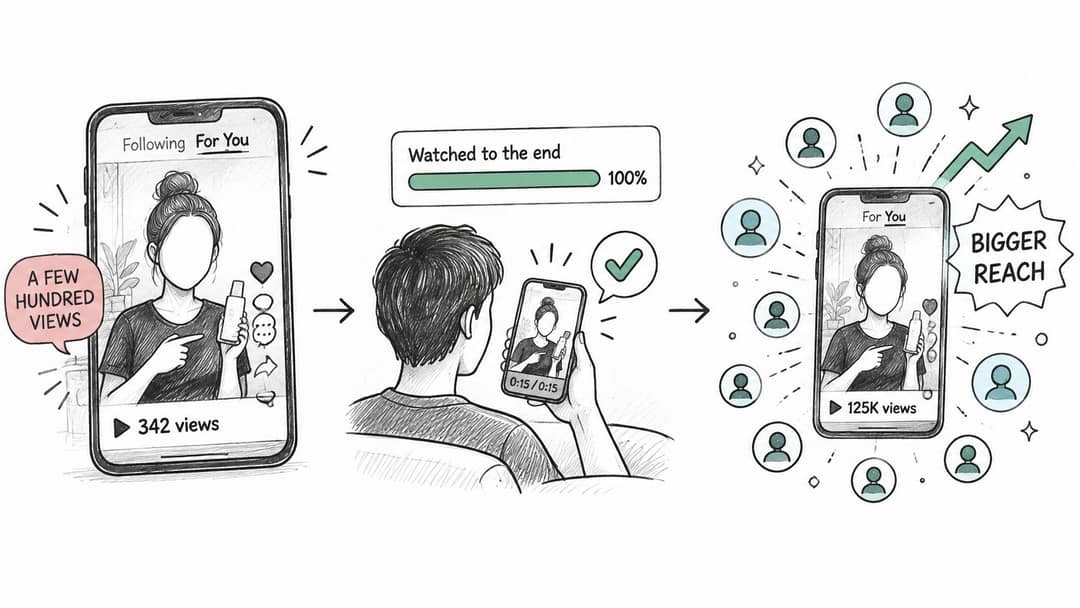
A faceless product demo gets a few hundred For You views. The people who stay finish it, then distribution stops. The small test passed. There was no reason to expand it, often because the topic was broad, such as "cool desk setup," with nothing a specific person was trying to solve.
A small business answers a narrow question, such as how to film a product on a phone at night. Almost nobody sees it on For You. The caption uses the words someone would type. That post can still earn search views, because the packaging matches a query instead of a trend.
A creator copies a broadly trending sound inside a saturated topic. The initial batch arrives, then better-matching videos take the next round. The sound classified the clip. It did not win the comparison.
Prompt to try
Make a 30-second vertical TikTok answering the search question "how to film a product on your phone at night". Open with the exact phrase on screen in the first second, then show three quick fixes: a desk lamp as key light, locking exposure, and a white card as reflector. Clean stock visuals, calm voiceover, bold captions.
Content Gap Versus a Borrowed Sound
TikTok's Creator Search Insights, as described in this guide to the Content gap feature, flags topics with real search demand but few or no matching videos through its "Content gap" label. A video can get weak For You distribution and still reach people who are already looking, if it answers that underserved query.
Compare For You views, search views, retention, traffic source, and whether the caption or on-screen words match a searched phrase. A low-view post with strong completion in a small audience may need a tighter topic, not a new account and not a heavier posting schedule.
| Situation | For You views | Search views | Likely failure | First fix |
|---|---|---|---|---|
| Faceless demo, viewers finish, then reach stops | A few hundred | Few or none | Small test passed, topic too broad | Narrow to a specific question |
| Small business answers a specific question | Almost none | Some, from caption wording | Search-led video | Repeat the searched phrase in caption and opening |
| Trending sound in a saturated topic | Initial batch, then drops | Low | Outclassed by better-matching videos | Replace the broad sound with a defined gap |
Narrowing can improve discovery even when it reduces mass appeal. Answering a defined gap beats borrowing a sound everyone else is using. Small businesses and faceless creators should not read weak broad reach as suppression.
This short walkthrough shows how a specific question changes what the first seconds have to do.
Payoff-first hook
Create a 20-second TikTok for a budget app that opens with the result on screen: "I cut my phone bill from $65 to $25 in two taps." Show the proof first, then the two steps, with no intro or logo. Fast cuts, punchy voiceover, large captions synced to the voice.
Rebuild the Opening Before You Post Again
You already know whether the last posts failed on early exits or on topic match. Use one rebuild, in this order, before you film or export the next file.
- Write the payoff in one sentence before you record. Name the result, the mistake, or the answer. If you cannot say it in one line, the viewer will not wait for you to find it.
- Put that sentence in the first second, as speech, on-screen text, or both. Cut the intro, the logo, and the hello. The first second is the test, not the trailer.
- Match the on-screen text to the caption. If the text promises a pricing trick and the caption is a vague product name, the first audience is selected by a promise the footage does not keep.
- Delete any second that does not change the story, the proof, or the result. Keep a length someone can finish. A shorter finished clip beats a longer one people abandon in the setup.
- Show the proof before the explanation. Outcome first, then the steps. A reveal that arrives after people have left never enters the comparison.
- Add one sound and a few precise hashtags only after the watch path works. They classify the clip. They are not the strategy.
One Before and After
A weak opening says "wait until the end for a pricing trick" and spends four seconds on a face and a room. A stronger opening puts the price difference on screen immediately, then shows the two taps that created it. Same product, same length, different first second.
If the video is search-led, the opening should repeat the searched phrase, even if that makes it less broad. "Film a product on a phone at night" should be readable in the first second, not implied by a moody shot.
Change one variable on the next post so the analytics comparison stays readable. A new hook and a new topic in the same upload makes the numbers impossible to trust.
If you want a production pass on that first second, creating engaging videos for social platforms is a useful checklist for cutting setup and putting the point on screen. The edit still has to survive the watch-time comparison, not just look polished in the export.
Publish One Changed Video and Measure It
Publish one video that changes only the weakness you marked. If people swiped early, change the first second and leave the topic alone. If completion was already strong and reach stayed small, narrow to one searched question and leave the opening structure alone.
Leave the posting schedule, the hashtag pile, and the account itself alone for this test. Two changes at once make a better number impossible to read.
Once the video has had time to meet an initial audience, compare it only with similar-length posts. Look at average watch time, completion, shares, and traffic source.
A pass is more of the video watched, or more views from search when search was the goal, even if the view count is not dramatic. A fail means the opening promise and the footage still disagree, or the topic is still too broad to match a query.
For the next test, you can borrow a structure that already held attention. Search real TikToks by topic and engagement, read the hook and transcript of a video people finished, and remix that format into an original video about your own product or idea. Do not copy the clip. 400+ creators have reached 100k+ views with Revid, and that is not a promise for your next upload. Results still depend on the idea, the offer, and distribution.
The action is one changed upload, then a comparison against the row you picked. Not a new account.
Revid.ai turns an idea, a link, or a proven short-form format into a finished TikTok, Reel, or Short, with the hook and structure you can edit before you publish. Use it to test the one change this diagnosis calls for, a clearer first second or a narrower searched question, instead of posting the same flat video again. When you are ready to build that next upload, start at revid.ai.