
On this page
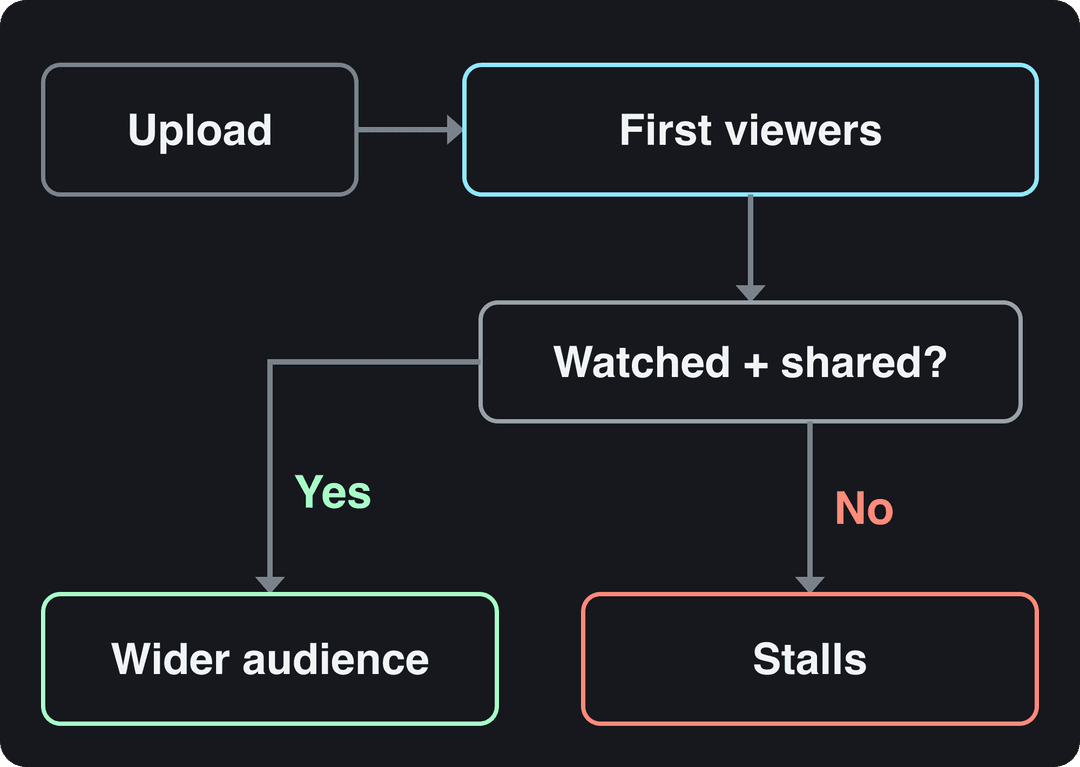
Algorithm-friendly content on TikTok, Instagram and YouTube is a vertical 9:16 video that hooks viewers in the first seconds, holds them to the end and gets shared. All three apps show a new video to a first group of viewers and widen its reach only when those viewers keep watching and interact.
The most repeated timing tip is also the one the data contradicts. Many guides still say to post on TikTok between 6 and 10 p.m., but in Revid's analysis of 176,367 TikToks with 1,000+ likes posted between October 2025 and October 2026, posts from 5 to 9 p.m. US Eastern had the weakest median views, and 3 to 6 a.m. was the best window. The rest of this guide works the same way: what each platform rewards, what to change on every video, and what the numbers say.
How TikTok, Instagram and YouTube decide who sees a video
The recommendation systems on all three apps rank short videos by how real viewers respond: whether they stop scrolling, watch to the end, rewatch, share, comment or follow. Your caption, on-screen text, spoken words, sound and hashtags tell the system what the video is about, so it knows which viewers to try it on. None of the three publishes exact weights, so distrust any guide that claims a precise formula.
The signals overlap, but the rules around them differ:
| TikTok | Instagram Reels | YouTube Shorts | |
|---|---|---|---|
| Main discovery feed | For You feed | Reels and Explore | Shorts feed |
| Length limit | Uploads up to 60 minutes (10 minutes with the in-app camera) | Up to 20 minutes | Up to 3 minutes, square or vertical |
| Reach rule to know | Realistic AI content must be labeled; the label alone does not reduce distribution | Reels over 3 minutes are not recommended to non-followers | Shorts over 1 minute with an active Content ID claim are blocked |
| Hashtags | No verified cap; 3 to 4 did best in Revid's data | Up to 5 per post | Optional; the title (up to 100 characters) matters more |
| Built-in testing | None; read retention in TikTok Studio | Trial reels, shown first to non-followers | Test & Compare exists, but Shorts are not eligible |
| Format | 9:16 at 1080x1920 recommended | 1.91:1 to 9:16, at least 30 FPS and 720 px | Square or vertical |
One change matters for US creators in 2026: TikTok USDS Joint Venture, set up on January 23, 2026 to run TikTok in the US, is retraining and updating the recommendation algorithm on US user data. Rules of thumb written before then may not hold for the US For You feed, so check every tip below against your own analytics. For the mechanics of the feed itself, see how the TikTok algorithm works.
TikTok video optimization: what to do on every video
Make the video for TikTok first. Its audience swipes fastest, and a video that holds viewers there usually needs only small changes for Reels and Shorts.
Decide who the video is for
The algorithm needs to know which viewers to try your video on, and a vague video gives it nothing to work with. Pick one viewer and one problem per video. "Makeup tips" is a category; "a natural makeup look for oily skin" is a video TikTok can match to people who watch that kind of content.
Before filming, finish this sentence: "This video is for [viewer] who wants [result]." If you cannot, the video is not ready.
Prompt to try
Make a 25-second vertical TikTok about the cheapest way to meal prep for a week. Open with the hook "This is the cheapest way to meal prep, and nobody talks about it" over a close-up of finished containers, then show 3 quick steps with short voice-over lines and bold on-screen captions. End with "Send this to the friend who still spends $15 on lunch."
How do you hook viewers in the first 3 seconds?
The first 3 to 5 seconds decide whether someone keeps watching or swipes, and an early swipe is the clearest negative signal a video can send. Open on the most interesting moment: the finished dish in close-up, the sizzling pan, the before-and-after, the claim that sounds wrong.
Spoken hooks follow patterns. In Revid's study of the 1,588 TikToks with over 100 million views, 51% of the videos with a transcript open with a statement, 16% with a question and 14% by addressing the viewer directly. A template for each:
- Statement: "This is the cheapest way to meal prep, and nobody talks about it."
- Question: "Why does your sourdough come out flat every time?"
- Direct address: "If you run a small shop, stop posting plain product photos."
Talk less than you think. In Revid's 12-month study, TikToks with under 40 characters of speech had a 123K median and 20.2% passed 1 million views, against 68K and 11.9% for videos that talked throughout. Let the picture carry the hook and keep the voice-over tight. For more openers, browse these TikTok hooks that stop the scroll.
What length should a TikTok be?
Length matters less than the old advice claims. In Revid's 12-month study, every length from under 15 seconds to 10 minutes had a median between 58K and 76K views, with 61 to 90 seconds at 70K. Videos under 15 seconds had the lowest median (58K) but the most shares per view: 1.41 per 100. Revid's full index across all posting dates found an edge for 16 to 30 seconds (about 141K median), but for recent posts that edge has faded.
Length alone barely moves views: every bucket lands between 58K and 76K median views (the 790 videos over 10 minutes are a small, unusual group). Clips under 15 seconds get shared the most per view.
Source: Revid analysis of 176,367 TikToks with 1,000+ likes posted between Oct 1, 2025 and Oct 16, 2026 (61,203 creators)
Show the data
| Median views | Share that passed 1M views | Shares per 100 views | |
|---|---|---|---|
| Under 15 s | 57.6K | 11.6% | 1 |
| 16 to 30 s | 64.9K | 12.3% | 1 |
| 31 to 60 s | 61.8K | 11.8% | 1 |
| 61 to 90 s | 70.5K | 12.2% | 1 |
| 91 s to 3 min | 63.4K | 11.1% | 1 |
| 3 to 10 min | 76.4K | 12.4% | 1 |
| 10 min+ | 129.6K | 13.8% | 0 |
Choose by goal:
- If you want shares and reach from new viewers: under 15 to 30 seconds, one idea, no intro.
- If you are in the Creator Rewards Program: at least one minute, because shorter videos do not earn.
- If you teach something: as long as the steps need, with every pause and repeat cut.
Then check the retention graph for each video in TikTok Studio. If viewers drop off at the same point, trim that moment or move the payoff earlier.
Write a caption people would search for
TikTok reads your caption to understand the video, and people search TikTok like a search engine. Write the caption with the words a viewer would type. In Revid's study, captions of 41 to 80 characters had the best median (67K views, 12.5% past 1 million); videos with no caption had 36K and 7.5%.
- Weak: "Morning routine"
- Better: "Natural makeup look for oily skin with drugstore products"
To find the words, type your topic into TikTok's search bar and read the suggestions. Google Keyword Planner or Ubersuggest show Google demand, useful when a topic is also searched outside TikTok. Use one keyword phrase written as a normal sentence, and say the same phrase in the voice-over and on-screen text. Stuffing ten keywords into a caption reads as spam to viewers.
How many hashtags should you use on TikTok?
Use 3 to 4. In Revid's study, videos with 4 hashtags had the best median (77K views, 13.4% past 1 million), and 3 hashtags came close at 75K. Videos with no hashtags had 51K (9.8%), and 9 or more hashtags dropped to 16K (7.8%).
Posts with 3 or 4 hashtags earned the most views. Captions stuffed with 9 or more hashtags did worst of all, with median views cut by about 80%.
Source: Revid analysis of 176,367 TikToks with 1,000+ likes posted between Oct 1, 2025 and Oct 16, 2026 (61,203 creators)
Show the data
| Median views | Share that passed 1M views | |
|---|---|---|
| None | 51.1K | 9.8% |
| 1 | 64K | 11.8% |
| 2 | 71.3K | 12.7% |
| 3 | 75.4K | 13.1% |
| 4 | 77.2K | 13.4% |
| 5 | 67.3K | 12.1% |
| 6 to 8 | 71.8K | 12.7% |
| 9+ | 15.6K | 7.8% |
A simple mix: one broad tag for the category, two niche tags for your audience, one specific tag for this video. TikTok has no verified hashtag cap, but Instagram allows only 5 per post, so 3 to 4 travels to both apps without edits.
Put captions on screen
Many people scroll with the sound off, and a video they cannot follow on mute gets swiped. Burn in subtitles for every spoken line and keep key text away from the bottom and right edge, where TikTok's buttons and caption sit. Revid's TikTok subtitle generator adds synced captions automatically.
Faceless format to try
Create a 20-second faceless TikTok in a reaction-style format about three kitchen myths that are wrong. Hook: "You've been storing tomatoes wrong your whole life." Use fast-cut close-up visuals, a punchy voice-over and large captions, one myth per scene.
Use trends as a format, not a copy
Trending sounds and formats give the system an audience that already watches them. Check TikTok trends today for rising hashtags and sounds, then put your own subject inside the format instead of copying someone's video.
The format you pick matters more than the trend. In Revid's study, challenges had a 182K median, comedy 155K and reactions 105K, against 62K for tutorials. Faceless videos had a 114K median versus 67K for one person on camera. If you are in Creator Rewards, note that duets, stitches, lightly modified reposts and videos with lip syncs or copyrighted music playing over one minute do not count as original.
Ask for the share, not just the like
Shares and comments signal that a video is worth passing on. End with a specific reason to act:
- "Send this to the friend who still does it the old way."
- "Comment your favorite [X] below."
- "Tag someone who needs to see this."
For a yardstick: across Revid's sample, likes equaled 7.1% of views, shares 0.88% and comments 0.08%. A video that beats those ratios is outperforming the typical TikTok that already passed 1,000 likes. Reply to comments, especially with video replies, since each one is a new video that points back to the original.
When should you post on TikTok?
In Revid's study, English TikToks posted at 4 a.m. US Eastern had the highest median (120K views) and the highest share past 1 million (19.9%); 7 p.m. posts had the lowest median (50K). By day, Saturday had the best median (70K) and Sunday the highest share past 1 million (13.6%), while weekdays sat within a few percent of each other (63K to 65K).
Two limits apply. Times are converted to US Eastern and English TikToks come from creators worldwide, so 3 to 6 a.m. Eastern is also daytime in the UK, Europe, India and Asia. And the sample only holds videos that already passed 1,000 likes, so it shows what strong videos have in common, not what causes success.
The practical rule: stop defaulting to the evening. In TikTok Studio, the Viewers tab shows when your viewers were most active over the last 7 days, and the Followers tab breaks activity down by hour and day. Test slots just before your own peak, and keep a schedule you can sustain, such as twice a week, so you have enough posts to compare.
Read your analytics and fix the drop-off
TikTok analytics live in TikTok Studio (profile > menu > TikTok Studio > Analytics > View all), on Studio Web and in the TikTok Studio app, with 7, 28, 60 or 365 day ranges or a custom one. Once a week:
- Open your three best and three worst videos from the last 28 days.
- Find where the retention line drops on each.
- Compare hook, length, format and caption between the winners and the losers.
- Make the next videos with what the winners share, changing one thing at a time.
How to adapt the video for Instagram Reels
The same vertical video works on Reels with a few changes. More detail is in these Instagram Reels best practices.
- Keep it at 3 minutes or less. Reels can run up to 20 minutes, but longer ones are not recommended to non-followers.
- Cut hashtags to 5 or fewer. With more than 5, the caption or comment will not post.
- Test hooks with trial reels. They need a public account with at least 200 followers (professional) or 1,000 followers (personal), are shown first to non-followers, report insights within 24 hours and do not affect the ranking of your standard reels.
- Upload a clean file without another app's watermark. Instagram's Edits app exports without one.
- Disclose photorealistic AI video with Meta's AI disclosure tool; Meta shows the label as "AI info".
- Read Views and follower activity in insights. Most-active times need at least 100 followers, and insights cover up to the past 90 days.
How to adapt the video for YouTube Shorts
Shorts reward the same retention, with different rules on length, music and titles. The YouTube Shorts algorithm guide covers the feed in depth.
- Stay at 3 minutes or less, square or vertical.
- Watch the music. A Short over 1 minute with an active Content ID claim is blocked globally. Most Shorts Audio Library songs can run up to 90 seconds in a 3-minute Short; some are limited to 60 or 30 seconds.
- Write the title like a search, using your keyword phrase. Titles can be up to 100 characters.
- Do not read too much into raw view counts. Since August 24, 2026, YouTube counts a view the moment a video starts playing, while YPP earnings still use engaged views, so judge a Short by its retention.
- Add a custom thumbnail if your account is verified: upload it in YouTube Studio on a computer (9:16, 2160x3840 recommended).
- Keep your own voice in it. AI tools are allowed for monetized content, but mass-produced AI videos built on generic templates are not allowed to monetize.
How to make algorithm-friendly videos with Revid
Revid starts a video from a format audiences already watched instead of a blank prompt.
- Search Revid's library of about 2.77 million short-form videos by topic, platform and engagement tier, and open one that fits your niche (repurpose viral videos).
- Run Deep analysis (free, up to 60 a day) to see its hook, timed structure and scroll-stopping moment.
- Choose "Make it about your topic" to apply that hook style and pacing to your subject, or start from your own script in the AI TikTok video generator. Revid adds visuals, a voice-over, synced captions and music.
- Export in 1080p or 4K and publish or schedule to TikTok, Instagram and YouTube from one queue. Each post reports its views, likes and comments, and any post that did well can be remixed in one click.
FAQ
How do I optimize a TikTok video before posting?
Run a five-point check: a hook in the first 3 seconds, a caption of 41 to 80 characters with the phrase people search, 3 to 4 hashtags, burned-in captions, and an ending that asks for a share. Then post at a time your TikTok Studio analytics show your viewers are active.
Does labeling a video as AI-generated hurt its reach?
No. TikTok says its AI-generated label does not affect distribution for videos that follow the Community Guidelines, and YouTube says disclosure alone does not limit audience or earning eligibility. Skipping the label on realistic AI content is the risk: YouTube may apply labels, remove content or suspend YPP for repeat failures.
Can I post the same video on TikTok, Instagram and YouTube?
Yes. Export a clean 9:16 file with no other app's watermark, keep it at 3 minutes or less so Reels and Shorts can recommend it, trim hashtags to 5 or fewer for Instagram, and rewrite the title for YouTube search.
How many views does a TikTok need to make money?
Under the Creator Rewards Program, a video starts earning after 1,000 qualified For You feed views, and only videos of one minute or longer qualify. TikTok publishes no fixed rate per 1,000 views; payouts depend on qualified views and on how well-crafted and engaging the content is.