On this page
The best YouTube channel topics in 2026 are gaming, how-to tutorials, education, product reviews, comedy, challenges, vlogs, lifestyle, interviews and commentary. The best topic for you is the one where you can list 50 video ideas, similar videos already get views, and there is a clear way to earn.
The topic also decides how much your views pay. Tubular Labs found that 77% of global YouTube views in 2025 came from videos under a minute long, yet AIR Media-Tech's 2026 analysis of 274 channels found Shorts RPM was only 3% to 14% of long-form RPM in almost every niche. A topic that only works as quick clips can win views and still earn very little.
How to choose the best topic for your YouTube channel
Run every idea through three filters, in this order. If an idea fails one, drop it and test the next one.
- Can you list 50 video ideas? Give yourself 20 minutes. If you stall well before 50, the topic is too narrow, or you will run out of motivation before the channel finds its audience.
- Do videos on it already get views? Search the topic on YouTube and look past the giant channels. When channels your size have videos with far more views than subscribers, there is demand you can reach. If only famous creators get views, pick a narrower angle.
- Is there a way to earn? Ad revenue needs the YouTube Partner Program; affiliate links, sponsors and your own product don't. Topics where viewers make buying decisions (tech, software, beauty, tools) attract sponsors early. Pure entertainment depends on ad revenue and volume.
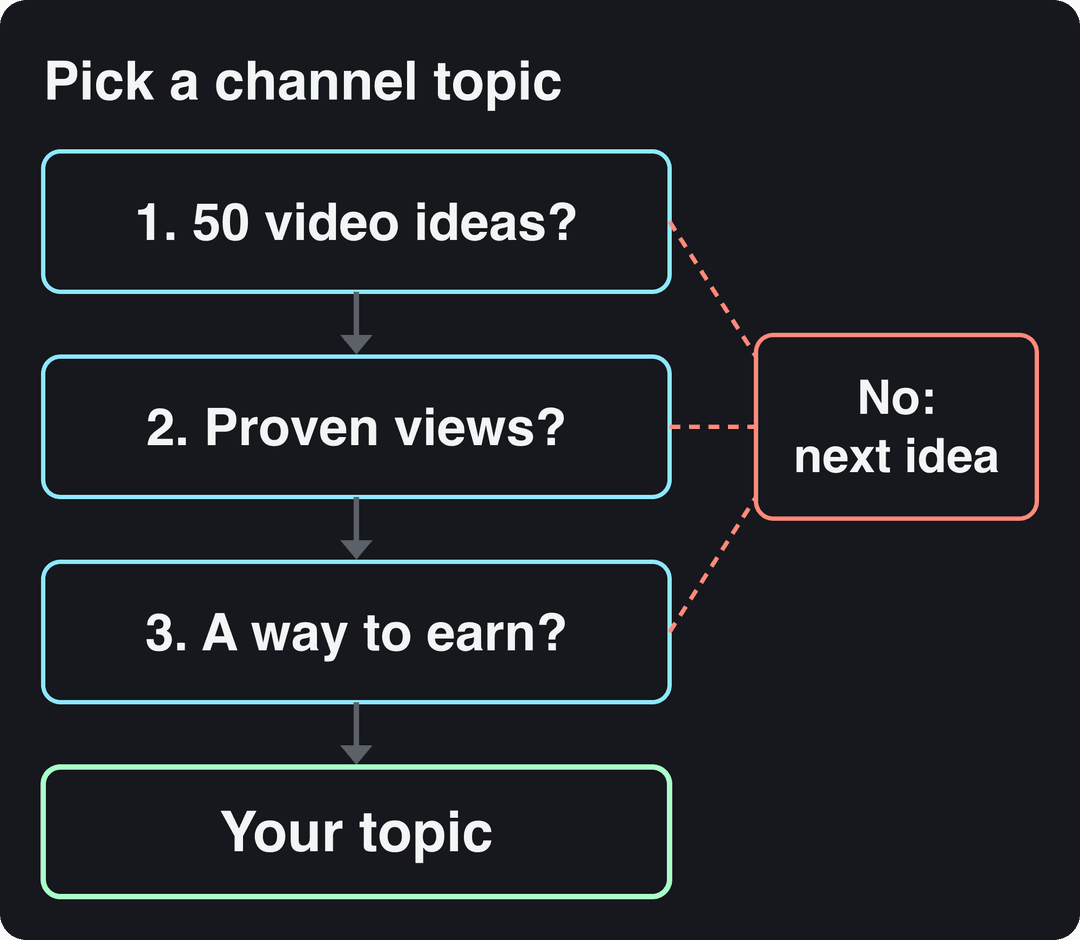
So which topic is best for a YouTube channel? The one that passes all three filters for you. A topic you know and can sustain beats a more popular one you would quit after a month, because viewers subscribe for a reason they can name: "the channel that explains X" or "the channel that tests Y".
The 10 best topics for a YouTube channel in 2026
| Topic | Video ideas | On camera? | Strongest format |
|---|---|---|---|
| Gaming | Beginner guides, tier lists, patch breakdowns | Optional | Long-form and Shorts |
| How-to tutorials | Cooking, home repairs, software walkthroughs | Optional (hands or screen) | Long-form |
| Education and explainers | Science, history, languages, money basics | Optional | Both |
| Product and tech reviews | Comparisons, "after 6 months" reviews | Usually hands only | Long-form |
| Comedy and sketches | Sketches, parodies, recurring characters | Usually | Shorts |
| Challenges and experiments | 30-day challenges, testing viral hacks | Yes, or POV | Both |
| Vlogs | Day in the life, travel, projects | Yes | Long-form |
| Lifestyle, beauty and fashion | Routines, hauls, room makeovers | Often | Both |
| Interviews and podcasts | Expert interviews, collabs, Q&As | Yes | Long-form, clipped to Shorts |
| Reactions and commentary | Trailers, news, trends with your take | Usually | Both |
For ready-made video ideas inside a topic, see our list of YouTube ideas for channel growth.
1. Gaming
Gaming is one of the few categories YouTube still publishes Trending Charts for, alongside music videos and movie trailers. The space is crowded, so pick a lane: one game you know well, one genre (cozy games, horror), or one skill (speedruns, beginner guides). Markiplier built his channel on personality-driven playthroughs; a new channel gets traction faster through usefulness, such as the clearest beginner guide for a new release.
2. How-to tutorials and guides
Tutorials answer searches people type every day ("how to fix...", "how to make..."), so a good one keeps getting views for years. Pick this topic if you have a skill others want: cooking, home repairs, a piece of software, a craft. Tasty showed how far tight, step-by-step cooking videos can go. Put the outcome in the title and show it in the first seconds.
Prompt to try
Make a 60-second vertical explainer on why the Roman Empire split in two. Open with the hook "Rome didn't fall in a day, it split first." Use clear narration, simple animated maps and on-screen captions, and end by teasing a longer video on the fall of the West.
3. Education and explainers
Veritasium and Vsauce made science a mainstream YouTube topic with well-researched video essays. You don't need a lab: history, languages, personal finance basics, exam prep and "how X actually works" all fit. Since October 15, 2024, vertical Shorts can run up to 3 minutes, enough to explain one concept and point viewers to the full video.
4. Product and tech reviews
People watch reviews right before they buy, which makes this one of the easiest topics to earn from: affiliate links and sponsors pay before ad revenue does. Marques Brownlee (MKBHD) set the standard with clear, opinionated tech reviews. Angles that work for a small channel: "X vs Y", "after 6 months", "best under a budget", and products the big reviewers skip. YouTube's lower Partner Program tier (500 subscribers) gives you access to YouTube Shopping and fan funding.
5. Comedy and sketches
Smosh grew from comedy sketches, and comedy is among the strongest short-form formats in Revid's TikTok data (below). It is also the hardest topic to produce on a schedule. Pick it if you can write jokes every week; recurring characters and series formats ("types of people at...") make the next idea easier.
6. Challenges and experiments
MrBeast turned challenges into one of the biggest channels on YouTube, but the format doesn't need his budget. "I tried X for 30 days", "testing viral life hacks" and "I followed a celebrity's routine" all work at small scale. The promise is in the title, so the video has to deliver it.
7. Vlogs: what to vlog about
Vlogs about your life only work once people already care about you. Vlogs with a hook work from the first upload: a job outsiders find fascinating, a place (a city, a van, a farm), or a project with an end date (a renovation, a race, a move abroad). Casey Neistat made the daily vlog famous, but for a new channel the hook is what keeps strangers watching.
8. Lifestyle, beauty and fashion
Routines, hauls, outfit ideas, apartment makeovers and recipes. This category overlaps with reviews, so it earns well through affiliate links and brand deals. Pick a specific audience (petite fashion, small apartments, budget skincare) rather than "lifestyle".
9. Interviews and podcasts
Rhett & Link's Good Mythical Morning and many podcasts show how the format works: guests bring their own audience, and every episode can be clipped into several Shorts. Start with people in your niche who have something to teach, and prepare questions that lead to stories rather than yes or no answers.
10. Reactions and commentary
Reactions to trailers, music, news and trends are popular, but this is the topic most likely to fail YouTube's monetization review. YouTube treats content that relies on mostly non-verbal reactions, or only reads out material you didn't write, as reused content, and that policy applies to the whole channel. Add analysis, context or a verdict viewers can't get from the original.
Which topics get the most views on YouTube?
At the very top of YouTube, kids' content wins: Tubular Labs found that 8 of the 10 most-viewed videos across all social video platforms in 2025 were kids' YouTube Shorts. That doesn't make it the best topic for a new creator, since content made for kids comes with its own YouTube rules; read them before you choose it.
For formats, the clearest data comes from short-form video. In Revid's analysis of 176,367 TikToks with 1,000+ likes posted between October 2025 and October 2026, challenges had the highest median views (182K, with 25.6% passing 1M views), followed by comedy (155K) and reactions (105K); tutorials had 62K. This is TikTok data, and the sample only includes videos that already reached 1,000 likes, so it shows what popular videos have in common, not what causes views. The full method is in our study of what makes a TikTok go viral.
Challenges and comedy passed 1M views about twice as often as tutorials and storytelling, which are the most common formats.
Source: Revid analysis of 176,367 TikToks with 1,000+ likes posted between Oct 1, 2025 and Oct 16, 2026 (61,203 creators)
Show the data
| Median views | Share that passed 1M views | |
|---|---|---|
| Challenge | 182.3K | 25.6% |
| Comedy | 154.8K | 22.1% |
| Reaction | 104.8K | 16% |
| Dance | 83.8K | 15.5% |
| Storytelling | 66.1K | 12.2% |
| Lip Sync | 61.7K | 12.3% |
| Tutorial | 61.9K | 12.1% |
Two lessons carry over to choosing a YouTube channel topic. Entertainment formats (challenges, comedy) pull the most views per video, while tutorials pull fewer views but match what people search for, which suits long-form. And you don't need a face: in the same data, faceless videos had a 114K median against 67K for one person on camera, and faceless tutorials had 156K against 52K for on-camera tutorials. If you would rather stay off camera, see how to start a faceless YouTube channel.
What should I talk about on my YouTube channel?
If you know your topic but freeze in front of a blank list, use these prompts. Each one should produce several videos.
- The question friends and coworkers keep asking you for help with
- Something you learned in the last 12 months that a beginner would want to skip ahead on
- A project you are working on, documented from the start
- Your job, explained to people outside it
- Mistakes you made and how you fixed them
- Products you researched before buying, compared honestly
- Your take on news or changes in your niche
- A skill you are learning from zero, one video per milestone
Turn each prompt into a title that promises one result ("How I...", "X vs Y", "I tried X for 30 days"), then get variations from a free YouTube title generator. Each video can then follow a simple shape: a hook that restates the promise, the steps or story, and the payoff.
Things to talk about on stream
Streams need talking points that fill quiet moments and invite chat:
- Your setup, and why you chose each piece
- Answers to chat's questions, or a weekly Q&A
- Live tier lists or rankings viewers vote on
- Behind the scenes of your next video
- A running challenge or goal across streams
- News in your niche since the last stream
Prompt to try
Create a 45-second YouTube Short titled "Recursion explained in 45 seconds" for computer science students. Hook: "This function calls itself, and that's not a bug." Use a calm voice-over, code snippets and simple diagrams of a call stack, with bold captions, and finish on one practice problem viewers can try.
YouTube content ideas for computer science students and indie hackers
Technical viewers watch to learn something they can use the same day, and screen-recorded videos need neither a face nor a studio. These ideas work in 2026:
| Idea | Example title | Format |
|---|---|---|
| Build in public | "Week 12 of building my SaaS: what worked" | Long-form |
| Weekend builds | "I built X in a weekend with AI coding tools" | Long-form and Shorts |
| One concept, explained | "Recursion explained in 3 minutes" | Shorts |
| Interview prep | "Solving a classic interview problem, step by step" | Long-form |
| Teardowns | "How a popular app works under the hood" | Long-form |
| Launch stories | "My launch day: numbers and mistakes" | Long-form |
| Student life | "What my CS degree didn't teach me" | Both |
The faceless tutorial result above supports starting with screen recordings and a clear voice-over. Founders can also turn a product launch into content: here is how the Squad.so launch video was made with the Revid CLI.
How to choose YouTube topics for a business
A business channel's topics come from your customers, not from trends.
- List the questions customers ask before buying. Sales calls, support tickets, reviews and comments are the source. Aim for 20.
- Turn each into a searchable title. "How to...", "X vs Y", "Is X worth it", "X for beginners".
- Check demand. Type each title into YouTube search and note the autocomplete suggestions and what already ranks.
- Match the format. Tutorials, demos and comparisons go long-form, where search keeps sending viewers. Quick tips and before-and-afters go to Shorts.
- Stay on one topic cluster for your first 30 videos so viewers (and YouTube) learn what the channel is for.
| Business | Topics that work |
|---|---|
| SaaS or app | Use-case tutorials, workflows, comparisons with alternatives |
| E-commerce | Product in use, how-tos with the product, customer questions |
| Local service | Before-and-after, pricing explained, common mistakes |
| Agency or consultant | Teardowns, project breakdowns, client FAQs |
Shorts also reach people you won't find on other apps: Google said in April 2026, citing GWI data, that 45% of YouTube Shorts users are not on TikTok. More sourced figures are on our YouTube Shorts statistics page.
How to find trending topics on YouTube
YouTube no longer gives you one general trending page: its Help Center now describes Trending Charts only for movie trailers, music videos and gaming. Use these sources instead:
- YouTube search autocomplete. Type your topic plus "how to", "best" or "vs" and note the suggestions.
- Google Trends set to YouTube Search. Compare 2 or 3 topics and see which one is rising.
- Outlier videos. On channels in your niche, sort videos by Popular and look for recent uploads far above the channel's usual views. When a small channel has an outlier, the topic did the work.
- Short-form platforms. Trends also surface on TikTok and Reels; a topic spreading there can be worth a longer YouTube version.
- Revid's viral library. Search a topic and filter by platform and engagement tier to see which videos on it are getting views now.
More methods and tools are in our guide to finding trending topics.
Long-form or Shorts: which topics fit each format
Most YouTube views are now short: Tubular Labs found 77% of global views in 2025 came from videos under a minute. But Shorts pay far less per view: in AIR Media-Tech's 2026 data, most channels needed 11,000 to 34,000 Shorts views to earn what 1,000 long-form views generate. Watch hours from Shorts in the Shorts Feed also don't count toward the 4,000 watch hours of the Partner Program.
- Long-form topics: anything viewers search for or use to make a decision: tutorials, reviews, comparisons, explainers, interviews, documentaries about your niche.
- Shorts topics: one idea, one joke or one tip: comedy, challenges, quick facts, reactions, clips from your long videos.
What should you talk about in long-form videos? Pick questions that need more than 3 minutes to answer well and that people type into search: "how to", "X vs Y", "what I learned after...". Then use Shorts to send viewers to them. AIR Media-Tech's study of 18,000 English-language channels found the best results when Shorts made up 25% to 40% of a channel's uploads.
Topics YouTube won't monetize
Some topics get views but can't earn ad revenue, however you film them. Under YouTube's monetization policies, these are out:
- Videos that react with little commentary, or read out text you didn't write (reused content)
- AI-generated videos made from generic templates that look mass-produced
- Strings of unrelated AI clips made to shock, or realistic AI visuals of events that didn't happen
- AI personas presented as human experts giving health, legal, financial or political advice
AI tools are allowed when the final video shows your creative vision, for example AI to edit a script or create a background visual. If you plan an automated channel, read the rules in our guide to automated YouTube channel ideas first.
To earn ad revenue today, you need 1,000 subscribers plus either 4,000 public watch hours in the last 12 months or 10 million Shorts views in the last 90 days. From February 1, 2027, new applicants need 8,000 watch hours in 365 days or 20 million Shorts views in 90 days; channels already in the program are not affected.
Test a topic with Revid before you commit
The cheapest way to choose between 2 or 3 topics is to post a few Shorts on each and compare the results. Revid handles the research and the production:
- Search Revid's viral video library, about 2.77 million short-form videos with their engagement data, by topic, platform, engagement tier and length.
- Run a free deep analysis (up to 60 a day) on the top results to see the hook, the timed structure and ways to adapt it to your niche.
- Choose "Make it about your topic" to turn a proven format into an original video, or start from your own script with the AI YouTube Shorts generator.
- Publish directly to YouTube from Revid and compare each topic's views, likes and comments in your post results.
Sign-up and library search are free, and new accounts get free credits to try making videos (no credit card needed); regular creation then uses the monthly credits of a paid plan, from $39/month. If a Short uses realistic AI visuals, turn on the "AI use" disclosure in YouTube Studio; disclosure alone doesn't limit a video's audience or its eligibility to earn.
FAQ
What are YouTube Topic channels?
Topic channels are channels YouTube creates automatically, usually for music artists, named "Artist name - Topic". They collect an artist's official audio tracks; you can't create one yourself, and they are not a channel niche.
Can I change my YouTube channel's topic later?
Yes. Your existing videos stay up, but current subscribers may not follow the new topic, so expect slower growth while the channel finds its new audience. Moving to a closely related topic is easier than a complete change.
Do I need to show my face on YouTube?
No. Gaming, tutorials, explainers and reviews all work with a voice-over, screen recordings or hands-only shots. In Revid's TikTok data, faceless videos had higher median views than videos with one person on camera.
How many subscribers do I need to make money on YouTube?
500 subscribers, with 3,000 watch hours in a year or 3 million Shorts views in 90 days, qualifies you for fan funding, YouTube Shopping and Creator Partnerships. Ad revenue needs 1,000 subscribers plus the watch-hour or Shorts-view thresholds above.
What is the best content for a YouTube channel?
Content that solves a specific problem or delivers a specific feeling for a specific audience, in a format you can repeat every week. Tutorials and reviews earn through search and buying intent; comedy and challenges earn through volume and shares.