How to Increase Customer Engagement: 5 Strategies That Last
Five strategies that turn one-time buyers into repeat customers: personalization, proactive video, community, loyalty perks and a re-engagement sequence for customers who went quiet.
On this page
To increase customer engagement, give customers a reason to interact at every stage: personalize messages with what they have already told or shown you, reach out before they need help, build a community around your product, and reward loyalty with access, not just discounts. Then win back lapsed customers with a short re-engagement sequence.
The most common mistake is measuring engagement in likes and follows while customers quietly stop buying. The second is treating a "we miss you" discount as the only win-back move, which teaches your best customers to wait for the coupon. Everything below is built around actions that show up in repeat purchases, retention and referrals.
What counts as customer engagement (and how to measure it)
Customer engagement is every voluntary interaction a customer has with your brand after the first sale: opening your emails, using the product, replying, leaving a review, referring a friend, buying again. Followers and impressions measure reach. Engagement measures whether people come back.
Track the metrics that tie to revenue:
| Metric | What it tells you | What to watch |
|---|---|---|
| Customer lifetime value (CLV) | Total revenue a customer brings over time | Rising CLV means engagement is paying off |
| Churn rate | Share of customers you lose in a period | The clearest early warning sign |
| Repeat purchase rate | Share of customers who buy again | The core metric for e-commerce |
| Active users (DAU and MAU) | Whether people keep using your product | The core metric for apps and SaaS |
| Net Promoter Score (NPS) | How likely customers are to recommend you | The trend matters more than any single score |
| Video view-through rate | Whether people watch your videos to the end | Shows which messages hold attention |
Decision rule: pick one primary metric for your business model (repeat purchase rate if you sell products, active users if you sell software) and judge every tactic in this article against it. If a tactic raises comments but not your primary metric, it is entertainment, not engagement.
Map engagement to each stage of the customer lifecycle
Good engagement is planned, not hoped for. Each stage needs a different goal and a different touchpoint:
| Stage | Goal | Best touchpoint |
|---|---|---|
| New customer | First success with your product | Welcome message plus an onboarding video for the feature they care about |
| Active | Deeper use | Tips, early access, community invites |
| Loyal | Advocacy | Loyalty tiers, referrals, featuring their content |
| At risk | Prevent churn | A proactive check-in when usage or orders drop |
| Lapsed | Win them back | A re-engagement sequence (covered below) |
If you want a longer template for writing this down, ChatBotGen has a walkthrough on building customer engagement plans.
Strategy 1: Personalize with data customers already gave you
Putting a first name in a subject line is the minimum, not personalization. Real personalization uses what customers have already shared (purchase history, browsing, survey answers, support tickets) to send something that is obviously meant for them. Use only data they gave you knowingly, and it reads as attentive rather than invasive.
An outdoor gear store, for example, can skip the generic "you might like this" email. A customer who just searched for hiking boots and previously bought rain gear gets an email featuring the new waterproof boots plus a guide to wet-weather trails. The sales pitch becomes a useful recommendation.
You cannot hand-craft every message, so segment narrowly and automate:
- Behavioral segments: what people did or skipped. "Viewed the pricing page but never signed up" or "bought the coffee machine but not the grinder."
- Lifecycle segments: where they are with you. A new user needs a welcome and first steps; a long-time customer would rather get early access to something new.
- Interest segments: the categories they browse most, so the home cook never gets your camping gear email.
Sprinklr's overview of customer engagement covers how companies are adding AI to make these interactions more real-time and context-aware.
Strategy 2: Reach out before customers ask, with video
Proactive engagement means anticipating the next question and answering it first. Video works well here because a face and a voice feel personal in a way a text receipt never does. Customers also prefer the format: when asked how they would most like to learn about a product or service, 63% of consumers in Wyzowl's 2026 survey chose a short video, ahead of text articles at 12% (more short-form video statistics).
The moments that deserve a proactive video:
- Right after a big purchase: a short thank-you that names the product and shows one feature worth trying first.
- Onboarding: a walkthrough of the first steps for the goal the customer gave you at sign-up, not a generic tutorial. An explainer video maker handles the evergreen version.
- Milestones: an account anniversary, a new loyalty tier, a usage achievement.
- Known friction points: if your analytics show people stall on one feature, trigger a short how-to when they reach it.
- When usage drops: a check-in before the customer has decided to leave.
These videos work best as part of a broader video content strategy, so your one-to-one messages and your public content sound like the same brand.
How to send personalized videos at scale with Revid
Recording thousands of individual videos is not realistic, but rendering them from a script is. Revid turns a script into a finished video with an AI voice-over and synced captions, and every paid plan includes the API, MCP server and CLI.
- Write one script template with placeholders: customer name, product or plan, and one relevant tip.
- Connect your store, CRM or app to Revid's script-to-video API, or let an AI agent drive it through the Revid MCP server and CLI.
- Trigger a render on the events you mapped above (a purchase, a new loyalty tier, a lapse). Your system fills in the placeholders and sends the script.
- Pick a voice (1,000+ voices in 70+ languages) or a talking avatar presenter for a face on screen.
- Use Revid's webhooks to pick up the finished video and drop it into your email or in-app message.
Each render uses credits from your plan, and you can estimate the cost of a video before generating it.
Strategy 3: Turn customers into a community
One-to-one messages build relationships; a community lets customers build them with each other. Bonusqr's article on how to retain customers and build real loyalty makes the same case: belonging keeps people around longer than transactions do.
Start two-way conversations
Treat your social feed like a shop counter, not a billboard. Instead of "Our new update is here," ask "What is one problem you want this update to solve for you?" Then reply to every answer.
- Live Q&A sessions on Instagram or YouTube, where you answer real questions on camera.
- Polls and quizzes that double as product research.
- Behind-the-scenes posts that show the people who make the product.
For platform-specific tactics, see our guide to increasing social media engagement.
Put customers in the spotlight
Customer content persuades other customers. Bazaarvoice's Shopper Experience Index (November 2024) found that 65% of global shoppers rely on UGC such as ratings, reviews, photos and videos in their buying decisions.
A fitness apparel brand might ask customers to post a photo of a personal record in its gear, with a clear hashtag and one simple reward: being featured on the brand account. The result is a gallery of real people that prospects can picture themselves in, and customers who feel seen.
Listen before you post
Social listening means tracking conversations about your brand, your category and your competitors, not just your tagged mentions. Use it to catch complaints before they spread, spot trends worth joining and learn what people actually love about you. When someone praises a feature, name it in your reply and mention the team behind it. Specific replies get more follow-up conversation than "thanks."
Prompt to try
Create a 30-second vertical video congratulating a customer on reaching the gold tier of a coffee subscription loyalty program. Open with the hook "You just unlocked gold, here is what changes." Show three perks in warm, bright motion graphics: early access to new roasts, a members-only tasting event and double points on reviews. Friendly, upbeat voice-over with captions.
Strategy 4: Build a loyalty program people actually use
Buy-ten-get-one-free cards reward transactions, not loyalty. Businesses keep investing in better programs: Fortune Business Insights projects the global loyalty management market will grow from $13.31 billion in 2024 to $41.21 billion by 2032. For more benchmarks, Antavo keeps a running list of customer loyalty statistics.
What makes a program worth joining:
- Tiers: bronze, silver and gold levels give members a goal and make loyalty visible.
- Early access: first look at new products or features.
- Experiences: a members-only event, a session with an expert, a behind-the-scenes visit.
- Exclusive content: a members-only newsletter or a library of advanced guides.
- Rewards for actions, not just spend: badges or points for reviews, referrals and shares, plus challenges like "try three new products this month for a surprise gift."
Then personalize the reward itself:
| Customer segment | Standard reward | Personalized reward |
|---|---|---|
| Frequent buyer | 10% off the next purchase | A surprise gift from their most-bought category |
| New member | 50 bonus points for signing up | A short welcome video that uses their name |
| Inactive member | A generic "we miss you" discount | An offer on a product they viewed recently |
| New gold-tier member | A notification email | A video congratulating them and showing their new perks |
The last two rows are the same automated video workflow described in Strategy 2, triggered by a different event.
Strategy 5: How to re-engage customers who have gone quiet
Customer re-engagement is the process of winning back customers who have stopped buying, logging in or opening your messages. Winning back someone who already knows your product is usually easier than finding a new customer, but only if you lead with value instead of a reflex discount.
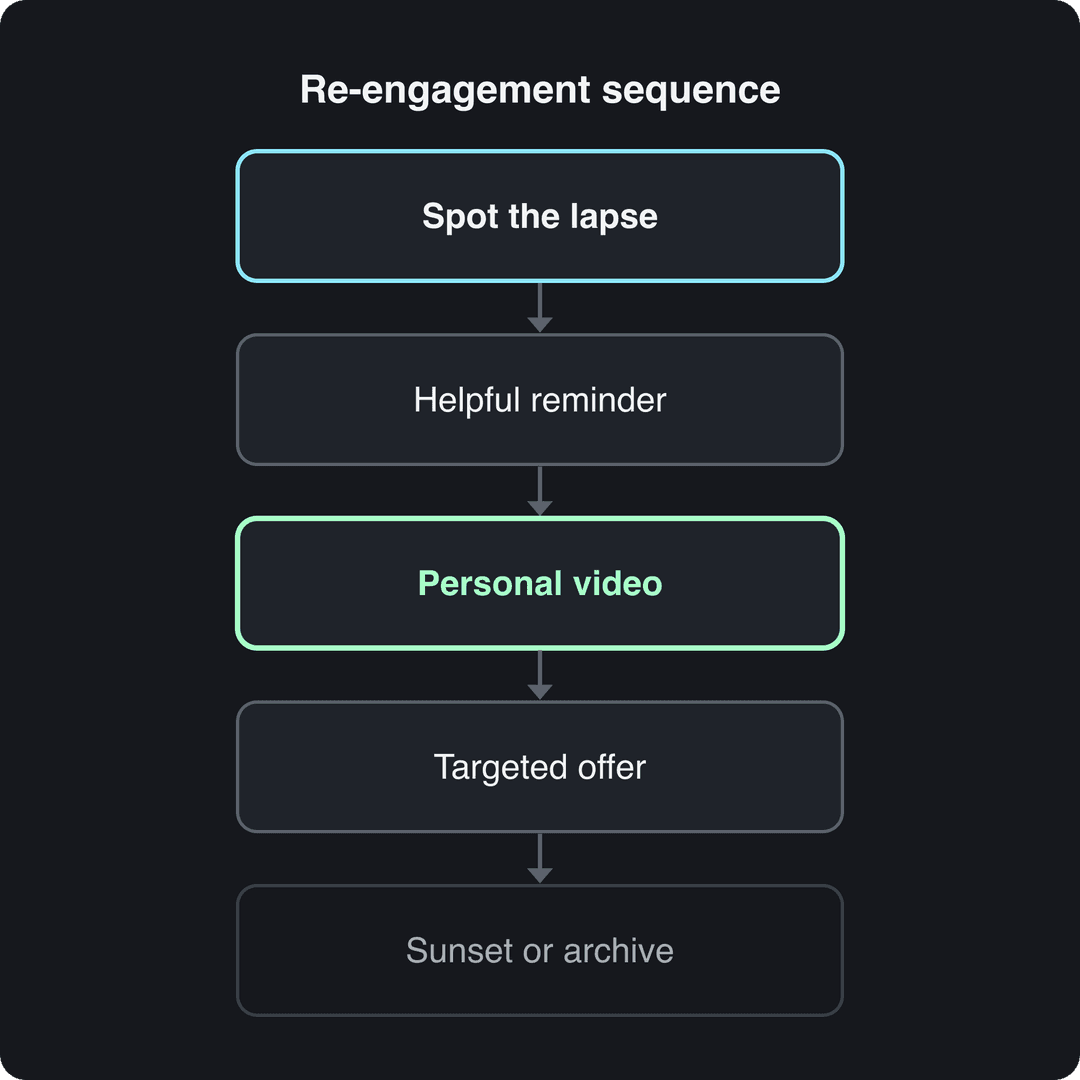
- Spot the lapse. Define "inactive" from your own data: a customer who has gone noticeably longer than their usual gap between purchases or logins. If people normally buy monthly, someone silent for a full quarter is lapsed.
- Send a helpful reminder. Share something new that matters to them: a feature they never tried, a refill for what they own, a tip for the product they bought.
- Make it personal. A short video or note that names what they bought and why it is worth coming back. This is the step generic campaigns skip.
- Ask why. One question with a few answer options ("too expensive," "didn't need it," "switched to another brand"). The answers tell you what to fix.
- Make a targeted offer. If they still have not returned, offer something tied to their history, such as a product they viewed, rather than a blanket discount.
- Sunset the rest. Stop emailing people who never respond. Mailing inactive addresses hurts your deliverability to the customers who do engage.
Prompt to try
Make a 25-second vertical re-engagement video for a customer who bought a cordless vacuum months ago. Hook: "Your vacuum just got a new trick." Show the new pet-hair attachment in clean product-style visuals with a calm, friendly voice-over, then end with: "If it is not working for you anymore, hit reply and tell us why."
Re-engagement message templates
Adapt these to your brand:
- Subject line, product brand: "Your [product] just got a new trick"
- Subject line, software: "[Name], the report you asked for is live"
- Subject line, feedback step: "Can we ask you one question?"
- Video script: "Hi [Name], this is [Brand]. You picked up [product] a while back, and we just added [feature]. Here is the quick version of how to use it. If it is not working for you anymore, hit reply and tell us why."
How to increase customer engagement on a small budget
The cheapest tactics are often the strongest because they are personal. Pick one or two channels where your customers already are and answer every comment and message yourself. Send a real thank-you email after each purchase. Start a weekly newsletter with useful tips rather than promotions, and feature customer photos and reviews whenever you get them. Our small business marketing tips cover more low-cost channels.
FAQ
What is the difference between customer engagement and customer retention?
Engagement is the interaction (opening, using, replying, reviewing), and retention is the outcome (customers staying and buying again). Engagement is the leading indicator: when it drops, churn usually follows.
Is a discount a good way to re-engage customers?
Use it as a late step, not the first one. Lead with something useful or personal, and if you do offer a discount, tie it to a product the customer viewed or bought so you are not training everyone to wait for coupons.
How is a personalized video different from a regular marketing video?
A marketing video is one message for everyone; a personalized video is rendered for one customer with their name, product or goal in it. With a script-to-video API, you write the template once and every customer gets their own version.
How often should you contact customers?
Often enough that each message is useful, and never just to fill a calendar. Tie messages to real events (a purchase, a milestone, a drop in usage) and watch unsubscribe and churn rates to tell you when you have gone too far.
Which customer engagement metric matters most?
The one tied to your business model: repeat purchase rate for e-commerce, active users for software, and CLV for both. Treat likes and follower counts as reach, not engagement.