Short Form Video Trends 2026: The Creative Formats Winning Now
The short-form video trends that work in 2026 are formats, not sounds. Here is what the data on 176,367 TikToks and the latest platform changes say to make on TikTok, Reels and Shorts.
On this page
The short-form video trends that work in 2026 are formats, not sounds: challenges, comedy, reactions, POV clips and faceless explainers, cut tight with on-screen text and a payoff worth sharing. Sounds and memes rotate every week. These formats keep earning views on TikTok, Instagram Reels and YouTube Shorts.
The gap between formats is bigger than most creators assume. In Revid's analysis of 176,367 TikToks with 1,000+ likes posted between October 2025 and October 2026, challenges had a median of 182K views and comedy 155K, while tutorials sat at 62K. The same tutorial shot faceless reached a 156K median, against 52K with one person on camera.
The short-form video trends of 2026 at a glance
| Trend | What the evidence says | What to do |
|---|---|---|
| Formats beat trending sounds | Challenges, comedy and reactions lead Revid's TikTok data | Pick the format before the topic |
| Faceless and POV framing | Faceless videos: 114K median views vs 67K for one person on camera; POV 107K vs selfie 48K | Show hands, screens and scenes instead of a selfie |
| Less talking | Videos with under 40 characters of speech: 123K median, 20.2% past 1M views | Let visuals and on-screen text carry the idea |
| Length matters less than it did | Every length bucket from under 15 s to 10 min landed between 58K and 76K median views | Cut to the payoff, not to a target duration |
| Freshness on Meta | Same-day posts made up more than 30% of recommended Reels in Q1 2026, more than double a year earlier (Meta) | Post while the topic is still live |
| AI video, labeled | TikTok has labeled over 3 billion videos as AI-generated; the label alone does not cut distribution | Disclose realistic AI and add your own insight |
| Originality enforcement | Facebook's March 2026 rules and YouTube's "inauthentic content" policy target reposts and mass-produced clips | Remix the structure, never the footage |
| Series packaging | YouTube began rolling out Shorts series (seasons and episodes) in September 2026 | Number your episodes and reuse a recognizable opener |
Read the TikTok figures as patterns, not proof of cause: the index only holds videos that already passed 1,000 likes, so it shows what the best-performing videos have in common. The method, every chart and the known biases are in Revid's study of what makes a TikTok go viral.
Which creative formats are trending on TikTok and Instagram Reels this week?
A weekly trend is usually a new skin on an old format: a sound, a meme template or a challenge name laid over a challenge, a skit, a reaction, a POV scene or a reveal. The skin changes every few days. The format underneath is what keeps working, so save trends by mechanism ("unexpected reveal", "POV of a familiar moment", "reaction plus demonstration") rather than by sound name.
Revid's TikTok data ranks those formats clearly. Challenges had a 182K median and 25.6% passed 1 million views; comedy 155K (22%); reactions 105K (16%); dance 84K; storytelling 66K (12.2%); tutorials 62K (12.1%). This is TikTok data, but the same formats travel to Reels and Shorts.
Challenges and comedy passed 1M views about twice as often as tutorials and storytelling, which are the most common formats.
Source: Revid analysis of 176,367 TikToks with 1,000+ likes posted between Oct 1, 2025 and Oct 16, 2026 (61,203 creators)
Show the data
| Median views | Share that passed 1M views | |
|---|---|---|
| Challenge | 182.3K | 25.6% |
| Comedy | 154.8K | 22.1% |
| Reaction | 104.8K | 16% |
| Dance | 83.8K | 15.5% |
| Storytelling | 66.1K | 12.2% |
| Lip Sync | 61.7K | 12.3% |
| Tutorial | 61.9K | 12.1% |
For the specific trends of this week, check a page that updates daily instead of an article: Revid's TikTok trends today tracks rising hashtags, sounds and videos, and the viral Instagram Reels finder shows Reels that are taking off right now.
Use a simple rule. If a trend fits a format you can already make in under an hour, post it the same day. If it needs a new set, a new skill or a person you do not have, skip it and save the mechanism for later. On Instagram, test a risky trend as a trial reel first: trial reels are shown to non-followers, report insights within 24 hours and do not affect the ranking of your standard reels. They need a public account with at least 200 followers (professional) or 1,000 (personal).
Five creative formats to make right now
| Format | Sample hook | Best fit | Metric it wins |
|---|---|---|---|
| Challenge or comedy skit | "I tried to explain my job to my mom using only emojis." | TikTok, Reels | Shares and comments |
| POV story | "POV: you open your analytics after the video you were sure would work." | TikTok | Shares |
| Faceless tutorial or listicle | "Three editing mistakes costing you viewers." | Shorts, TikTok | Completion and saves |
| Before-and-after reveal | "This is the same drawer, 20 minutes later." | Reels | Shares and profile visits |
| Response (duet, stitch, reply) | "The advice is right, but it skips the part that matters." | TikTok | Comments and discovery |
Challenges and comedy skits
These are the top two formats in the TikTok data, and the funny version pays off for brands too: in HubSpot's 2026 research, 48% of marketers said funny content yields the highest ROI among short-form content types. Keep the premise readable in the first frame and land the joke before the viewer can guess it. Faceless comedy (hands, objects, animals, text) reached a 327K median in Revid's data, against 136K on camera.
Prompt to try
POV: the client says 'just one small change' an hour before the deadline. Open on the email notification, then cut every 3 seconds between the designer's face, the cluttered screen and the clock, with the situation written as on-screen text. Relatable office comedy style, vertical, 20 seconds, ending on a twist where the 'small change' is a full redesign.
POV stories
POV clips put the viewer inside a familiar moment before any explanation starts. Write the caption as the situation ("POV: the client says 'just one small change'"), then shift expression, location or on-screen text every few seconds. POV was the strongest shooting style in Revid's data at a 107K median, ahead of handheld (80K), tripod (77K) and selfie (48K).
Faceless tutorials and listicles
This is the clearest finding for educational creators: faceless tutorials reached a 156K median, three times the 52K for on-camera tutorials. Show the screen, the hands or the result, and put each step on screen as text. For lists, give every item one visual and cut any item you would not save yourself. The faceless video generator builds this kind of voiced, captioned video from a script.
Before-and-after reveals
Show the starting state in the first second, compress the process, and make the contrast impossible to miss. Reels suits this format because a visible result travels well through shares and saves in lifestyle, home, beauty and product niches.
Responses: duets, stitches and replies
A response borrows its premise from someone else, so your part must stand alone: a correction, a demonstration or a counterpoint. Reactions had a 105K median in the TikTok data, but platforms have tightened what counts as original.
Video editing trends for 2026
The editing style that performs in 2026 is quieter and more visual than the fast-cut talking head of earlier years.
- Fewer words. Videos with under 40 characters of speech had a 123K median and 20.2% passed 1 million views. Videos talking from start to finish had 68K and 11.9%. Silent videos sat at 73K. Cut the narration that only describes what the viewer can already see.
- Designed for mute. In Clutch's October 2025 survey, only 9% of US consumers said they give short-form videos their full attention. Burn the key line into the frame as text and make every beat readable with the sound off.
- POV and screen recordings over selfies. Screen recordings reached a 91K median, nearly double the 48K for selfie footage.
- Native editors. Instagram's Edits app exports without a watermark and adds generated captions; Meta said nearly 10% of the Reels people view each day are created in Edits.
- AI scenes, disclosed. In Revid's study of AI videos vs real footage, AI-generated TikToks averaged twice the views of real footage, while on X, Instagram and Threads AI visuals clustered in the lowest engagement tier. TikTok, YouTube and Meta all require a label on realistic AI content, and TikTok and YouTube say the label alone does not limit distribution. Since May 2026, YouTube also applies labels automatically to undisclosed photorealistic AI.
- Original assembly. YouTube does not monetize mass-produced AI from generic templates or strings of unrelated AI clips. Use AI for scenes and drafts, and keep your own script, opinion and example in the final cut.
Prompt to try
Make a 30-second vertical video titled 'Your captions aren't the problem. Your first sentence is.' Open on that contrarian claim over a messy desk, cut to a clean editing setup as the pattern interrupt, then show one before-and-after opening line as the payoff. Clean motion graphics, bold on-screen text readable with sound off, minimal narration.
The hook, pattern interrupt, payoff arc
Most short videos that hold attention follow three beats, whatever the format.
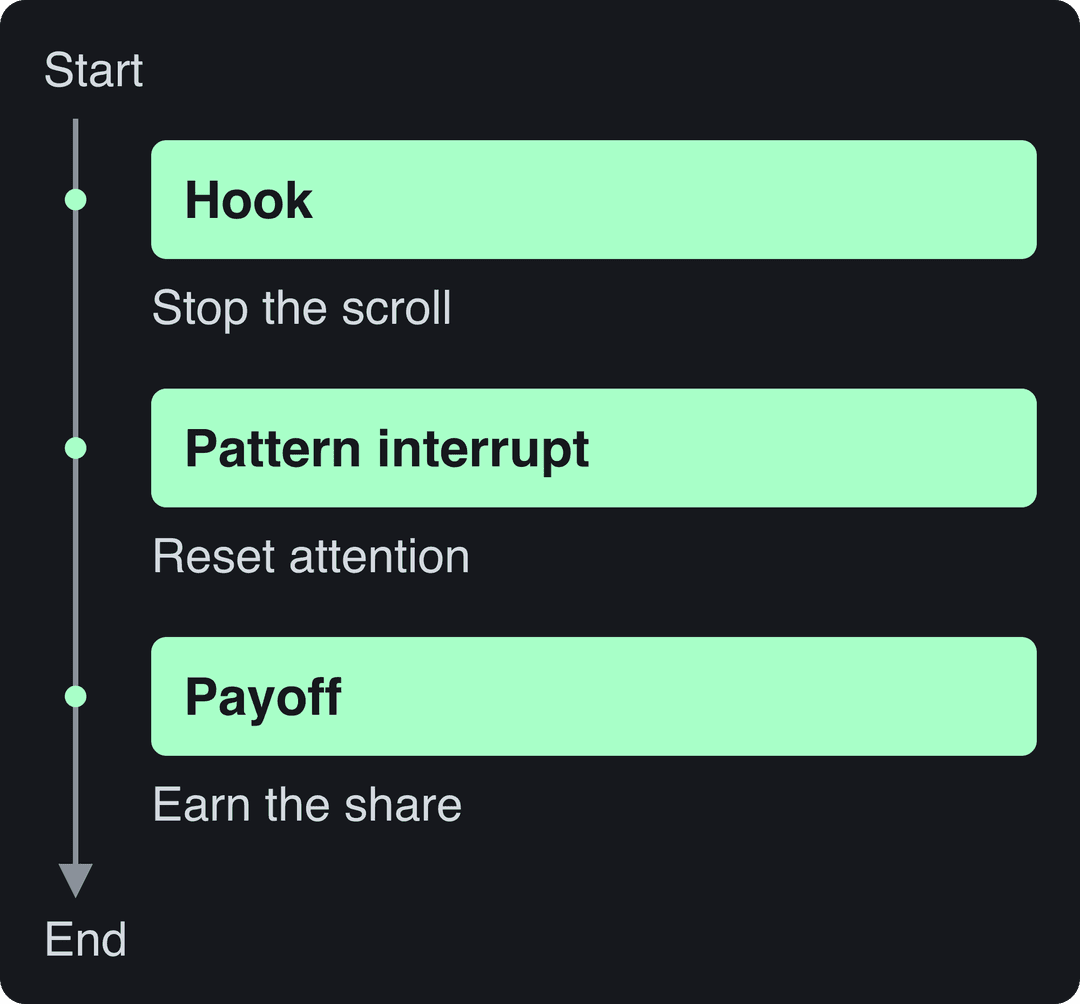
- Hook: stop the scroll with a clear question, tension or result in the first moments.
- Pattern interrupt: change the visual, framing, sound or information before the viewer predicts the next frame.
- Payoff: deliver what the hook promised, clearly enough to earn a share, save, follow or rewatch.
The hook is where emotion shows up in the data. Outrage-driven TikToks had a 156K median, humor 121K and sadness 104K, while inspirational videos sat at 45K. A strong reaction beats a pleasant one, so open on the tension, not the moral.
Four hook types that work across platforms:
- Contrarian claim: "Your captions aren't the problem. Your first sentence is."
- Visual jolt: open on the messy desk, then cut to the clean setup.
- Cold open with stakes: start at the moment something went wrong, explain after.
- Unfinished loop: "I changed one line in this product demo and the buyer finally got it." Deliver the line at the end.
For more openers to adapt, Revid keeps a list of TikTok hooks that stop the scroll.
Then test the arc: mute the video and name the hook, the interrupt and the payoff from visuals and captions alone. If one beat disappears, fix that beat before adding effects.
TikTok vs Instagram Reels vs YouTube Shorts in 2026
| TikTok | Instagram Reels | YouTube Shorts | |
|---|---|---|---|
| Maximum length | Uploads up to 60 minutes | Up to 20 minutes | Up to 3 minutes (square or vertical) |
| Reach limit to know | None stated for length | Reels over 3 minutes are not recommended to non-followers | Shorts over one minute with an active Content ID claim are blocked |
| Hashtags | 3 to 4 did best in Revid's data; 9 or more did worst | Up to 5 per post | Optional |
| Testing tool | Post variations | Trial reels | Shorts series for episodic formats |
| Best for | Fast discovery, trends, responses | Visual brands, products, existing followers | Searchable topics, evergreen answers, channel growth |
Independent coverage describes TikTok as strongest for rapid discovery and Reels for Instagram relationships and millennial reach, with YouTube broadest in overall US adult reach (Vidico's short-form video statistics). Socialinsider's 2026 study of 69 million short-form videos adds a useful wrinkle for small accounts: under 5,000 followers, YouTube Shorts averaged 15,160 views per video against 625 on Reels and 350 on TikTok, while TikTok led on engagement rate by followers (2.60% vs 0.45% for Reels and 0.30% for Shorts).
The decision rule: if you need reach from zero, start on Shorts; if you need conversation and fast creative feedback, start on TikTok; if you sell something visual to people who already follow you, start on Reels. Copy the promise across platforms, not the exact edit. Revid's comparison of Instagram Reels vs TikTok goes deeper on that choice.
If you put paid budget behind your best organic shorts, Wojo Media's overview of short-form video ads covers how to test opening concepts in paid campaigns. And if part of your audience is customers you reach by SMS, Call Loop's guide to sending a video through text explains how to deliver a clip outside the feeds.
Short-form video statistics for 2026
| Statistic | Source |
|---|---|
| YouTube sees over 200 billion daily Shorts views | YouTube, August 2026 |
| 37% of US adults use TikTok, up from 21% in 2021 | Pew Research Center, 2025 |
| Instagram Reels watch time grew more than 30% year over year in the US in Q4 2025 | Meta earnings call, January 2026 |
| US social video ad spend is set to grow 13% in 2026, outpacing connected TV (11%) for the first time | IAB, May 2026 |
| 88% of US consumers say a video must grab their attention in 30 seconds or less | Clutch, October 2025 survey |
| Short-form video is the top ROI content format, cited by 49% of marketers | HubSpot State of Marketing 2026 |
Competition is rising with consumption. Short-form publishing grew 71% year over year and TikTok posts rose 156% in Metricool's 2025 analysis, as reported by MarketingTechNews. More creators fight for the same opening seconds, which is why format and hook matter more than posting volume.
Revid keeps a sourced, regularly checked list of short-form video statistics, with data on 2.4 million TikToks. For more third-party figures, Kapwing's compilation of 2026 TikTok, Reels and Shorts statistics gathers survey and platform data; check each figure's original source before you quote it.
Metrics that show a trend is working
Views confirm distribution. They do not tell you whether the creative earned attention or moved anyone to act. Read each post as a chain.
| Metric | What it validates | Compare against |
|---|---|---|
| Early retention | The hook and first visual | Your own account baseline |
| Completion rate | Pacing and payoff | Your videos of similar length |
| Shares per view | Relatability and usefulness | Your history for the same format |
| Saves | Reference value (tutorials, lists) | Profile visits from the same post |
| Follows per view | Whether the series promise is clear | Same topic on other platforms |
Completion falls as videos get longer, so never compare a 15-second clip with a 3-minute one. In Vidyard's 2024 benchmarks, 65% of viewers stayed to the end of business videos under 1 minute, against 20% for videos over 20 minutes. Umbrex's explainer on video completion rate covers how the metric is calculated and read. For duration choices by platform, see Revid's social media video length best practices.
Short clips have a specific strength: in Revid's TikTok data, videos under 15 seconds had a lower median (58K) but the most shares per view, 1.41 per 100. If your goal is shares, short wins; if it is watch time, 61 to 90 seconds did slightly better (70K median).
How to turn a trend into an original video with Revid
Revid starts from videos that already performed instead of a blank prompt.
- Search Revid's library of about 2.77 million viral videos by topic, platform, engagement tier and length, and open one that matches the format you picked.
- Run the free Deep analysis (up to 60 a day) to see its hook, timed structure, scroll-stopping moment and three ways to adapt it to your niche.
- Choose "Make it about your topic" or "Same energy, new script": Revid writes a new script and visuals, adds an AI voice-over in 70+ languages and synced captions, and writes original music direction instead of copying the source audio.
- Fix any scene in the timeline editor, then publish or schedule to TikTok, Instagram and YouTube from one queue and read each post's views, likes and comments.
Sign-up is free and new accounts get free credits to try video creation, no credit card needed; regular creation then uses the monthly credits of a paid plan, from $39/month.
A 30-day short-form trend test
Run the next month as a controlled test, changing one variable at a time.
- Week 1, hooks: publish five versions of one topic with different openings (contrarian claim, visual jolt, question, cold open, unfinished loop). Keep the one with the best early retention.
- Week 2, format: put the winning hook into one repeatable format, such as a faceless tutorial or a POV story, and make variations. Measure views to engagement.
- Week 3, payoff: test payoff styles (reveal, answer, twist, call to follow) and track completion rate.
- Week 4, scale: produce several versions of the winner, adapt it per platform, and add one new format as a controlled comparison. Judge by total watch time and follows.
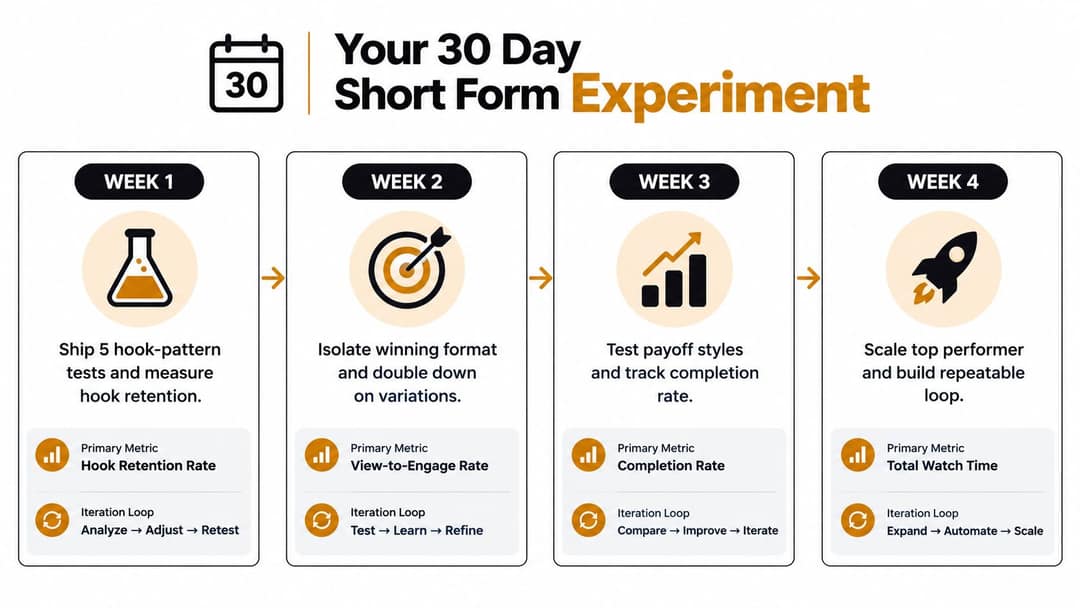
Log the hook, format, platform, length, payoff and primary metric for every post. At the end, the useful question is not which video went viral but which decision kept improving the next metric. That decision is your plan for month two.
FAQ
What is the biggest short-form video trend in 2026?
The shift from chasing sounds to repeating proven formats, especially faceless and POV videos. In Revid's TikTok data, faceless videos had a 114K median against 67K for one person on camera.
How long should a short-form video be in 2026?
As long as the payoff needs and no longer. In Revid's 12-month TikTok sample, every length bucket landed between 58K and 76K median views, so pacing matters more than duration; keep Reels under 3 minutes if you want reach beyond followers.
How many hashtags should I use on TikTok and Reels?
Use 3 to 4 on TikTok and up to 5 on Instagram, which is Instagram's limit per post. In Revid's TikTok data, 4 hashtags had the best median (77K) and 9 or more did worst (16K).
Does labeling a video as AI-generated hurt its reach?
No, not by itself. TikTok and YouTube both say the disclosure label does not limit distribution, and both require it for realistic AI content; skipping it risks labels being applied for you or penalties.
Should I post the same short on TikTok, Reels and Shorts?
Post the same idea, adapted to each platform. Change the hook, caption and hashtags per feed, and avoid lazy reposts: Facebook now deprioritizes reels changed only with borders, captions or speed.