Short Form vs Long Form Video: Which Wins for Your Goal
Short form vs long form video compared by audience, platform fit, effort and engagement, with a guide to picking the right format in 2026.

On this page
Views on YouTube rose while average view duration fell 36.96%, from 3.98 minutes to 2.51 minutes, and engagement dropped 45.36%, according to Metricool's analysis of 799,718 videos from 71,177 YouTube accounts. Two curves, one platform, opposite directions.
That gap is the short form vs long form argument reduced to a single number pair. Reach and attention are separate assets, bought with different videos, and most content calendars track only one of them. The right format isn't the one with the most views. It's the one that moves the number you're judged by, whether that's profile visits, watch time, clicks or revenue.
- Viewers who finish business videos shorter than one minute
- 65%
- Vidyard, 2024
- Viewers who finish business videos longer than 20 minutes
- 20%
- Vidyard, 2024
- Views Shorts received compared with regular YouTube videos
- 4x
- Longitudinal YouTube Shorts study
- Consumers who prefer discovering products through short-form video, vs 8% long-form
- 37%
- HubSpot consumer trends, 2024
Short-Form and Long-Form Video at a Glance
Short-form video is a vertical clip of roughly 60 seconds to three minutes, built to be swiped through on TikTok, Instagram Reels or YouTube Shorts. Long-form video runs eight minutes or more, often 10 to 30, and is built to be watched to the end: a demonstration, a comparison, an interview, an argument that needs room.
The two formats differ on six dimensions that decide how you budget for them.
| Dimension | Short-form | Long-form |
|---|---|---|
| Typical length | About 60 seconds to 3 minutes | 8 to 30 minutes, sometimes longer |
| Main job | Discovery and reach | Explanation, trust and depth |
| Completion | About 65% for videos under one minute | About 20% for videos over 20 minutes |
| Engagement pattern | More likes per view | More comments per view |
| Production effort | Lower per video, needs high volume | Higher per video, fewer uploads |
| Typical platforms | TikTok, Instagram Reels, YouTube Shorts | YouTube, long-form series, websites |
Completion separates them hardest. A roundup of video length benchmarks reports that 65% of viewers complete business videos shorter than one minute, against 20% for videos longer than 20 minutes. A viewer who finishes a 30-second clip has given you half a minute. A viewer who finishes a 20-minute explainer has given you four minutes, which is eight times the attention even though the completion rate looks three times worse.
The index leans toward videos that surface in hashtag and keyword searches, so its view counts run high: compare the groups, not the absolute numbers.
Source: Revid TikTok index: 2,377,477 TikToks with AI labels per video, snapshot of Sep 15, 2026. Median views estimated from view buckets.
Show the data
| Median views | Share past 1M views | |
|---|---|---|
| 0-7s | 88.3K | 19.9% |
| 8-15s | 111.1K | 22.6% |
| 16-30s | 141K | 25.1% |
| 31-60s | 120.4K | 22.8% |
| 61-120s | 97K | 19.8% |
| 2-5 min | 89.1K | 18.3% |
| 5 min+ | 90.1K | 17.2% |
The trade-off this article tests
Short-form buys reach. Long-form buys depth. Neither one proves the other is wasted, and no single number on an analytics dashboard tells you which of the two is earning its keep.
Pick the column before you pick the format. If you can't name the metric a video has to move, the length debate is decoration.
Name the column that matches your goal, then check whether your production week can fill it. The format isn't the strategy. The metric is.
Who Watches Each Format and Why

38% of UK adults watched long-form video daily in 2026, including 19% who watched it multiple times per day, according to YouGov's survey of UK media consumption. Long-form is a routine choice for a substantial share of viewers, not just a legacy format.
Discovery tilts toward short-form. HubSpot's consumer trends research found that in 2024, 37% of surveyed consumers preferred discovering products through short-form video, compared with 8% who preferred long-form video. These findings describe different stages of viewing: people may discover a product in a feed, then spend more time evaluating it.
Two modes, two jobs
Scrolling mode is often about entertainment, a quick answer, or a first encounter with an unfamiliar creator. The decision to keep watching happens almost immediately. A short clip must earn attention before it can deliver anything else, so reach alone does not show whether viewers have understood or remembered its message.
Sitting-down mode is more deliberate. Viewers may be learning a process, comparing products, or deciding whether a creator knows enough to earn their trust. A 40-second skincare Reel can spark interest; a 20-minute review can help a buyer assess a $90 serum. The same person may watch both, but for different reasons.
Industry can shape that choice more than platform. An audience of B2B engineers may watch a long technical interview and skip its 30-second cut, even if the cut travels further. The short clip can introduce the topic, while the interview provides material viewers can cite in a procurement meeting. Short-form can win distribution without earning the same depth of attention.
How to tell which mode your audience is in
- Check the arrival source. Search and suggested video can indicate that viewers arrived with a question. Feed traffic often means viewers are browsing and need a reason to stay.
- Count returning viewers. Repeat visits suggest people are choosing to spend more time with the channel, regardless of the format of their first video.
- Read the comments, not just the likes. Brief replies and emoji may signal a quick reaction. Detailed comments and follow-up questions show viewers are engaging with the subject.
- Look at session length. If viewers leave after one clip, the video may be serving as entertainment rather than leading them to explore more of your work.
When feed traffic dominates and returning viewers are scarce, the audience may be discovering the content without forming a habit. That points to a gap between reach and retention, not a problem with video length. Judge each format by the outcome you need: short-form can introduce an idea, while longer viewing may be better suited to explaining it and building trust.
How Platforms Reward Each Format
Platforms hand out distribution unevenly, and their own data shows which format they currently favour.
A longitudinal study of YouTube Shorts built on YouTube Data API metadata tracked the two years after Shorts launched in March 2021. It found Shorts received roughly four times as many views as regular videos across the platform, and by the end of 2022 that gap had widened to six times. Inside a single channel the comparison gets sharper, with Shorts averaging 110 times the views of their long-form counterparts.
Those are averages from channel-level comparisons, not a forecast for your account. A channel whose traffic comes from search will see a far smaller gap. A channel that lives on the feed will see a bigger one. Treat the ratio as evidence of which format the recommendation system prefers, not as a target you failed to hit.
Here's how the two formats sit against each other once reach is stripped out.
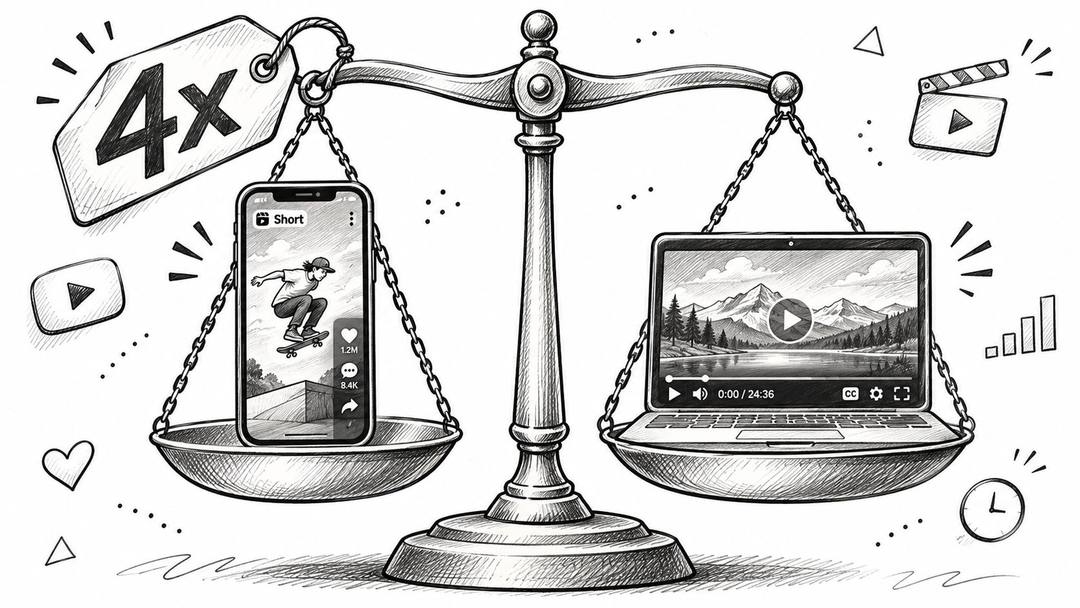
Reach and conversation are different currencies
The reaction differs as much as the reach. The same YouTube analysis found Shorts attracting more likes per view, which is what lightweight approval looks like in data: a fast tap with no commitment behind it. Regular videos attracted more comments per view, the signature of a viewer with something to say. One format collects applause, the other collects replies.
For a creator selling something, that distinction has a price. Comments are where objections surface, where buyers ask about fit, and where you find out that your explanation of the offer landed or didn't.
The ceiling keeps moving
TikTok's product history shows the same widening from the other direction. ByteDance launched Douyin in China in September 2016, and within about a year it had reached 100 million users and more than 1 billion video views per day. TikTok expanded internationally in September 2017 and took its present global form in 2018 with a one-minute posting limit. From 2020 the ceiling went to three minutes, then five, and by 2023 it reached 10 minutes.
Platforms raise the limit because successful creators keep asking for more room for tutorials, commentary and storytelling. The practical consequence is that upload limits move, so check the current limit inside the app before you plan a series that depends on it.
Put length where your viewers already search and scroll, not where a platform's launch page says the future is.
Production Effort and Cost per Video
Short-form and long-form aren't the same job at different speeds. They're different jobs with different bottlenecks.
Where the hours go
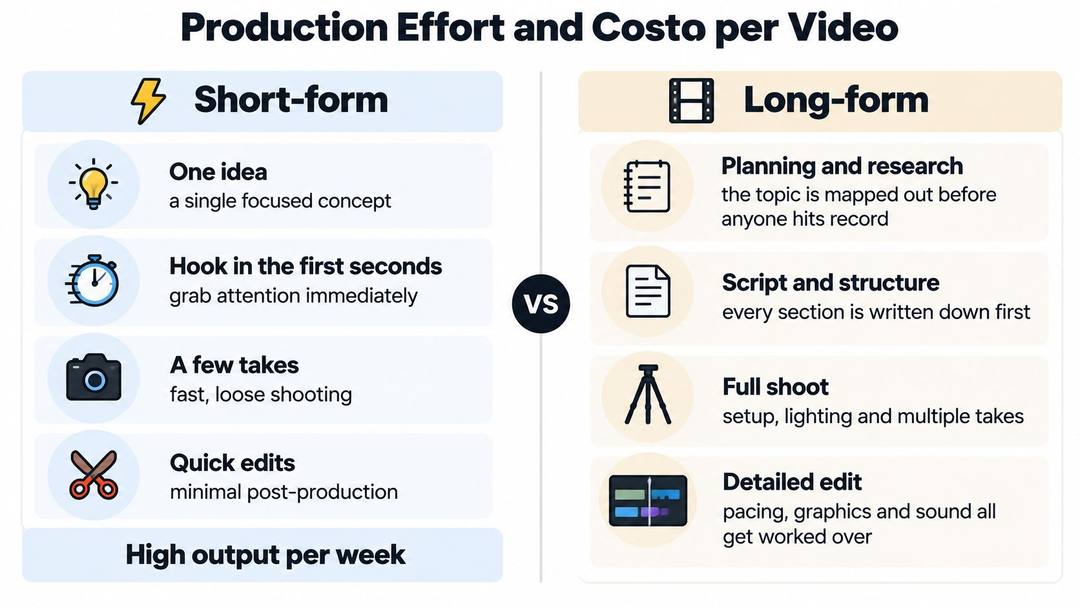
A short clip starts with one idea. You write a hook for the first two seconds, shoot a few takes on a phone or in a browser tab, cut the dead air, add captions and publish. The whole cycle fits inside an afternoon, which is why a solo creator can ship several a week.
A long video starts before anyone hits record. Research, an outline, a script or a running order, a recording session with setup and lighting, then an edit that has to hold attention across a dozen minutes with pacing changes, graphics, chapters and a thumbnail that survives a crowded sidebar. Fewer uploads come out the other end.
Cost per published minute
Comparing a short video to a long one by sticker price tells you nothing, because they aren't sold by the same unit. Normalise both to hours of production per published minute: total production hours for one video, divided by its running time.
Take a 30-second clip that takes 90 minutes end to end, which works out at three hours of work per finished minute. A 15-minute explainer that takes 10 hours works out at about 40 minutes of work per finished minute. The clip is roughly four and a half times more expensive per minute of video, which sounds damning until you count how many clips a feed needs in a month.
Compare like with like. Hours per published minute, multiplied by the number of months each video keeps earning views, is the only cost comparison that holds across both formats.
Videos include an AI voiceover; clip quotes are AI highlights without one. Clip and motion graphics quotes are minimums: the final charge depends on the source video or the footage generated. AI video clips are on the Pro model; the Base model costs 110 credits for 30 s.
Source: Revid public endpoint POST /api/public/v3/calculate-credits, queried October 29, 2026: workflow video-to-clips with 1 and 3 outputs, and prompt-to-video at 30 and 60 seconds with each media type. Cents = credits x $39 / 2,000, rounded.
Show the data
| Credits | US cents on Growth | |
|---|---|---|
| 1 clip from a YouTube link | 1 | 2 |
| 3 clips from a YouTube link | 3 | 6 |
| 30 s video, stock footage | 11 | 21 |
| 30 s video, animated AI images | 37 | 72 |
| 60 s video, animated AI images | 75 | 146 |
| 30 s video, motion graphics (estimate) | 190 | 371 |
| 30 s video, AI video clips (Pro model) | 341 | 665 |
What the tooling costs
Revid.ai's credit pricing puts a number on the short-form side. A typical 30-second video with Pro moving images and a voiceover costs about 40 to 80 credits, so 2,000 credits cover roughly 25 to 50 such videos a month. It is less suited to long-form film production, or to teams that only want to edit their own footage by hand.
That's the honest boundary. Generated short-form scales because the marginal clip is cheap. A location shoot, a demo rig or an expert interview doesn't scale that way, and budgeting it as if it does is how teams end up with a channel full of clips and nothing to point them at.
If a video needs a real location, a product demonstration or a named expert on camera, budget long-form time even when a 60-second cut would publish faster. Count production hours per published minute for both formats before you choose, and weigh that cost against how long each video keeps earning views.
Engagement Metrics That Show Each Format Working
A view count registers a click, not a minute and not a decision. It's the easiest number to grow and the least informative, which is why so many format arguments stall.
The fix is to give each format the numbers it can move.
| Format | Primary KPI | Secondary KPI | Warning sign |
|---|---|---|---|
| Short-form | Reach and profile visits | Completion rate and shares | Views rise but profile visits stay flat, so the hook is not converting |
| Long-form | Watch time and returning viewers | Comments and clicks to a next step | Views hold but returning viewers fall, so the video does not lead to the next one |
| Funnel handoff | Clicks from short clips to the full video | Watch time on the full video | Clip views rise but clicks stay near zero, so the clip promise does not match the full video |
Prompt to try
Make a 40-second vertical Short that opens with the hook "Your 15-minute tutorial is losing viewers in the first 30 seconds, here's why." Give one clear tip on tightening video intros, use bold captions and quick stock b-roll, and end by naming the creator and telling viewers the full breakdown is in the long video linked on the channel.
Reading the warning signs
Each row fails in a predictable way. A short clip with rising views and flat profile visits is entertaining without being identifying: viewers enjoyed it and never learned who made it or what else exists. Fix the last two seconds before you shoot more.
A long video with steady views and falling returning viewers has a different problem. It answered a question completely enough that nobody needed a second visit, which is fine for search traffic and fatal for a channel built on subscriptions. Add a next-step hook or a series structure.
The funnel row is one many teams skip. If clips pull views and nobody clicks through, the clip promised something the long video doesn't deliver, or the pointer arrives so late that the viewer has already scrolled.
What happens to the long videos
The relationship between formats isn't neutral. A 2024 study of 250 YouTube creators with substantial audiences found that introducing short-form content was associated with significantly lower view counts and engagement on those creators' long-form videos, while the short-form itself generally generated higher engagement. The study didn't find statistically significant declines in long-form likes and comments, so the fair reading is competition for attention rather than cannibalisation.
That's an argument for sequencing, not for dropping either format. Short clips compete with long videos for the same viewer's evening.
Completion rate isn't revenue
A 22-second clip can hit a high completion rate and never mention price, objections or fit. High completion tells you the video was short enough to finish and interesting enough not to swipe. It says nothing about whether the viewer can now make a buying decision.
Before publishing, settle one question: which metric pays for this format? A fuller breakdown of video engagement metrics covers how to instrument the handoff so the answer comes from data rather than instinct.
Which Format Fits Your Goal
Start with the goal. Length is the last decision, not the first.
| Goal | Lead with | Support with | Reason |
|---|---|---|---|
| Reach new viewers | Short-form | Long-form playlist for followers | Short clips introduce the creator to non-followers |
| Teach a complex process | Long-form | Short teaser clips | Demonstrations need time to show each step |
| Sell a high-consideration product | Long-form | Short ads for awareness | Buyers need objections answered before they act |
| Build trust through interviews or case studies | Long-form | Short quotes | Depth and personality show credibility |
| Launch a simple, quick offer | Short-form | Landing page or direct link | A single clear promise fits in seconds |
| Test ideas cheaply | Short-form | Long-form only for winning angles | Low production cost per test |
Adoption is not evidence
Heavy short-form use is often cited as proof that short-form converts better. The adoption figures don't support that reading. In 2024, 83% of surveyed marketers used short-form video, compared with 39% who used long-form video, according to HubSpot's 2024 Video Marketing Report.
That spread describes production speed, not outcomes. A clip can be planned, shot and published inside a day, so it gets adopted first and tested most. A long video requires research, a shoot and an edit that survives scrutiny, so fewer teams do it. Neither number says which one produced revenue, and treating adoption as evidence gets the causality backwards.
The rule that sets the length
Match duration to the minimum time needed to deliver the promised value, then cut the setup rather than forcing the idea into a short clip. A demo that needs four steps needs four steps. A price objection that needs context needs context.
There's an edge case worth naming. A short hook can carry the whole message when the offer is simple: one product tip, one limited discount, one setting change. In that case the long version is padding, and the clip is the complete asset rather than a trailer for something else.
If you can't name the goal in one sentence, choose the format that answers the first question your viewer asks, and answer it fully.
That question is usually "what is this and is it for me". A clip answers it in seconds. A long video answers the question that comes next, which is "how does it work".
Choose Your Format Mix Before You Publish
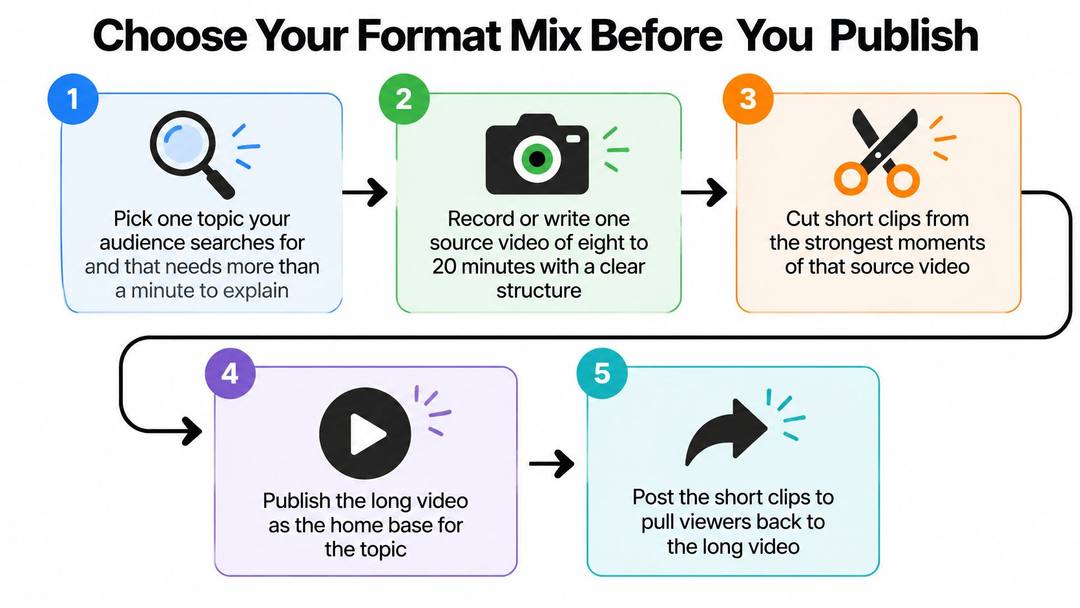
The mix works when the formats feed each other instead of competing for the same slot. Six steps, in order.
- Pick one topic your audience searches for that needs more than a minute to explain. If it fits in 30 seconds, it isn't a long video topic and shouldn't become one.
- Record or write one source video of eight to 20 minutes with a clear promise. One promise, stated early, delivered fully. This is the asset everything else derives from.
- Cut three to five clips under 60 seconds, each with one hook and one claim. One clip carries one idea. Two ideas in 45 seconds means neither lands.
- Post the clips on separate days across Shorts, Reels and TikTok, each pointing at the full video. Separate days give each angle its own test instead of splitting attention three ways in one afternoon.
- Track clicks from clips to the long video, and watch time on the long version. Those two numbers tell you whether the clips are acquiring the right people or just acquiring people.
- Keep the angles that bring returning viewers and drop the ones that earn views but no clicks. A clip with strong reach and no handoff is a paid impression you didn't budget for.
Here's the sequence laid out end to end.
Why the order matters
Short clips acquire viewers. The long video converts and retains them. Running the steps in reverse, publishing a long video first and hoping clips appear later, means the source asset was built for an audience that hasn't arrived yet.
Revid can turn a YouTube video, an article or a song into Shorts, Reels and TikToks, add captions to any video in 30 styles, and publish the results to TikTok, Instagram and YouTube. Clipping is one half of the workflow. The half that decides whether it works is still yours: choosing a topic worth 15 minutes and refusing to cut a clip that promises something the long video doesn't deliver.
Name the lead format for next month and the one metric that will prove it. If you can't pull that metric within a minute of opening your analytics, pick a simpler one, because a metric you check quarterly can't steer a weekly calendar.
Revid.ai fits the mix this article argues for: it turns one long video, article or song into a batch of captioned Shorts, Reels and TikToks, publishes them to TikTok, Instagram and YouTube, and tracks post stats so you can see whether the clips earn clicks or only views. If you want to test a short-clip-to-long-video funnel without hiring a production team, revid.ai gives you the tooling and the numbers to judge it by.
FAQ
What is the difference between short-form and long-form video?
Short-form video is a vertical clip of roughly 60 seconds to three minutes, built to be swiped through on TikTok, Instagram Reels or YouTube Shorts. Long-form video runs eight minutes or more, often 10 to 30, and is built to be watched to the end. Short-form mainly buys discovery and reach, while long-form buys explanation, trust and depth.
Do YouTube Shorts get more views than long videos?
Yes, on average. A longitudinal study of YouTube Shorts found they received roughly four times as many views as regular videos, a gap that widened to six times by the end of 2022. Long videos, however, attracted more comments per view, while Shorts collected more likes per view.
Does posting Shorts hurt my long-form YouTube videos?
A 2024 study of 250 YouTube creators found that introducing short-form content was associated with lower view counts and engagement on their long-form videos. It found no statistically significant drop in long-form likes and comments, so the fair reading is competition for attention rather than cannibalisation. That argues for sequencing clips and long videos, not dropping either.
Which video format is better for selling a product?
For a high-consideration product, lead with long-form and support it with short ads for awareness, because buyers need objections answered before they act. For a simple, quick offer, short-form can carry the whole message with a landing page or direct link. Match the length to the minimum time needed to deliver the promised value.
How do I combine short-form and long-form video?
Record one source video of eight to 20 minutes on a topic your audience searches for, then cut three to five clips under 60 seconds, each with one hook and one claim. Post the clips on separate days across Shorts, Reels and TikTok, each pointing at the full video. Track clicks from clips to the long video and its watch time, and keep the angles that bring returning viewers.
Sources
- Revid TikTok index: 2,377,477 TikToks with AI labels per video, snapshot of Sep 15, 2026. Median views estimated from view buckets.
- Revid public endpoint POST /api/public/v3/calculate-credits, queried October 29, 2026: workflow video-to-clips with 1 and 3 outputs, and prompt-to-video at 30 and 60 seconds with each media type. Cents = credits x $39 / 2,000, rounded.
- Vidyard, Video in Business Benchmark Report (2024)
Charts and figures checked on November 23, 2026.