Podcast to Video: Turn Any Audio Episode into a YouTube Video
Upload your episode to Revid's Audio/Video to video tool, pick 16:9 for a full YouTube episode or 9:16 for clips, choose your visuals and generate. These are the current steps, costs and YouTube settings.
On this page
To turn a podcast into a video, open Revid's Audio/Video to video tool (sidebar Create, then From a link or audio). Upload the episode or paste its link, pick 16:9 for a full YouTube episode or 9:16 for clips, choose a media type and click Generate video. Revid matches scenes to the conversation and adds synced captions.
The usual mistake is posting the audio over a single still cover image. A podcast is all talk, and talk alone holds attention poorly. In Revid's analysis of 176,367 TikToks with 1,000+ likes posted between October 2025 and October 2026, videos with speech all the way through had a median of 68K views, against 123K for videos with under 40 characters of speech. The picture has to keep people watching while the voice carries the content: scenes that change, readable captions, something worth looking at.
Videos with just a few spoken words (a line or two) beat both silent videos and videos that talk the whole way through, which were the most common and the weakest.
Source: Revid analysis of 176,367 TikToks analyzed by AI, with 1,000+ likes posted between Oct 1, 2025 and Oct 16, 2026 (61,203 creators)
Show the data
| Median views | Share that passed 1M views | |
|---|---|---|
| No speech | 73.3K | 14.3% |
| Under 40 | 122.7K | 20.2% |
| 40 to 120 | 97.2K | 17.6% |
| 120 to 300 | 91.6K | 16.8% |
| 300+ | 67.7K | 11.9% |
That sample only includes TikToks that already passed 1,000 likes. It shows what successful videos have in common, not what causes their success. The method and every chart are in our study of what makes a TikTok go viral.
Full episode or clips: decide before you upload
A full YouTube episode and a batch of vertical clips need different ratios, and often different tools. Choose your goal first.
| Goal | Ratio | Revid tool | Where it goes |
|---|---|---|---|
| Full episode as a YouTube video show | 16:9 | Audio/Video to video, with the complete episode file | YouTube (regular videos) |
| One clip from an audio file | 9:16 | Audio/Video to video, with the trimmed moment, or the podcast clip generator | Shorts, TikTok, Reels |
| Several clips from an episode already on YouTube | 9:16 | YouTube Long to Shorts (1 to 3 extracts per run) | Shorts, TikTok, Reels |
In older versions of Revid, the Audio to Video panel had an extract counter. The current interface puts the "How many extracts do you want?" setting in the YouTube Long to Shorts tool, covered in the clips section below.
Step 1: Open Audio/Video to video and add your episode
Pick an episode that deserves a video: a listener favorite, or one built on a clear story or a strong opinion that works without context.
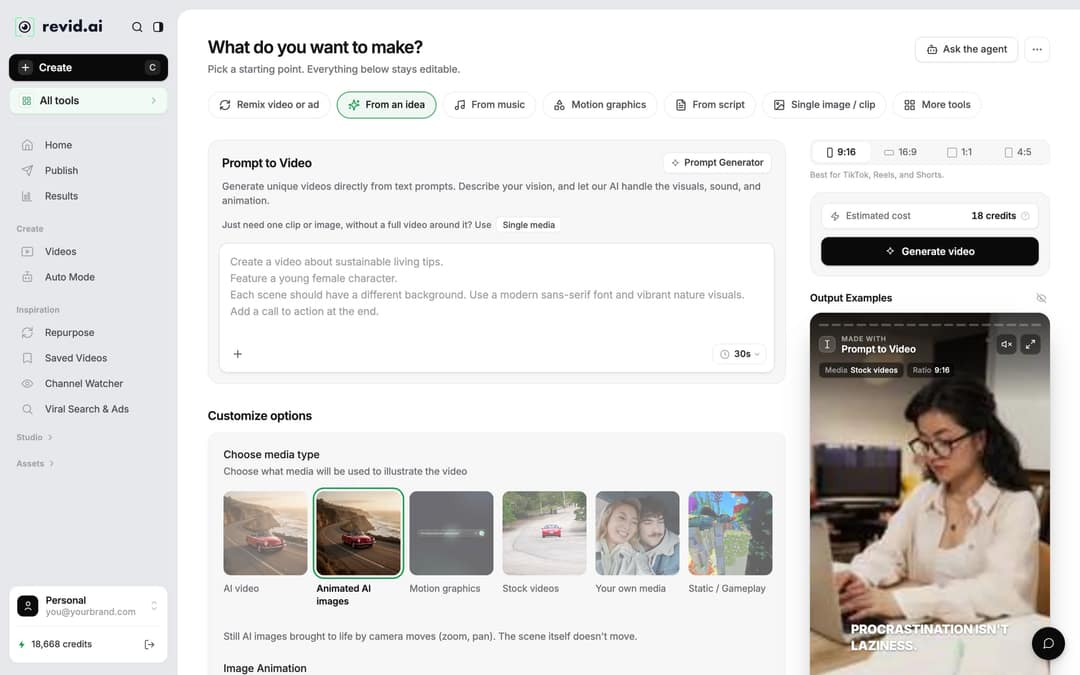
- Click Create at the top of the sidebar, or press C. The page opens on "What do you want to make?"
- Click the From a link or audio chip. On a narrower window it is folded under More tools, where it appears first. You can also open the Audio to Video tool directly.
- Upload the episode file (MP3, WAV or M4A) or paste a link to it.
Step 2: Pick the ratio and the media type
The ratio picker sits in the right column, above the cost estimate. It offers four options: 9:16, 16:9, 1:1 and 4:5.
- 16:9 for a full episode published as a regular YouTube video.
- 9:16 for YouTube Shorts, TikTok and Instagram Reels.
- 4:5 or 1:1 for feed posts.
Next, choose the visuals under Choose media type. This one setting decides both the look of the video and most of its cost.
| Media type | What viewers see | Pick it when |
|---|---|---|
| Animated AI images (default) | Still AI images brought to life by zooms and pans | Most episodes: it moves and stays affordable on long audio |
| AI video | Generated clips from Seedance 2.5, MiniMax Hailuo H3, Wan 3.0 or Google Veo 3 | Short clips where real motion matters (paid plans only) |
| Motion graphics | Animated text and graphics | Business, tech or explainer shows full of numbers and lists |
| Stock videos | Real footage matched to the topic | Lifestyle, news and travel topics |
| Your own media | Photos and clips you upload | Host photos, studio shots, product images |
| Static / Gameplay | One background, or gameplay footage | Archive uploads of very long episodes |
If the episode is not in English, open Advanced options and set Language & Localization > Language to the episode's language. The default, Automatic, can mishear some audio, and a fixed language makes captions more accurate.
Step 3: Check the cost and generate
Before you commit, the Estimated cost box next to Generate video shows the credit price. On a long episode, it is worth comparing media types here first. Current rates:
- Animated AI images: 1, 4 or 16 credits per image (Low, Pro, Ultra).
- AI video: billed per 5 seconds: 15 (Low), 50 (Pro), 100 (Ultra, Veo 3, MiniMax Hailuo H3), up to 500 for Seedance 4K. On a full episode, this adds up fast, so keep AI video for short clips.
- Motion graphics: 2, 3 or 5 credits per second, with a 15-second minimum per generation.
Click Generate video. If a build fails, Revid refunds its credits automatically.
Step 4: Fix scenes and captions in the editor
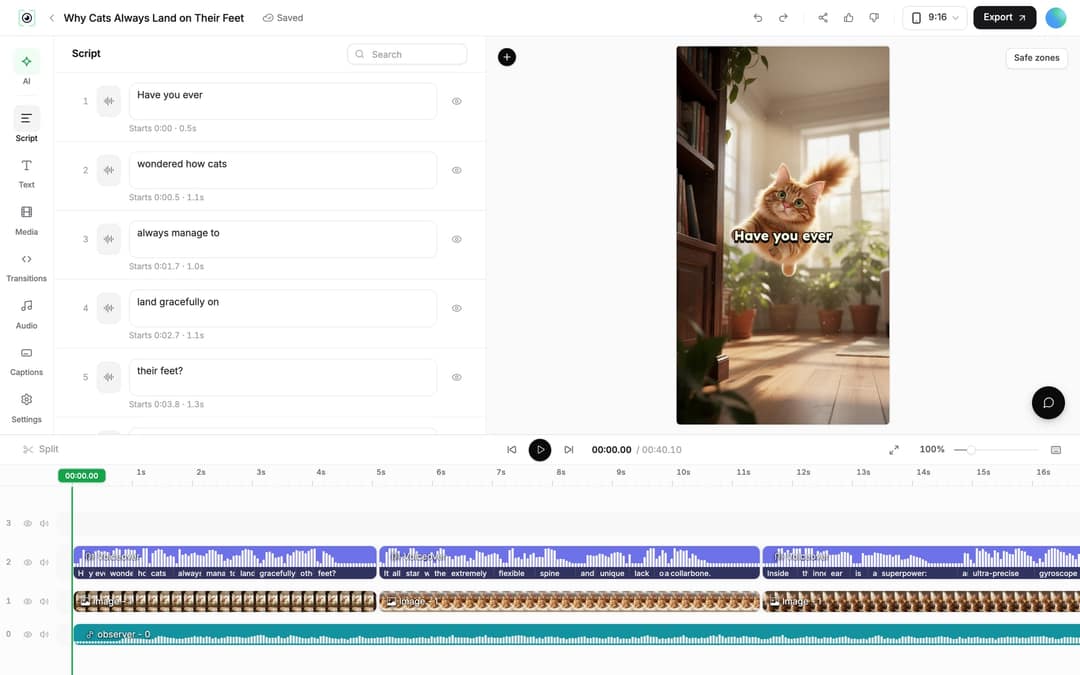
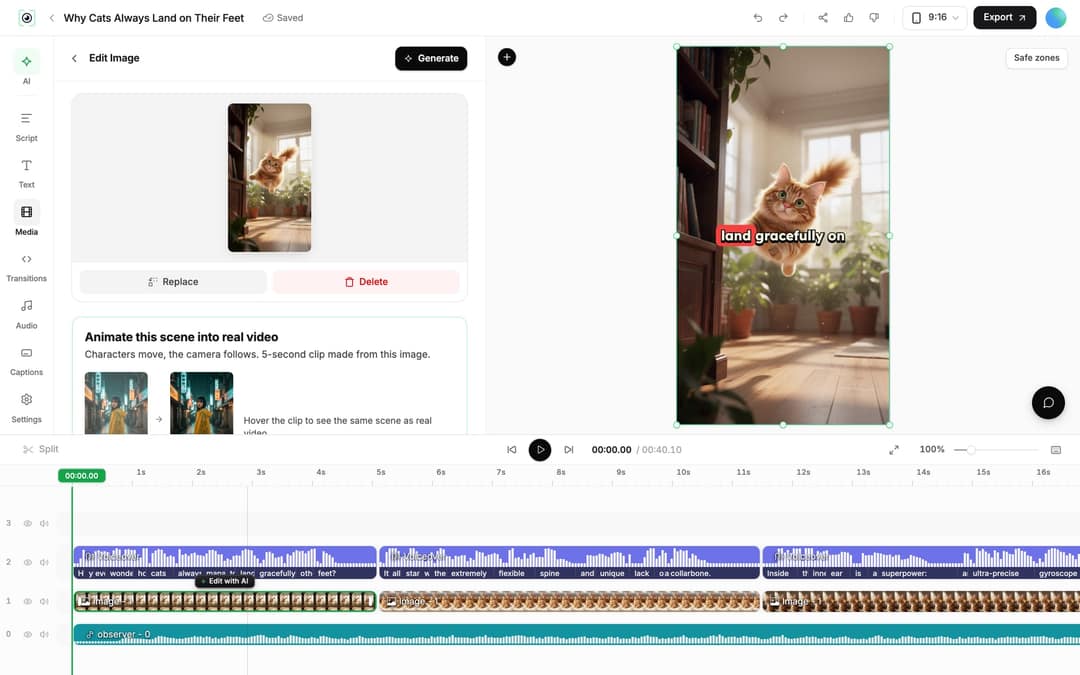
Click the finished video to open it in the editor. The left rail holds Script, Text, Media, Transitions, Audio, Captions and Settings.
- Fix misheard words. The Script panel lists every caption segment with an editable text box and its start time. Correct guest names, brand names and jargon there.
- Replace a scene. Select an image clip and click Replace to pick another file from the Media library. For AI images, Regenerate/Edit image makes a new one from a prompt.
- Trim. Drag a clip's start or end edge on the timeline, or move the playhead and press S to split. This is the quickest way to cut intro music out of a clip.
- Style the captions. The Captions panel offers 30 caption styles. Captions matter on podcast clips because many people scroll with the sound off.
Step 5: Export and publish
- Click the button at the top right of the editor. It reads Export on paid plans and Export / Publish otherwise. You can export in 720p, 1080p or 4K at 30 or 60 fps (4K export adds 10 credits).
- To post from Revid, use Publish on the project card or the editor's publish button. In the Publish Video dialog, choose your accounts under Publish to, then click Publish to post now or Add to queue to schedule it.
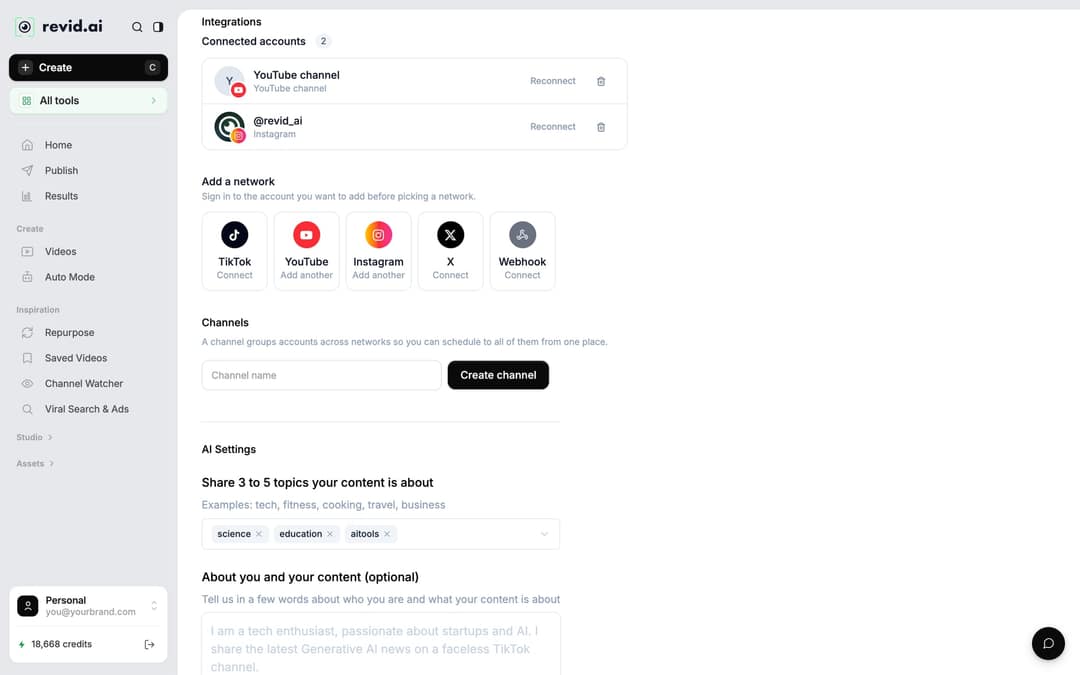
Before you can publish, connect your accounts in Settings > Integrations > Add a network. The options are TikTok, YouTube, Instagram (business or creator account required), X and Webhook. The Publish page links there too, and our page on publishing directly to YouTube, TikTok and Instagram covers scheduling.
How to turn an audio podcast into a YouTube video show
A YouTube podcast show is the full episode published as a regular 16:9 video, on a schedule. Once you have exported it, these YouTube settings decide whether people find it. Our guide to YouTube upload settings covers the file side.
- Verify your account first. YouTube limits uploads to 15 minutes by default, and most episodes run longer. Verified accounts can upload longer videos.
- Title: up to 100 characters. Lead with the topic or the guest people would search for, not the episode number.
- Description: up to 5,000 characters. Start with a two-line summary, then add timestamps for each topic so viewers can jump to the part they want.
- Custom thumbnail: YouTube recommends 3840x2160 (16:9, minimum width 640 px), and custom thumbnails need a verified account. A guest's face plus three or four words of the main claim beats the podcast logo.
- AI label: if your realistic AI visuals show real people or events that did not happen, turn on the "AI use" setting in YouTube Studio. Non-realistic styles such as illustrations don't need the label, and disclosure alone does not limit reach or monetization.
Your own conversation is original content. AI visuals on top of it fit YouTube's rules for AI-assisted videos, which allow automated tools when the final video reflects the creator's own creative work.
How to make podcast-to-video clips for Shorts, TikTok and Reels
If the episode is already on YouTube, the fastest route is YouTube Long to Shorts, the YouTube clip maker. Find it under More tools on the Create page.
- Paste the episode link.
- Set How many extracts do you want? to 1, 2 or 3.
- Leave Auto-reframe video on (the default). It keeps the speaker in a vertical frame and costs 10 credits.
If you only have the audio file, trim the moment you want in any audio editor first. Then run it through Audio/Video to video at 9:16.
Either way, keep clips whose first sentence makes sense without the rest of the episode. A clip that opens mid-thought ("and that's why he left") loses people before the point arrives.
Platform limits to know:
- YouTube Shorts: vertical or square videos up to 3 minutes count as Shorts.
- Instagram Reels: reels can run long, but reels over 3 minutes are not recommended to people who don't follow you.
- TikTok: uploads can run far longer than any clip you would make, so length is your call, not the platform's.
On length, the TikTok data says not to stress. In the same Revid analysis, every length bucket from under 15 seconds to 10 minutes had a median between 58K and 76K views. Clips under 15 seconds had the lowest median (58K) but the most shares per view (1.41 per 100). Cut where the idea ends, not at a target duration.
Length alone barely moves views: every bucket lands between 58K and 76K median views (the 790 videos over 10 minutes are a small, unusual group). Clips under 15 seconds get shared the most per view.
Source: Revid analysis of 176,367 TikToks with 1,000+ likes posted between Oct 1, 2025 and Oct 16, 2026 (61,203 creators)
Show the data
| Median views | Share that passed 1M views | Shares per 100 views | |
|---|---|---|---|
| Under 15 s | 57.6K | 11.6% | 1 |
| 16 to 30 s | 64.9K | 12.3% | 1 |
| 31 to 60 s | 61.8K | 11.8% | 1 |
| 61 to 90 s | 70.5K | 12.2% | 1 |
| 91 s to 3 min | 63.4K | 11.1% | 1 |
| 3 to 10 min | 76.4K | 12.4% | 1 |
| 10 min+ | 129.6K | 13.8% | 0 |
For more clip formats and posting ideas, see how to convert podcast episodes into social media videos.
Automate clips for every new episode
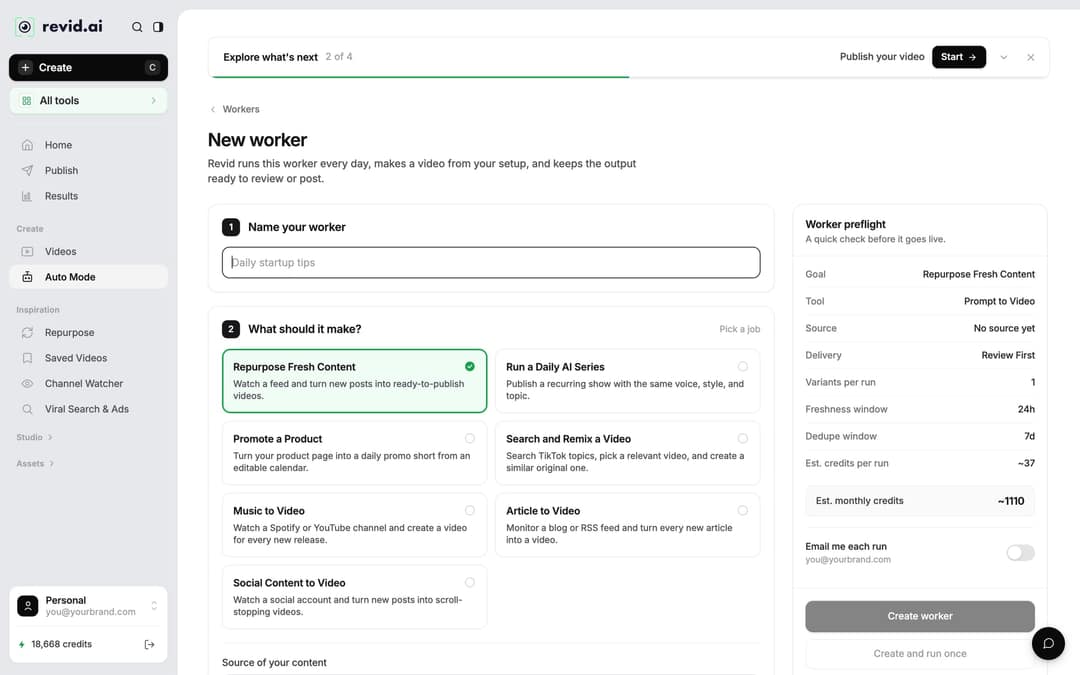
If each episode lands on your YouTube channel, an Auto Mode worker can pick up new uploads every day without you starting each video by hand.
- Open Auto Mode in the sidebar and click New worker.
- Name it, then choose Repurpose Fresh Content under "What should it make?" and enter your YouTube channel as the source. Single video links are refused.
- Under Pick the format, choose the tool that makes the video. The "YouTube to Shorts" template defaults to Voiceover Video, which voices a new script instead of clipping your episode.
- Keep Review First to check each video, or pick Auto Queue and select the accounts to post to.
- Check Est. credits per run in the Worker preflight panel, then click Create worker.
Each worker runs once a day between 1 AM and 5 AM and makes one video from a recent post. It skips the run when nothing new appears. Workers need a paid plan: Growth includes 3.
Can you convert a podcast to video for free?
Partly. Revid sign-up is free, and new accounts get free credits to try video creation, with no credit card needed. Regular creation then uses credits from a paid plan, starting with Growth at $39/month ($32/month billed yearly) for 2,000 credits. The live list is on the Revid pricing page. Media type is the biggest cost lever: Animated AI images are the cheapest moving option, and premium AI video costs the most.
The fully free route is a still image or a waveform over your audio in any video editor. It works for archiving episodes on YouTube, but as the data above suggests, a static frame gives scrollers little reason to stay.
Other ways to make a video podcast
- Record on camera from now on. If you want a true video podcast, filming the next episodes is the cleanest change. Audio-to-video covers your back catalog in the meantime.
- You only need a simple visual: an audio waveform generator puts an animated waveform over the episode instead of generated scenes.
- You already film and only want highlights cut: a dedicated clipping tool may fit better. Our Revid vs OpusClip comparison explains when.
FAQ
Can AI turn a podcast into a video?
Yes. An audio-to-video tool like Revid's takes your recording, matches visuals to what is being said and adds synced captions. You then edit any scene and export.
What is the best podcast to video app?
It depends on what you start with. With audio only, use a tool that generates visuals, such as Revid. If you already filmed the episode, a clipping tool such as OpusClip is built to cut existing footage.
Can I make podcast clips in French or another language?
Yes. Revid generates captions in 100+ languages, so you can transformer un podcast en clips the same way: set the episode's language under Advanced options for more accurate captions. To translate a finished video, use Translate on the project card, which covers 74 target languages.
How do I change my audio podcast into a video podcast without re-recording?
Upload each existing episode to Audio/Video to video, choose 16:9, pick a media type and publish the result to YouTube. Your original audio stays, with visuals and captions added on top.