On this page
A TikTok video from an account a viewer doesn't follow can achieve end-to-end viewing at roughly 44%–46%, compared with 38%–42% for videos from followed accounts, according to a peer-reviewed study of 347 users and 9.2 million recommendations (study of TikTok recommendations). That finding changes the question. The important issue isn't just who posted the video or which sound it uses. It's whether the clip earns attention from a stranger, keeps that attention, and creates a reason to watch again, share, or save.
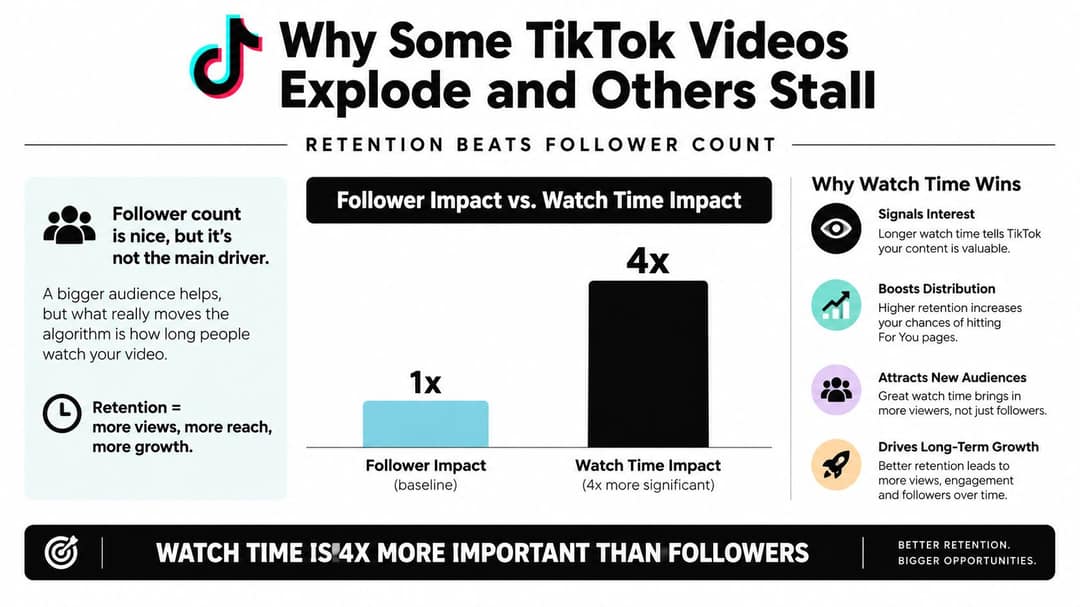
Why Some TikTok Videos Explode and Others Stall
TikTok users often watch a surprisingly large share of recommended videos to the end, and completion is often stronger for accounts they do not already follow. That shifts the logic of virality. A video does not spread because the creator starts with audience loyalty. It spreads because the clip proves, second by second, that it deserves more distribution.
That is why heavy app usage does not make viewers more patient. A weak opening still loses them. Strong videos state the subject fast, show movement early, and create a payoff worth waiting for. For creators, virality is less about status and more about whether a stranger can understand the premise immediately and feel rewarded for staying.
The signals that matter
The most useful way to read TikTok performance is as a sequence of behavioral tests. First, the video has to stop the scroll. Then it has to hold attention long enough for the viewer to understand what is happening. After that, it needs to create enough value, surprise, clarity, or emotion to earn another action.
The practical signals to watch are:
- Completion rate: Did viewers reach the ending?
- Average watch time: How long did the clip hold attention?
- Rewatches: Did the ending, reveal, or information density make another viewing useful?
- Shares: Did the viewer consider the clip entertaining or useful enough to send on?
- Saves: Did it solve a problem worth returning to?
- Comments and profile visits: Did the video create enough curiosity to prompt a next step?
These metrics matter because they describe different failure points. One video loses viewers before the premise is clear. Another holds attention in the middle but drops at the payoff because the ending feels obvious. A third gets solid watch time yet weak shares because it satisfies curiosity without giving viewers a reason to involve someone else. Raw view counts flatten those differences. Retention curves separate them.
Practical rule: Treat every upload as a behavioral experiment. Your job is to give viewers a reason to continue at every stage.
So the strongest answer to “what videos go viral on TikTok” is not a sound, niche, or creator size. It is a video that aligns with a recognizable interest, communicates its promise quickly, and keeps earning attention as the For You system tests it against broader groups of viewers.
The Myth of the Trend Sound
Trending audio gets credited for outcomes it rarely creates on its own. In practice, sound usually acts as packaging for a viewing experience that was already likely to hold attention. Creators notice the audio because it is easy to copy. Viewers respond to timing, clarity, tension, and payoff.
Sound still matters. It can signal genre, set mood fast, and make a video feel native to the feed. It can also organize attention. A beat drop tells the viewer that a reveal is about to land. A familiar reaction clip frames a joke before the punchline arrives. A restrained background track in a tutorial keeps spoken instructions clear while maintaining pace.
That is the useful frame. Audio is a retention tool when it helps the viewer process what is happening next.
What the sound is really doing
A transformation clip makes the distinction obvious. The music does not make the before-and-after interesting. The edit does that by establishing contrast, delaying the reveal, and landing the change at the right moment. The sound supports that sequence by giving the reveal a clean timing cue. In reaction content, a recognizable phrase can establish context quickly. In demonstrations, audio can separate steps and prevent dead space from feeling accidental.
This is why copying a popular track often produces flat results. The track travels easily. The underlying structure usually does not. If the subject is vague, the opening is slow, or the ending arrives without a satisfying turn, the same sound just decorates weak construction.
A practical workflow helps:
- Define the promise: What will the viewer learn, see, or feel?
- Choose the opening action: Show the result, problem, conflict, or surprising object.
- Set the pace: Decide where information, movement, and visual changes occur.
- Add sound: Select audio that reinforces the structure instead of competing with it.
- Measure behavior: Compare completion, rewatches, shares, and saves.
This also explains why a lower-budget video with a very specific premise can beat a polished production. Production quality helps with readability. It does not fix weak relevance. A simple clip about a narrowly felt problem often earns stronger watch behavior because the intended viewer understands immediately why it is for them.
So the role of a trending sound is narrower than creators often assume. It earns its place when it helps the viewer understand, anticipate, or feel a moment more clearly. If it does none of that, it is decoration. If it strengthens the hook, pacing, and payoff, it becomes part of the retention design.
Engineering the First Three Seconds
The opening has three jobs: identify the subject, create an information gap, and promise a payoff. If one of those jobs fails, the viewer has little reason to delay the next swipe.
“Hey guys, today I'm going to show you a few tips” identifies almost nothing. A stronger opening names the audience and outcome: “If your product videos look flat, move the light before you change the camera.” The second version gives the viewer a concrete problem and implies that a useful explanation is coming. Among the 1,588 TikToks in Revid's index with over 100 million views, 51% of those with a transcript open with a statement and 16% with a question (the 100M Club).
Three opening tests
Subject test. Can a viewer understand the topic without relying on the caption? Say the subject aloud and put a concise version on screen. “Budget meal prep for night shifts” is easier to classify than “What I eat in a day.”
Gap test. What remains unresolved? A demonstration might begin with the failed result, then ask whether a different method fixes it. A surprising explanation can state the common assumption before challenging it. The gap should be specific enough to create curiosity, not so vague that it feels like clickbait.
Payoff test. Can the viewer picture what staying delivers? Show the finished design briefly, reveal the object that will be tested, or state the decision the viewer will be able to make. Don't explain every detail immediately. Give the viewer a reason to reach the next beat.
Prompt to try
Make a 30-second TikTok for small business owners titled "If your product photos look flat, move the light before you change the camera." Open on a dull product shot, then show three quick lighting fixes with a new visual every 2 seconds and bold on-screen text naming each fix. End on the finished bright photo next to the original.
Re-hooks prevent mid-video abandonment
A strong first second won't carry a clip through a dull middle. Re-hooks can arrive as a visual change, a new piece of evidence, a question, a beat shift, or a direct escalation. For example, a cleaning demonstration can move from the product to the stained surface, then to a close-up comparison, rather than showing one uninterrupted application.
Audit a draft with this sequence:
- Opening: Is the premise visible before context?
- Early middle: Does new information arrive before the first idea becomes repetitive?
- Late middle: Does the viewer know why the ending is still worth reaching?
- Payoff: Does the result directly answer the opening promise?
- Loop: Does the final frame make a replay useful or satisfying?
The payoff shouldn't be delayed by a logo animation, biography, or broad setup. Those elements may matter elsewhere, but they spend the most valuable attention before the viewer understands why the clip deserves it.
The following video offers a visual reference for thinking about timing, attention, and the first decision point.
A useful opening works across niches because it isn't tied to entertainment. “I tested this workflow on three stubborn spreadsheet problems” can serve an educator. “This is the one angle that makes a small room look wider” can serve a designer. Specificity gives both the viewer and the recommendation system something concrete to understand.
The Five Formats That Travel the Furthest
The most transferable viral formats share a useful property: they make the subject legible while creating a clear reason to continue. Research on TikTok recommendations found that users encountered an average of 52.5 content clusters per day, while roughly 30%–50% of recommendations during users' first 1,000 videos reflected predicted individual interests (large-scale recommendation analysis). A precise topic helps a clip travel between relevant clusters without becoming vague.
| Format | Retention Shape | Rewatch Value | Audience Spread | Best For |
|---|---|---|---|---|
| Demonstration | Builds through visible progress | High when steps move quickly | Practical-interest clusters | Products, education, crafts |
| Before-and-after | Front-loads contrast, then proves it | High for visual comparison | Broad visual audiences | Beauty, design, repair |
| Surprising fact or explanation | Opens with a knowledge gap | Moderate to high when dense | Curiosity and learning clusters | Experts, educators, publishers |
| Reaction | Front-loads the stimulus and emotion | Variable, often driven by detail | Communities around a shared topic | Commentary, entertainment |
| Participatory prompt | Builds through an invitation | High when viewers can respond | Interest communities and creator chains | Challenges, opinions, community formats |
Demonstrations
A demonstration gives the viewer a visible process and a reason to wait for the result. It works best when the action begins immediately. “Here's how to fix a loose cabinet hinge” is stronger when the first frame shows the hinge moving, followed by the exact adjustment.
The retention curve often builds as progress becomes evidence. Rewatch value comes from steps viewers need to replicate, especially when the hands, tools, or sequence move quickly.
Before-and-after transformations
Contrast supplies the hook. Show the starting state, establish the constraint, and reveal the result with enough proof to make the comparison credible. A transformation can attract broad attention, but its topic still needs precision. “Small bedroom layout before and after” tells the system and viewer more than “Room makeover.”
Surprising facts and explanations
These clips create an information gap. The strongest versions state the misconception or unexpected fact early, then use a compact explanation to earn the payoff. They don't rely on mystery alone. The viewer needs to know why the answer matters.
Reactions and participatory prompts
Reactions borrow an existing subject, but the creator must add interpretation, humor, expertise, or emotion. Participatory prompts work differently. They invite the viewer to choose, attempt, respond, duet, or share an experience. Both formats can generate comments, but participation only helps when the prompt is easy to understand. In Revid's analysis of 2.39 million popular TikToks, challenges (median about 227,000 views) and comedy (194,000) got the most views per video, even though storytelling is the most common type (short-form video statistics).
For teams producing brand content, Boocoo's 2026 business video guide provides useful context on planning and producing business video. The format decision should still come from the audience problem and the evidence you can show, not from whichever template is currently visible on the For You page.
Editing Cadence, Sound, and On-Screen Text
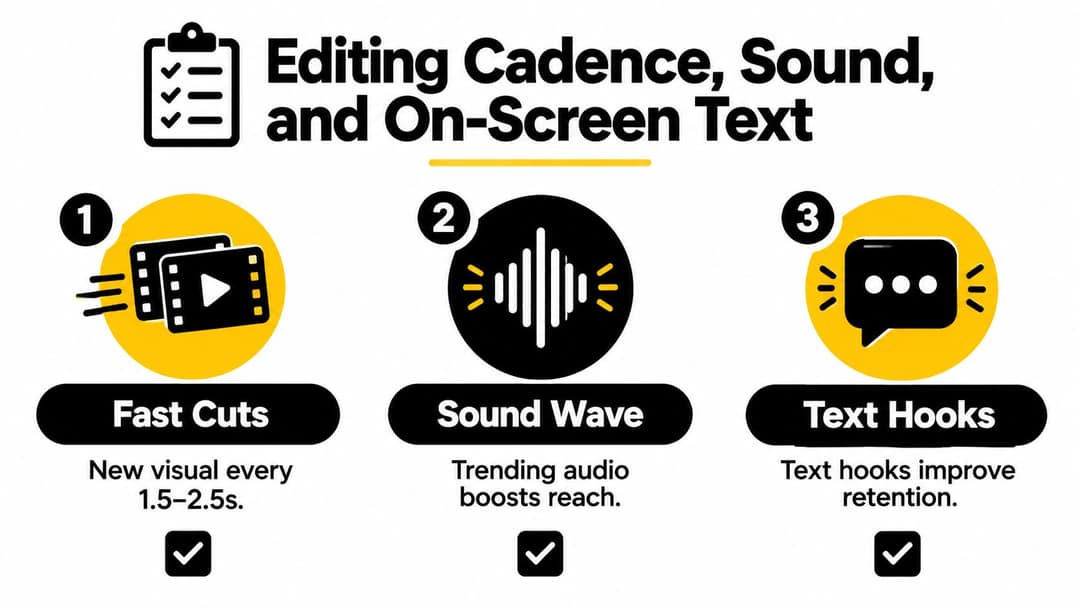
Retention is shaped by small production decisions. A cut can clarify the next action, a caption can remove ambiguity, and a sound cue can make a reveal feel timed rather than random. None of these choices works in isolation. They need to reinforce the same promise.
Make each edit answer a question
A practical starting point for many niches is a new visual element every 1.5–2.5 seconds. That isn't a universal law, and a deliberate pause can be valuable. The point is to prevent the frame from becoming informationally static while the viewer is still deciding whether to stay.
Use the cadence to expose progression:
- Opening visual: Show the subject or outcome.
- Second beat: Introduce the problem, constraint, or unexpected detail.
- Third beat: Demonstrate movement, evidence, or a new angle.
- Payoff beat: Resolve the promise with visible proof.
Text overlays should make the topic understandable to someone watching without sound. They also reinforce semantic signals. The large-scale recommendation analysis cited earlier supports making the clip's topic explicit through spoken language and metadata, because the system routes videos across distinct interest clusters.
Write text that names the problem rather than describing the creator's activity. “Three ways to reduce echo in a bedroom” is useful. “Come with me while I test this” is less informative unless the test itself is already obvious.
Align audio, image, and language
Sound should mark the same moment as the visual and verbal message. If the on-screen statement says “the mistake is here,” the frame should show the mistake and the audio should avoid masking the explanation. A music build that peaks before the reveal can flatten the payoff instead of strengthening it.
Creators who need a lightweight production workflow can find affordable video editing tools before committing to a more complex setup. The tool matters less than whether it lets you inspect each cut, caption, and audio transition against the retention objective.
Run this edit-level checklist before publishing:
- Does the first frame show the subject?
- Does every cut add information, movement, or contrast?
- Can the key statement be understood with sound off?
- Does the caption use the phrase a viewer would search?
- Does the audio support, rather than bury, the spoken hook?
- Does the final frame prove the opening claim?
A video doesn't need constant motion. It needs a reason for the viewer to keep updating their understanding. Sometimes that means a rapid sequence. Sometimes it means holding a close-up long enough for the evidence to register.
Distribution Levers Most Creators Miss
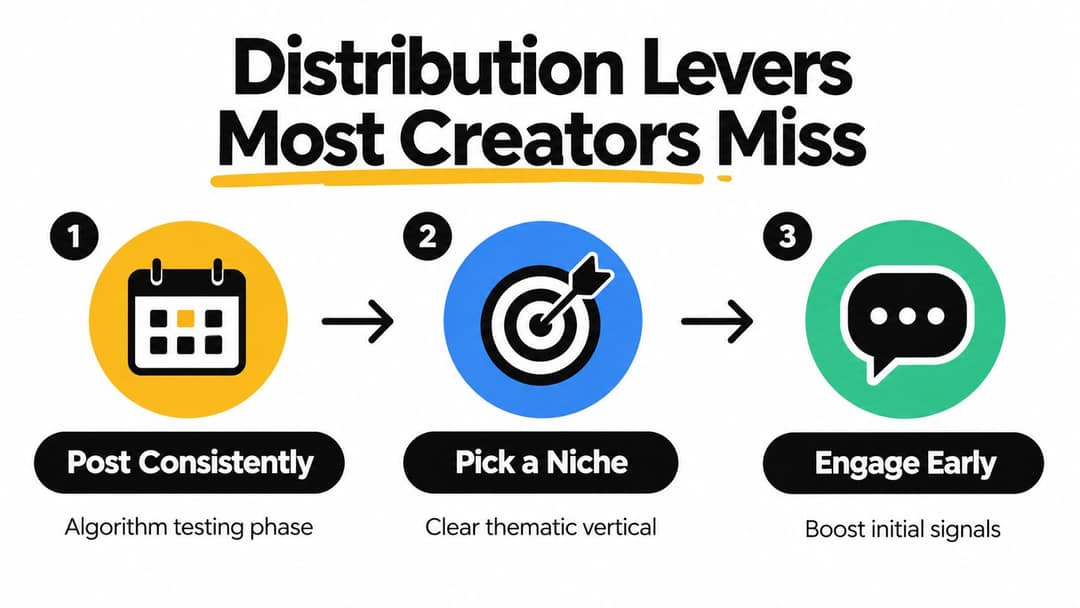
Distribution starts before a video goes live. Creators who publish within a clear thematic vertical give TikTok more context for who should receive each new post, and they give themselves cleaner feedback across uploads. Pew Research Center found that the top 25% of U.S. adult TikTok users by posting volume produced 98% of publicly accessible videos from that group (Pew Research Center's TikTok analysis). The useful takeaway is practical: consistent output increases testing velocity, and faster testing helps creators find the hooks and topics that hold attention.
Search is a second discovery path
TikTok is not only a recommendation feed. It is also a search engine with recurring intent. Reported platform data indicates that 73% of TikTok users search on the platform at least daily, nearly 40% search several times daily, and 25% enter a query within 30 seconds of opening the app (TikTok search behavior reporting). Because search demand can persist well beyond a trend cycle, a useful answer clip can keep collecting views after a trending sound has already peaked.
That changes how creators should package information. Use Creator Search Insights to spot topics where demand is clear and coverage is thin, then build a video that still earns For You distribution by showing a result, a mistake, or a tension point immediately. Put the target phrase in the spoken script, the on-screen text, and the caption. Do not open with a string of keywords. Open with evidence that the answer is worth staying for.
A searchable video works best as part of a small cluster, not a one-off post. One clip can answer the main question. Another can address the objection that usually blocks action. A third can show the same solution in a different setting. That structure builds relevance at the account level and gives viewers a reason to watch multiple videos around the same intent.
For a clearer model of recommendation signals, review how the TikTok algorithm works. Then treat early performance as a diagnosis:
- Low early retention: Rewrite the opening and remove setup.
- Strong opening, weak middle: Add a re-hook or shorten the explanation.
- Strong completion, weak shares: Increase usefulness, surprise, or emotional relevance.
- Strong saves, modest reach: Keep the topic and test a clearer package.
- Strong rewatch, weak profile visits: Clarify the account's broader promise.
Views show how far a post traveled. These patterns show why.
A Repeatable System for Engineering Virality
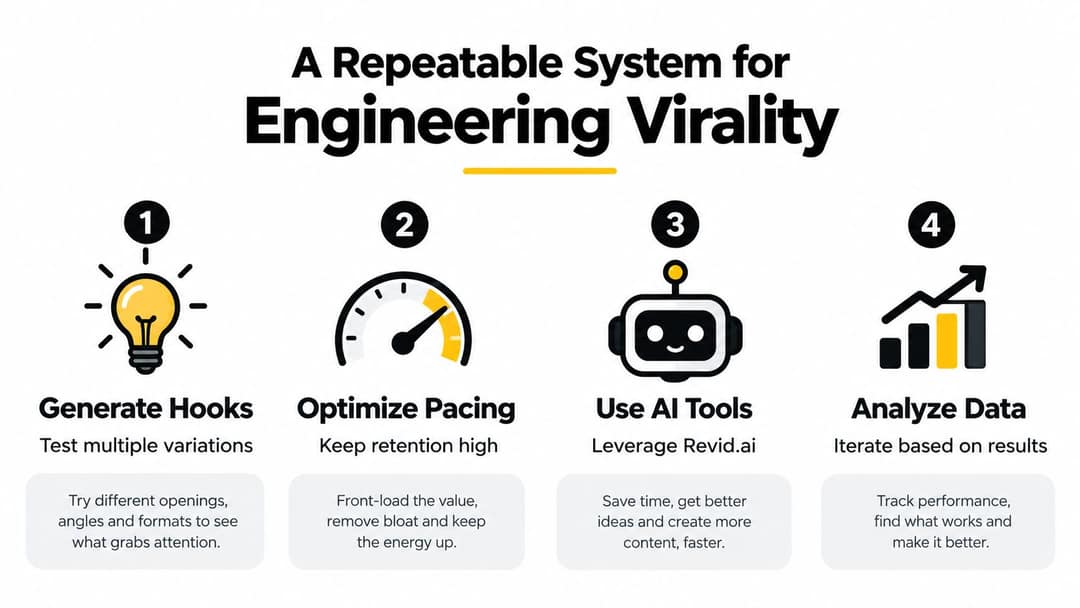
Creators who test more than one execution per idea usually learn faster than creators who burn a fresh concept on every post. On TikTok, that matters because the For You system keeps re-evaluating a clip as behavior comes in. A repeatable process gives you cleaner reads on what changed performance: the premise, the packaging, or the edit.
The production loop
Start with one promise. Write the outcome in a single sentence. “Show renters how to reduce kitchen clutter without drilling” is specific enough to shape the visuals and still broad enough to support multiple versions.
Generate several openings. One can begin with the end result, one with the problem, and one with a constraint that creates tension. Keep the rest of the video as comparable as possible so the opening remains the main variable.
Publish and inspect behavior. Look at completion, average watch time, rewatches, shares per view, and saves per view. Views matter for reach, but they do not isolate why one version held attention and another lost it.
Change one failure point. If viewers drop before the explanation starts, rewrite the hook. If retention falls in the middle, compress the demonstration or add a visual turn. If viewers finish without replaying, tighten the final proof and make the payoff denser.
This system also protects creators from a common mistake: changing five things at once, then drawing the wrong conclusion. Stable topics with controlled variation produce clearer signals. Teams that need to streamline creative production with Sprello can use that kind of workflow to keep versions organized while leaving editorial choices to the creator.
Prompt for your 14-day test
Create a 25-second TikTok for renters: "How to cut kitchen clutter without drilling a single hole." Start with the cluttered counter as the hook, show three no-drill fixes with quick cuts and captions, and finish on the clean counter. Make a second version that opens with the finished result instead.
A 14-day test
- Days 1–2: Choose one niche problem and write multiple precise promises.
- Days 3–5: Produce variations using demonstrations, transformations, or explanations.
- Days 6–8: Compare opening retention and completion. Keep the clearest premise.
- Days 9–11: Test a different pacing pattern and a search-led caption.
- Days 12–13: Review shares, saves, rewatches, and profile visits.
- Day 14: Select the strongest format, document the winning edit choices, and plan the next batch around a related problem.
Revid can support this loop by turning ideas or existing content into short-form videos, writing the scripts, letting you adjust every scene in a timeline editor, and publishing directly to TikTok, Instagram and YouTube, where each post reports its views, likes and comments back to you. The goal is controlled variation: enough iterations that retention data, not instinct, drives the next creative decision.
Revid helps creators turn ideas and existing content into TikTok-ready videos, starting from a library of about 2.77 million real short-form videos with their engagement data, so each test can begin from a format audiences already watch. Visit revid.ai to build a repeatable testing process around hooks, pacing, completion, shares, and saves rather than relying on trend sounds alone.