On this page
The best AI script generator is the one that matches what you do after the script: for finished short-form videos, pick an all-in-one tool such as Revid, Pictory, Fliki, InVideo, Kapwing or VEED. For long-form YouTube use vidIQ's Script Writer, for brand teams Jasper, and for text-only drafts Copy.ai or Writesonic.
The most common mistake is accepting the generator's default: narration that fills every second. In Revid's analysis of 176,367 TikToks with 1,000+ likes, videos with under 40 characters of speech had a median of 123K views, against 68K for videos with talking throughout. A good script tool lets you cut, not just add.
Quick comparison of the 10 tools
| Tool | Best for | What you get | Starting price |
|---|---|---|---|
| Revid | Short-form videos built on proven viral formats | Script, voice, AI visuals, captions, editor, publishing | $39/month (2,000 credits) |
| Pictory | Faceless narrated videos with a team review step | Script, licensed stock, voice, captions | From $29/month |
| Fliki | Narrated Shorts and Reels in batches | Script, 2,000+ voices, timeline editor | From $28/month |
| InVideo | Editing by chat across many media types | Script, stock library, avatars, voice clones | From $20/month per seat |
| Kapwing | Quick script-to-edit in the browser | Script, editable video project | Check current plans |
| VEED | Beginners and avatar explainers | Script, auto-subtitles, stock avatars | Roughly $10 to $24/month |
| vidIQ | Long-form YouTube structure | Hooks, outlines, scripts inside a YouTube toolkit | Check current plans |
| Jasper | Marketing teams with brand rules | On-brand drafts with Brand Voice and Knowledge | Check current plans |
| Copy.ai | Teams turning research into briefs | Chat drafts, automated workflows | Check current plans |
| Writesonic | Writers who also produce SEO content | Long-form drafts, brand voice | Check current plans |
How to choose an AI script generator
Script writing is now a common feature: many of these products sit on similar large language models, and McKinsey's 2025 State of AI report describes how companies are reorganizing whole workflows around generative AI rather than bolting on a chatbot. The same logic applies to scripts. What separates the tools is the workflow around the model.
Use these rules:
- If you need a published video, not a document, pick an all-in-one tool. Pasting a script into a second editor doubles the work.
- If you post TikToks, Reels or Shorts every day, prefer a tool that starts from what already performs (Revid) over one that only knows what you typed.
- If your channel is long-form YouTube, start with vidIQ and record yourself.
- If several people write for one brand, Jasper's brand controls matter more than video features.
- If you also write blog posts and newsletters, Copy.ai or Writesonic cover more formats.
- If budget is tight, run one real brief through your two finalists and count the credits (test below).
Do your topic research before you prompt, whether from your own notes, primary sources or an AI search tool such as Premier Broadband's AI advanced search. A script generator rewrites what you give it; it rarely finds better facts on its own.
All-in-one tools: from script to finished video
1. Revid
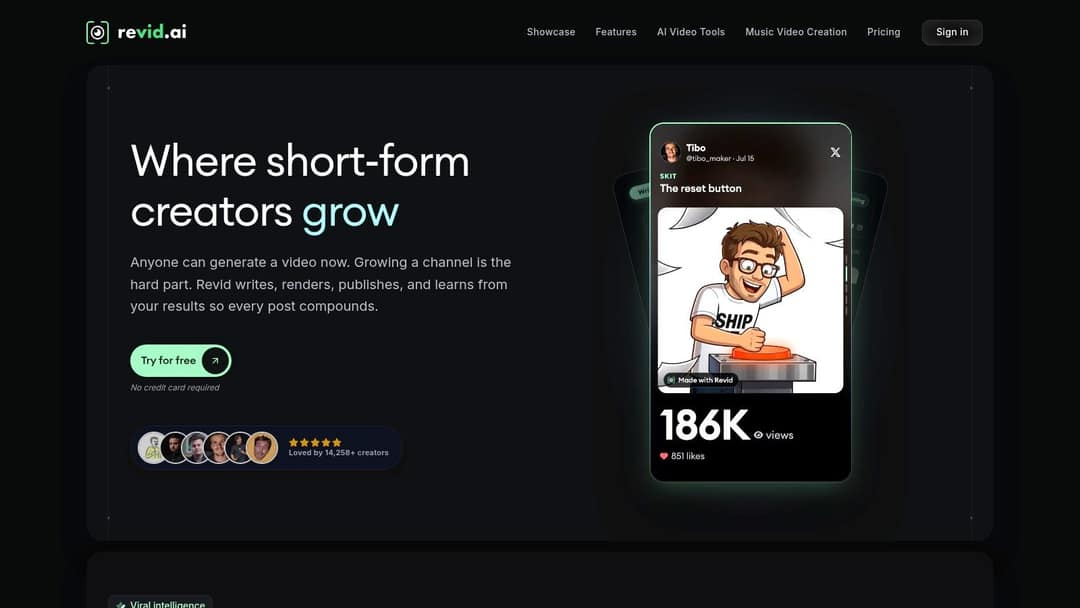
Revid is an AI video platform that turns an idea, a link or a proven viral format into a finished short-form video and publishes it to TikTok, Instagram and YouTube. The script is where it differs most. When Revid writes from a prompt in automations and several tools, it first retrieves transcripts of related TikToks with more than 10,000 likes and uses them as references for style and story, so the draft starts from what audiences already watch instead of a blank prompt.
You can also start from one specific video. Revid's library holds about 2.77 million real short-form videos and posts with their public engagement data. Open one, choose "Same energy, new script" or "Make it about your topic", and the script writer analyzes the reference (hook, shot-by-shot structure, timing, tone), keeps the spoken structure and writes new words and visuals instead of copying it.
After the script, everything stays in one place: 1,000+ AI voices in 70+ languages, 30 caption styles, AI visuals from Seedance 2.5, MiniMax Hailuo H3, Wan 3.0 or Google Veo 3 (chosen per scene), a timeline editor, export up to 4K, and direct publishing and scheduling. Every paid plan includes the API, the MCP server and the CLI for teams that automate.
Sign-up is free, with no credit card needed, and new accounts get free credits to try video creation; regular creation then uses the credits of a paid plan, from $39/month for 2,000 credits on Growth ($32/month billed yearly). As a guide, a 30-second video with Pro AI visuals and a voice-over costs about 40 to 80 credits, and you can estimate the cost before generating. The current Revid plans are the authoritative price list.
To write and produce a script with Revid:
- Draft a first version with the free AI script generator, or paste an idea, script or link into Revid.
- For a proven structure, search the library for a high-engagement video in your niche and pick "Make it about your topic".
- Edit the script: cut every line that repeats what the visuals already show.
- Choose a voice, caption style and visuals, then turn the script into a voiceover video and fix any scene in the timeline.
- Publish or schedule to TikTok, Instagram and YouTube from the same queue.
Skip Revid if you only want a text editor, or if you produce long-form essays or cinematic edits where every shot is cut by hand.
2. Pictory
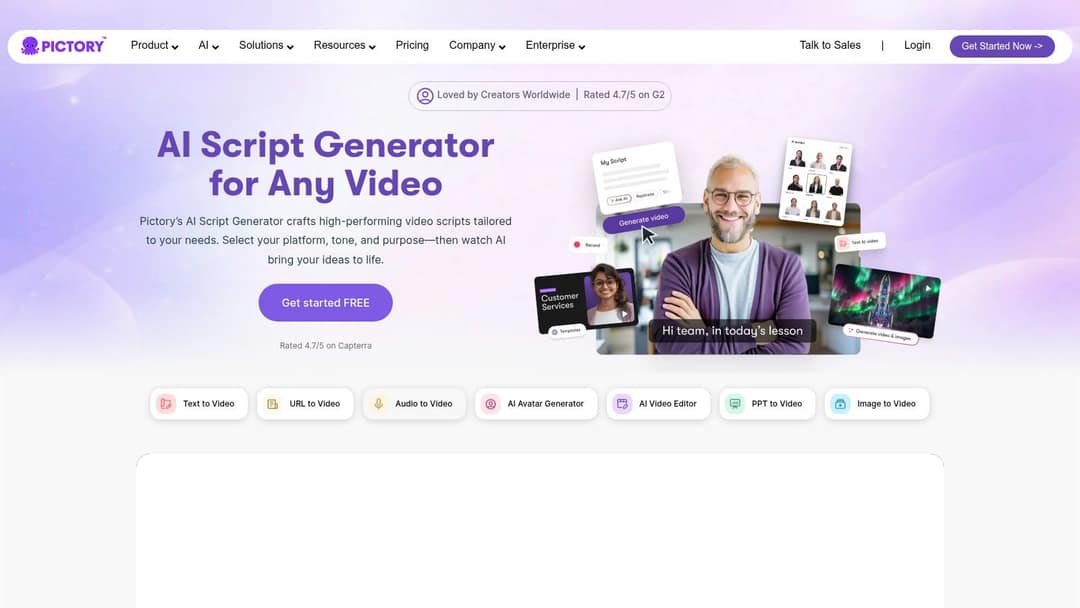
Pictory turns a script, blog post or URL into a narrated video built on stock footage. Its AI Script Generator writes the draft, then the cloud editor adds b-roll from a 12M+ licensed library (Getty Images and Storyblocks), narration (ElevenLabs voices on premium plans), music and captions. It also clips highlights from Zoom, Teams and webinar recordings, and offers an enterprise API and MCP server.
It fits training, educational and faceless channels built on narrated b-roll, especially teams where one person drafts and another approves. Plans start at $29/month with a free trial and no permanent free tier, and regenerating voiceovers draws on your allowance. The stock-footage look is recognizable, so add your own angle. Start with Pictory's AI script generator, or read the Revid vs Pictory comparison.
3. Fliki
Fliki is voice-first: 2,000+ voices in 80+ languages, with emotional delivery (laughing, sarcasm, deadpan) after its 2026 engine rebuild. You write or generate a script, pair it with stock visuals or avatars, adjust timing in a timeline editor, and can run recurring TikTok series with direct publishing.
Pick it for a faceless series where a consistent narrator is the brand. Plans start at $28/month ($21 billed yearly); the free plan exports with a watermark at 720p and caps videos at one minute. Visuals lean on stock slideshows, and there is little help choosing topics. See Fliki's script-to-video workflow and the Revid vs Fliki breakdown.
4. InVideo
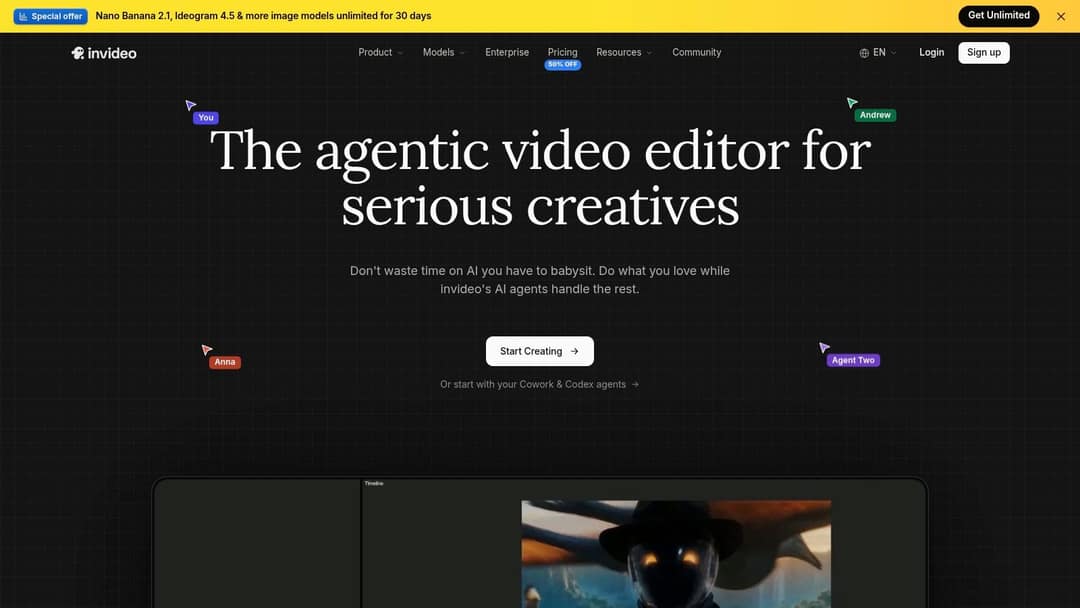
InVideo works as a chat-style agent: you describe the video, then edit by typing commands instead of working on a timeline. It drafts the script, pulls from a 16M+ stock library (with metered iStock assets on paid plans), bundles avatars and voice clones from the entry tier, and gives access to a menu of third-party generation models.
It suits creators testing many visual directions for one script. Plans start at $20/month per seat, and the free plan carries a watermark and weekly generation limits. Each model draws credits differently, so record what one complete run costs before you plan a weekly schedule. Try InVideo and compare it in Revid vs InVideo.
5. Kapwing
Kapwing's AI Script Generator writes for TikTok, YouTube, Reels or Shorts, then hands the draft to Kapwing's browser editor, where you add narration, subtitles and the right aspect ratio. The value is the handoff: a solo creator can write a hook, build a first cut and fix pacing without exporting anything.
AI actions such as script writing, text to speech and dubbing share one credit allowance, so heavy revising costs more than the first draft suggests. Check the free tier's watermark and limits against your volume. It is less useful for research-heavy or multi-act long-form scripts. Test Kapwing's AI script generator with one real brief.
6. VEED
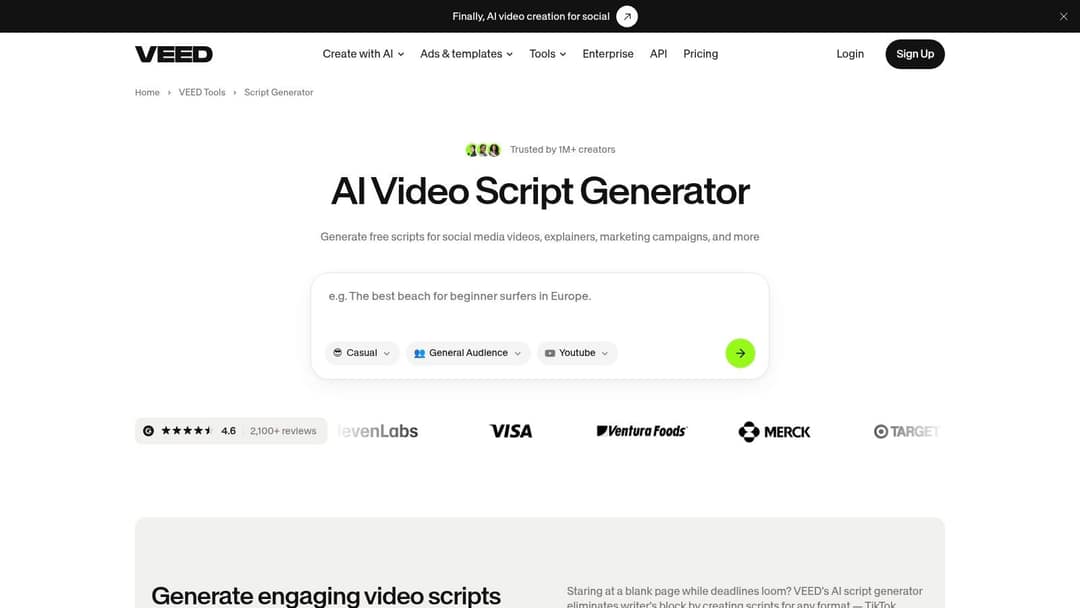
VEED's free AI Video Script Generator asks for a topic, a tone, an audience and a platform, then writes a script you can turn into a video in VEED's editor with its auto-subtitles, 30+ stock avatar presenters and AI dubbing. It is the gentlest start for beginners and small businesses making short explainers.
Entry plans run roughly $10 to $24/month; the free plan adds a watermark and exports at 720p. The interface favors speed over control, so long YouTube scripts with chapters and sourcing need another tool. Try VEED's AI script generator, or see Revid vs VEED.
Best for long-form YouTube
7. vidIQ AI Script Writer
vidIQ is a YouTube growth toolkit, and its Script Writer is shaped around YouTube: an opening hook, pacing that holds viewers, callbacks and a clear structure. It sits next to vidIQ's topic and keyword research, so the script is one step in a channel strategy rather than a standalone document.
Scripts use AI credits, and longer scripts cost more, which adds up when you regenerate. Shorts usually need trimming and rewriting by hand, and there is no voice, stock or rendering. Use vidIQ's AI Script Writer when you record long-form videos yourself and retention is the main goal.
Best writing-first tools
8. Jasper
Jasper now pitches itself as AI agents for marketing workflows. For scripts, its useful parts are Brand Voice and Knowledge, which keep terminology, positioning and approved facts consistent across writers, plus workspaces for longer drafts and campaign revisions. Advanced agent and research features can use extra credits, so check the current plan.
It fits agencies and marketing departments that need governance, not solo creators who want a quick hook. Before setting up a team process, decide which steps need human approval; our guide on how to get an AI to write a script covers prompts and review. Visit Jasper for current plans.

9. Copy.ai
Copy.ai combines a chat workspace for hooks, outlines and full drafts with automated workflows that chain research, briefing and writing steps. Its strength is upstream: turning scattered notes into a usable script brief before a writer shapes the final version.
It has no voices, b-roll or rendering, so a faceless channel would still need a video tool. Chat and automated workflows can be metered differently, so check how workflow runs count against your plan. See Copy.ai if scripts are one output among landing pages, emails and campaign copy.
10. Writesonic
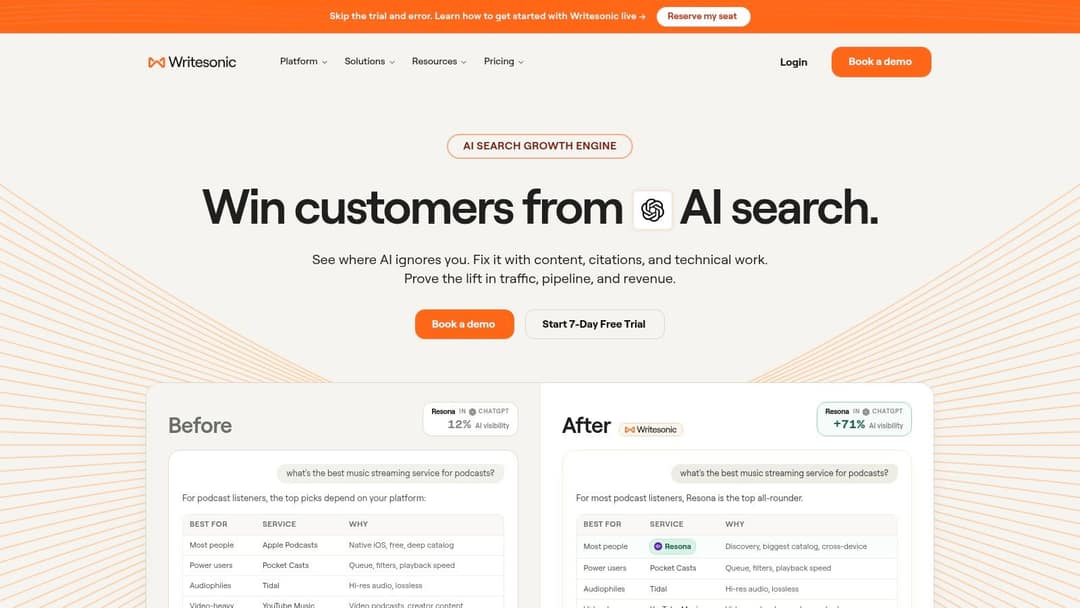
Writesonic started as a long-form writing and SEO tool, and it can still draft YouTube scripts, hooks and narration alongside articles, with brand voice and multi-language support. Its homepage now leads with AI search visibility, so script writing is a secondary use.
Choose it if your bottleneck is drafting and you also publish SEO content; choose something else if you need voice, captions and a rendered video. Packaging has changed over time, so verify plans and included usage at Writesonic before buying.
For picks focused only on video scripts by use case, see our AI video script generator roundup.
What makes a good AI-written video script
Most generators write narration from the first frame to the last. Revid's data points the other way for short-form. In the analysis of 176,367 TikToks with 1,000+ likes posted between October 2025 and October 2026, videos with under 40 characters of speech had a 123K median and 20.2% passed 1 million views. Videos talking throughout (300+ characters) had a 68K median and 11.9% past 1 million, and silent videos sat between them at 73K. The sample only includes videos that already did reasonably well, so this shows what top videos have in common, not a cause.
Videos with just a few spoken words (a line or two) beat both silent videos and videos that talk the whole way through, which were the most common and the weakest.
Source: Revid analysis of 176,367 TikToks analyzed by AI, with 1,000+ likes posted between Oct 1, 2025 and Oct 16, 2026 (61,203 creators)
Show the data
| Median views | Share that passed 1M views | |
|---|---|---|
| No speech | 73.3K | 14.3% |
| Under 40 | 122.7K | 20.2% |
| 40 to 120 | 97.2K | 17.6% |
| 120 to 300 | 91.6K | 16.8% |
| 300+ | 67.7K | 11.9% |
Tone matters too: in the same study, videos with outrage or humor as the dominant mood had medians of 156K and 121K, while inspirational videos had 45K. Ask the generator for a sharper emotional angle before you ask for more words.
Then run four checks on every draft:
- Hook and payoff: the first line makes a promise and the last line keeps it.
- Consistency: the narrator's voice and claims stay the same from start to finish.
- Logic: each claim follows from the one before, and every fact has a source you checked.
- Read aloud: strike any line you stumble on or that describes what the viewer already sees.
These mirror how researchers grade scripts. CML-Bench scores dialogue coherence, character consistency and plot reasonableness, and its automated scores reached a 0.80 Spearman correlation with averaged expert ratings, according to the CML-Bench paper.
Prompt to try
Make a 20-second vertical video on why phone batteries drain faster in cold weather. Open with the hook "Your battery isn't dying, it's freezing." Keep narration to two short lines, let fast close-up visuals carry the rest, and end on a clear payoff with bold captions.
How to test a script generator before you pay
Never judge a tool by its demo. Give your two or three finalists the same brief:
Topic:
Audience:
Platform and target length:
Key facts (with sources):
Tone:
Call to action:- Generate a script from the brief in each tool.
- Revise it twice the way you normally would.
- Produce the full video where the tool allows it, including one regenerated voiceover.
- Write down the credits or minutes the whole run consumed.
- Multiply by your weekly volume and compare with the plan's allowance.
For broader reading on the creator business, readmore.info collects online information for content creators.
Can you monetize videos with AI-written scripts?
Yes, on YouTube, if the final video shows your creative vision and gives viewers educational or entertainment value. YouTube does not allow monetization of mass-produced content made from generic templates, or of videos that only read out material you did not write, such as website text or a Reddit thread. A polished paraphrase still needs your commentary, examples or analysis.
AI-written outlines and scripts do not need an AI disclosure on YouTube. Disclosure is required for realistic altered or synthetic content, such as making a real person appear to say something they did not; YouTube's guidance on altered and synthetic content explains the cases, and disclosing does not by itself limit reach or earnings. TikTok similarly requires a label on realistic AI-generated images, audio or video, not on the script.
FAQ
Is there a free AI script generator?
Yes. Revid's free AI script generator and VEED's script generator both write drafts at no cost, and Kapwing, Fliki and InVideo have free tiers with limits or watermarks on the video side.
Can ChatGPT write video scripts?
Yes, general chatbots can draft a script from a good brief. They know nothing about what currently performs in your niche and do not produce the video, so you still need to supply the angle, check facts and move the script into an editor.
Which AI script generator is best for YouTube?
vidIQ's Script Writer is the strongest pick for long-form YouTube because it sits next to topic research and focuses on retention. For YouTube Shorts, an all-in-one tool such as Revid writes and produces the video in one place.
How long should a short-form video script be?
Shorter than most generators write by default. In Revid's 12-month TikTok study, every length from under 15 seconds to 10 minutes had a median between 58K and 76K views, so length matters less than keeping speech tight and the payoff clear.
Are AI-generated scripts original?
Only as original as your input. A script built from a generic prompt drifts toward the average, so add a clear thesis, your own examples and a point of view before you publish.