On this page
The failure that sinks a dubbed video isn't a bad translation. It's a voice that finishes the sentence before the mouth does.
Watch a handful of auto-dubbed clips with the sound on and the pattern repeats. The new line arrives a beat early, a joke lands without its timing, and the presenter's lips keep moving after the audio stops. Language coverage stopped being the bottleneck in dubbing AI; the fit between new words and an existing performance is where it still breaks. The tools below are ranked by the job they do, because that fit decides whether a dub is worth publishing.
- Dubbing and voice-over market size in 2025
- $4.8B
- VoxBooster, citing Business Research Insights
- Projected yearly growth of AI dubbing for OTT, 2026 to 2031
- 26.71%
- Mordor Intelligence
- Viewers watching 10+ minutes of YouTube auto-dubbed content daily (Dec 2025)
- 6M+
- Broadband TV News
- Average watch duration of an auto-dubbed version vs. the original
- 75%
- Industry account via Broadband TV News
Best AI Dubbing Tools in 2026 by Job
No single dubbing AI tool wins every job. A creator shipping 40-second vertical clips and a studio prepping a 100-minute feature need different controls, different review steps and very different bills, so rank the tool against the video you publish.
The category holds both ends of that range. VoxBooster's 2026 industry-statistics report put the dubbing and voice-over market at roughly $4.8 billion in 2025, citing Business Research Insights. The AI slice grows faster than the whole: Mordor Intelligence projects the AI dubbing-for-OTT market at $0.53 billion in 2025, reaching $2.45 billion by 2031, a 26.71% compound annual growth rate from 2026 through 2031.
AI dubbing tools ranked by job, 2026
| Tool | Ranked for | Real strength | Who it is for |
|---|---|---|---|
| Revid | Short-form social clips built in several languages | Generates script, voiceover, media and subtitles from text or a link in one workflow | Creators posting short social videos |
| ElevenLabs | Voice-led dubbing where voice quality and cloning matter | Natural voice synthesis and voice cloning across many languages | Creators and studios who need consistent voices |
| HeyGen | E-learning and talking-head explainers | Video translation with lip-sync and avatars | Course creators and trainers |
| Rask | Multilingual marketing and short video | Video translation with voice cloning and lip-sync | Marketers localizing campaigns |
| VEED | Quick subtitled and dubbed edits for social teams | Browser editor combining translation, dubbing and subtitles | Social media teams working in a browser |
| Descript | YouTube creators who edit by text | Editing audio and video through the transcript, with translation features | YouTube creators and podcasters |
Vendors repackage plans constantly, so treat any price printed in a roundup as a claim to verify. Copy the number from each vendor's own pricing page on the day you buy and note the check date beside it.
Revid takes the short-form row because its job is producing the clip itself. You feed it text or a link, and it returns a finished video with script, voiceover in 70+ languages, captions in 100+ languages and direct publishing to TikTok, Instagram and YouTube. For a creator who ships the same short in more than one language, the voiceover is generated in the target language as part of the build, so nothing gets re-recorded or retimed afterward. ElevenLabs holds the voice-led row because synthesis and cloning are the product, which matters most when one recognizable voice has to survive a dozen languages. HeyGen fits e-learning because talking-head explainers and avatars are its native format. Rask sits with marketers who localize campaigns and want cloning plus lip-sync in a single pass. VEED earns its place with social teams who never leave the browser. Descript suits YouTube creators who already edit by deleting words from a transcript.
If Rask is on your shortlist, browse Rask AI pricing breakdown to see what each tier includes before you commit to an annual plan.
Find your row, then run the same 30-second clip through the top two candidates. The tool that keeps the new voice inside the original pauses is the one worth a year's subscription.
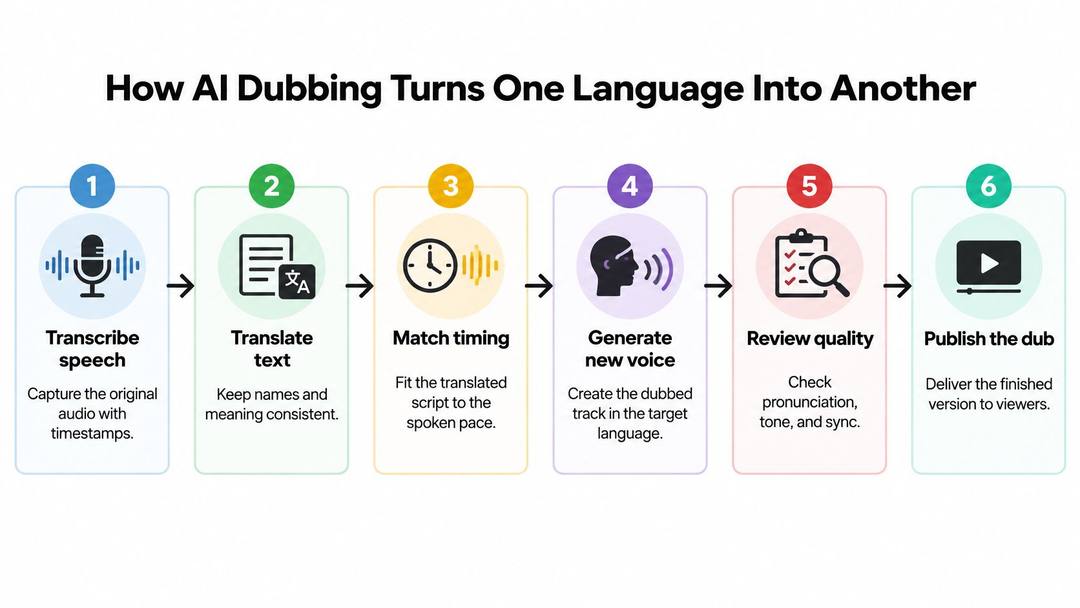
How AI Dubbing Turns One Language Into Another
A dub is a cover version. The translated line has to arrive on the same beat as the original, with the same pauses, or the illusion collapses no matter how good the words are. Every tool runs the same six steps, and knowing what each one solves tells you which controls you need.
Transcribe the original speech with timestamps. Every line gets a start and end time, which becomes the budget the translation has to fit. Skip the timestamps and you're guessing at length for the rest of the job.
Translate the text while protecting names, idioms and intent. Machine translation alone produces grammatically correct text with the wrong tone. A literal rendering of a joke usually kills it, and a translated brand name can read like a different company.
Fit the length to the original. The translated line has to occupy roughly the same duration as the source, pause where the speaker pauses, and finish where the mouth finishes. The technical name for that constraint is isochrony, and tools that ignore it produce fluent speech that has drifted seconds out of sync by the end of a paragraph.
Synthesise the voice. Speech synthesis renders the text in a stock voice or a clone of the original speaker, and the better systems let you tune pace and emotion per line. A clone needs a clean sample with no music bed and no second speaker bleeding in.
Align audio to picture, then regenerate the mouth where supported. Visual dubbing rebuilds mouth movement to match the new phonemes. Audio-only alignment is faster and cheaper, and it leaves the mismatch visible on every close-up.
Review and export. You get either a new audio track for the original video or a fully rendered file. Watch it end to end before anyone else does.
How to tell which steps a tool controls
Most tools automate steps one through four and hand you a file. The differences show up in step three, where timing gets fitted, and step five, where the mouth is handled.
A tool that lets you edit the translated script line by line, lock pauses and regenerate a single segment gives you control a one-click render can't. That control is what you pay for when a client's name is in the voiceover.
Judge the tool by its edit controls, not its demo. The demo shows one good take; the controls decide whether you can rescue the other nineteen.
Where AI Dubs Break and How to Fix Them
The flaw viewers spot first is the mouth arriving at the wrong moment. Recent evaluations of dubbing output identify synchronization errors, timing and lip-sync mismatches among them, as the most recurrent quality problem, with 20 to 44 errors observed in some one-minute monologues, according to the prosodic alignment research.
The cause is structural rather than a flaw in one vendor's model. Languages express the same meaning with different syllable counts, word order, pause placement and consonant articulation, so a faithful translation runs long in one scene and short in the next. The audio sounds fine. The fit is wrong. When a whole track drifts rather than one line, work through the sequence for bringing video and audio back into sync before you re-render the file.
Dubbing symptoms, causes and fixes
| Symptom | Likely cause | Fix |
|---|---|---|
| Lines run past the mouth movement | Translation is longer than the original speech | Shorten the translation, then regenerate that segment |
| Speech runs ahead of visible speech | Original pauses removed to fit the length | Restore source pauses and allow limited timing relaxation |
| Voice tone drifts across scenes | Cloned voice trained on a weak or mixed sample | Re-record a clean sample and regenerate |
| Brand or name mispronounced | Synthesis guesses the pronunciation | Respell the name in the script or add a pronunciation entry, then regenerate |
Which fixes take minutes and which need a rewrite
Regenerating one segment is a minutes-long job. Rewriting the translated script to hit a shorter duration is a script pass, and on a 20-minute video that's the difference between a coffee break and an afternoon.
Reach for the cheapest fix first. Cut filler words such as really, you know and just from the translated line before you touch any pacing control, because filler is usually what pushed the line past the mouth in the first place. Speed ramps should be the last resort, not the first.
Speed a voice up to fit a line that's four words too long and you get a chipmunk reading a disclaimer.
Then measure. A published dubbing system scores its own output with Lip Sync Error Distance and character error rate, reporting LSE-D scores of 10.75 and 12.19 with CERs of 4.62% and 3.02% on German-to-English test subsets, per the EMNLP system demonstration. You don't need those exact numbers to publish, but you do need both halves of the check. A metric catches drift across a whole file. A human watch catches the one close-up where the audio is clean and the picture is wrong.
Review Checklist Before You Publish a Dub
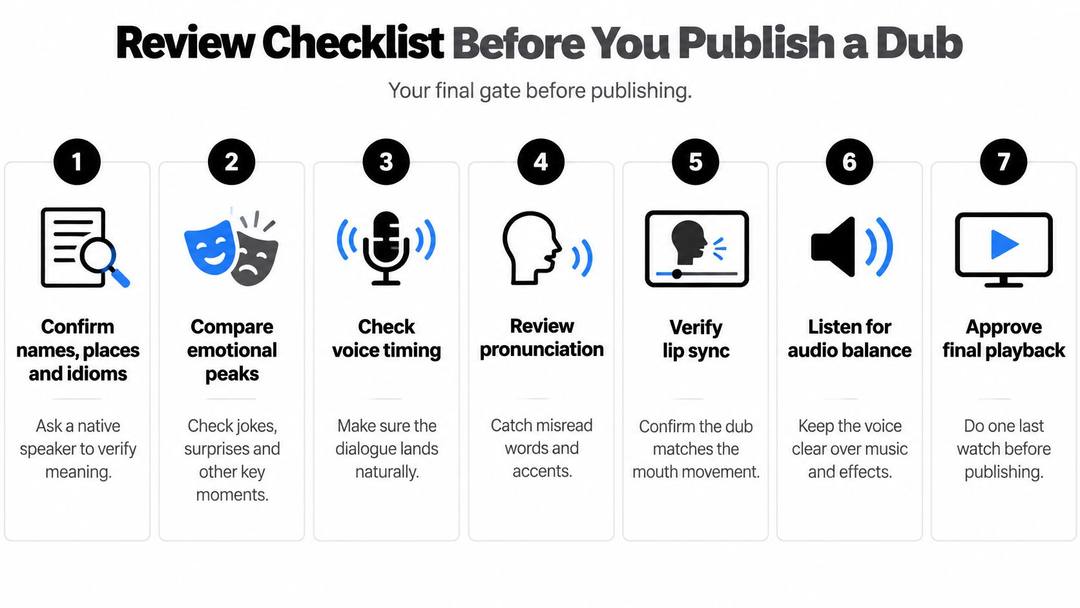
Seven checks stand between a generated track and a published one. Run them in order, because the cheap ones catch the expensive problems.
Names, places and idioms, confirmed with a native speaker. Machine translation handles standard prose well and stumbles on exactly the words that carry your brand.
Emotional peaks compared against the source. Play the joke, the surprise and the call to action side by side and listen for whether the energy survived the language change.
Timing around jokes and calls to action. A punchline that lands half a second late reads as a mistake, and a call to action that overlaps the next shot gets missed.
Pronunciation of brands and proper nouns. This is the fastest failure to fix and the most embarrassing to leave in.
Permission and endorsement. Confirm the synthetic voice doesn't imply an endorsement the speaker never gave, and that consent for any cloned voice is documented, in writing, for the markets you're publishing into.
Keep the original transcript beside the export. Comparing translated lines against the source text takes minutes and catches dropped sentences no listening test will surface.
Watch with sound on, then with sound off. Sound off exposes mouth mismatch that a good mix can hide.
The three-way decision
Accept the dub when all seven checks pass. Regenerate a single segment when timing or pronunciation fails, since that's a five-minute fix. Send the file to a human reviewer when the content depends on humour, cultural references or an emotional scene, because those are the places where a technically correct dub still misses.
That isn't a knock on the software. A 2025 study of quality in AI dubbing separates synchronization, voice consistency, expressiveness, narrative cohesion, sound design and translation as distinct failure points, and its prototype treats character extraction, emotional intensity capture, transcription, translation and synthesis as separate stages. Failures start in different places, so checking the whole chain beats blaming the translation every time.
Integrated generation is the fast path: one upload, one render, one file. Modular workflows, where you translate, edit and synthesise in separate passes, give finer control over terminology and timing and cost you more editing hours. Neither is wrong. The mistake is assuming both produce the same result on a script with three jokes in it.
The fastest workflow isn't automatically the best one. It's the one that needs the fewest repairs after the render.
Prompt to try
Create a 45-second vertical explainer on how to brew pour-over coffee in 4 steps. Open with the hook: "Your coffee tastes bitter because of one mistake." Use clean close-up b-roll, a calm narrator, short sentences with no slang or wordplay so it translates well, and bold captions.
Which YouTube and Social Videos Justify Dubbing
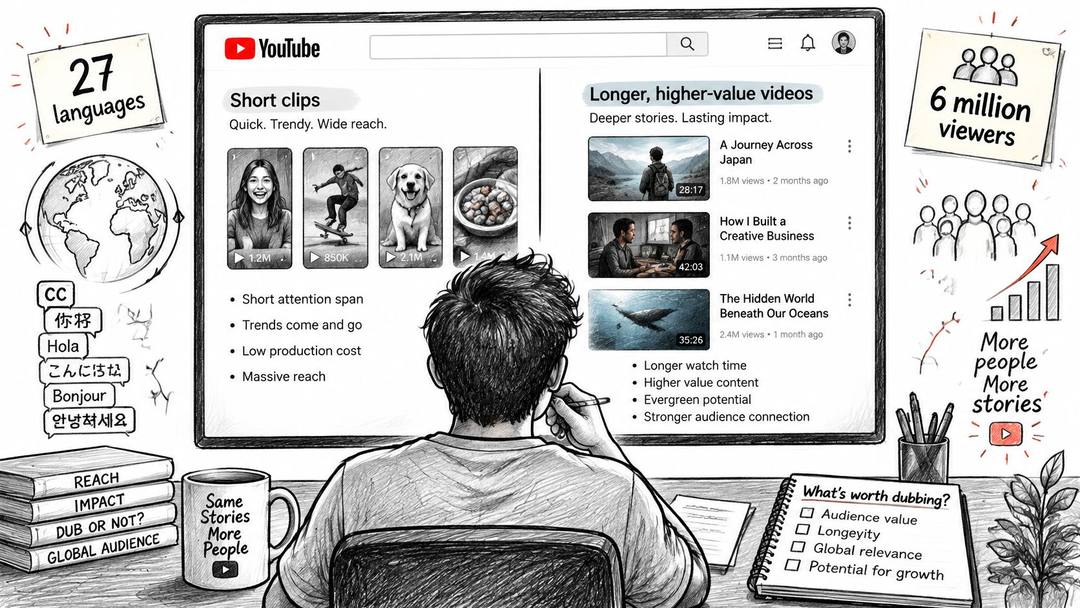
Auto dubbing stopped being an experiment when the platform started defaulting to it. Broadband TV News reported that more than 6 million viewers watched at least 10 minutes of auto-dubbed content daily in December 2025, with the feature available in 27 languages. Demand at that scale is real. It still doesn't mean your entire back catalogue should be dubbed.
Two routes get confused here. Automatic dubbing is generated by the platform. A multilingual audio track is a file you supply: in YouTube Studio you choose the video, pick the language, select the audio option, upload a supported audio-only file about the same length as the original, and publish, as YouTube's multilingual audio instructions describe. The dub has to exist before you upload, which is why a dubbing tool and a Studio upload belong in the same workflow.
The test that settles it
Run three versions of the same video: original only, subtitles only, and dubbed. Segment the results by country and language rather than reading one blended average, and track qualified watch time, completion rate, follows, comments and conversions. A dub that triples views from a country that never converts is a vanity metric.
Retention is where dubs pay for themselves or don't. Broadband TV News also cites an industry account putting average watch duration on an auto-dubbed version at roughly 75% of the original. Reaching twice as many people while holding three quarters of the watch time can still be a win, but you only know that after you measure it.
Content type decides more than tool choice. Evergreen explainers, tutorials and product demos dub well because the information survives translation. Personality-led comedy, rapid banter and anything built on wordplay transfer badly, and no lip-sync model fixes a joke that doesn't exist in the target language.
Keep a language only when the dubbed version beats subtitles on the metrics you already track. Everything else is a recurring cost with a flag on it.
The index leans toward videos that surface in hashtag and keyword searches, so its view counts run high: compare the groups, not the absolute numbers.
Source: Revid TikTok index: 2,377,477 TikToks with AI labels per video, snapshot of Sep 15, 2026. Median views estimated from view buckets.
Show the data
| Median views | Share past 1M views | |
|---|---|---|
| Indonesian | 314.3K | 32.6% |
| Vietnamese | 208.6K | 27.2% |
| Turkish | 200.3K | 23.7% |
| Korean | 195.2K | 26.8% |
| Japanese | 188K | 25.6% |
| Arabic | 185.5K | 25.7% |
| Portuguese | 174.8K | 26.2% |
| Russian | 160.4K | 26% |
| Chinese | 155.7K | 25% |
| Thai | 143.5K | 22.4% |
Film and Premium Dubbing Costs Compared
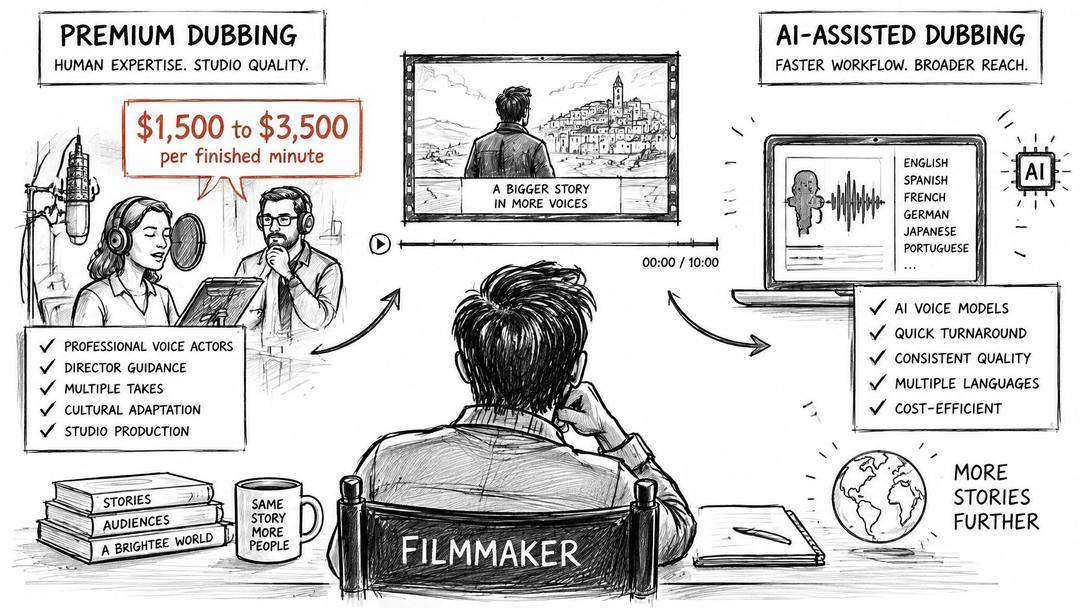
Premium dubbing prices by the finished minute and schedules by the week, so the budget question for any release is how many languages it can justify. One industry market report on native-language dubbing puts professional dubbing at $1,500 to $3,500 per finished minute, landing a 120-minute feature at roughly $180,000 to $420,000 for one language version across a typical production span of four to eight weeks.
Professional dubbing cost and turnaround references
| Dubbing type | Cost reference | Turnaround reference |
|---|---|---|
| Native-language dubbing, per finished minute | $1,500 to $3,500 | Priced per minute, so a 120-minute feature lands on the row below |
| Native-language dubbing, 120-minute feature, one language | $180,000 to $420,000 | Four to eight weeks typical span |
| Expedited work, any format | Rush premium on top of standard rates | Speeds delivery while the review steps stay the same |
A separate global professional dubbing services market report notes that lip-sync work costs more than ordinary voice dubbing because facial and dialogue timing demand extra technical analysis, and that rushing a job adds a premium rather than removing a step. Read the pricing model before the numbers: every additional language repeats the per-minute spend and most of the schedule, so a ten-language release is a ten-line budget.
Now set the AI figures beside that. A 2026 academic study of an AI-powered film-localization system reported 79.07% speech-recognition accuracy on two-person dialogue clips, and 21 listeners gave the cloned voices a mean opinion score of 4.05 out of five, with nine describing the clone as very similar with minor differences and two as identical.
The two results belong together. The voice half of the problem is close to solved in controlled conditions. The transcription half still drops a meaningful share of dialogue, and multi-speaker scenes with shot transitions are where it slips hardest. On a film shortlist, ElevenLabs fills the voice-cloning job and Rask fits where lip-sync and campaign speed matter more than a final mix. Neither replaces a post house for the theatrical deliverable, because the mix, the stems and the QC pass are still human work.
Where AI is ready: voice, speed and volume. Where it isn't: a complex scene with three speakers and a joke in the middle.
Choose Your Tool and Test Dubbing This Week
One week, one video, one language. That's enough to learn whether dubbing pays for your channel.
Pick a video that already performs in its original language. A 30 to 60 second product demo or a short YouTube explainer beats a brand film nobody watched.
Pick one target language where demand already shows. Comments in that language, or a country that appears in your analytics with no localized content, are the only signals worth acting on.
Match the video to the opening table. Short-form social videos that also need captions and publishing start with Revid. YouTube creators who edit by text start with Descript. Voice-led dubbing starts with ElevenLabs, e-learning talking heads with HeyGen, campaign localization with Rask, and quick browser edits with VEED.
Run the seven-point checklist on the export before it goes anywhere near an audience.
Publish the dub beside a subtitled version and compare qualified watch time, completion, follows and conversions by country. Keep a language only when the dub wins.
Revid takes that first slot for the short-form job specifically: Revid's video translation page says the tool translates and re-voices short videos. Voiceovers run in 70+ languages and captions in 100+ languages, and publishing to TikTok, Instagram and YouTube with post stats sits in the same workflow, so the test above doesn't need a second tool for captions or scheduling.
Choose the video, choose the language, pick the tool for the job, review the export, then measure it against subtitles.
Common Questions About AI Dubbing
Which dubbing tool should I try first? Whichever matches your publishing job. Revid covers short-form social videos that also need captions and publishing, ElevenLabs covers voice cloning, HeyGen covers e-learning talking heads, Rask covers campaign localization, VEED covers browser edits and Descript covers transcript-based YouTube edits.
Why do dubbed lines miss the mouth? Because the new speech has to keep the meaning while matching duration, pauses, speaking rate, articulation, timbre and emotion at once. That timing constraint is isochrony, and it's harder to solve than translation.
Should every video be dubbed? No. Auto dubbing now spans dozens of languages and draws millions of daily viewers, but the maths only works where a dub beats a subtitle track on watch time and follows. Personality-led comedy usually loses. Evergreen explainers usually win.
How is a Studio upload different from automatic dubbing? The automatic track is generated for you. A multilingual audio track is a file you prepare first and attach afterwards, which is why you need a dubbing tool before the upload.
What still needs a person? Humour, cultural references, emotional scenes and the final mix. Professional native-language dubbing is still priced per finished minute and scheduled in weeks, which tells you where the last ten percent of quality comes from.
Revid.ai builds the whole short video in one workflow, from script and voiceover to captions, with voiceovers in 70+ languages and captions in 100+ languages, then publishes straight to TikTok, Instagram and YouTube with post stats so you can see which language earned its keep. Translate one video this week, run the review checklist on the export, and compare it against a subtitled version before you commit to a second language. Start at revid.ai.
Sources
- Revid TikTok index: 2,377,477 TikToks with AI labels per video, snapshot of Sep 15, 2026. Median views estimated from view buckets.
Charts and figures checked on November 13, 2026.