
How to Scale Content Creation: 7 Steps That Keep Quality High
A 7-step system to scale content creation without losing quality: find the bottleneck, write the system down, repurpose one pillar asset, use AI for drafts and measure cost per piece.
On this page
To scale content creation, build the system before adding volume: document one brief template and style guide, produce one pillar asset per week, turn it into 5 to 10 derivative pieces, use AI for drafts and checks, keep one human review step, and publish from a single calendar. Measure cost and results per piece before adding more.
The risk at scale is not running out of ideas. It is publishing filler that platforms now push down. On July 15, 2025, YouTube renamed its "repetitious content" monetization policy to "inauthentic content" to cover mass-produced videos. Since March 2026, Facebook deprioritizes reels that only add borders, captions or speed changes to existing clips. More volume without an original angle gets you less reach, not more.
What is scalable content?
Scalable content is content made by a repeatable system, so each extra piece costs less time and money than the one before. A team that can double its output by adding templates, repurposing and automation has scalable content. A team that can only double output by doubling headcount does not.
Content scalability measures that: how much more you can publish before quality drops or costs rise in step with volume. Content scaling is the work of raising it: finding the bottleneck, writing the process down and moving repetitive steps to tools.
Content creation at scale vs traditional production
Traditional production treats every piece as a one-off project. Creating content at scale treats each piece as an output of the same pipeline.
| Traditional production | Content creation at scale | |
|---|---|---|
| Starting point | A blank page for each piece | A pillar asset and a brief template |
| Drafting | A writer starts from scratch | AI or a template produces a first draft; a person edits |
| Review | Ad hoc, several approvers | One named reviewer and a written checklist |
| Distribution | One channel per piece | One asset adapted to 5 to 10 formats |
| Measurement | Page views | Cost per piece, conversions, cycle time |
| Who owns quality | Whoever wrote it | The style guide and the reviewer |
The last row matters most. At scale, no single person reads everything anymore, so quality has to live in documents and checklists.
How to scale content creation in 7 steps
1. Set one goal and the KPIs that prove it
Pick one business goal and make it SMART (specific, measurable, achievable, relevant, time-bound). Examples: increase organic blog traffic by 25% in six months, or reach a set number of demo requests from content each month. Track it in Google Analytics alongside conversions, not just page views.
Decide what scaling should change: more output, a lower cost per piece, or more results per piece. Alex Birkett's guide to content scaling covers how to choose goals before you grow output.
2. Find your bottleneck before you add people
List every stage a piece goes through: idea, brief, draft, edit, design, approval, publishing, distribution. For your last few pieces, note how long each stage took and how long each piece waited between stages.
The waiting time is usually the problem. If pieces sit in approval for days, hiring another writer only makes the queue longer. Decision rule: if waiting time is longer than working time at a stage, fix that stage (fewer approvers, a deadline, a checklist) before you add capacity anywhere else.
3. Write the system down: brief, style guide, governance
Three documents let new writers, freelancers and tools produce work that sounds like you:
- Brief template. Every piece starts from the same fields: goal and KPI, audience and their problem, main search or angle, key points and sources, format and length, planned derivatives, owner, reviewer and deadline.
- Style guide. Tone, banned phrases, terminology, formatting, how to cite sources, and two or three example pieces that set the bar.
- Governance model. Who decides topics, who approves, who can publish, and what happens when a piece misses its deadline.
Terminology drifts first as more people write. Tools like Acrolinx check content against your terminology and style rules automatically, which matters most for regulated or highly technical companies.
4. Build around one pillar asset per week and repurpose it
The cheapest new piece is one you have already researched. Produce one substantial asset per week (a webinar, a long article, a customer interview, a product demo) and plan its derivatives in the brief, before the pillar is made.
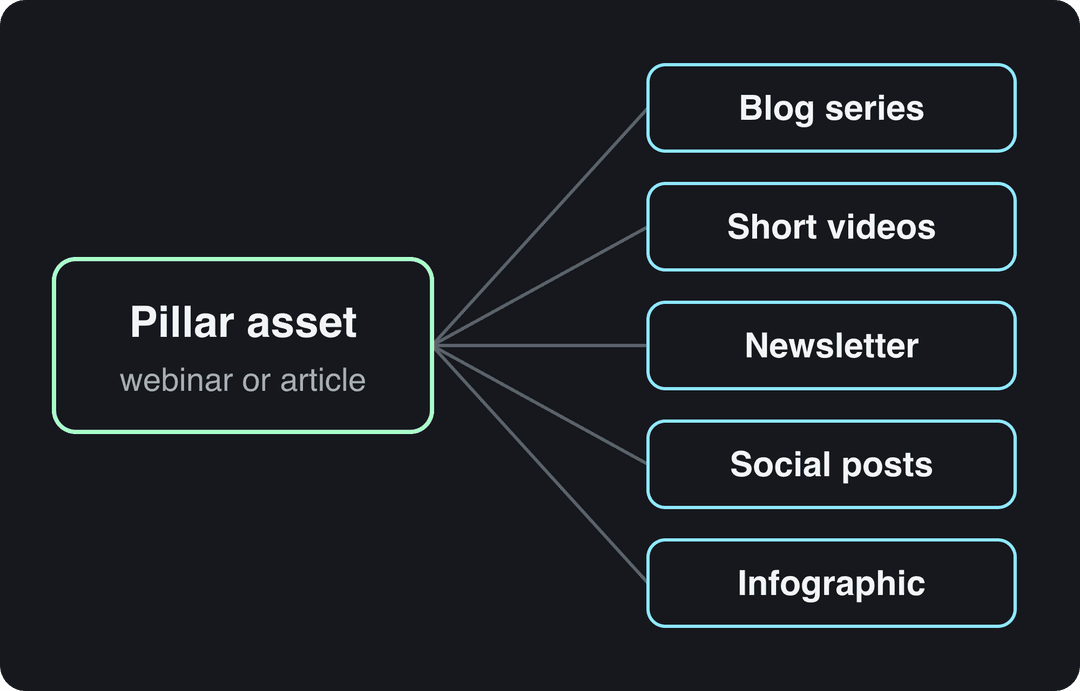
| Derived format | What to take from the pillar | Tools | Effort |
|---|---|---|---|
| Blog post series | One key takeaway per post | Transcription, your CMS | Low |
| Short-form videos | One idea or quote per vertical clip | Video editor or AI video tool | Low |
| Social posts | Quotes, stats, one tip per post | Scheduling tool | Low |
| Email newsletter | A recap linking to the full asset | Mailchimp or another email platform | Low |
| Infographic | The framework or process, visualized | Canva or another design tool | Medium |
Start with your highest-traffic posts and best-performing videos: a proven idea carries over to new formats better than an untested one. For the full process, follow this content repurposing workflow.
5. Use AI for first drafts and checks, not final judgment
HubSpot's 2026 State of Marketing Report found that 80% of marketers use AI for content creation, so AI drafts alone no longer give you an edge. Use AI where it removes repetitive work: outlines from the brief, first drafts, transcript summaries, title variants, grammar and style checks. Keep people on what makes a piece worth reading: the angle, the examples, the facts and the final edit.
Skipping that edit has a cost. In Sprout Social research published in March 2026, 50% of Gen Z said they had already blocked, muted or unfollowed a brand or creator because its content felt like "AI slop."
6. Run a scalable content publishing workflow
A scalable content publishing workflow has fixed stages, one owner per stage and automatic handoffs:
- The topic owner approves the brief.
- The writer drafts in a shared doc such as Google Docs, with comments instead of email threads.
- One named reviewer checks the draft against the checklist within a set deadline.
- Design and video derivatives are made from the approved version.
- The piece is scheduled from one calendar and published.
- Results are logged against the brief's KPI.
Track each piece as a card in a project tool such as Asana, and use Zapier to move it along automatically: an approved doc creates a design task, and a published post creates social tasks. For templates, see how to streamline your content creation workflow.
7. Measure cost and results per piece, then add volume
Increase output only once cost per piece and results per piece have been stable for a few weeks. If quality signals drop when volume rises (more revision rounds, lower conversions, less watch time), go back to step 2: a new bottleneck has appeared.
Prompt to try
Make a 40-second faceless vertical video for B2B marketers titled "Your content team doesn't need more writers." Open with the hook: "Hiring another writer can make your content queue longer." Explain that waiting time between stages is the real bottleneck, then give three fixes: fewer approvers, a review deadline and a checklist. Use clean motion graphics, a calm confident voice and bold captions.
How to scale content creation without adding headcount
You can usually raise output with the same team by removing work rather than adding people:
- Repurpose before you create. Each pillar asset should feed several formats (step 4).
- Record experts instead of asking them to write. A 30-minute interview with an engineer or founder gives a writer material for several pieces.
- Template everything that repeats: briefs, intros, video structures, thumbnails, email layouts.
- Automate handoffs and publishing. This guide to content creation automation covers what to automate first.
- Use freelancers for volume and keep strategy and editing in-house.
- Make video without filming yourself. Faceless formats (voice-over, screen recordings, AI visuals) remove the most expensive part of video: someone on camera.
Faceless video does not have to cost you views. In Revid's analysis of 176,367 TikToks with 1,000+ likes posted between October 2025 and October 2026, faceless videos had a median of 114K views and 17.4% passed 1M views, against 67K and 12.7% for videos with one person on camera. The sample only includes TikToks that had already reached 1,000 likes, and it shows what successful videos have in common, not causes. The full study of what makes TikToks go viral explains the method.
Faceless videos earned a median of 114K views, against 67K for videos with one person on camera, and passed 1M views 38% more often.
Source: Revid analysis of 176,367 TikToks with 1,000+ likes posted between Oct 1, 2025 and Oct 16, 2026 (61,203 creators)
Show the data
| Median views | Share that passed 1M views | |
|---|---|---|
| Animals | 147.4K | 24.1% |
| Faceless | 113.9K | 17.4% |
| Groups of people | 96.1K | 16% |
| Objects or products | 70.8K | 13.2% |
| One person on camera | 67.4K | 12.7% |
How to scale content writing
Most teams try to scale writing first, and that is where quality slips fastest. What works:
- Approve outlines, not drafts. A reviewer spends minutes on an outline and saves hours of rewrites.
- Research once per topic cluster. Use Semrush or Ahrefs for keyword and competitor research, then hand writers a cluster of briefs instead of one keyword at a time.
- Group writers into pods by topic, each with its own editor, so expertise builds up.
- Give writers sources, not just topics. Most weak content comes from writers guessing.
- Ask AI for a first draft only from a full brief. A one-line prompt produces the generic average of the internet.
How do you keep quality consistent when scaling content?
Consistency at scale comes from three things: written standards, one accountable reviewer and regular sampling.
- Turn the style guide into a checklist the reviewer ticks for every piece: one clear angle, sourced facts, search intent answered, correct terminology, working links, a call to action.
- Run every draft through a checker such as Grammarly or ProWritingAid before it reaches a person, so the review can focus on substance.
- Each month, audit a random sample of published pieces and score them against the checklist. Falling scores are your early warning.
Generic content also costs trust. In Klaviyo's December 2025 survey of 8,000 consumers, 32% said low-quality or generic AI content from brands makes them trust those brands less.
What tools help you publish more than your team can handle?
Pick one tool per job and connect them, so work moves between stages without anyone copying links by hand.
| Job | Tools | What they remove |
|---|---|---|
| First drafts and variants | Jasper, Copy.ai | Blank-page time |
| Grammar and style | Grammarly, ProWritingAid | Line editing by hand |
| Research and SEO | Semrush, Ahrefs | Guessing topics |
| Project tracking | Asana, Trello | Status meetings |
| Content calendar | CoSchedule | Missed dates and double bookings |
| Automation | Zapier | Manual handoffs |
| Social scheduling | Buffer, Hootsuite | Posting by hand |
| Mailchimp | Manual sends | |
| Short-form video | Revid | Filming and editing each video |
The test of a connected stack: when a piece is approved, its next tasks appear on their own, and when it is published, its social and video derivatives are already queued.
How to automate content refresh at scale
Old pages lose rankings as facts and years go stale, and refreshing them is often cheaper than writing new ones. To run refreshes at scale:
- Each quarter, export pages from Google Search Console or your analytics tool and flag those that lost clicks over the last 3 months or rank on page two or three.
- Create a refresh task for each flagged page automatically, for example with a scheduled Zapier export into your project tool.
- Refresh every page with one checklist: update years and outdated facts, replace unsourced statistics, answer the searches the page already appears for, add internal links and an FAQ.
- Change the "last updated" date only when the content really changed, and check the result after 6 weeks.
Centralized, distributed or hub-and-spoke teams
| Model | How it works | Best for | Watch out for |
|---|---|---|---|
| Centralized hub | One content team produces everything | Small companies, strict brand voice | Becomes a bottleneck as demand grows |
| Distributed network | Each department creates its own content | Large companies with many experts | Inconsistent voice and quality |
| Hub and spoke | A central team sets standards and edits; experts across teams contribute | Most companies past a handful of writers | Needs a clear governance model |
As you grow, add roles in this order: a content operations manager (process, calendar, tools) before more writers, then an editor per pod, then SEO and strategy specialists. Freelance writers, designers and video editors give you flexible capacity. Keep the editor and strategist in-house so your standards stay with you.
What does a scalable global content production pipeline look like?
A global pipeline produces one master asset and adapts it for each market, instead of creating every market's content from scratch:
- Master in one source language, with a glossary of product terms and phrases that must not be translated.
- Translate with machine translation plus human review for your priority markets.
- Localize examples, currencies, references and calls to action for each market.
- Review per market with a native speaker who knows the product.
- Publish on local schedules and track results by market, so you know which markets justify more investment.
For video, Revid's video translator translates an existing Revid project into another language while keeping the edit, media and captions, with voice-overs available in 70+ languages.
Prompt to try
Create a 30-second YouTube Short that turns one blog takeaway into a quick tip: "Approve outlines, not drafts, and save hours of rewrites." Start with the hook "Stop reviewing full drafts." Show a simple before and after workflow with stock office footage, an upbeat voiceover and large captions, ending with one clear action step.
Which formats should you scale first?
Scale the format your audience already uses. If your buyers watch YouTube, invest in video first. If they read LinkedIn, long posts and articles from people at your company usually travel further than brand posts.
| Format | Production effort | Scalability | Best for |
|---|---|---|---|
| Blog post | Medium | High | Search traffic, product education |
| Short-form video | Low to medium | High with templates or AI | Reach and awareness |
| Long-form video | High | Medium | Trust and consideration |
| Podcast | Medium | Medium | Expert interviews that feed other formats |
| Infographic | Medium | High | Frameworks and processes |
| Social posts | Low | High | Distributing every other format |
Short-form video was the top ROI-driving format in HubSpot's 2026 State of Marketing Report, cited by 49% of marketers, ahead of long-form video at 29%. Stellar Content's overview of content scaling across formats has more on building a format mix.
How do you measure ROI from scaling content production?
Track two sets of numbers: what content costs to produce, and what it returns.
| Type | KPI | Why it matters |
|---|---|---|
| Production | Pieces published per week | Shows whether the system really scaled |
| Production | Cost per piece (team hours plus tools, divided by pieces) | Should fall as you scale |
| Production | Cycle time from brief to publish | Reveals new bottlenecks |
| Production | Revision rounds per piece | Rising rounds mean unclear briefs or standards |
| Performance | Conversions or leads per piece | Ties content to revenue |
| Performance | Organic clicks and search positions | Leading indicator for written content |
| Performance | Watch time and shares | Leading indicator for video |
The ROI formula is simple: revenue attributed to content, minus total content cost, divided by total content cost. Attribution is the hard part. A buyer might find you through a short video, read three articles and convert from an email. A multi-touch attribution model gives each of those touchpoints partial credit, so it captures the value of top-of-funnel formats that single-touch models miss.
How to scale short-form video with Revid
Video is usually the slowest format to scale, and short-form video is what Revid is built for.
- Turn each pillar article into a narrated short with the article to video converter, or cut a long recording into vertical clips with the YouTube clip maker.
- Start from a proven format: search Revid's library of about 2.77 million real short-form videos with engagement data, and remix one into an original video on your topic.
- Set up Auto-Mode workers that create a fresh video every day from a prompt or a content source (3 workers on the Growth plan).
- Check each video in the timeline editor, then publish and schedule to TikTok, Instagram and YouTube from one queue.
Sign-up is free and new accounts get free credits to try video creation, no credit card needed. Paid plans start at $39/month; see current plans and credits.
FAQ
Can AI scale content creation on its own?
No. AI writes first drafts, summaries and variants fast, but without a human-set angle, real sources and a final edit it produces generic content that readers skip and that platforms such as YouTube may not monetize. Use it to remove repetitive work, not judgment.
How do you scale content creation for a high-tech company?
Record your engineers and product managers instead of asking them to write, and have the content team turn those recordings into articles, docs and videos. Keep one technical reviewer who signs off on accuracy, and maintain a terminology glossary.
Does labeling content as AI-generated reduce its reach?
Not by itself. YouTube and TikTok both say the AI disclosure label alone does not limit distribution, and both require it for realistic AI video. Failing to disclose is the bigger risk.
Should you hire writers or use freelancers to scale?
Use freelancers to add volume quickly, and keep the editor and strategist in-house. Hire full-time once a role has steady weekly work and your brief and style guide are clear enough for a new person to follow without you.