How to Create a Video From an Article in 5 Steps (2026)
Paste an article URL into Revid's Article to Video tool, choose how the text is handled, pick visuals, voice and music, and get a narrated, captioned video in under 5 minutes. Steps, settings and data inside.
On this page
To create a video from an article, open Revid's Article to Video tool (Create > More tools), paste the article URL, choose how the text is handled, pick a media type, ratio, voice and music, then click Generate video. Revid writes the script, illustrates it and opens the result in the editor in under 5 minutes.
Most people skip the setting that decides whether anyone watches: how Revid handles your text. An article is written to be read, and narration that reads every sentence aloud gets swiped away. In Revid's TikTok data (below), videos that talked the whole way through did worse than videos with a line or two of speech.
Here is an example made from Revid's article on converting 4K videos to 1080p for YouTube:
What you need before you start
- An article URL: a blog post, a news article or any page with readable text. If the text is not online, use "From script" on the Create page instead and paste it into the "Your video narrator script" box.
- A target platform, so you know which screen ratio to pick.
- A Revid account. Sign-up is free, new accounts get free credits to try video creation, and regular creation then uses the monthly credits of a paid plan (see Revid plans and credits).
Step 1: Open the Article to Video tool
- Click Create at the top of the left sidebar, or press C. The Create page opens with "What do you want to make?".
- Click More tools at the end of the row of starting points, or "All tools" in the sidebar, and choose Article to Video. You can also start from the Article to Video tool page.
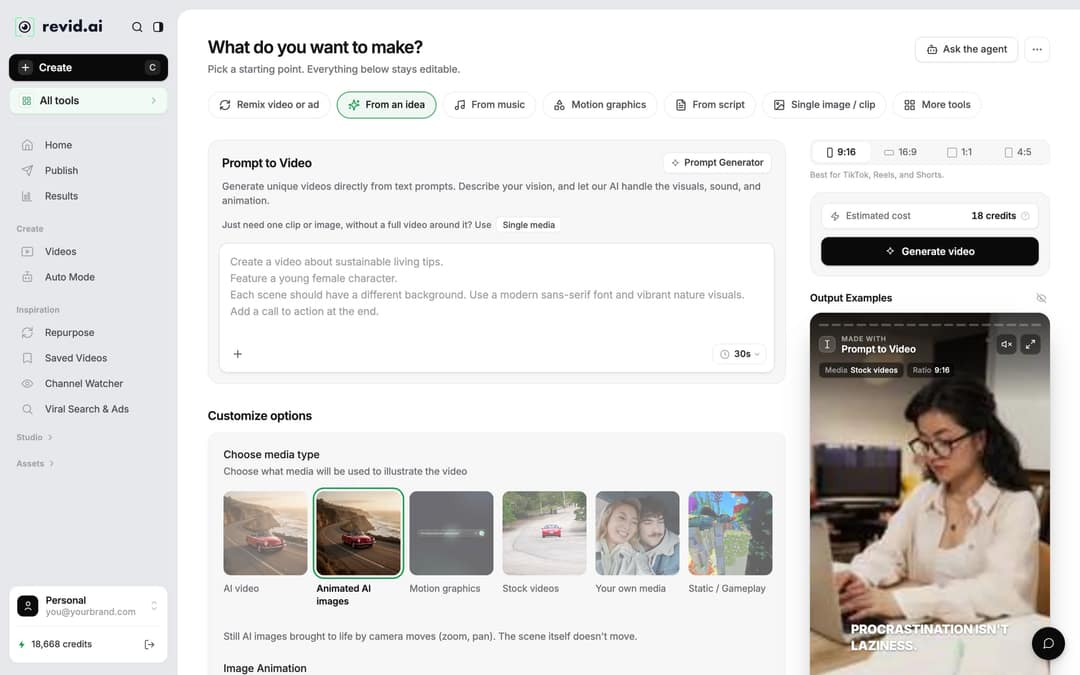
If you used the older version of this tool: the separate page with numbered boxes (Enter your article URL, Select Voice, Import images, Pick your parameters, Select audio) is gone. The settings now sit in one form on the Create page, and the cost estimate shows before you generate.
Step 2: Paste the URL and choose how to handle the text
Paste the article link into the URL field. Revid reads the page and writes the narration from it.
Then set How should we handle your content. This replaces the old "Prevent content summarization" toggle and has three options:
| Option | What it does | Use it when |
|---|---|---|
| Summarize | Condenses the article into a short script | Long posts going to TikTok, Reels or Shorts |
| Summarize if long | Keeps short pages as written, condenses long ones | You batch articles of very different lengths |
| Keep as is | Reads the text without condensing it | Every sentence must be heard, such as a short announcement or notice |
Turning on the old Prevent content summarization toggle is the same as choosing Keep as is today.
Step 3: Pick the media type and screen ratio
Article to Video has its own media list. It includes Article images, Article images + stock, and Motion graphics, which is the default.
| Your article | Media type | Why |
|---|---|---|
| Has its own screenshots, product photos or charts | Article images | The video shows the real visuals the article talks about |
| Has a few images, not enough for every scene | Article images + stock | Stock footage fills the gaps between the article's images |
| Abstract topic, numbers or ideas with few images | Motion graphics | Animated text and shapes carry the points of the script |
Pick the ratio in the composer's ratio cell. Use 9:16 for TikTok, Instagram Reels and YouTube Shorts, 16:9 for a regular YouTube video, 4:5 for a feed post and 1:1 for square placements.
Step 4: Choose the voice and the music
Choose an AI voice for the narration. Revid has 1,000+ voices in 70+ languages. Match the voice to the article: a calm, authoritative voice for explainers and how-tos, a younger, expressive one for trends and listicles.
The language defaults to "Automatic". If the article mixes languages or the AI picks the wrong one, set it under Advanced options > Language & Localization > Language.
For music, pick a track from the built-in library of 199 tracks. Choose music that sits under the voice instead of competing with it: calm or electro tracks for explainers, suspenseful ones for stories and reveals.
Step 5: Check the cost and generate
- Look at Estimated cost at the bottom of the form, next to the Generate video button. The number updates as you change media type, length or voice.
- Click Generate video. Revid writes the script, builds the scenes, records the voiceover, syncs the captions and adds the music.
- The finished project opens in the editor. If a build fails, its credits are refunded automatically.
Edit the video before you post it
The editor's left rail has Script, Text, Media, Transitions, Audio, Captions and Settings. Three edits fix most article videos.
Tighten the script. Open the Script panel: every caption segment has its own text box and start time. Rewrite or shorten a line, or click the eye icon to hide a segment.
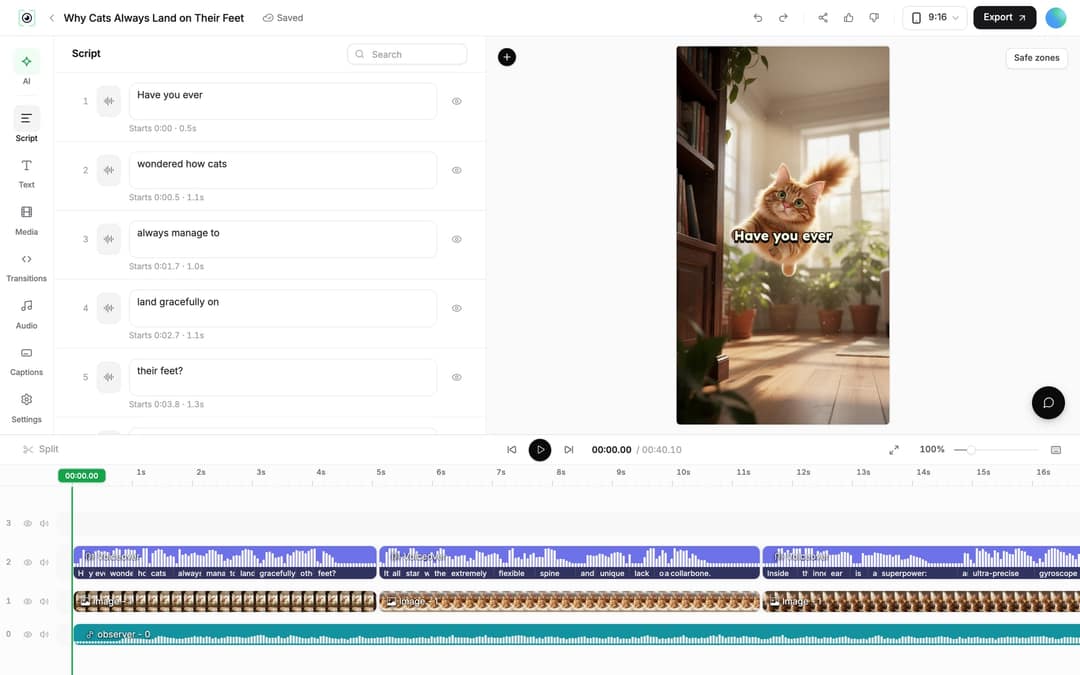
Regenerate the voiceover. After you change text, Revid shows "Caption updated. Re-generate voice if timing changed." Open the Audio panel, find the line under Project Voiceovers and click Re-generate, then Generate Voice in the dialog. Leave "Keep timeline in sync" on so clips and music follow the new timing. This needs a paid plan and costs 10 credits per started 500 characters.
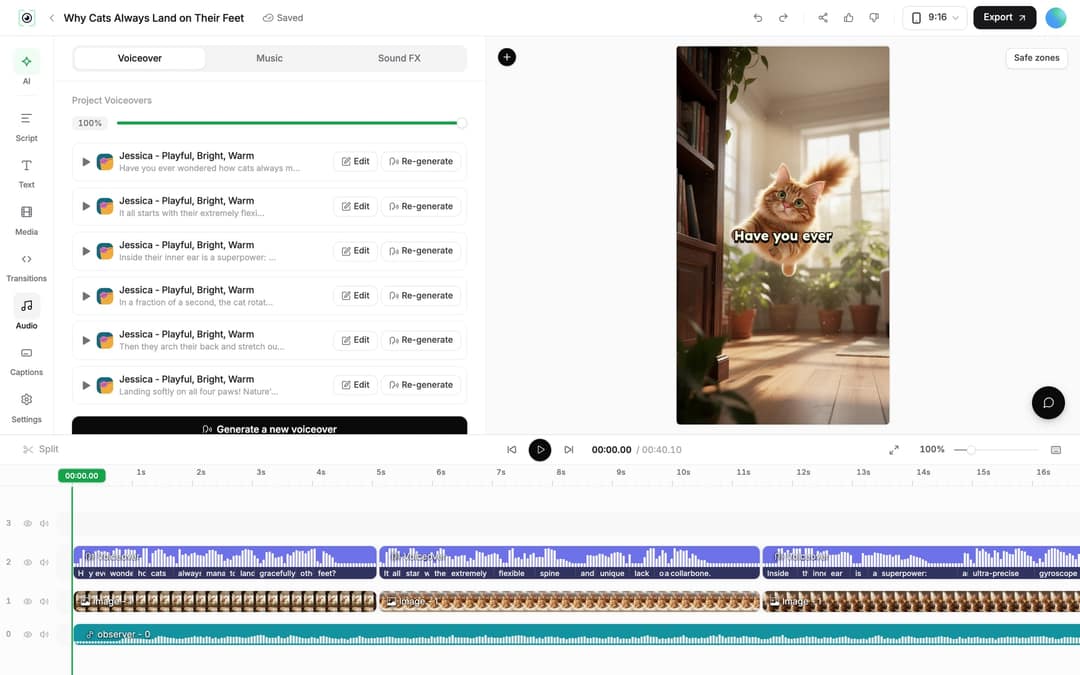
Swap weak visuals. Select an image or video clip and click Replace to pick another file from the Media panel Library, or use Regenerate/Edit image on AI images. To trim, drag a clip's edge on the timeline or press S to split at the playhead.
Export or publish
Click Export in the top right ("Export / Publish" on free accounts). You can export in 720p, 1080p or 4K at 30 or 60 fps, or open the Publish Video dialog, pick accounts under "Publish to" and click Publish or Add to queue.
To post directly, connect your accounts first in Settings > Integrations under "Add a network": TikTok, YouTube, Instagram (Business or creator account), X and Webhook. The social media publishing features cover scheduling from one queue.
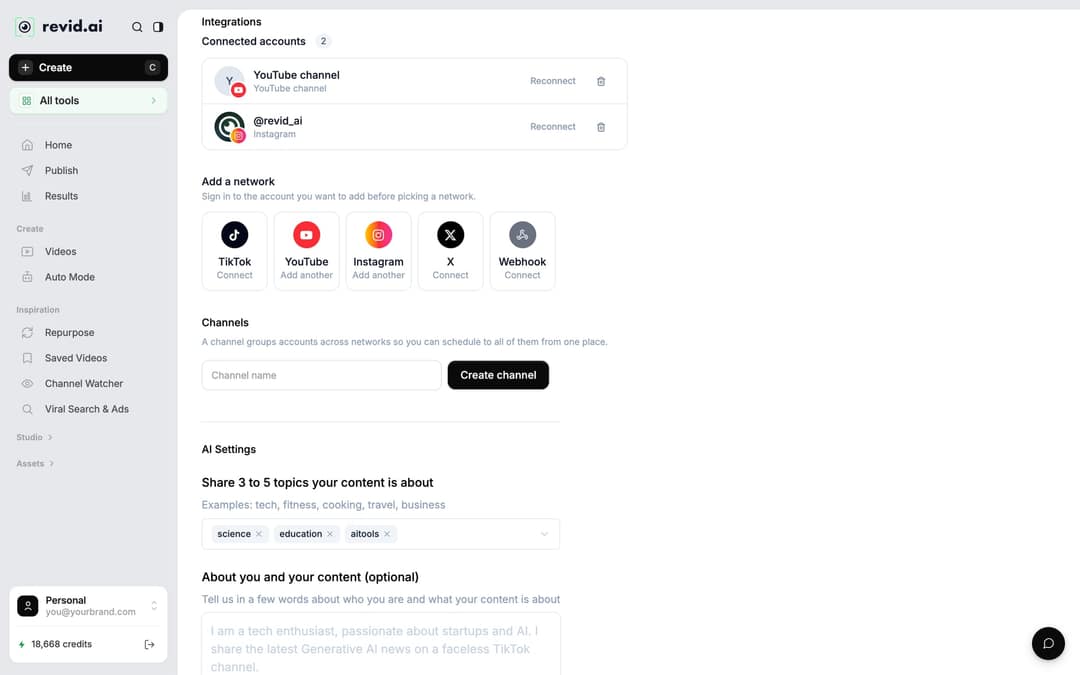
Turn every new article into a video automatically
If you publish a blog regularly, an Auto Mode worker can make a video from each new post. Auto Mode needs a paid plan: Growth includes 3 workers, Elite 5 and Ultra 10.
- Click Auto Mode in the sidebar, then New worker.
- Under "Name your worker", give it a name.
- Under "What should it make?", choose Article to Video.
- In "Source of your content", paste your blog's RSS feed or homepage. Single article URLs are refused: the worker watches a source, not one post.
- Pick the format, then the delivery: "Review First" keeps each video in Revid for you to check, "Auto Queue" sends it to the posting queue of the accounts you select.
- Check "Est. credits per run" and "Est. monthly credits" in the Worker preflight panel, then click Create worker.
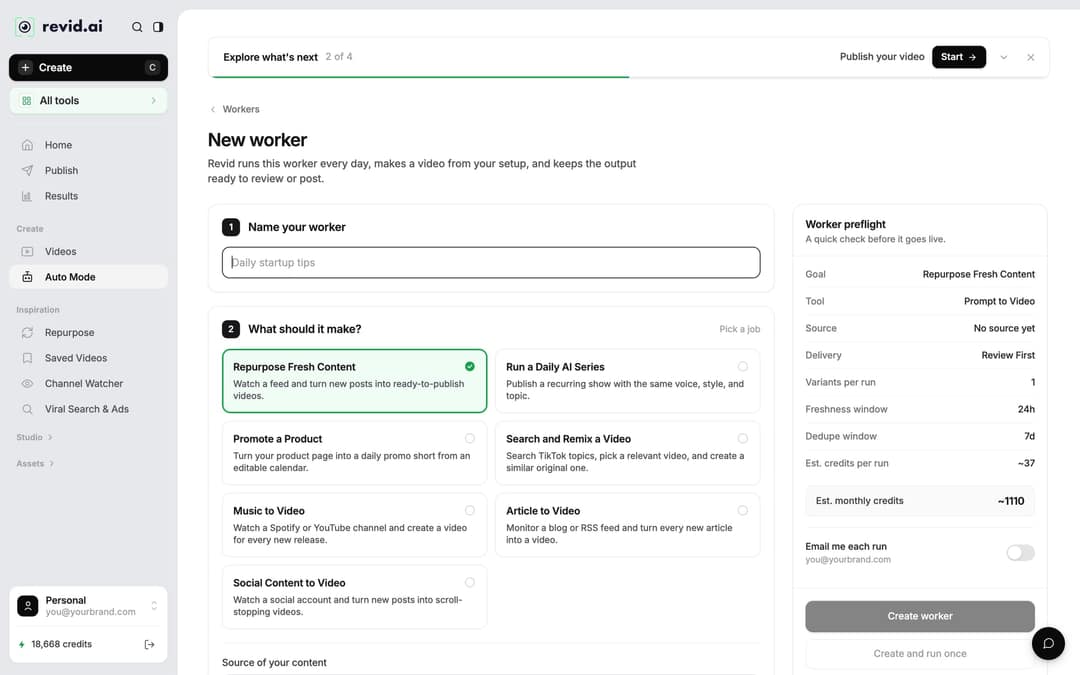
Each worker runs once a day between 1 AM and 5 AM, picks one new post, and skips the run when nothing new was published. More on this in automated video creation.
How to make an article video people actually watch
Keep the narration short
An article video is a voiceover video by nature, which makes the amount of speech your biggest lever. In Revid's analysis of 176,367 TikToks with 1,000+ likes posted between October 2025 and October 2026, videos with under 40 characters of speech had a median of 123K views and 20.2% passed 1M views. Videos talking throughout (300+ characters of speech) had a 68K median and 11.9% past 1M. The sample only includes videos that already did reasonably well, so this shows what top videos have in common, not a cause. The full method is in Revid's study of what makes a TikTok go viral.
Videos with just a few spoken words (a line or two) beat both silent videos and videos that talk the whole way through, which were the most common and the weakest.
Source: Revid analysis of 176,367 TikToks analyzed by AI, with 1,000+ likes posted between Oct 1, 2025 and Oct 16, 2026 (61,203 creators)
Show the data
| Median views | Share that passed 1M views | |
|---|---|---|
| No speech | 73.3K | 14.3% |
| Under 40 | 122.7K | 20.2% |
| 40 to 120 | 97.2K | 17.6% |
| 120 to 300 | 91.6K | 16.8% |
| 300+ | 67.7K | 11.9% |
In practice: choose Summarize, and if the article is long, feed Revid only the section that holds the main idea. Paste that paragraph into "From script" instead of giving the whole URL.
Prompt to try
Make a 30-second vertical video for TikTok that opens with the hook: "Most people export 4K for YouTube and lose quality anyway." Explain in three quick points why YouTube recompresses uploads and when exporting at 1080p makes sense. Use motion graphics with bold on-screen text, a calm explainer voice and short narration.
Open with the article's most surprising line
The first sentence of the narration is your hook. If the generated script opens by restating the headline, rewrite the first segment in the Script panel so your strongest number, claim or result comes first, then re-generate that voiceover line. "Most people export 4K for YouTube and lose quality anyway" beats "In this video, we'll talk about 4K exports."
Don't chase a specific length
In the same study, every length bucket from under 15 seconds to 10 minutes had a median between 58K and 76K views, with 61 to 90 seconds slightly ahead at 70K. Videos under 15 seconds had the most shares per view (1.41 per 100). Pace matters more than duration: cut any scene that repeats a point.
Let the visuals do part of the explaining
When the article has real screenshots or product photos, choose Article images: showing the actual interface or product is more convincing than generic footage. Keep captions on so the video works with the sound off.
Other ways to turn text into video
- For pasted text, scripts or prompts instead of a URL, see the guide to converting text to video.
- For a podcast episode or a recording, the audio to video converter ("From a link or audio" on the Create page) turns the audio into a captioned video.
FAQ
Is it free to create a video from an article with Revid?
You can start for free: sign-up costs nothing and new accounts get free credits, no credit card needed. Regular creation then uses a paid plan's credits, from $39/month (Growth, 2,000 credits); a 30-second video with Pro AI visuals and a voice-over costs about 40 to 80 credits.
How long does it take to turn an article into a video?
Under 5 minutes for most articles: paste the link, choose the settings and click Generate video. Edits in the editor afterwards take as long as you want to spend on them.
Can I make the video in a different language from the article?
Yes. Pick a voice and set the language under Advanced options before generating, or translate a finished project: open the project card menu, click Translate, and the AI video translator keeps the edit, media and captions in any of 74 target languages.
Can I turn articles into videos through an API?
Yes. Every paid plan includes Revid's API, MCP server and CLI, so a script or an AI agent can send article URLs and get videos back. Start with the article to video API docs.
Can I use my own voice instead of an AI voice?
Yes, in two ways. Voice cloning (Elite plan and above) gives you an AI voice that sounds like you. You can also record the narration yourself and upload it to the Audio to Video tool, which builds the captioned video around your recording.