How to Create a Cinematic Video With AI in Revid (Step by Step)
Turn a script into a cinematic AI video in Revid: one line per shot, AI video scenes, a narration voice and a soundtrack, then shot-by-shot fixes in the editor. Every step matches today's interface.
On this page
To create a cinematic video with AI in Revid, click Create (shortcut C), choose From script and paste a script with one line per shot. Set the media type to AI video and the ratio to 16:9 or 9:16, pick a voice and music, then click Generate video. Fix weak shots in the editor and export in up to 4K.
The visuals are the easy part. The common failure is a gorgeous, calm, uplifting montage that nobody finishes: in Revid's TikTok data, inspirational videos had the lowest median views of any mood we measured. Step 1 shows the numbers and how to fix your story before you spend a single credit.
Here is a finished example video:
Step 1: Pick a story with something at stake
A cinematic video needs one character, one conflict and one turn. Three formats work well:
- A dramatic short story: one person, one problem, one reveal.
- A trailer-style teaser for a product, launch or event (the AI movie trailer maker is built for this).
- A visual poem: strong images under a slow narration, with a twist in the last line.
Mood matters more than polish. In Revid's analysis of 176,367 TikToks with 1,000+ likes posted between October 2025 and October 2026, videos whose dominant mood was outrage had a median of 156K views (23.7% passed 1 million), humor 121K and sadness 104K. Inspirational videos had only 45K. The sample only holds TikToks that already reached 1,000+ likes, and the figures show what top videos share, not causes. The method is in the full TikTok virality study.
High-arousal emotions (outrage, humor, sadness) earned the most views. Calm, inspirational videos earned the least, even though they collect the most likes per view.
Source: Revid analysis of 176,367 TikToks with 1,000+ likes posted between Oct 1, 2025 and Oct 16, 2026 (61,203 creators)
Show the data
| Median views | Share that passed 1M views | |
|---|---|---|
| Outrage | 156K | 23.7% |
| Humor | 121K | 19.3% |
| Sadness | 104.4K | 16.5% |
| Excitement | 92.5K | 15.9% |
| Joy | 89.9K | 18% |
| Informative | 64.1K | 11.2% |
| Neutral | 61.2K | 11.5% |
| Inspirational | 44.6K | 11.3% |
The decision rule: if your idea is a pure feel-good montage, add a loss, a threat or a twist before the uplifting ending. The example video above started from a dramatic scene written with Revid's AI script generator.
Prompt to try
A 45-second dramatic short story: a night-shift nurse finds a patient's chart signed with her own name, dated tomorrow. Open on the chart in close-up with the line 'She hadn't written this yet.' Moody hospital corridors, cold blue light, slow camera moves and film grain, ending on a twist reveal.
Step 2: Open Create and choose your starting point
Click Create at the top of the sidebar (or press C). The page asks "What do you want to make?" and offers chips: Remix video or ad, From an idea, From music, Motion graphics, From script, Single image / clip and More tools.
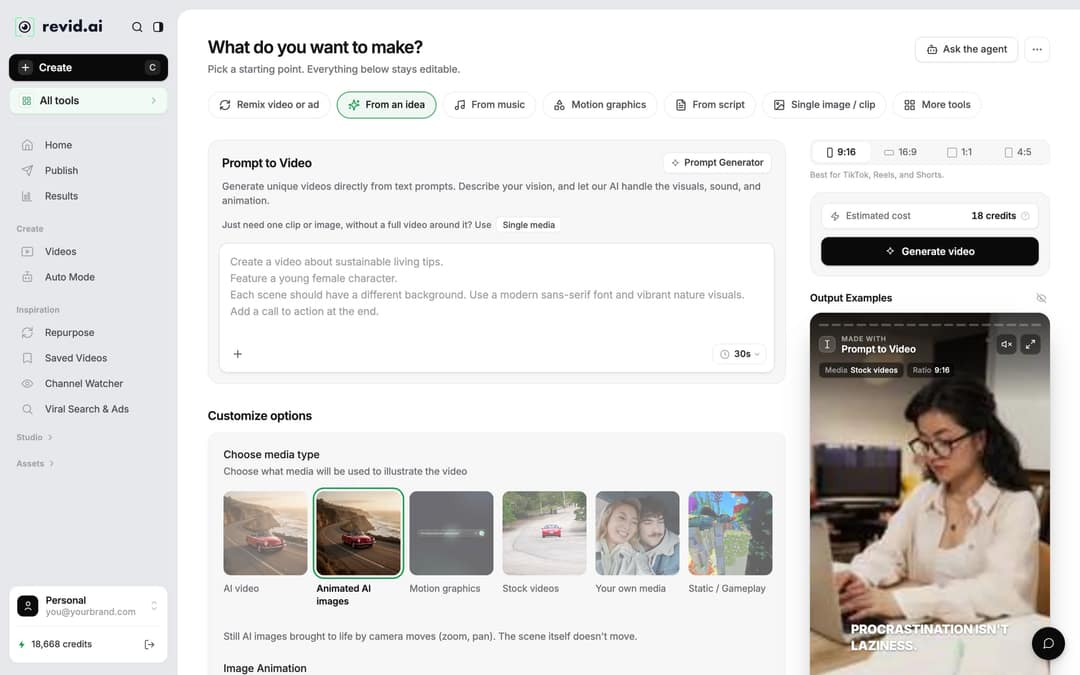
Pick the path that matches what you have:
| You have | Choose | What Revid does |
|---|---|---|
| A finished script | From script | Voices your exact words and builds a scene for each line |
| Only an idea | From an idea (Prompt to Video) | Writes the video from your description |
| A story you want turned into a screenplay | The Cinematic Video generator | Writes the screenplay from your story, then builds the video |
For the most control over every shot, use From script. The rest of this guide follows that path; the media type, ratio and cost steps are the same on the other two.
Step 3: Write the script one shot per line
The script field ("Your video narrator script") understands three kinds of markup, and its placeholder still lists them:
- A new line starts a new scene. Write one line per shot.
- Square brackets are visual notes, not narration. Revid maps them back onto the scenes as hints for the visuals, so this is where the cinematic direction goes.
- The break tag
<break time="1.0s" />adds a pause, for example before a reveal. The maximum is 10 seconds.
Use the brackets like a director's shot list: framing, light, movement and texture. A sample:
The lighthouse keeper had not seen a ship in decades. [wide shot, lone lighthouse on a cliff, storm clouds, film grain]
Tonight, a light answered his. [close-up, old man's face lit by a distant flashing light]
<break time="1.0s" />
He knew that signal. It was his own. [slow push-in on a faded logbook, candlelight]If you use From an idea instead, describe the style directly in the prompt ("wide shots, golden hour, slow camera moves, film grain").
One caveat on pauses: ElevenLabs and MiniMax voices honor the break tag, but Gemini and Kling voices drop it with no pause. On ElevenLabs v3 or v4 voices, a bracket such as [whispers] is read as an acting direction rather than a visual note.
Prompt to try
A 60-second widescreen story about an old lighthouse keeper who sees a ship's light answer his after decades of silence, and realizes the signal is his own. Hook: 'He hadn't seen a ship in forty years.' Wide shots on stormy cliffs, candlelit close-ups, slow push-ins, film grain, a suspenseful score and a deep, slow narration.
Step 4: Pick a narration voice and music
Open the voice picker and choose a voice that fits the tone: a deep, slow voice for drama or action, a soft one for emotional scenes. The picker filters voices by language. If the script is not in English, set it under Advanced options > Language & Localization > Language (the default is Automatic) so the AI is more accurate.
Then choose a soundtrack from the music options. Revid's built-in library has 199 tracks. For drama, a calm or suspenseful track works better than an energetic one: fast music under a slow story makes every cut feel off-beat. You can change both the voice and the music later in the editor's Audio panel.
Step 5: Set AI video, the ratio and the model
Under Choose media type, the options are AI video, Animated AI images (the default), Motion graphics, Stock videos, Your own media and Static / Gameplay. For a cinematic result, pick AI video: real motion in every scene instead of still images with camera moves. AI video needs a subscription.
Set the ratio in the picker next to the prompt (9:16, 16:9, 1:1 or 4:5). Choose 16:9 for the widescreen film look on YouTube or a big screen, and 9:16 for TikTok, Reels and Shorts.
Revid offers Seedance 2.5, MiniMax Hailuo H3, Wan 3.0 and Google Veo 3 under one subscription, and you can choose a model per scene. Generate a short test, then switch models only on the scenes that miss. Revid's AI video model index compares the models' speed and failure rates across production generations.
AI video is billed per 5 seconds of footage, pro rata per second:
| Visual tier or model | Credits per 5 seconds |
|---|---|
| AI video, Low | 15 |
| AI video, Pro | 50 |
| AI video, Ultra | 100 |
| MiniMax Hailuo H3 | 100 |
| Google Veo 3 | 100 |
| Seedance 2.5 (1080p) | 250 |
| Seedance 4K | 500 |
Narration adds 10 credits per started 500 characters, and a 4K export adds 10. Animated AI images cost far less (Low 1, Pro 4, Ultra 16 credits per image), which makes them a cheap way to test a story before rendering it as AI video.
Step 6: Generate, then fix weak shots in the editor
Check the Estimated cost next to the button, then click Generate video. Failed builds are refunded automatically.
Open the result in the editor (click the project card). The left rail has Script, Text, Media, Transitions, Audio, Captions and Settings. The fixes that matter most for a cinematic video:
- Replace a shot. Select the clip, then use Replace to pick a new file from the Media library, or Generate to create one.
- Regenerate an AI shot. On an AI video clip, Regenerate from prompt offers Re-animate, New image + video and Edit with AI. On an image clip, Animate this scene into real video turns a still into motion.
- Tighten the pacing. Drag a clip's edge on the timeline, or split at the playhead with S.
- Rewrite a line. Edit the text in the Script panel, then use Re-generate in the Audio panel. The Generate Voice dialog has a Keep timeline in sync option so clips, texts and music follow the new timing. Regenerating a voiceover is for paid plans.
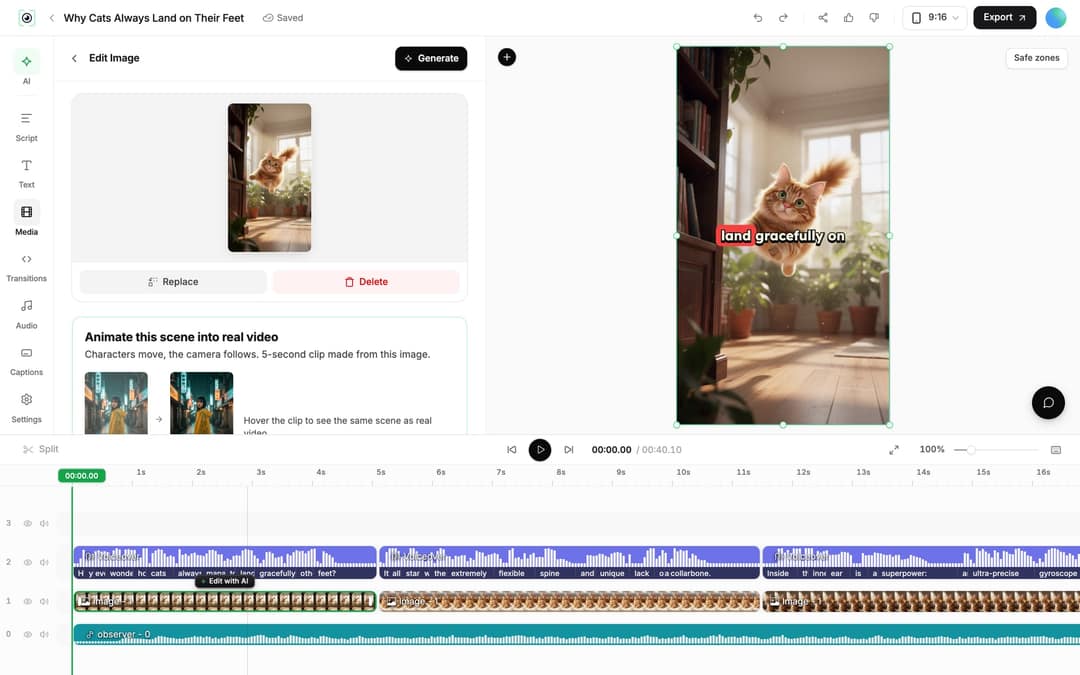
Add captions from the Captions panel so the story works with the sound off; the guide to adding captions in Revid covers styles and languages.
Step 7: Export, label and publish
Click Export (Export / Publish on free accounts). Revid exports in 720p, 1080p or 4K at 30 or 60 fps.
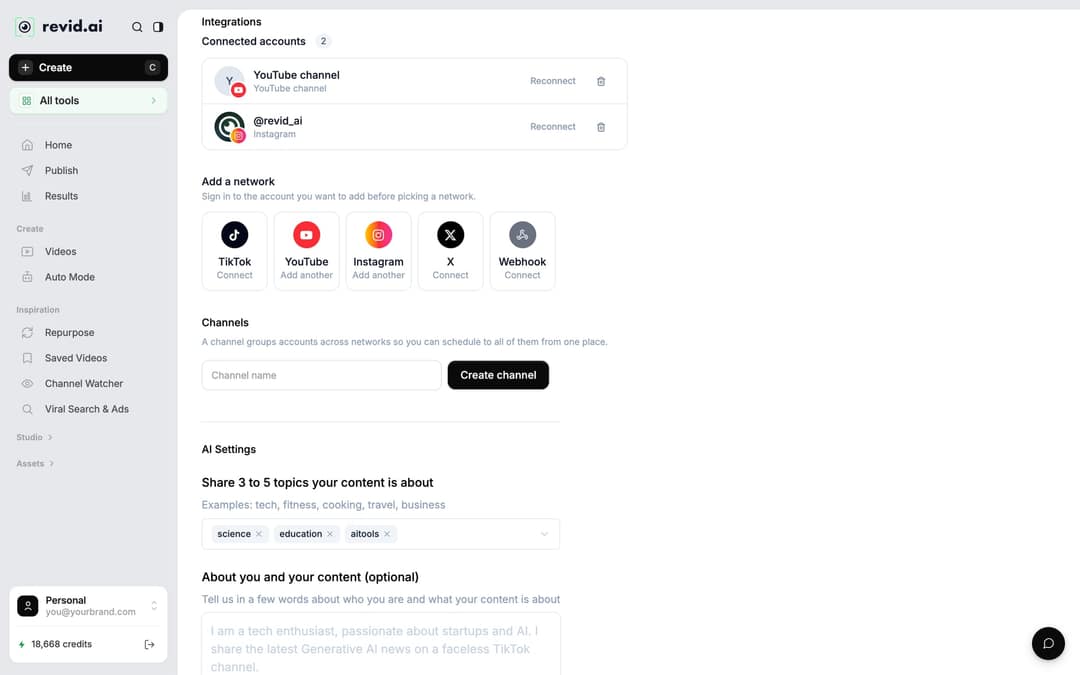
To post directly, connect your accounts once in Settings > Integrations (Add a network: TikTok, YouTube, Instagram, X or Webhook). Then use Publish on the project card or Export / Publish in the editor: the Publish Video dialog lets you post now or add the video to your queue, and Revid can publish and schedule it to TikTok, Instagram and YouTube.
Label realistic AI footage before you post
Cinematic AI scenes are usually realistic, so the platforms' disclosure rules apply:
- TikTok requires a label on AI-generated content with realistic images, audio or video, and says the label does not affect distribution if the video follows its Community Guidelines.
- YouTube requires the "AI use" setting in YouTube Studio for realistic AI content. Since May 2026 it labels undisclosed photorealistic AI automatically, and labels are permanent on content made with Veo.
- Instagram and Facebook require Meta's AI disclosure tool for photorealistic AI video and show an "AI info" label.
Disclosing on YouTube does not by itself limit reach or earnings; failing to disclose repeatedly can lead to removal or YPP suspension.
FAQ
Is Revid free for making cinematic videos?
Sign-up is free and new accounts get free credits, with no credit card. The AI video media type needs a subscription, so test your story with Animated AI images first; plans start at $39/month (Growth, 2,000 credits), and the pricing page has the current list.
Which AI model is best for a cinematic video?
No single model wins every shot. Start with one model for a short test, then switch only the scenes that look wrong to Seedance 2.5, MiniMax Hailuo H3, Wan 3.0 or Google Veo 3, since Revid lets you choose per scene.
Can I narrate a cinematic video with my own voice?
Yes. Upload your recording with the From a link or audio option to build a captioned video around it, or clone your voice (Elite plan and above) to use it as an AI voice.
Can I make the same cinematic video in another language?
Yes. Open the project card menu and choose Translate: the video translator keeps the edit, media, timing and captions, and you can keep the original voice or pick another. Revid offers voiceovers in 70+ languages.