How to Create Faceless Videos With AI for TikTok and YouTube (2026)
How to create faceless videos with AI step by step, which faceless format fits your content, the TikTok and YouTube rules that decide whether you get paid, and what the data says about faceless reach.
On this page
To create faceless videos with AI, pick a format that doesn't need your face (an AI voice-over on top of visuals, a screen recording, text on screen or animation), write a short script, let an AI tool generate the visuals, voice-over and captions, then export vertical (9:16, 1080x1920) and post. Tools like Revid run all of those steps from one prompt or link.
Skipping the camera doesn't cost you reach. In Revid's analysis of 176,367 TikToks with 1,000+ likes posted between October 2025 and October 2026, faceless videos had a median of 114K views and 17.4% passed 1 million views, against 67K and 12.7% for videos with one person on camera.
Faceless videos earned a median of 114K views, against 67K for videos with one person on camera, and passed 1M views 38% more often.
Source: Revid analysis of 176,367 TikToks with 1,000+ likes posted between Oct 1, 2025 and Oct 16, 2026 (61,203 creators)
Show the data
| Median views | Share that passed 1M views | |
|---|---|---|
| Animals | 147.4K | 24.1% |
| Faceless | 113.9K | 17.4% |
| Groups of people | 96.1K | 16% |
| Objects or products | 70.8K | 13.2% |
| One person on camera | 67.4K | 12.7% |
Two limits apply: the sample only holds TikToks that already passed 1,000 likes, and it shows what successful videos have in common, not what causes success (the faceless or on-camera tag comes from Revid's AI analysis of each video). The full viral TikTok study explains the method. Revid's larger faceless vs on-camera study of 2.4 million TikToks from all posting dates points the same way: a 199.4K median for faceless videos against 104.8K for person-focused ones, and 30% past 1 million against 22%.
What sinks most faceless channels is not the missing face. It's the template: YouTube refuses to monetize mass-produced AI videos, TikTok doesn't pay Creator Rewards on text-only posts, and narrating text you didn't write counts as reused content. The method below avoids all three.
How to create faceless videos with AI, step by step
- Pick one niche and one format. Choose a topic you can make dozens of videos about and one format from the table in the next section. Switching formats every week makes it hard to learn what works.
- Start from a video that already works. Search viral faceless videos in your niche (the faceless TikTok video finder lists them) and note the hook, the length and how often the picture changes. Borrow the structure, never the content.
- Write a short script. The first line states the payoff or the problem ("This setting is draining your battery"). Then one idea per sentence and one sentence per scene. Add something only you bring: a number you checked, an opinion, a comparison. That is what separates a channel from a template.
- Generate the visuals. Give each sentence a scene: stock footage, AI images, AI video clips, a screen recording or an animation. Keep one visual style across the whole video.
- Add the voice-over and captions. An AI voice or your own recorded voice both keep the video faceless. Always add captions with an auto caption generator, because many people scroll with the sound off.
- Export vertical and publish. TikTok recommends 9:16 at 1080x1920 pixels, and the same file works for Instagram Reels and YouTube Shorts. If the video contains realistic AI footage, turn on the AI label when you post (rules below).
Prompt to try
Make a 45-second faceless explainer titled "This phone setting is draining your battery." Open with that line as the hook, then show three settings to turn off, one per scene, with clean stock footage of phone screens, a calm AI voice-over and bold captions.
Which faceless video format should you choose?
The format decides how much work each video takes and whether it can earn money. Match it to what you know.
| Format | How it's made with AI | Best for | Watch out for |
|---|---|---|---|
| AI voice-over + visuals | Script, AI voice, stock or AI-generated scenes | Explainers, stories, history, facts | Generic scripts sound like every other channel |
| Screen recording | Record your screen, add an AI voice and captions | Software, apps, games, how-tos | Dead time while menus load: cut it |
| Text on screen | Text, music and a background clip | Tips, quotes, lists | TikTok Creator Rewards doesn't pay on text-only or photo-only posts |
| Animation or cartoon | AI generates characters and scenes | Stories, kids' content, explainers | Characters must stay consistent between scenes |
| Hands or POV footage | You film hands or your point of view; AI adds voice and captions | Cooking, crafts, unboxing, product demos | Needs real footage, so more time per video |
| Story over gameplay | An AI voice reads a story over game footage | Reddit-style stories | Reading text you didn't write is reused content on YouTube |
| AI avatar | A synthetic presenter reads your script | Training, explainers | YouTube won't monetize AI personas posing as experts on health, legal, financial or political topics |
In Revid's TikTok data, faceless videos beat on-camera ones inside the same format. Faceless tutorials had a 156K median (22.1% past 1 million) against 52K (10%) for on-camera tutorials, and faceless comedy reached 327K against 136K. Animal videos, a classic faceless niche, had a 147K median with 24.1% past 1 million.
Faceless tutorials earned about 3x the median views of on-camera tutorials (156K vs 52K).
Source: Revid analysis of 176,367 TikToks with 1,000+ likes posted between Oct 1, 2025 and Oct 16, 2026 (61,203 creators)
Show the data
| Median views | Share that passed 1M views | |
|---|---|---|
| Faceless tutorials | 155.6K | 22.1% |
| Product or object tutorials | 80.7K | 14.9% |
| On-camera tutorials | 52.5K | 10% |
| Faceless storytelling | 72.7K | 13.3% |
| On-camera storytelling | 64.4K | 11.7% |
| Faceless comedy | 326.7K | 26.4% |
| On-camera comedy | 135.5K | 20.7% |
Shooting style tells the same story: POV videos had a 107K median and screen recordings 91K, against 48K for selfie-style videos. If you teach software, a screen recording is not the lazy option; it's one of the stronger ones. For niche ideas with an earning angle, see these faceless channel ideas that earn.
How to create videos without showing your face (with or without AI)
You don't need AI for every faceless video. These setups keep you off camera with a phone and a free editor:
- Screen recording: your screen plus your voice, for anything taught on a computer or phone.
- Hands only: a phone above the table pointing down, for cooking, crafts, drawing or unboxing.
- POV: the camera at chest or eye level showing what you see.
- B-roll with voice-over: footage of places, objects or your workspace, narrated.
- Back to camera or silhouette: you appear, your face doesn't.
AI then handles the parts that take the longest: the script, the voice, the captions and, when you have no footage, the visuals themselves.
How to make faceless TikTok videos
TikTok recommends 9:16 at 1080x1920. Uploads can run up to 60 minutes and the in-app camera records up to 10, but a faceless TikTok rarely needs that much.
Talk less than you think. In Revid's data, TikToks with under 40 characters of speech (one short line) had a 123K median and 20.2% passed 1 million, against 68K and 11.9% for videos with speech throughout. Silent videos sat at 73K. When your format allows it, let the visuals carry the video and use the voice for the hook and the key line.
Use 3 or 4 hashtags and a short caption. Posts with 4 hashtags had a 77K median and posts with 3 had 75K, while 9 or more dropped to 16K. Captions of 41 to 80 characters did best (67K median); posts with no caption had 36K.
Label realistic AI. TikTok requires creators to label AI-generated content that contains realistic images, audio or video, and may auto-label uploads carrying C2PA Content Credentials. TikTok says the label alone doesn't affect distribution when the video follows its Community Guidelines.
Know what earns. The Creator Rewards Program needs a Personal account, age 18+, 10,000 followers and 100,000 video views in the last 30 days, and it only pays on videos at least one minute long. Photo-only, text-only, looping and lightly modified reposts don't count as original, so a text slideshow can grow an account but won't earn rewards.
Faceless videos on YouTube: what decides whether you get paid
Vertical or square videos up to 3 minutes long count as Shorts. A Short longer than one minute with an active Content ID claim is blocked worldwide, so use music you have the rights to.
YouTube allows AI in monetized videos when the result shows your creative vision and gives educational or entertainment value (AI to edit a script or create a background visual is fine). It does not monetize:
- AI videos built on generic templates that look mass-produced, without your own insight
- compilations of unrelated AI clips made to shock, or realistic visuals that fake events
- AI personas presented as human experts giving health, legal, financial or political advice
- videos that only read out material you didn't write, such as website text or news feeds
On July 15, 2025, YouTube renamed its repetitious content policy to "inauthentic content" to make clear it covers repetitive, mass-produced videos.
Disclosure is a separate rule. Realistic AI content (a real person appearing to say something they didn't, a realistic scene that never happened) must be disclosed with the AI use setting in YouTube Studio. AI-written scripts, captions, thumbnails and a clone of your own voice don't need disclosure. Since May 2026, YouTube also labels undisclosed photorealistic AI automatically.
What AI tools do faceless creators use?
A faceless video needs three jobs done: a script, visuals with a voice, and editing and publishing. Some tools do one job; some do all three.
| Tool | What it does | Pick it if |
|---|---|---|
| Revid | Script, scene visuals (stock, AI images, AI video from Seedance 2.5, MiniMax Hailuo, Wan 3.0 and Veo 3), voice-over in 70+ languages, captions, music, timeline editor, direct publishing to TikTok, Instagram and YouTube | You want finished shorts from an idea or a link, on a schedule |
| CapCut | Manual editor with a free 1080p export, auto-captions and trend templates | You edit screen recordings or footage you filmed (Revid vs CapCut) |
| Synthesia | AI avatar presenters in 140+ languages, slide-based workflow | You need a presenter for training or explainers (Revid vs Synthesia) |
| Fliki | Text to video with 2,000+ voices in 80+ languages over stock visuals | Voice variety matters more than visuals |
| Lumen5 | Turns articles into text-and-image videos | You repurpose blog posts |
| OpusClip | Cuts long videos into captioned short clips | You already record podcasts or streams |
A simple rule: if you have no footage, use a generator; if you have footage, use an editor or a clipping tool.
How to make a faceless video with Revid
Revid's faceless video generator turns an idea, a script or a link into a finished vertical video:
- Enter a prompt or paste your script, or start from a link (a blog post, a Reddit thread, a YouTube video).
- Choose a voice (1,000+ AI voices in 70+ languages) and a caption style.
- Revid writes the script and generates the scenes, voice-over, synced captions and music.
- Change any scene, line or caption in the timeline editor.
- Export in 720p, 1080p or 4K, or publish and schedule directly to TikTok, Instagram and YouTube.
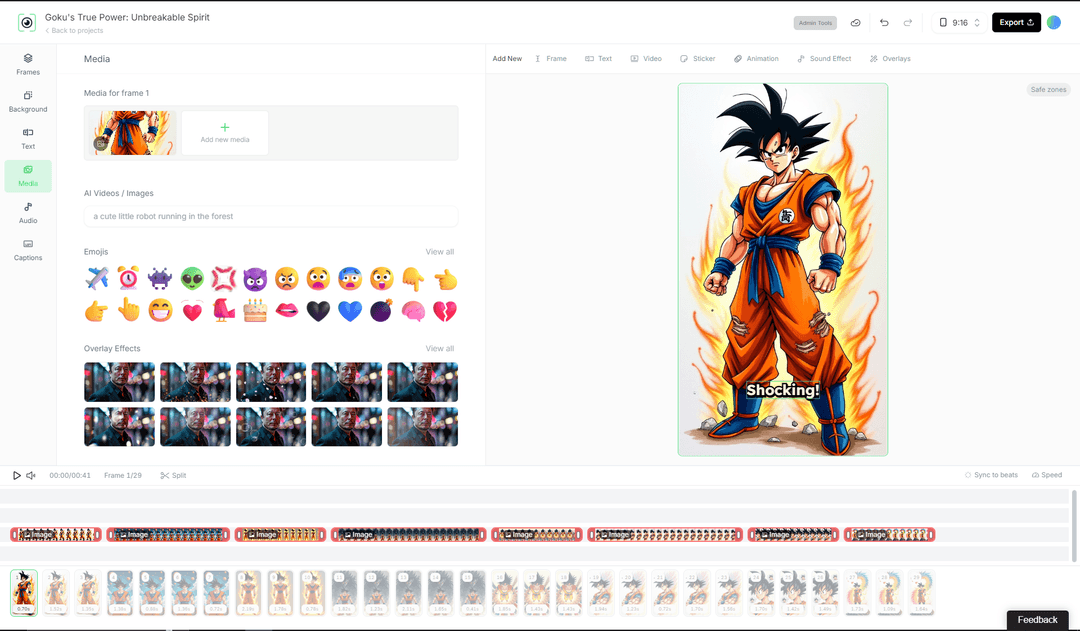
To start from proof instead of a blank prompt, search Revid's library of about 2.77 million videos, open a faceless video that performed in your niche and choose "Same energy, new script" to get an original video with the same structure. To keep a daily pace, Auto-Mode workers create a fresh video every day from a prompt or a content source. Sign-up is free and new accounts get free credits to try video creation, no credit card needed; regular creation then uses the monthly credits of a paid plan, from $39/month on Revid's Growth plan.
Prompt to try
Create a 60-second YouTube Short on "The Roman trick that kept concrete standing for 2,000 years." Start with the payoff in the first line, change the visual every sentence with historical AI images, and end on one surprising fact with captions throughout.
Tips that keep faceless videos watched
- Lead with the payoff. Without a face, the first line and the first image do all the work of stopping the scroll.
- Change the picture often. A static frame with a voice over it is the easiest video to swipe past.
- Keep one voice. A recognizable voice is your face on a faceless channel. On Revid's Elite plan you can clone your own voice, and YouTube doesn't require disclosure for that.
- Batch your production. Write a week of scripts in one sitting, then generate and schedule them together.
FAQ
Can you make money with faceless videos?
Yes, on the same terms as any creator. YouTube ad revenue needs 1,000 subscribers plus 4,000 watch hours in 12 months or 10 million Shorts views in 90 days (from February 1, 2027, new applicants need 8,000 hours or 20 million Shorts views), and TikTok Creator Rewards needs 10,000 followers, 100,000 views in 30 days and videos of at least one minute. Template-made or reused content doesn't qualify on either platform.
Do I have to label AI-generated faceless videos?
Only when the AI content looks realistic. TikTok and YouTube both require a label for realistic AI images, audio or video, and both say the label alone doesn't reduce reach; AI-written scripts and non-realistic animation don't need disclosure on YouTube.
How long should a faceless TikTok be?
Length matters less than the hook: in Revid's 12-month TikTok study, every length from under 15 seconds to 10 minutes had a median between 58K and 76K views. If you want Creator Rewards, go past one minute, since shorter videos don't earn.
Can I make faceless videos with AI for free?
Partly. CapCut's free tier exports at 1080p with auto-captions if you bring the footage. Revid sign-up is free, with free credits to try video creation and no credit card needed, plus search of its viral video library; regular creation then uses the monthly credits of a paid plan, from $39/month.
Is an AI avatar video still a faceless video?
Yes, because your own face never appears. Avatar tools like Synthesia (and Revid's talking avatars) work well for explainers, but YouTube won't monetize AI personas presented as human experts on health, legal, financial or political topics.