How to Make Money on YouTube Without Making Videos: 3 Ways (2026)
You can earn from YouTube without filming: run an AI-made faceless channel, sell through creators, or sell video services. Here are the YPP thresholds, AI rules and workflows that keep it monetizable.
On this page
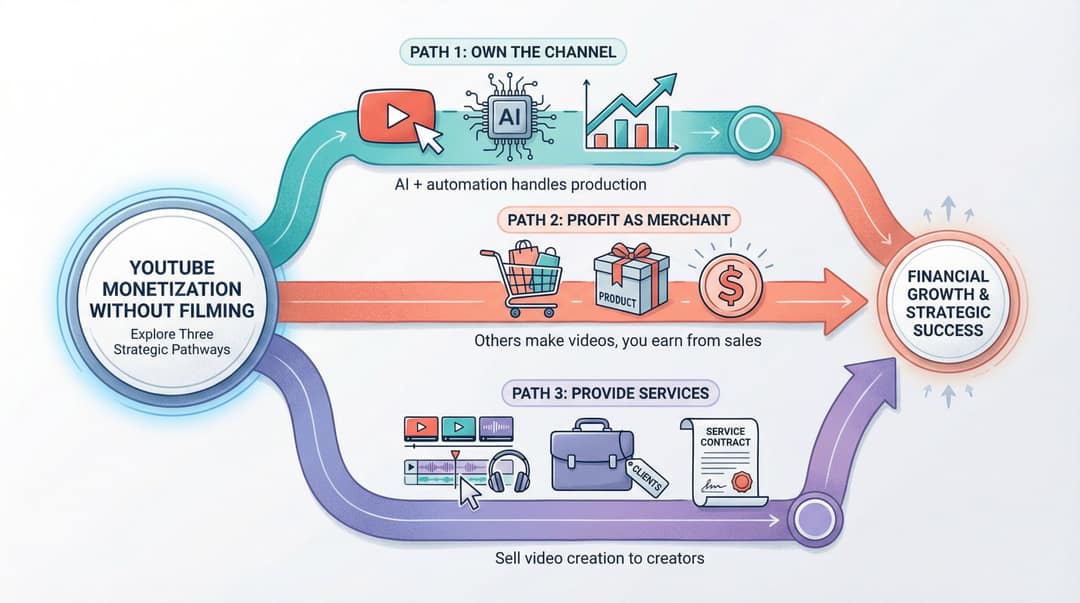
You can make money on YouTube without filming or editing videos yourself, in three ways: run a faceless channel where AI writes, voices and edits the videos; earn from products other creators feature; or sell video production to channels. Ad revenue needs 1,000 subscribers plus 4,000 watch hours or 10 million Shorts views.
What most guides skip is that Shorts ad money is thin and the bar is rising. AIR Media-Tech's September 2026 analysis of 274 channels found that most channels need 11,000 to 34,000 Shorts views to earn what 1,000 long-form views pay. From February 1, 2027, earning Shorts ad revenue in a given month will also require 10 million qualified Shorts views in the last 90 days. A faceless channel that lives only on Shorts ads is the weakest version of this plan. The rest of this guide covers the stronger ones.
The 3 ways to make money on YouTube without making videos yourself
You still need videos on YouTube to earn from YouTube. What you can skip is the camera, the timeline editing and starting every upload from scratch. That leaves three models:
| Model | What you do | Where the money comes from | Needs your own audience? |
|---|---|---|---|
| Faceless channel | Choose the niche and ideas, direct AI production, review every video | YPP ad revenue, fan funding, affiliate links, your own products | Yes |
| Merchant or brand | Give creators your product, tracking links and talking points | Sales from creator videos and YouTube Shopping | No |
| Service provider | Script, produce or manage channels for clients | Client fees | No |
A simple decision rule: if you know a topic well and can publish for 90 days before seeing money, run a faceless channel. If you already sell something, let creators make the videos and pay them on results. If you need income this month, sell production as a service, because clients pay before any algorithm does.
How much money can you make on YouTube without filming?
YouTube defines RPM as what you earn per 1,000 views after its revenue share, and it publishes no standard RPM. Your rate depends on niche, audience country and how many ads actually run. The math itself is simple: earnings equal monetized views divided by 1,000, times your RPM.
| Monetized views | RPM (hypothetical) | Your earnings |
|---|---|---|
| 500,000 | $5 | $2,500 |
Shorts work very differently. In AIR Media-Tech's 2026 partner data, Shorts RPM was 3% to 14% of long-form RPM in almost every niche, and US Shorts RPM was $0.328 per 1,000 views (versus $0.166 for the UK). For most of the 274 channels studied, Shorts brought 1% to 35% of total views but less than 2% of revenue. More sourced figures are on our YouTube Shorts statistics page, and the payout mechanics are in how YouTube Shorts pay works.
How do you make $10,000 a month on YouTube without making videos?
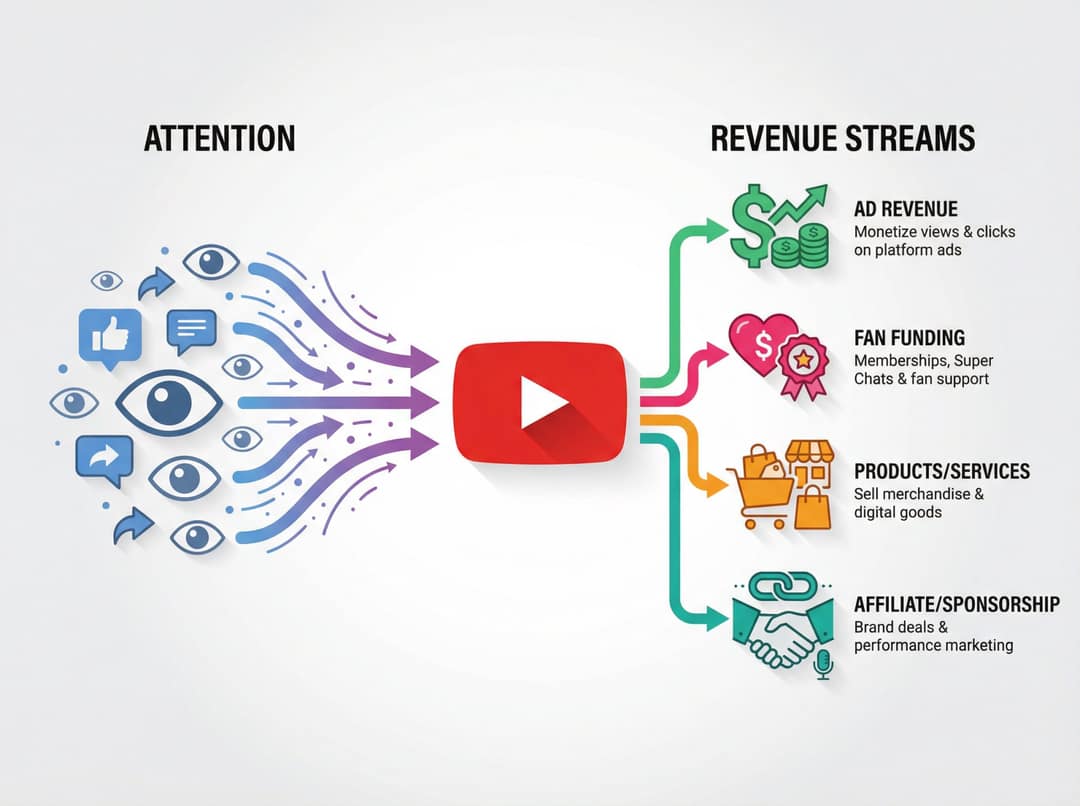
From ads alone, $10,000 at that hypothetical $5 RPM takes four times the 500,000 monetized long-form views in the example, every month. Few faceless channels reach that on ads. Channels that earn that much usually treat YouTube as the top of a funnel and stack several streams:
- Affiliate links for tools or products the videos already discuss
- A digital product: templates, a course, a paid newsletter
- Sponsorships once view counts are steady
- Services sold to the audience, such as consulting or done-for-you work
Most of these can pay before you qualify for ads. The options are covered in ways to earn without AdSense.
YouTube Partner Program requirements in 2026 (and what changes in 2027)
None of YouTube's monetization rules require showing your face or using a camera. They require reaching thresholds and following policy. YPP has two tiers, and YouTube's Partner Program explainer walks through both.
| Tier | Requirements today | New applicants from February 1, 2027 | What you get |
|---|---|---|---|
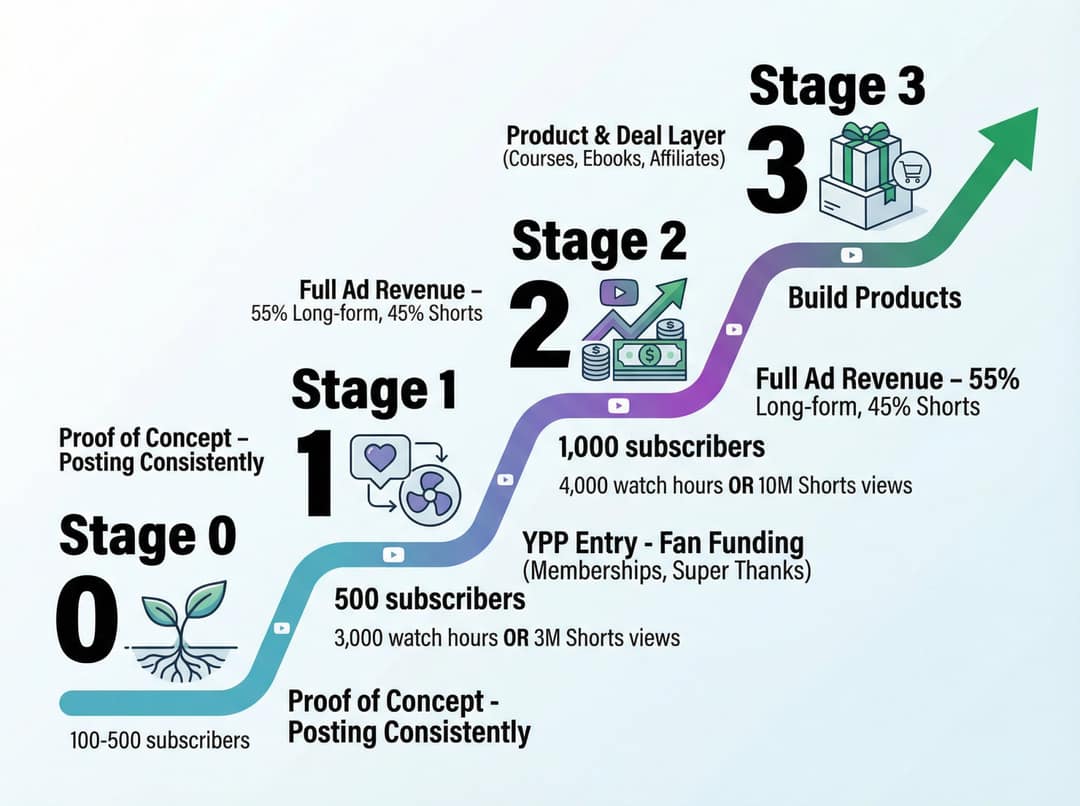
| Fan funding | 500 subscribers, 3 public uploads in the last 90 days, and 3,000 qualified watch hours in 12 months or 3 million qualified Shorts views in 90 days | Unchanged | Memberships, Super Chat, Super Thanks, YouTube Shopping, Creator Partnerships. No ad revenue |
| Ad revenue | 1,000 subscribers and 4,000 qualified watch hours in 12 months or 10 million qualified Shorts views in 90 days | 1,000 subscribers and 8,000 qualified watch hours in 365 days or 20 million qualified Shorts views in 90 days | Everything above, plus about 55% of ad revenue on long-form and 45% of your Shorts Creator Pool allocation |
The rules that trip up faceless channels:
- Shorts watch hours don't count. Hours from the Shorts Feed are excluded from the 4,000-hour threshold, so a Shorts-only channel has to qualify through Shorts views.
- From February 1, 2027, earning Shorts ad and Premium revenue in a month needs 10 million qualified Shorts views in the last 90 days. Channels below that stay in YPP and keep long-form earnings.
- Current members must accept the updated terms in YouTube Studio by January 31, 2027, or stop earning from the affected features.
- Your public view count is not your YPP number. Since August 24, 2026, YouTube counts a view the moment playback starts, but eligibility uses qualified views and earnings use engaged views.
- Joining also requires an eligible country, no active Community Guidelines strikes, 2-Step Verification, advanced features access and a linked AdSense account. Review typically takes about a month.
Check the live terms on the official YouTube Partner Program page before you plan around a threshold.
Can you monetize AI-generated videos on YouTube?
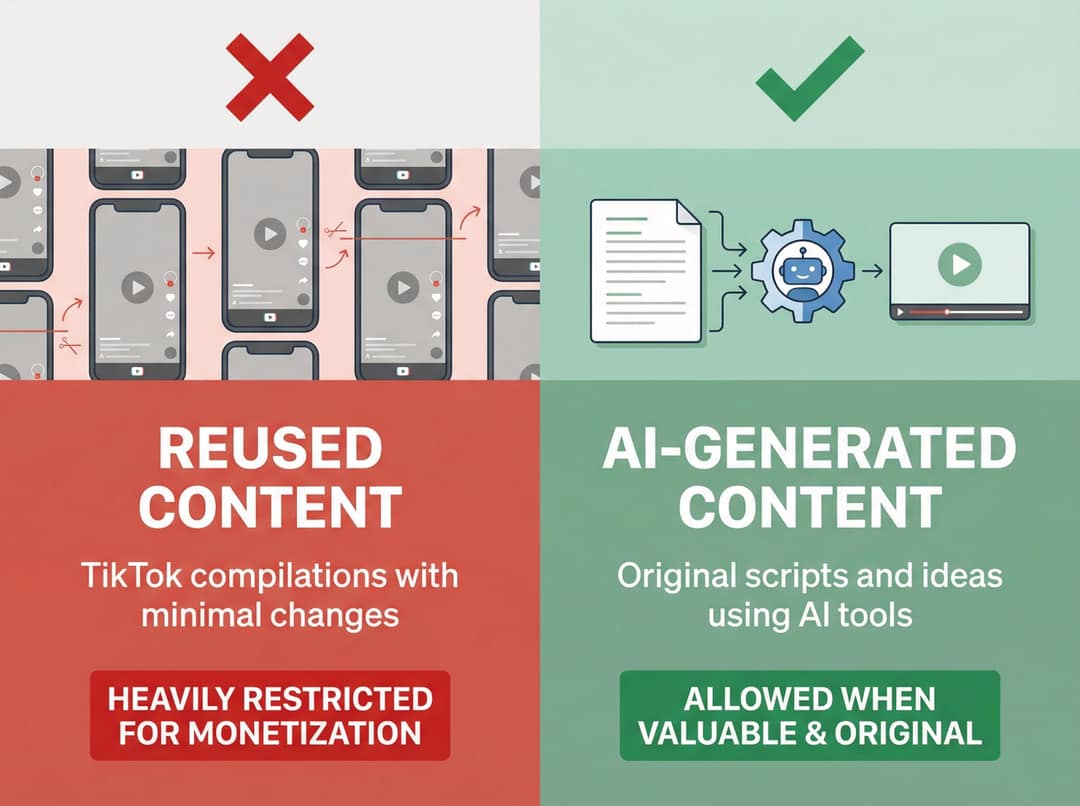
Yes. YouTube allows AI and automated tools in monetized videos when the final video shows your creative vision and gives educational or entertainment value, for example AI that edits your script or creates a background visual. What it refuses to pay for is AI used as a factory.
On July 15, 2025, YouTube renamed its repetitious content policy to inauthentic content, clarifying that it covers repetitive or mass-produced videos. The current channel monetization policies draw the line like this:
| Monetizable | Not monetizable |
|---|---|
| AI-assisted script, voice-over and visuals built around your own idea or explanation | Generic AI videos from unoriginal templates that look mass-produced |
| A series with a consistent format where each video makes a distinct point | Unrelated or inconsistent AI clips stitched together to shock, or realistic visuals that fake events |
| Your own cloned voice reading your own script | AI personas presented as human experts giving health, legal, financial or political advice |
| Your own blog post turned into a narrated video | Videos that only read out text you didn't write, such as website copy or news feeds |
| Commentary that adds analysis to clips | Mostly non-verbal reactions to someone else's content |
Press coverage of AI slop channels on YouTube shows what YouTube is reacting to: surreal, low-effort Shorts produced at volume. YouTube's FAQ on reused content adds that reused material needs meaningful differences, such as commentary, editing or educational value, before it can earn.
Do you have to label AI videos on YouTube?
Only realistic ones. YouTube requires you to disclose realistic AI content with the AI use setting in YouTube Studio, for example a real person appearing to say something they didn't, or a realistic scene that never happened. AI-written scripts, captions, thumbnails, non-realistic animation and cloning your own voice need no disclosure. Disclosing does not by itself limit reach or earnings, while repeatedly failing to disclose risks labels, removal or YPP suspension. Since May 2026, YouTube also labels undisclosed photorealistic AI automatically.
Can you use AI avatars, face swaps or cloned voices?
Only of people who agreed. YouTube is rolling out likeness detection for creators so they can flag AI clones of their face or voice. Clone your own voice, use generic avatars, and treat celebrity likeness as off limits. Revid offers talking avatars, face swap and voice cloning (on Elite and above), and you are responsible for having the rights to any face or voice you use.
What is the difference between reused content, copyright and fair use?
Three ideas get blurred online:
- Reused content is YouTube's monetization term for videos made mostly of someone else's material with little change, like compilations. It is heavily restricted for monetization even when you have permission.
- Copyright infringement is a legal issue: using protected material without permission, which can bring takedowns or strikes.
- Fair use is a legal defense, not a feature. YouTube says only courts can decide fair use, not Content ID.
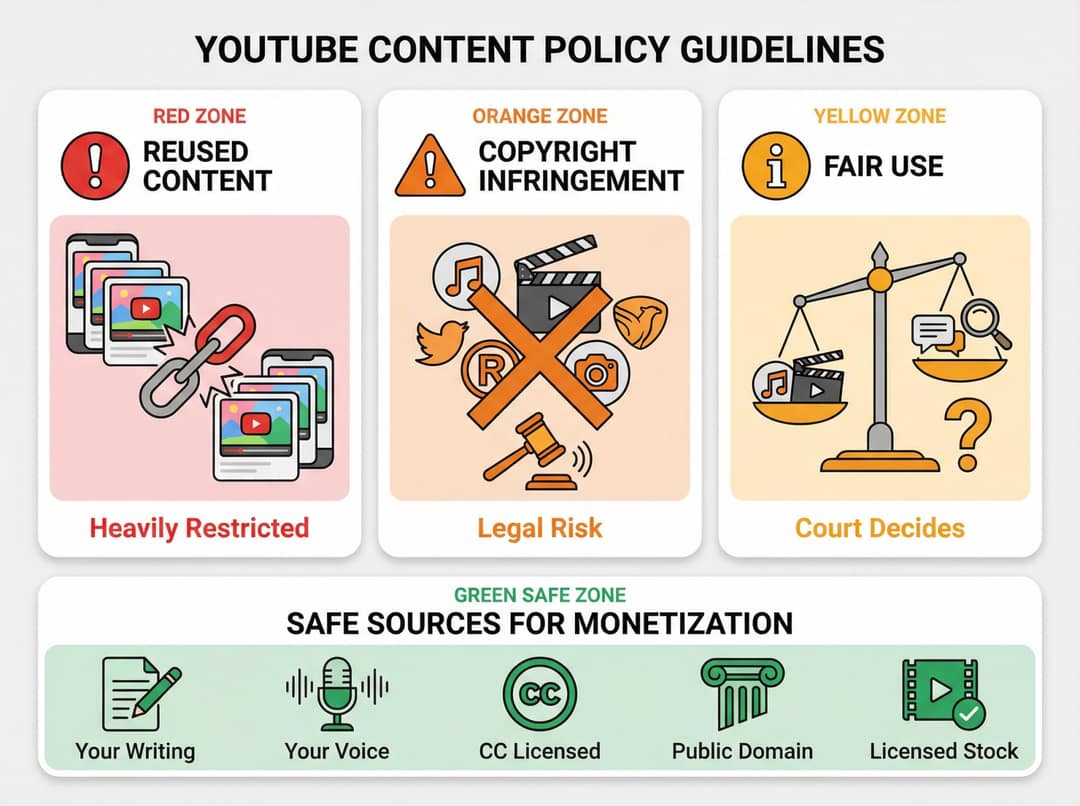
Sources that are safe to build a monetized channel on: your own writing and voice, content you commissioned or bought rights to, public domain material, Creative Commons work that allows commercial reuse, and correctly licensed stock. Even then, each video still needs your own angle to pass the inauthentic content test.
Prompt to try
Create a 45-second faceless YouTube Short for beginners explaining why phone batteries drain faster in cold weather. Open with the hook "Your phone isn't broken, it's just cold", then give one clear explanation and one practical tip. Use clean motion graphics, a calm explanatory voice and bold synced captions in 9:16.
Best niches for a faceless YouTube channel in 2026
The niche decides how easy it is to make videos without your face and what you can sell behind them. Pick a topic where people have ongoing questions, where products or services exist to recommend, and where you could make hundreds of short videos without running out of angles.
| Niche | Faceless format | How it earns beyond ads | Watch out for |
|---|---|---|---|
| Education and how-to | Screen recordings, motion graphics, diagrams | Courses, templates, affiliate tools | Explaining without a specific example |
| Software and AI tools | Screen recordings plus voice-over | SaaS affiliate programs, sponsorships | Thin reviews that only read feature lists |
| Finance and business | Charts, text animation, stock footage | Affiliates, newsletters, sponsorships | AI personas posing as human experts giving financial advice are not monetizable |
| History and stories | Maps, archival images, stylized AI scenes | Sponsorships, long-form watch hours | Incoherent AI clips that fake events |
| Gaming commentary | Gameplay plus voice-over | Merch, affiliate links | Mostly footage with little commentary |
| Relaxation and ambience | Simple loops with music | Long-form watch hours | Near-identical uploads that read as mass-produced |
Faceless formats also hold their own with audiences. In Revid's analysis of 176,367 TikToks with 1,000+ likes posted between October 2025 and October 2026, faceless videos had a median of 114K views and 17.4% passed 1M views, against 67K and 12.7% for one person on camera. Faceless tutorials reached a 156K median versus 52K for on-camera tutorials. This is TikTok data, not YouTube, and the sample only includes videos that already got 1,000+ likes, so it shows what successful videos have in common rather than proving cause. The method is in our study of what makes a TikTok go viral.
Faceless videos earned a median of 114K views, against 67K for videos with one person on camera, and passed 1M views 38% more often.
Source: Revid analysis of 176,367 TikToks with 1,000+ likes posted between Oct 1, 2025 and Oct 16, 2026 (61,203 creators)
Show the data
| Median views | Share that passed 1M views | |
|---|---|---|
| Animals | 147.4K | 24.1% |
| Faceless | 113.9K | 17.4% |
| Groups of people | 96.1K | 16% |
| Objects or products | 70.8K | 13.2% |
| One person on camera | 67.4K | 12.7% |
If you're stuck, choose "explain one thing I already understand to beginners" over the most saturated trend you saw last week. Trend channels are the first to die when policies tighten. For specific angles, see these faceless YouTube channel ideas.
4 workflows to make YouTube videos without filming
Each workflow has an input you already have, a part AI does, and a part you still decide. That last part is what keeps the channel monetizable.
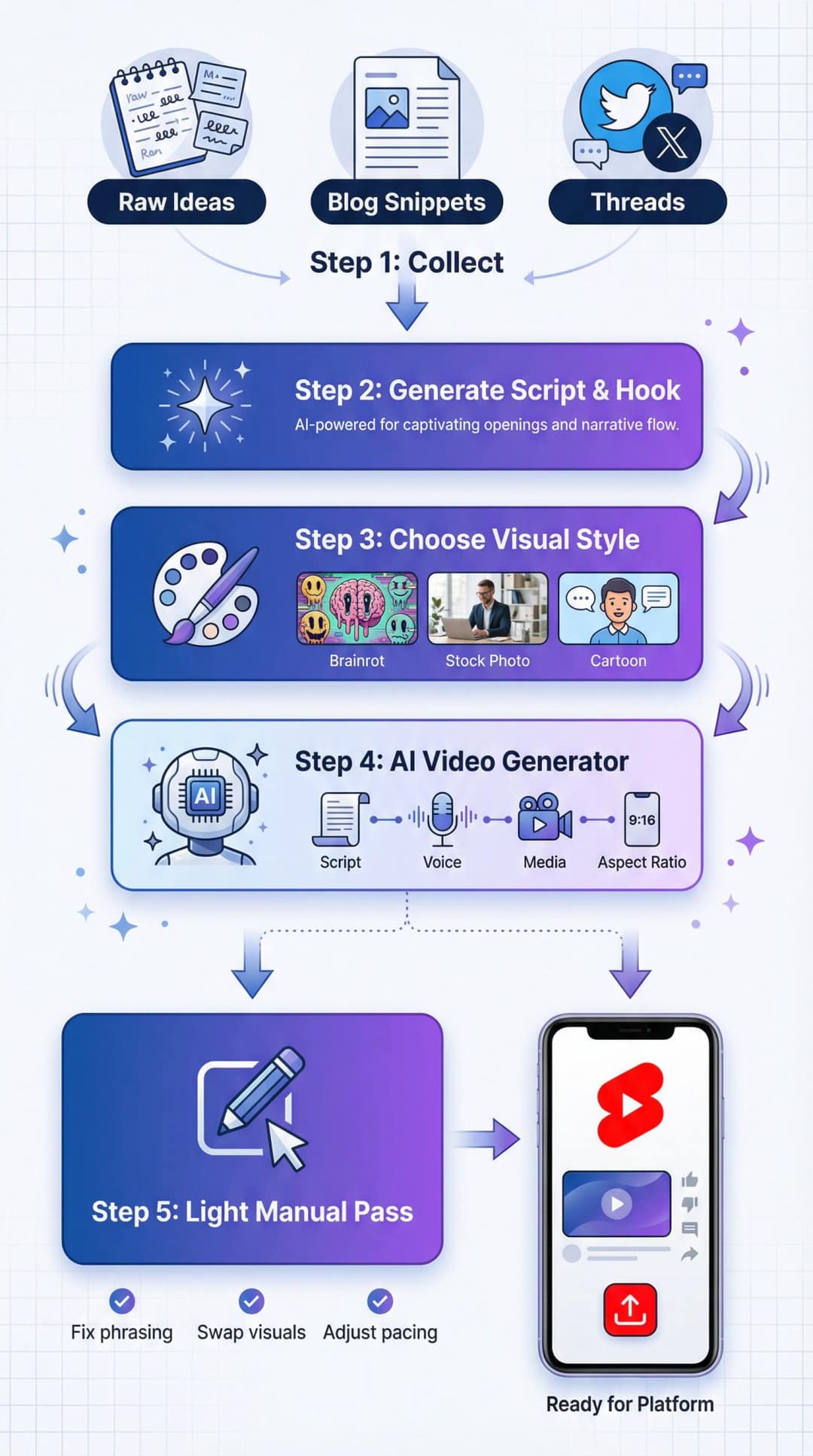
1. Turn your ideas into Shorts
Best for writers and educators who prefer typing to talking.
- Keep one idea per note: one insight, one story or one common mistake.
- Write a 20 to 60-second script with the hook in the first 1 to 3 seconds and a single payoff. A YouTube Shorts script generator gives you a draft; rewrite it with your own specifics. Hooks that work as a starting point: "Most people get X wrong because..." or "The one thing nobody tells you about Y..."
- Pick one visual style and keep it: clean stock and typography, motion graphics, cartoon scenes or gameplay backgrounds.
- Generate the video. In Revid's faceless video generator, paste the script, choose a voice (1,000+ voices in 70+ languages) and the visuals: stock footage, AI images or AI video from Seedance 2.5, MiniMax Hailuo H3, Wan 3.0 or Google Veo 3, in 9:16 with synced captions and music.
- Do a human pass in the timeline editor: fix mispronounced words, swap weak scenes, tighten the pacing.
- Publish or schedule it to YouTube directly, with a title that matches what people actually search.
2. Turn your own blog posts into Shorts
Best for anyone who already writes articles or newsletters. One 1,000 to 3,000-word post can become 3 to 10 Shorts.
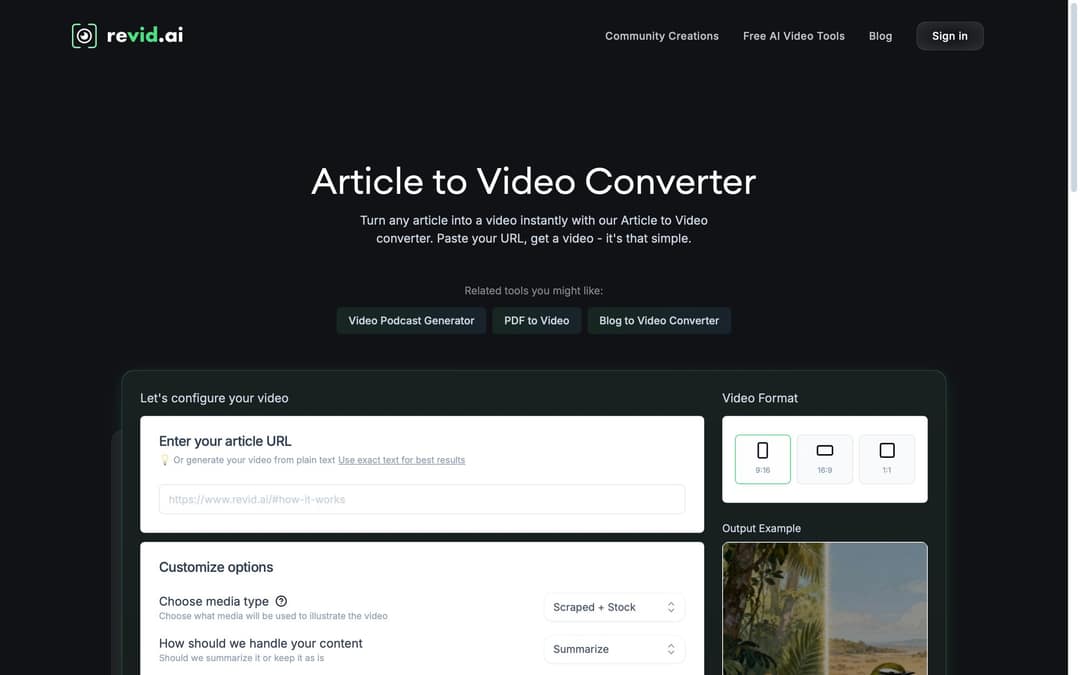
- Paste the URL or text into Revid's article to video tool. It extracts the key points and generates a narrated video.
- Split it: one Short per key idea, or a Part 1, Part 2, Part 3 series.
- Keep the same voice, caption style and visual look so the Shorts read as one series.
- Use it only on writing you own. Narrating someone else's article is the reused content case YouTube refuses to monetize.
3. Turn podcasts and long videos into clips
Best for podcasters, coaches and anyone who already records audio. Revid's audio to video tool turns an MP3, WAV or M4A file into a captioned video, and its YouTube clip maker cuts a long YouTube video into vertical Shorts. Pick the quote moments yourself, open each clip with a one-line hook, and point viewers to the full episode. One episode can supply a week of Shorts, and you never film anything.
4. Automate a daily baseline, then review it
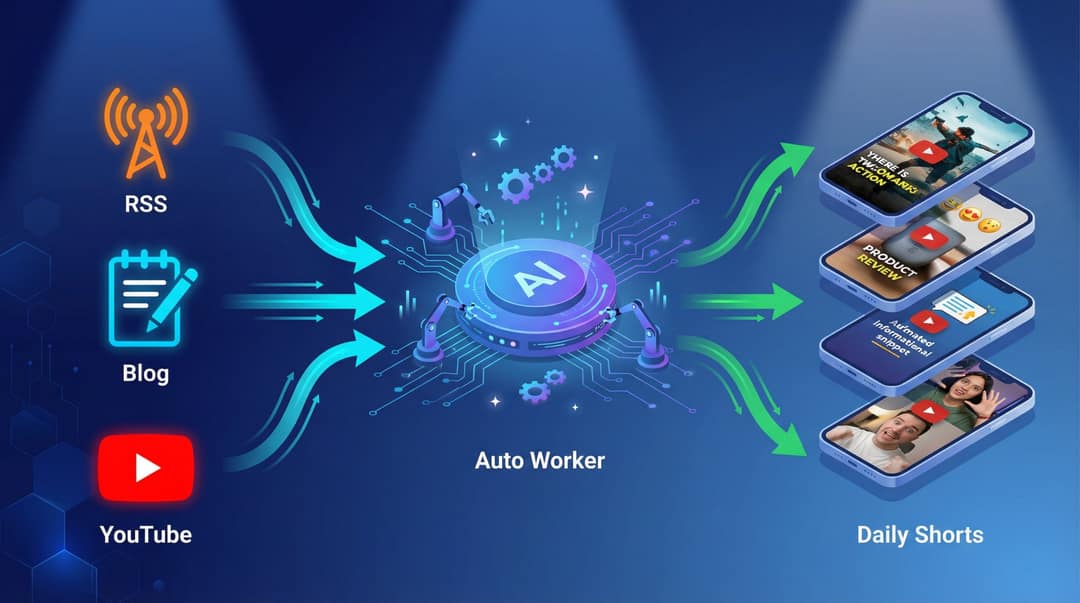
Best for people with a content library or a clear niche who want to post every day. Revid's automated video creation runs Auto-Mode workers that create a fresh video every day from a prompt or a content source such as a blog or YouTube channel (3 workers on Growth, 5 on Elite, 10 on Ultra). A Search and Remix worker can also pick a high-engagement reference from Revid's library of about 2.77 million short-form videos and generate an original video on the same structure, so you start from formats audiences already watch.
The guardrail is non-negotiable under the inauthentic content policy: review drafts before they publish, reject anything repetitive, and rotate hooks and layouts. Let automation hold the baseline schedule and spend your own time on the few videos with the strongest ideas. Sign-up is free and includes free credits to try video creation, and plans start at $39/month (2,000 credits).
How do creators monetize AI videos on YouTube, TikTok and Instagram?
The same faceless video can earn on several platforms, but each has its own payout program and originality rules.
| Platform | Built-in payout | Rules that matter for AI and faceless videos |
|---|---|---|
| YouTube Shorts | Shorts revenue sharing: 45% of your Creator Pool allocation | 10 million qualified Shorts views in 90 days to join through Shorts; Shorts over one minute with an active Content ID claim are blocked and can't earn |
| TikTok | Creator Rewards Program, paid per qualified For You views | 18+, 10,000 followers, 100,000 views in the last 30 days, Personal account, videos at least one minute long; looping, photo-only and text-only videos don't count as original; label realistic AI content (the label doesn't reduce distribution) |
| Varies by account; check the tools in your professional dashboard | Disclose photorealistic AI video or realistic audio; Meta shows an AI info label | |
| Content Monetization, invite-only | Since March 2026, reels that only narrate what's on screen or stitch clips are treated as unoriginal and deprioritized |
On every platform, the payout programs reward watch time from original videos, and the bigger money still comes from what the videos sell: affiliate links, products and sponsorships.
Try the 3-mistakes format
Make a 50-second faceless Short titled "3 mistakes beginners make when starting to run". Hook in the first 2 seconds with "Mistake number one is why your knees hurt", then cover each mistake with a quick fix. Use energetic stock footage of runners, a friendly coach-style voice and large captions.
A 90-day plan to build a monetizable faceless channel
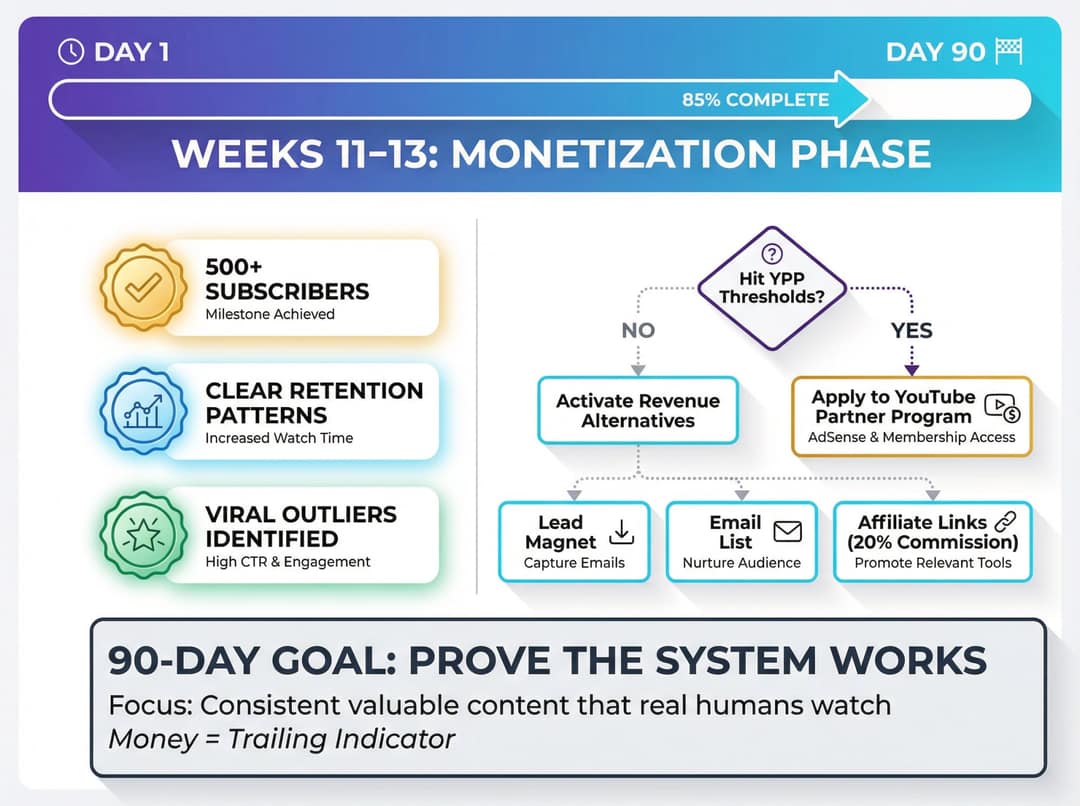
For 90 days you're not trying to make money. You're proving you can publish useful faceless videos on schedule that real people watch. Money follows that.
Weeks 1 to 2: niche and setup. Commit to one niche and define 3 formats, for example a 60-second concept breakdown, a 3-mistakes video and a myth-versus-reality video. Set up channel branding, pick 1 or 2 voices, one caption style and one visual style.
Weeks 3 to 6: volume and feedback. Publish 30 to 50 Shorts. After every 10, open the retention graph in YouTube Studio, find where viewers swipe away, and change the scripts and openings, not just the visuals.
Weeks 7 to 10: double down. Take your top 5 Shorts and make follow-ups: a Part 2, a different angle, the next question viewers asked in the comments. Add one 5 to 12-minute long-form video a week on your best topic, since long-form watch hours count toward the 4,000-hour threshold and Shorts Feed hours don't.
Weeks 11 to 13: monetize. Apply to YPP if you hit a threshold. If not, add income that doesn't wait for YouTube: a free lead magnet in the description, an email list, and affiliate links for tools you already talk about.
How to make money from YouTube without your own channel
As a brand or merchant
If you sell a product, you don't need to make videos at all. Run an affiliate program, give creators in your niche free access, tracking links and a few angles that work, and pay on results. If you have an online store, connect it to YouTube Shopping so creators can tag your products. If you want your own product videos anyway, AI product video tools can build demos from your product page without a shoot.
The reverse works too: if you'd rather promote tools than build an audience for your own products, Revid's affiliate program pays 20% of every payment for life to people who refer customers.
As a video service provider
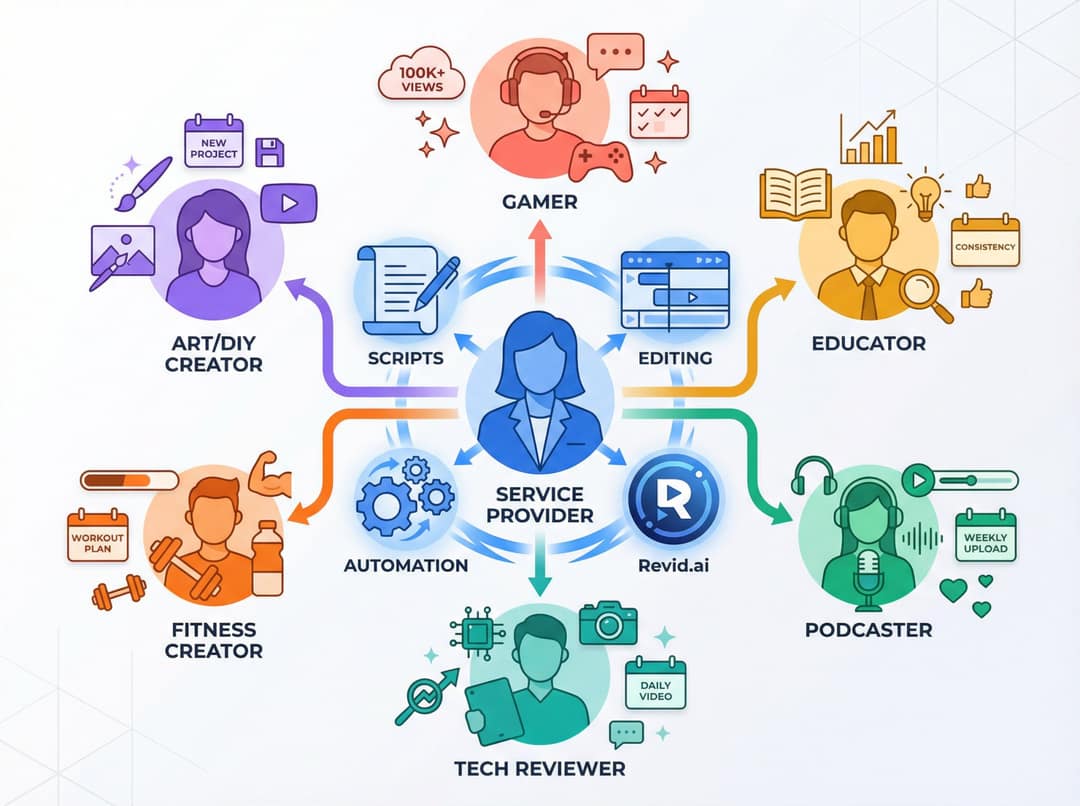
The people earning most reliably from YouTube automation are often the ones selling it. You can write scripts, turn clients' blogs and podcasts into Shorts with AI tools, or run done-for-you faceless channels. You solve a recurring problem (constant video output), price on value rather than hours, and spread risk across several clients. When a policy changes, you update one workflow and apply it everywhere.
FAQ
Can you make money on YouTube without making videos for free?
Partly. Uploading to YouTube is free, and the service and merchant models need no software budget to start, but a faceless channel usually pays for AI generation. Revid's sign-up is free, needs no credit card, and gives new accounts free credits to try video creation; regular creation then uses credits from a paid plan, starting at $39/month.
Is Revid AI safe to use for a monetized channel?
Yes. Revid is an independent software company founded in Paris in 2023 (formerly Typeframes), with more than 3,000,000 sign-ups since August 2024. Whether a channel stays monetized depends on the videos, not the tool: review each one for originality, disclose realistic AI, and never use someone's face or voice without permission.
How long does it take to get monetized on YouTube?
There is no fixed timeline: it depends on how fast you reach 500 or 1,000 subscribers plus the watch-hour or Shorts-view thresholds. Once you apply, YouTube's review typically takes about a month.
What happens if your channel gets demonetized?
You keep your channel and videos but stop earning from YPP features. Find the pattern YouTube flagged in its monetization policies, usually reused, repetitive or mass-produced content, and fix it across the channel before reapplying. YouTube may also turn off monetization on channels that haven't uploaded or posted for 6 months or more.
Should a faceless channel focus on Shorts or long-form?
Both, starting with Shorts to test topics and adding long-form for income. AIR Media-Tech's study of 18,000 English-language channels found the best results when Shorts made up 25% to 40% of a channel's uploads.
Is it too late to start a faceless YouTube channel in 2026?
No, but volume alone won't get you noticed: Alphabet said over ten million channels were publishing Shorts each day as of March 2026. A specific niche, a distinct angle in every video and steady publishing still stand out, especially as YouTube demonetizes mass-produced channels.