Best AI Video Editing Tools for TikTok in 2026: 8 Picks by Job
Eight AI video editing tools for TikTok compared by job and price, plus the edit order that keeps subtitles in sync and the fastest workflow for daily posting.
On this page
The best AI video editing tools for TikTok in 2026 depend on the job. Use Revid for a finished, captioned video from a script, link or talking clip, CapCut for editing footage you filmed, and Descript for cutting talking videos by their transcript. For captions and clips from long recordings, Submagic and OpusClip are the fastest picks.
Most of the time lost on a TikTok goes to the handoffs between apps, more than to the cut itself. You export from one app, caption in a second, resize in a third and upload by hand. Every handoff is another render and another chance for subtitles to drift out of sync. Pick the tool that removes the most handoffs from your workflow, not the one with the longest feature list.
- Video marketers who have used AI video tools to create or edit marketing videos
- 63%
- Wyzowl, December 2025
- Monthly price of Revid's entry paid plan (Growth, 2,000 credits)
- $39
- Revid pricing page
- Resolution TikTok recommends for 9:16 vertical video
- 1080x1920
- TikTok Creator Academy
- Languages for automatic captions on Revid
- 100+
- Revid
The 8 best AI video editing tools for TikTok, by job
The list is in no particular order: each tool wins a different job. Prices are entry prices checked in 2026, so confirm them on each vendor's site before you pay.
| Tool | Best for | What the AI does | Starting price |
|---|---|---|---|
| Revid | Finished videos from a script, link or talking clip | Writes the script, generates scenes, adds voice-over, captions and music, auto-edits talking clips; full timeline editor | Free sign-up with free credits to try; plans from $39/month |
| CapCut | Editing footage you filmed, on phone or desktop | Auto-captions, trend templates, effects | Free tier with 1080p export; about $9.99/month |
| Descript | Talking videos and podcasts | Edit the video by editing the transcript, filler-word removal, Studio Sound | Free plan (60 media minutes/month); $24/month or $16 billed yearly |
| Submagic | Polishing a talking clip in one pass | Animated captions in 48 languages, b-roll, zooms, sound effects, silence removal | Free plan (3 watermarked videos/month); $19/month or $12 billed yearly |
| OpusClip | Clips from podcasts, streams and webinars | Finds and scores the best moments, reframes to vertical, adds animated captions | Free plan with watermarked captions; from $15/month |
| Veed | Browser editing of real footage | Auto-subtitles and translation, AI dubbing, eye-contact correction | Free plan with watermark; roughly $10 to $24/month |
| Adobe Premiere Pro | Professional editors | Auto Reframe to vertical, scene edit detection, speech to text | Subscription; check Adobe's site |
| DaVinci Resolve | Color and finishing | AI-assisted color and masking tools | Free version; paid Studio version |
Revid and Submagic both publish straight to TikTok, and Revid also posts to Instagram and YouTube from the same queue. OpusClip offers posting and scheduling on paid tiers. For a wider list that includes mobile-first apps, see our TikTok video editor comparison.
US dollars per month
The plans do not buy the same thing: OpusClip, Vizard and Quso sell minutes of uploaded video, Klap sells clips, Submagic sells videos, Descript and Kapwing sell seats, and Revid sells credits that also make new videos from scratch. Billed yearly, most of these drop by 30 to 50%.
Source: Vendor pricing pages read October 29, 2026. Vizard's page did not render prices that day, so its figure is from vizard.ai/pricing on September 30, 2026; Klap's page showed yearly prices only, so its monthly price is from klap.app/pricing on August 13, 2026.
Show the data
| US dollars per month | |
|---|---|
| OpusClip Starter | 15 |
| Kapwing Pro | 16 |
| Submagic Starter | 19 |
| Descript Hobbyist | 24 |
| Vizard Creator | 29 |
| Klap Basic | 29 |
| Quso Lite | 29 |
| Revid Growth | 39 |
How do AI video editors handle captions, transitions and music syncing?
Captions. The editor runs speech-to-text on your audio, times each word, and renders the words in the style you pick. Accuracy depends on your audio: one clear voice with no music under it gives the cleanest transcript. Proofread names, brand terms and slang before you export, because that is where AI captions slip. Revid's TikTok subtitle generator handles this step for any video you upload.
Transitions. Auto editors find cut points from pauses in speech or changes of shot. They then cover each cut with a punch-in (a quick zoom), a b-roll insert or a transition. On TikTok, hard cuts and punch-ins look more native than wipes and spins, so check what the tool adds by default and turn off anything that feels like a template.
Music syncing. Tools detect the beat of the track, snap cuts to it, and lower the music under the voice (ducking) so dialogue stays clear. If the video is mostly talking, keep the music low and steady. If it is a montage, let the beat drive the cuts.
Which AI editor cuts, trims and adds transitions to raw footage?
Match the tool to the footage you have:
- A talking video (you to camera, a demo, a tutorial): Revid's Auto Edit Video returns it edited, with punch-ins on key lines, motion graphics and captions. Pick Descript when you want to control the cut yourself by deleting words from the transcript.
- A long recording (podcast, stream, webinar): OpusClip finds and ranks the moments worth posting and reframes them to vertical.
- Multi-shot footage (travel, events, b-roll): Premiere Pro's scene edit detection splits the clip at shot changes, and CapCut's templates drop your clips into trending formats.
- A clip that is already cut and only needs silence removal, zooms and captions: Submagic does all of that in one pass.
Whichever tool makes the cut, watch the opening and the ending before you post. Auto editors sometimes clip the first word or leave a dead frame at the end, and the opening is where viewers decide to stay.
How to crop, resize and reverse a clip without breaking subtitles
Captions stay aligned only if you add them after every edit that changes timing or framing. Work in this order:
- Cut and trim the clip.
- Reverse the segments you want reversed. Only reverse segments without speech, or mute them, because reversed speech cannot be captioned.
- Crop or resize to 9:16. Revid's resize video tool converts a clip to portrait 9:16, feed 4:5, landscape 16:9 or square 1:1.
- Generate captions.
- Export and publish.
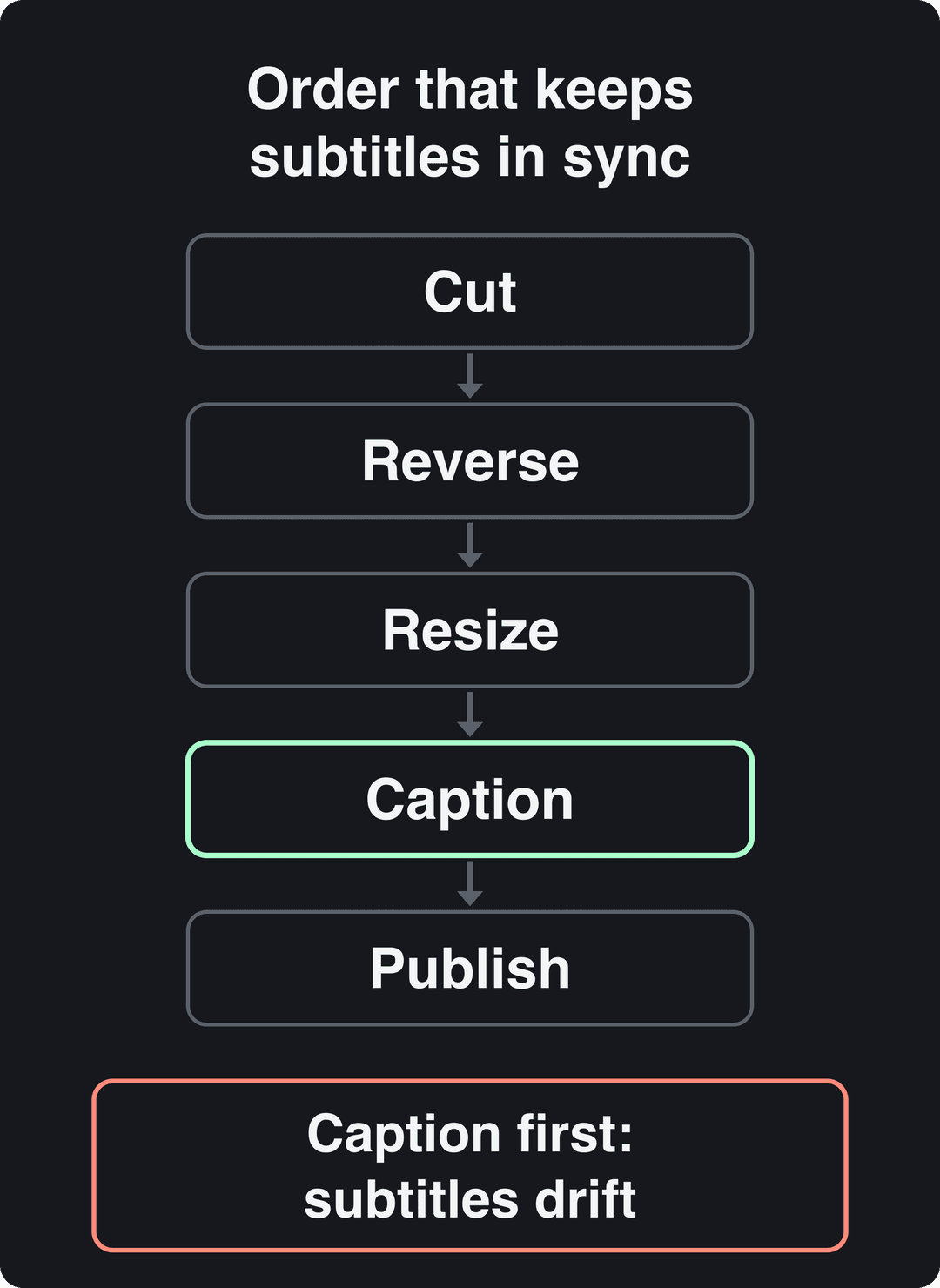
If you have to trim after captioning, use an editor that keeps captions as an editable track, as CapCut and Revid's timeline editor do, so you can regenerate or nudge them. Subtitles burned into the pixels cannot move when you trim, and a crop to vertical can slice them off the edge of the frame.
Prompt to try
Make a 30-second vertical TikTok about 3 mistakes beginners make when editing their first short video. Open with the hook "You're losing viewers in the first 2 seconds, here's why." Use punchy stock b-roll, hard cuts, bold word-by-word captions and a calm, confident voiceover, ending with one clear tip to try today.
Which TikTok video maker is fastest without losing quality?
The fastest tool depends on where you start:
| Your starting point | Fastest route | What you still do by hand |
|---|---|---|
| An idea or script, no footage | Revid script or prompt to video | Review the script and the scenes |
| A talking clip you filmed | Revid Auto Edit, Submagic or Descript | Proofread captions, check the cut |
| Footage you want to cut yourself | CapCut | Every cut, effect and caption tweak |
| A long podcast or stream | OpusClip | Choose which clips to post |
| A finished video in the wrong shape | A resize tool, then captions | Check nothing important was cropped |
Speed only costs you quality at export. TikTok's Creator Academy recommends 9:16 at 1080x1920, and Instagram lists 30 FPS as the minimum for Reels. Export at 1080p and at least 30 fps for both. Revid exports in 720p, 1080p or 4K at 30 or 60 fps.
If you post daily to TikTok and Instagram, the biggest time saver is publishing from the tool that made the video. Revid schedules and posts to TikTok, Instagram and YouTube from one queue (direct social media publishing). Its Auto-Mode workers (3 on the Growth plan) can also create a fresh video every day from a prompt or a content source.
Shares are of all 77,016 videos built in the period, including tools not shown.
Source: Revid product analytics (Amplitude), event project_built grouped by tool slug, September 29 to October 28, 2026, 77,016 builds
Show the data
| Videos built | Share of all videos (%) | |
|---|---|---|
| Prompt to video | 33.5K | 43.5% |
| Voice-over video from a script or link | 14.7K | 19.1% |
| Music video from a song | 12.4K | 16.1% |
| Audio to video | 4.3K | 5.6% |
| Article to video | 1.3K | 1.7% |
| Character swap | 1.2K | 1.6% |
| Captions on your own video | 999 | 1.3% |
| Clips from a long video | 973 | 1.3% |
| Talking avatar | 745 | 1% |
Revid AI features: what it does and where it fits
Revid is an AI video platform that turns an idea, a link or a proven viral format into finished short-form videos and publishes them to TikTok, Instagram and YouTube. It launched in 2023 as Typeframes and has been called Revid since April 2024. Its main features:
- Many ways to start: a script, a prompt, an article or link, a YouTube video, audio or a song, with 100+ specialized tools such as the AI TikTok video generator.
- AI video models: Seedance 2.5, MiniMax Hailuo H3, Wan 3.0 and Google Veo 3, chosen per scene under one credit system.
- Voice and captions: 1,000+ AI voices in 70+ languages, 30 caption styles and automatic captions in 100+ languages.
- Editing: a full timeline editor to fix any scene, caption or track before export.
- A viral video library: about 2.77 million real short-form videos with their engagement data, so you can start from a format audiences already watch and turn it into an original video.
- Publishing and automation: direct posting and scheduling, Auto-Mode workers, and an API, MCP server and CLI on every paid plan.
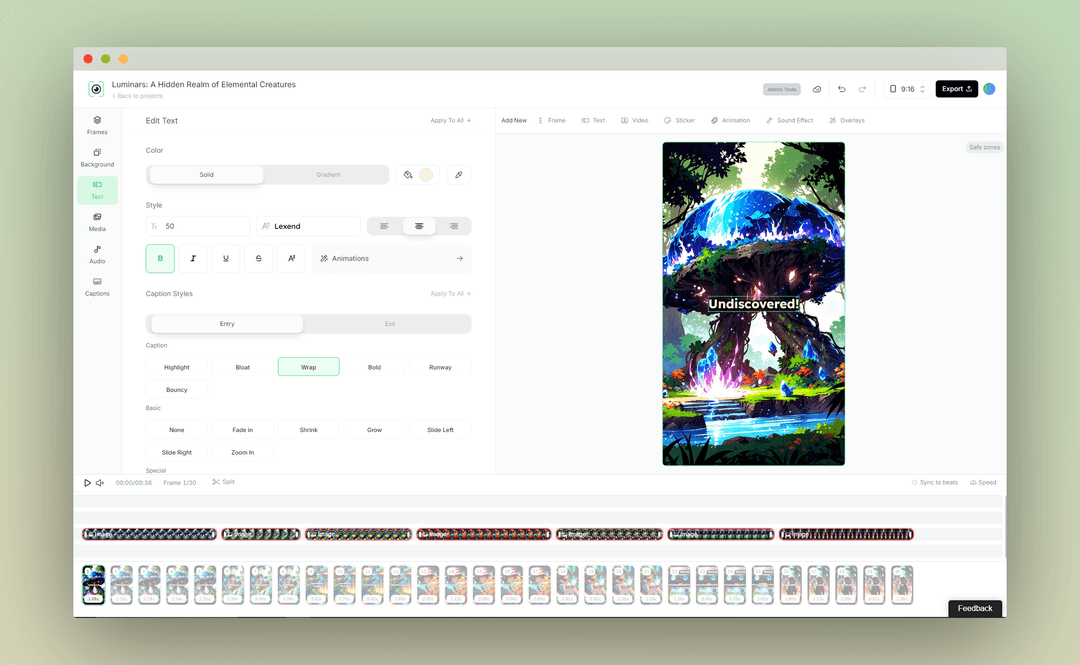
Sign-up is free and new accounts get free credits to try video creation, no credit card needed; regular video creation then uses the credits of a paid plan. Plans start at $39/month (Growth, 2,000 credits, or $32/month billed yearly); the Revid pricing page has the current list.
Revid is not the best fit for every job. If you only want to edit your own footage by hand, a manual editor fits better (Revid vs CapCut). If you mostly polish recorded talks by transcript, Descript is built for that (Revid vs Descript). For long-form or cinematic work where you edit every shot, use Premiere Pro or DaVinci Resolve.
Input
Your video as it is
Output
How to edit a talking clip with Revid
- Open Auto Edit Video and upload a talking video or paste a link.
- Revid returns it edited: key lines become motion graphics, with punch-ins and captions added.
- Fix any scene or caption in the timeline editor.
- Export in 1080p or 4K, then publish or schedule it to TikTok, Instagram or YouTube.
Habits that keep AI edits looking good
- Start with clean audio and light. Auto cuts and captions both read your speech, so a noisy room gives you worse cuts and more caption errors.
- Proofread every caption. One misspelled brand name in the first line costs you more credibility than a slow edit.
- Keep one caption style per series. Viewers recognize a series by its look before they read the words.
- Let AI do the repetitive steps and keep the judgment calls. Use AI for cutting, captioning and resizing, and decide the hook and the ending yourself.
AI in the edit is now the norm. In Wyzowl's 2026 survey (published December 2025), 63% of video marketers said they had used AI video tools to create or edit marketing videos, up from 51% a year earlier (more short-form video statistics).
FAQ
Is Revid AI free?
Sign-up is free, new accounts get free credits to try video creation, and a free account can search Revid's viral video library. Regular video creation then uses the monthly credits of a paid plan, starting at $39/month (Growth).
What is Revid.ai?
Revid is an AI video platform for founders and small business owners, also used by creators and agencies. It turns an idea, a link or a proven viral format into a finished short-form video and publishes it to TikTok, Instagram and YouTube.
What video editor can reverse a clip, add AI captions and post straight to TikTok?
CapCut does all three, with a reverse control, auto-captions, close TikTok integration and a free tier. Revid adds AI captions and posts directly to TikTok; for reverse playback, use a manual editor such as CapCut.
Is CapCut or Revid better for TikTok?
CapCut is better if you film your own footage and want to edit it by hand at low cost. Revid is better when you want the video made for you from a script, link or talking clip, then captioned and published from one place.
Can AI video editing tools replace a human editor?
For routine short-form edits like cuts, captions, resizing and music, mostly yes. You still need a person to judge the hook, proofread the captions and decide what is worth posting.
Sources
- Vendor pricing pages read October 29, 2026. Vizard's page did not render prices that day, so its figure is from vizard.ai/pricing on September 30, 2026; Klap's page showed yearly prices only, so its monthly price is from klap.app/pricing on August 13, 2026.
- Revid product analytics (Amplitude), event project_built grouped by tool slug, September 29 to October 28, 2026, 77,016 builds
- Wyzowl, Video Marketing Statistics 2026 (December 2025)
Charts and figures checked on November 6, 2026.